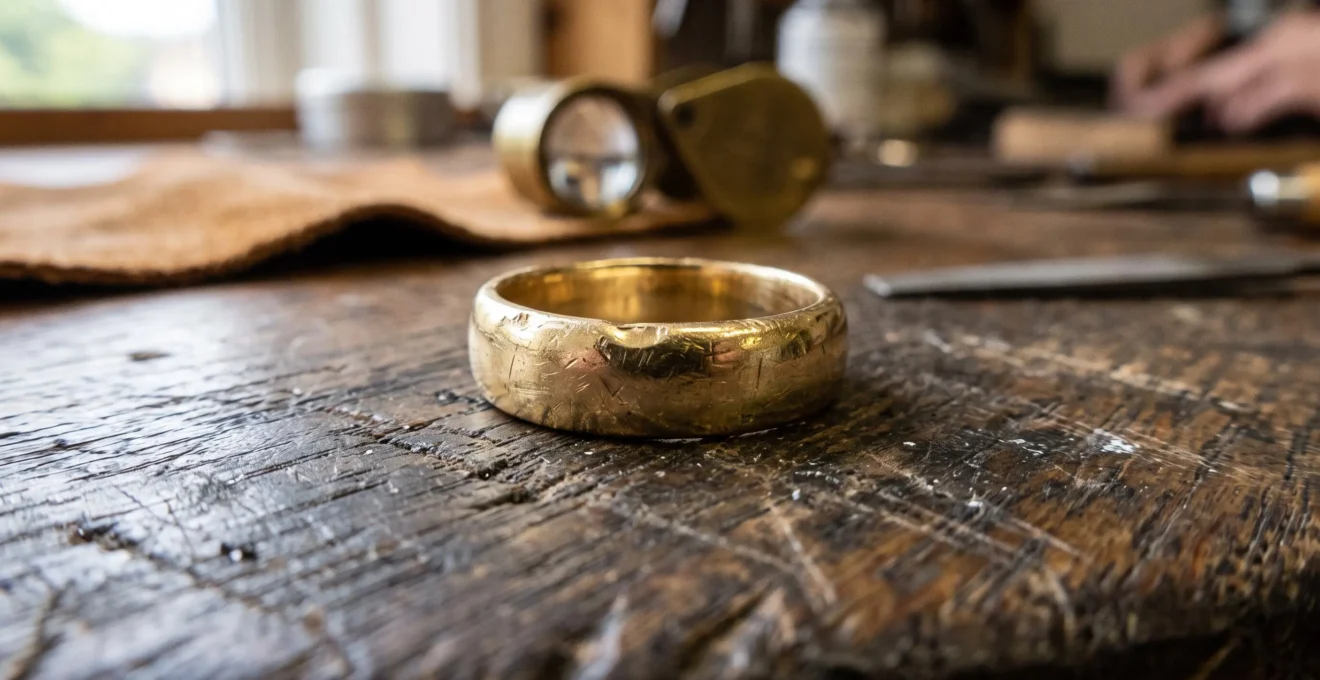
Pure gold bends easily because its natural softness and malleability allow it to change shape under pressure. In a ring worn every day, that means ordinary contact with desks, door handles, tools and other hard surfaces can leave dents, flatten the band or gradually distort its circular shape.
The higher the gold purity, the less resistance a typical ring offers to these everyday knocks. A 24K ring contains essentially pure gold, while 18K and 14K rings contain additional metals that can improve hardness and durability. The difference matters most when a ring has a thin band, an exposed gemstone setting or a design that concentrates pressure in a small area.
Pure gold is not necessarily a poor jewellery choice. It is simply a material that demands the right design, wearing habits and maintenance expectations. Understanding the relationship between purity, construction and daily wear helps prevent an expensive purchase from becoming an avoidable repair.
What matters most about pure gold rings
- 24K gold is particularly soft. It is more vulnerable to dents, scratches and deformation than many commonly used lower-karat jewellery alloys.
- 18K and 14K are generally more practical for daily wear. The right choice also depends on alloy composition, band thickness, design and lifestyle.
- Good construction and early maintenance matter. A substantial band, secure stone setting and regular inspections can reduce avoidable damage.
- Why Higher Gold Purity Increase Denting After Just Weeks of Wear?
- How to Choose Gold Purity for Daily Wear Without Guessing or Following Trends?
- 24K or 18K: Which Should You Choose if You Want a Ring That Keeps Its Shape?
- The Design Mistake That Makes Pure Gold Rings Lose Stones Faster
- When Should You Get a Pure Gold Ring Re-Shaped to Avoid Permanent Warping?
- Solid, Filled, or Plated: Which Should You Choose if You Want Years of Daily Wear?
- Why Do « Delicate » Rings Warp So Fast Even if the Metal Is Expensive?
- What Actually Increases Jewellery Durability for Daily Wear Without Making It Look Bulky?
Why Higher Gold Purity Increase Denting After Just Weeks of Wear?
Higher gold purity increases the likelihood of denting because pure gold is relatively soft and readily undergoes permanent deformation under pressure. A 24K ring may show surface damage sooner than a comparable 18K or 14K ring, particularly when worn continuously. However, no fixed two-week timeline applies: damage depends on the alloy, ring dimensions, activities and impacts experienced.
Gold is highly malleable. Its internal crystal structure allows permanent deformation without the metal necessarily cracking. That property makes gold useful for jewellery fabrication, but it also explains why a soft ring can develop flattened areas where it repeatedly contacts hard objects.
The Gemological Institute of America identifies 24K gold as especially vulnerable to scratches and dents in its comparison of ring metals for everyday wear. It describes 14K and 18K gold as more suitable options for routine use, while recognising that alloy composition affects performance.
Scratch resistance and resistance to bending are not identical. Scratching involves local surface damage, whereas a band bending out of round involves deformation of its overall structure. Both are influenced by material properties, but ring thickness and geometry become particularly important when the entire band is loaded.
Consider two hypothetical owners wearing similarly constructed rings. One spends most working hours at a desk and removes the ring before exercising. The other regularly carries heavy equipment, grips metal handles and works with tools. The second ring experiences more opportunities for pressure and impact, even if both owners purchased the same gold purity.
Factors that can accelerate visible damage include:
- Frequent contact with hard surfaces or equipment.
- A narrow or shallow band with limited metal supporting its shape.
- Sharp edges that expose small areas to concentrated contact.
- Continuous wear during lifting, exercise or physical work.
- Existing dents or distortion that concentrate subsequent pressure.
Repeated contact can gradually create additional dents and distortions. Actual loss of metal thickness results primarily from wear and abrasion, rather than from denting alone, which generally displaces metal.
The phrase « pure gold » also deserves scrutiny. In jewellery, 24K refers to essentially pure gold, commonly represented by a fineness marking such as 999. A product described simply as « gold » may have a substantially different composition, so the seller’s exact specification matters.
A ring can be high in gold content and still be poorly matched to everyday use. The more useful purchasing question is not simply how much gold it contains, but how its metal and construction will respond to the owner’s normal activities.
How to Choose Gold Purity for Daily Wear Without Guessing or Following Trends?
Choose gold purity by matching the ring’s alloy, design and intended use to the pressure it will experience. For many everyday rings, 18K or 14K offers a practical balance between gold content and durability. A 24K ring is better considered when wear is gentle, contact is limited and the owner accepts more visible marks and maintenance.
Start with how the ring will actually be worn. A person who types at a desk and removes jewellery before sport has different requirements from someone who handles tools or heavy objects. Even office wear creates repeated contact, particularly against metal furniture, desk edges and door handles.
The World Gold Council‘s explanation of gold caratage and purity distinguishes the gold content of common alloys and describes how additional metals influence colour and durability.
For a practical starting point, compare purity against daily activities and ring design.
| Wearing conditions | Practical starting point | Main consideration |
|---|---|---|
| Occasional wear with limited physical contact | 24K or 18K | High-purity gold may be acceptable if softness is understood. |
| Routine office and everyday wear | 18K | A balanced choice, provided the band and setting are well constructed. |
| Frequent physical activity or unavoidable knocks | 14K, with suitable construction | Greater resistance may help, but removing the ring for hazardous tasks remains important. |
| Solitaire with exposed prongs | 18K or 14K, depending on the setting | Prong design and structural security are critical. |
| Plain, substantial band worn carefully | 18K or potentially 24K | Band dimensions and maintenance expectations influence suitability. |
Gold content is commonly expressed in karats or fineness. A 750 mark indicates 75% gold, corresponding to 18K. A 585 mark indicates 58.5% gold, commonly designated 14K. A 999 mark indicates 999 parts gold per thousand, associated with 24K jewellery.
These markings describe composition, not guaranteed resistance to bending. Hallmarking rules, required accompanying marks and accepted standards differ between countries. A stamp alone is not conclusive proof of authenticity.
Before buying, request a written description that identifies the karat, fineness, metal construction and any gemstone specifications. For a valuable ring, ask what documentation supports the stated metal content and whether independent testing is available.
The cost trade-off is important. At comparable weight and other conditions, higher-purity gold contains more precious metal, which generally increases its intrinsic gold value. It does not automatically provide greater mechanical durability. A more expensive 24K ring may require more careful handling than a less gold-rich alternative.
Social-media photographs rarely communicate this difference. An extremely slim, high-purity band may look elegant when new, but photographs cannot demonstrate how well it will resist years of pressure.
Once the intended use is clear, the next decision is more specific: whether the visual appeal of pure gold outweighs the everyday shape retention offered by an appropriate alloy.
24K or 18K: Which Should You Choose if You Want a Ring That Keeps Its Shape?
For a ring intended to keep its shape through ordinary daily wear, 18K is generally the more practical choice than 24K. Its additional alloying metals can increase hardness and resistance to deformation. A 24K ring remains an option for careful or occasional wear, but its softness demands a suitable design and realistic expectations about damage.
The difference begins with composition. A 24K ring is essentially pure gold, while an 18K ring contains 75% gold and 25% other metals. Those other metals may include copper, silver, palladium or combinations selected to achieve particular properties and colours.
Alloying changes the way the finished metal responds to pressure. However, the performance of a particular 18K ring also depends on its precise formulation, manufacturing condition and design. Not every 18K alloy has identical hardness or strength.
| Criterion | 24K gold | 18K gold |
|---|---|---|
| Gold content | Essentially pure gold | 75% gold |
| Typical hardness | Relatively soft | Generally harder, depending on alloy |
| Resistance to dents | More susceptible | Generally better under comparable conditions |
| Shape retention | Greater deformation concern | Usually more practical for daily wear |
| Colour options | Characteristic rich yellow | Yellow, rose and white formulations |
| Weight | Generally denser than common lower-purity alloys | Density varies with alloy composition |
| Resizing and repair | Often workable, subject to condition | Often workable, subject to design and condition |
| Most suitable use | Careful or occasional wear | Routine wear with appropriate construction |
Weight deserves some context. For rings of comparable volume, pure gold is generally denser than common 18K alloys. However, a larger 18K ring can easily weigh more than a delicate 24K ring. Weight alone is therefore an unreliable way to determine purity or structural strength.
The colour difference also matters. Copper-rich alloys can create rose gold, while white-gold alloys may incorporate palladium or other whitening metals. These changes affect appearance alongside mechanical properties.
Some buyers worry that 18K is less authentic because it contains other metals. That concern confuses purity with legitimacy. An accurately described 18K ring is genuine gold jewellery. Its alloy composition is a deliberate way of achieving a different balance of appearance, workability and durability.
Both 24K and 18K rings may be resized or repaired professionally, although complex settings, previous repairs, metal condition and alloy characteristics can limit the options. Greater softness does not guarantee easier or unlimited repair.
For someone who expects frequent unavoidable contact, 14K may be worth discussing with a jeweller. It contains less gold and often offers improved hardness, although design and manufacturing quality remain essential.
The choice becomes especially important when gemstones are involved. A plain band may tolerate some bending without immediate loss of function, but a stone setting relies on metal components maintaining precise contact with the gem.
The Design Mistake That Makes Pure Gold Rings Lose Stones Faster
The main design mistake is combining very soft, high-purity gold with delicate settings that depend on thin metal components holding their exact shape. If a prong bends or wears enough to lose contact with a gemstone, the stone can become loose. The risk depends on setting design, construction quality and wear, not purity alone.
A prong holds a gemstone by extending over part of its edge. The metal must remain positioned correctly to prevent unwanted movement. When a ring is knocked, a slender prong may shift, bend or become worn. A setting can therefore lose security before the owner notices a dramatic change in appearance.
GIA’s explanation of engagement ring settings describes how prongs retain stones, why they require periodic inspection and how professional re-tipping can restore worn metal.
Several design details deserve particular attention when considering high-purity gold:
- Very thin prongs: limited metal can make a setting more vulnerable to damage or wear.
- High-set gemstones: exposed stones and settings may catch on clothing or strike nearby objects.
- Tension settings: these require carefully controlled metal properties and engineering, making material selection particularly important.
- Delicate halo and pavé work: numerous small stone-retaining elements create additional points that require inspection.
- Thin knife-edge structures: narrow supporting sections may leave less material to resist deformation.
These features are not automatically defective. A properly engineered setting made from an appropriate alloy may perform well. The problem is choosing a mechanically demanding design without considering whether the specific metal can support it reliably.
More protective alternatives may include substantial bezels, properly constructed flush settings or robust channel settings. A bezel surrounds part or all of the gemstone’s perimeter with metal, while flush and channel designs integrate stones more closely into the ring’s structure.
None of these designs guarantees stone security. Stone shape, workmanship, metal thickness and the condition of surrounding components still matter.
At home, stone inspections should remain visual and non-invasive. Under good lighting, look for prongs that appear lifted, uneven or worn. Listen for unexplained rattling during ordinary handling, without deliberately shaking or pulling the stone.
A professional may use a suitable probe to assess the setting, but this should not be copied as a home « tug test. » Pushing a gemstone or prong can worsen an already compromised setting. If anything appears loose, stop wearing the ring until it has been examined.
For a delicate, frequently worn high-purity ring, arrange a professional inspection schedule based on its construction and actual wear. A jeweller can establish an appropriate interval and adjust it when changes appear. There is no universal inspection frequency suitable for every gemstone and setting.
A secure gemstone depends on more than the ring’s gold content. The condition of its setting should be assessed whenever the band shows bending, unusual wear or evidence of impact.
When Should You Get a Pure Gold Ring Re-Shaped to Avoid Permanent Warping?
Have a pure gold ring professionally assessed when it first becomes noticeably out of round, develops an uneven fit or shows distortion near a gemstone setting. Early inspection may allow straightforward correction before additional wear complicates repair. However, re-shaping cannot restore metal that has already been lost, and some severely damaged rings require rebuilding rather than simple rounding.
A bent ring does not necessarily contain permanently damaged metal in the sense of being impossible to repair. Pure gold can often be worked back into shape. The concern is that continued wearing may worsen distortion, damage a setting or concentrate stress in already weakened areas.
Common warning signs include:
- The band appears oval rather than circular.
- The ring rotates, grips or slides differently from before.
- One side of the band looks visibly flatter or more worn.
- The gemstone setting no longer appears evenly aligned.
- A dent, split or weakened section develops near a previous repair.
A useful home check is to remove the ring, place it on a clean, flat surface and inspect the circular outline in good light. If appropriate for its design, carefully turn it to compare the sides. Avoid rolling a gemstone ring across a hard surface, since this can damage an exposed setting.
Do not try to squeeze the band back into shape with your fingers or strike it with a household hammer. Uneven pressure may distort the band further, damage a soldered joint or compromise gemstone security.
During professional re-shaping, a jeweller may place a suitable plain band on a tapered steel mandrel and use controlled pressure or an appropriate mallet to restore its profile. Rings with stones, complex construction or previous repairs require additional precautions and sometimes different tools.
Annealing, which involves controlled heating to soften worked metal, may be useful for certain repairs. It is not required for every re-shaping job and must be considered carefully where gemstones, soldered joints or other components are present.
Re-rounding itself does not necessarily remove metal. Abrasive finishing and polishing do, however, remove small amounts from the surface. Repeated aggressive polishing can gradually reduce thickness, while repairing badly worn areas may require adding new metal.
This is why the maintenance decision should consider both appearance and structural condition. A slightly oval but otherwise sound band may be easier to correct than one with severe thinning, damaged joins or distorted stone settings.
Five checks before deciding whether your ring needs repair
- Inspect the shape: view the ring from above on a clean surface and record whether the band looks round, oval or locally flattened.
- Document the damage: take clear photographs of any dents, worn sections or visible changes so a jeweller can assess progression.
- Check the fit: note any new twisting, uneven pressure or unexpected movement on the finger without forcing the ring.
- Inspect the setting visually: note lifted prongs, unusual gaps or misalignment without touching or testing the stone with pressure.
- Request a professional assessment: obtain a written description of the recommended repair, whether metal must be added or removed, and any risks to the setting.
Professional maintenance is most effective when it responds to actual wear rather than a fixed calendar alone. The next consideration is whether the jewellery’s underlying construction allows that maintenance to continue over many years.
Solid, Filled, or Plated: Which Should You Choose if You Want Years of Daily Wear?
For a ring intended to last through years of everyday wear and repeated maintenance, solid gold in a suitable karat is generally the most practical of these three constructions. Gold-filled jewellery offers a bonded gold layer over another metal, while gold-plated jewellery has a thinner surface coating. Both can be useful, but their appearance and repair options depend on the underlying materials.
The term « solid gold » is often misunderstood. It does not mean 24K gold. A solid 14K or 18K ring is made from its specified gold alloy throughout the relevant metal structure, rather than relying on a thin decorative gold coating over a different base metal.
Gold-filled jewellery is constructed with a mechanically bonded layer of gold over a base material. Gold-plated jewellery uses a deposited surface coating, whose thickness and wear resistance can vary considerably.
The US Federal Trade Commission‘s consumer guidance on gold and gold-plated jewellery explains these constructions and notes that gold plating eventually wears away depending on use and coating thickness.
| Feature | Solid gold | Gold-filled | Gold-plated |
|---|---|---|---|
| Construction | Gold alloy throughout | Bonded gold layer over another metal | Surface gold coating over a base material |
| Long-term appearance | Surface remains the specified gold alloy despite scratching | Gold layer can eventually wear through | Coating can wear and expose the underlying material |
| Resizing | Often feasible, depending on design | May disturb the bonded layer | May damage the coating and require refinishing |
| Polishing | Possible within structural limits | Limited by gold-layer thickness | Can remove or damage plating |
| Long-term maintenance | Often offers the most repair flexibility | Repair feasibility depends on construction | May require renewed plating or other finishing |
Neither gold-filled nor plated jewellery is automatically weaker against bending than solid gold. Structural strength depends heavily on the base metal and the design. A substantial base-metal ring may resist deformation better than a thin pure-gold band, even if its surface is less durable aesthetically.
That distinction is essential: surface longevity and structural durability are different properties.
A gold-plated ring can resemble a solid 24K ring when new. Once the coating wears, however, its underlying material may become visible. Depending on that metal and the wearer’s skin chemistry, discolouration or skin staining can occur, though neither is inevitable.
Terms such as « gold tone » generally describe appearance rather than gold content. « Vermeil » refers to gold plating over a silver base under applicable definitions, but legal standards and marking requirements vary between markets.
For purchases intended to provide five years or more of wear, there is no universal lifetime guarantee for any construction. Ask the seller whether the jewellery is solid alloy, bonded-layer or plated, what metal lies underneath any coating and which repairs can realistically be performed.
Once material construction is understood, the most common remaining weakness is often the ring’s geometry, especially when an elegant design uses very little metal.
Why Do « Delicate » Rings Warp So Fast Even if the Metal Is Expensive?
Delicate rings can warp quickly because their thin bands and narrow structural sections have limited resistance to bending, regardless of price. Expensive gold does not automatically provide better shape retention. When high-purity metal is combined with minimal thickness, the ring may deform under everyday pressure that a more substantial, appropriately alloyed design would tolerate better.
Ring strength depends on the amount of material available and how that material is distributed. A band that is narrow across its width or shallow through its depth has less capacity to resist certain bending loads than a thicker band made from comparable metal.
This is a matter of geometry as much as metallurgy. In many bending situations, increasing a component’s thickness significantly increases its stiffness. The exact benefit depends on the cross-section and direction of the applied force.
Consider a hypothetical comparison between two rings made from the same 18K alloy. The first has a very slim, shallow shank, while the second has a slightly deeper cross-section and a smoothly rounded profile. The second design may resist deformation more effectively without looking dramatically larger from above.
Several common delicate designs deserve attention:
- Ultra-thin stacking bands: reduced cross-sectional dimensions leave less material resisting distortion.
- Split shanks: the division of the band creates separate structural sections whose performance depends on their proportions and connections.
- Fine engagement-ring shoulders: narrow sections near the setting can experience concentrated loading.
- Open-ended rings: their geometry may allow the ends to move under pressure more readily than a comparably constructed closed band.
Expense is not a substitute for sound design. Jewellery prices reflect factors such as gold content, gemstones, craftsmanship and branding. None of those alone establishes the finished ring’s ability to resist bending.
A delicate appearance does not require the weakest possible construction. A suitably formulated 18K or 14K alloy, sufficient metal depth and carefully considered transitions between the band and setting can preserve a fine aesthetic while improving resilience.
Existing deformation can also create additional problems. Once a band becomes oval, its contact with the finger and surrounding objects may change. New pressure points can develop, and an already weakened section may be subjected to further stress.
That process is not inevitable or uniform. Some rings remain slightly distorted without rapidly worsening, while others deteriorate because of continuing impacts or insufficient metal in critical locations.
The most successful everyday ring does not have to be visually heavy. It needs sufficient strength in the places that matter, combined with a metal suited to the conditions in which it will be worn.
Key takeaways before choosing a daily-wear ring
- Prioritise suitable alloy composition and sufficient metal in structurally important areas rather than maximum gold purity alone.
- Examine the setting, band depth and shape together; a strong-looking band cannot compensate for a poorly supported gemstone.
- Make daily habits and professional inspections part of the durability decision before purchasing, not only after damage appears.
What Actually Increases Jewellery Durability for Daily Wear Without Making It Look Bulky?
Jewellery durability improves when metal selection, band geometry, gemstone settings and wearing habits work together. An 18K or 14K alloy, adequate thickness at vulnerable points, rounded transitions and protective settings can make a ring more resistant to everyday damage without requiring an oversized appearance. Regular inspection and sensible removal during high-risk activities help preserve those advantages.
The most important design decisions should be considered together, rather than treating one feature as a guarantee.
- Choose an appropriate gold alloy. For many daily-wear rings, 18K or 14K offers a more practical starting point than 24K. Specific alloy properties still matter.
- Maintain sufficient structural thickness. Avoid removing excessive metal from the underside of the band, shoulders or areas supporting gemstones.
- Protect the gemstone setting. Select a setting whose metal components provide appropriate retention and are accessible for inspection and repair.
- Use favourable geometry. Smoothly rounded edges and transitions can reduce snagging and avoid unnecessarily sharp, exposed areas.
- Adapt wearing habits. Remove the ring when activities create unnecessary impact, pressure, chemical exposure or a risk of injury.
A comfort-fit interior can improve how the ring feels on the finger. It does not automatically make the ring stronger, but it can be incorporated into a design with adequate material depth and a balanced external profile.
Likewise, adding metal only where it is structurally useful can improve durability without visibly enlarging the entire ring. A slightly stronger underside, reinforced shoulders or more substantial gemstone support may be less noticeable than simply making every dimension wider.
The best details depend on the individual design. A ring with a large centre stone requires different structural decisions from a plain wedding band, and a multi-stone ring introduces additional setting components that need protection.
Wearing habits are equally important. Gym equipment can squeeze a ring against the finger or expose it to hard impacts. Heavy lifting can deform the band, while some workplace tasks present additional finger-injury hazards.
Swimming introduces different risks. Cold water may change finger size enough to increase the chance of losing a ring, and chlorine exposure may affect certain jewellery alloys or finishes over time. Salt, sand and abrasive particles may also contribute to surface wear in relevant circumstances.
Hand creams and skincare products often leave residues around gemstones and settings. This mainly creates a cleaning and inspection issue, rather than proving that every cosmetic product chemically damages gold. Some ingredients or aggressive cleaning products may nevertheless be unsuitable for particular stones or finishes.
Clean jewellery according to the requirements of its most sensitive component. Warm water, mild soap and a soft brush may suit many gold rings, but porous, treated or delicate gemstones can need different care. Avoid ultrasonic cleaning when a stone is loose or its suitability has not been confirmed.
Finally, treat professional checks as part of ownership. A jeweller can assess prong wear, band thickness, soldered joints and early deformation, then recommend maintenance appropriate to the ring’s actual condition.
Before purchasing a daily-wear ring, ask the jeweller to identify its gold alloy, explain why the band and setting suit your activities, and describe its likely maintenance needs. That discussion is more valuable than choosing 24K simply because it sounds more prestigious. A ring that fits its intended use can preserve both its appearance and its function with fewer avoidable surprises.
Can a bent 24K gold ring be repaired without losing gold?
Often, yes. Professional re-rounding can restore a plain gold band’s shape without necessarily removing metal. However, polishing removes some surface material, and badly worn or damaged areas may need additional metal or rebuilding. Repair feasibility depends on the band, its condition and any gemstones or previous joins.
Does a 999 stamp mean a gold ring will bend easily?
A 999 mark indicates a stated fineness of 999 parts gold per thousand, associated with 24K gold. That high purity generally means greater softness than common 18K and 14K jewellery alloys. However, the ring’s thickness, geometry and manufacturing condition also influence deformation. A stamp should not be treated as independent proof of authenticity.
Will wearing two gold rings together damage them?
Two rings that rub together can develop contact wear, particularly when their surfaces or settings repeatedly touch. The result depends on relative hardness, pressure, movement and design. Rings intended for stacking should be assessed for compatibility, especially when one has exposed gemstones or delicate metal details.
Does 18K gold scratch even if it is stronger than 24K?
Yes. Greater resistance to scratching does not make 18K gold scratch-proof. Everyday contact with abrasive particles and harder surfaces can still leave marks. Different 18K alloys may also behave differently. Routine surface marks are normal wear and do not necessarily indicate that a ring is structurally unsafe.
Should a pure gold ring be polished every time it develops scratches?
Not necessarily. Minor scratches are often cosmetic and can be left alone. Abrasive polishing removes surface metal, so frequent polishing may gradually reduce thickness or soften decorative details. A jeweller can distinguish superficial marks from deeper damage that requires repair and recommend finishing only when appropriate.