Jewelry Through the Ages
Jewelry is one of humanity’s oldest forms of self-expression. Long before written language, people adorned themselves with shells, bones and stones, and every era since has left its own signature in metal and gem. Understanding how jewelry has evolved helps collectors, buyers and enthusiasts appreciate not just the beauty of a piece, but the story embedded within it.
This overview of jewelry through the ages walks you through the major periods, the materials and techniques that defined them, and what these shifts mean for anyone buying or collecting jewelry today.
Why Jewelry History Matters
Jewelry has never been purely decorative. Across civilizations, it has served as currency, protective talisman, status marker, love token and family heirloom. Recognizing the historical context of a piece can help you:
- Assess the authenticity and approximate period of vintage or antique jewelry
- Understand why certain designs, like Victorian lockets or Art Deco geometric bands, remain popular
- Make more informed purchasing decisions, whether at auction houses or estate sales
- Connect emotionally with pieces that carry genuine historical resonance
Think of jewelry history as a language: once you learn to read it, every brooch, ring and necklace tells you something about when, how and why it was made.
Prehistoric and Ancient Jewelry: The Foundations
The earliest known jewelry predates metalwork entirely. Early humans crafted beads from shells, animal teeth, carved bone and colored stones, often strung into necklaces or bracelets. These pieces were less about adornment for its own sake and more about identity, ritual and protection.
Egypt and the Birth of Symbolic Jewelry
Ancient Egyptian jewelers elevated ornamentation into a highly codified art. Gold, abundant in the Nile valley, became the metal of the gods and pharaohs. Popular motifs included scarabs symbolizing rebirth, the Eye of Horus for protection, and the ankh representing life. Egyptians also pioneered colorful inlay work using lapis lazuli, turquoise, carnelian and faience, a glazed ceramic material.
Greece and Rome: Wearable Art and Status
Greek jewelers introduced delicate filigree and granulation techniques, while Roman jewelry embraced volume and display. Romans popularized cameos, carved gemstones and pearl earrings, and made gold rings a marker of rank. Notably, the Romans also established the tradition of the betrothal ring, a precursor to today’s engagement ring.
Across these ancient cultures, three constants emerge:
- Materials signaled status — gold and gems were reserved for elites
- Symbolism mattered — every motif carried protective or spiritual meaning
- Techniques advanced steadily — granulation, casting and stone-setting laid the groundwork for everything that followed
The Middle Ages and Renaissance: Faith, Gold and Portraiture
During the medieval period, European jewelry was dominated by religious themes. reliquaries, rosaries and devotional pendants were common, and much goldsmithing was tied to the Church and the aristocracy. Gemstones were often valued for their supposed protective properties as much as their beauty, with rubies and sapphires believed to guard against illness and misfortune.
The Renaissance brought a flourishing of artistic ambition. Advances in gem cutting unlocked greater brilliance, and jewelry became a public statement of wealth, famously captured in the painted portraits of the era. Enameling flourished, and dramatic pieces such as pendant portraits and elaborately enameled girdle ornaments defined the style.
The Georgian and Victorian Eras: Sentiment Takes Center Stage
The Georgian period saw jewelry made largely by hand, with intricate metalwork often concealing the settings of foiled-back stones that amplified their glow by candlelight. Because pieces were crafted individually, Georgian jewelry is rare and highly sought after by collectors today.
The Victorian era transformed jewelry from aristocratic privilege into something accessible to a growing middle class, thanks to industrial production and new gold deposits. Queen Victoria’s personal taste shaped fashion profoundly:
- Sentimental jewelry — lockets holding locks of hair, mourning brooches and acrostic rings spelling words with gemstones
- Snake motifs — symbolizing eternal love after the Queen received a serpent engagement ring
- Revival styles — Etruscan, Gothic and Renaissance-inspired designs
Consider a modern buyer searching an estate sale: recognizing a Victorian mourning brooch by its black enamel, woven hair panel and sentimental inscription can mean the difference between an overlooked trinket and a genuine collector’s piece.
Art Nouveau and Edwardian Jewelry: Artistry Reimagined
At the turn of the century, jewelry split into two distinct movements. Art Nouveau jewelers treated each piece as a miniature sculpture, favoring flowing organic lines, enamel work and unconventional materials like horn, glass and opals. Nature dominated: dragonflies, orchids and female figures with flowing hair.
The Edwardian era, by contrast, embraced refined elegance. The invention of the small platinum crown setting allowed diamonds to appear almost suspended in air, creating delicate lace-like garland designs. Platinum’s strength made these airy constructions possible, a perfect example of how technology drives design.
Art Deco: Geometry and Glamour
The Art Deco period reacted against Art Nouveau’s softness with bold geometry, symmetry and contrast. Onyx, coral, emeralds and rubies were set alongside diamonds in sharp, architectural compositions inspired by Cubism, ancient Egypt and machine-age aesthetics. Long ear pendants, cocktail rings and flexible bracelets defined the era’s style, aligned with a new, liberated lifestyle for women.
Art Deco pieces remain among the most collectible in the market because they combine strong design, durable platinum construction and timeless wearability — a cocktail ring from this era still looks striking paired with contemporary fashion.
Retro, Mid-Century and Modern Jewelry
Wartime constraints pushed jewelers toward rose gold and semi-precious stones, producing the bold, sculptural Retro style. Afterward, mid-century design favored cleaner lines, abstract motifs and the rise of the independent designer-jeweler. Studio jewelry movements elevated the craft to fine art, and the democratization of fashion jewelry made stylish pieces available at every price point.
Contemporary jewelry is defined by diversity rather than a single dominant style:
- Ethical sourcing — conflict-free diamonds, recycled gold and lab-grown stones have reshaped buying priorities
- Personalization — stacking rings, initial pendants and bespoke commissions
- Blending eras — vintage and antique pieces are regularly mixed with modern designs
How to Identify the Era of a Piece of Jewelry
Whether you are evaluating an inherited item or browsing an antique fair, a few practical steps can help you place a piece in time:
- Examine the materials — platinum settings suggest Edwardian or later, while rolled gold plates and silvery alloys often point to Victorian or mid-century production
- Check for hallmarks and stamps — maker’s marks, purity marks and import marks offer strong chronological clues, particularly on British and European pieces
- Study the cut of the stones — old mine and old European cuts predate modern brilliant cuts; the round brilliant became standard later in the twentieth century
- Look at construction — hand-cut dovetail seams and irregular settings suggest earlier, handmade work, while precise machine finishing points to industrial-era production
- Compare with documented references — museum collections and auction archives are invaluable for confirming your assessment
When in doubt, an independent appraisal from a qualified gemologist is always worthwhile, especially before insuring or reselling a piece.
Caring for Vintage and Antique Jewelry
Older pieces require gentler handling than modern jewelry. Enamel, foiled-back stones and older settings are more fragile than they appear. Keep these habits in mind:
- Remove antique jewelry before swimming, cleaning or exercising
- Clean gently with a soft cloth and lukewarm water; avoid ultrasonic cleaners on enamel, pearls and glued components
- Store pieces separately to prevent harder gemstones from scratching softer materials
- Have settings and clasps inspected periodically by a professional jeweler
The Timeless Appeal of Jewelry Through the Ages
Every era of jewelry reflects its moment — its technology, values and aesthetics — yet the underlying impulse remains unchanged: people use adornment to mark love, status, memory and identity. That continuity is precisely why historical styles keep returning to fashion and why a well-chosen antique piece never feels dated.
Whether you are drawn to the symbolism of Egyptian scarabs, the romance of Victorian lockets or the clean geometry of Art Deco diamonds, understanding jewelry through the ages turns every purchase and every heirloom into something richer: a wearable piece of human history.
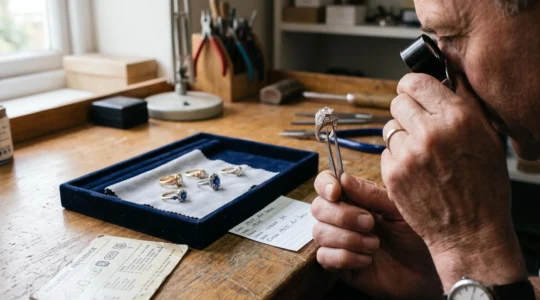
Which Jewellery Era Are You Actually Looking At When a Seller Says “Vintage” in the Listing?
A ring advertised as Victorian might have been manufactured in the 1980s. An Art Deco brooch might contain older diamonds in a later setting. And a seller describing something simply as « vintage » may not know its production decade at all….
Lire la suite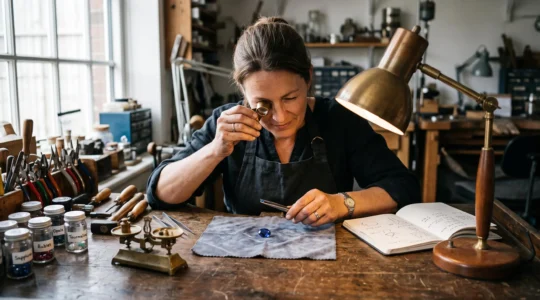
Why Do Certain Gems Show Up in Jewellery Styles Thousands of Miles From Their Source?
A gemstone can travel thousands of miles before becoming part of a jewel, crossing commercial networks, political borders and cultural traditions along the way. Its geological origin, the place where it was cut, the workshop that mounted it and the…
Lire la suite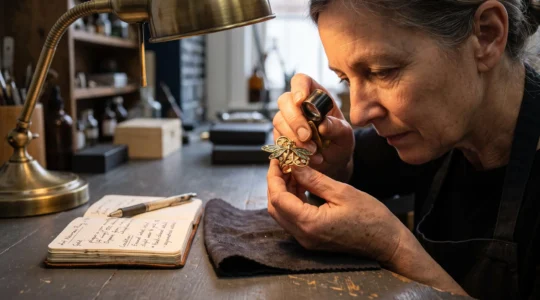
How Can You Tell Real Art Nouveau Organic Design From Modern Imitations in 3 Visual Checks?
A dragonfly brooch with translucent wings, a gold ring shaped like climbing vines, or a pendant framed by flowing hair can look unmistakably Art Nouveau. Yet the appearance alone does not establish whether the jewellery was made around 1900 or…
Lire la suite