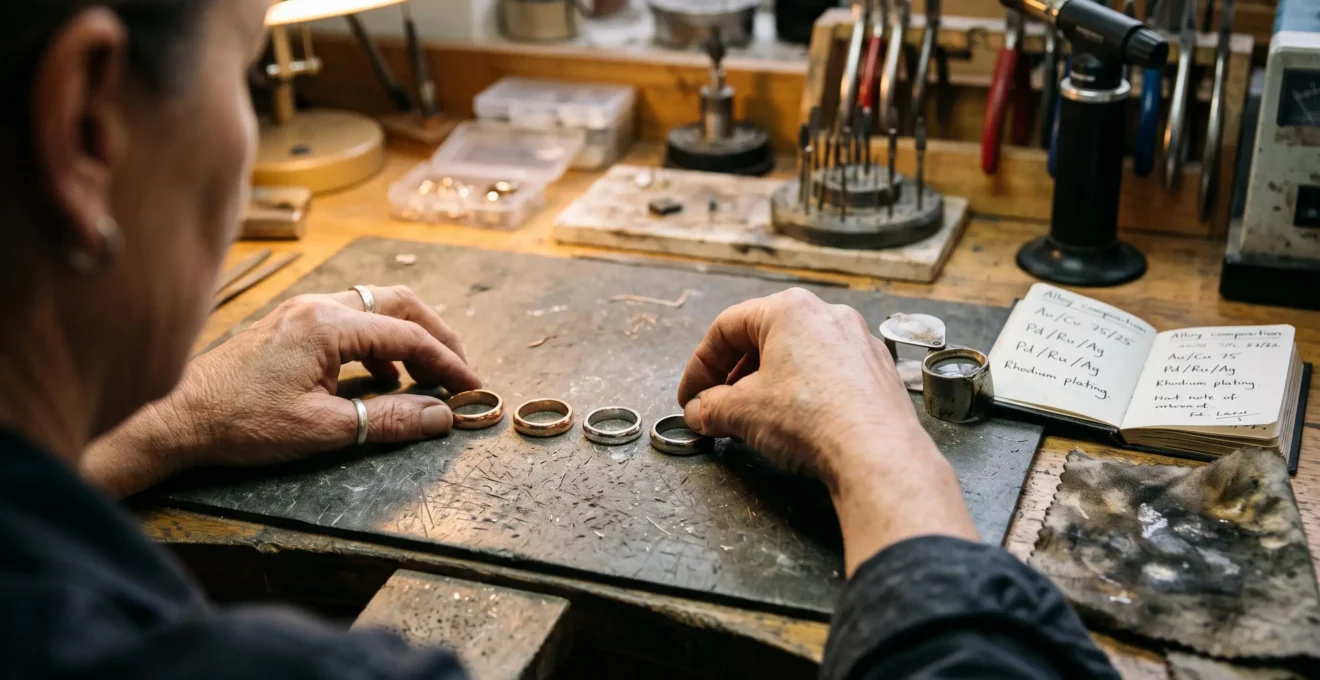
Two gold rings marked 18K can contain exactly the same proportion of gold yet behave differently on the finger. One may look pinker, another whiter; one may develop scratches more visibly, while another may leave a dark mark on the skin or require more frequent surface maintenance. These differences are not necessarily evidence that one ring is counterfeit or poorly made. They often reflect the metals mixed with gold, the way the ring was manufactured and the finish applied to its surface.
The distinction matters because karat measures gold content, not the complete performance of a ring. In 18K gold, 75% of the alloy is gold and the remaining 25% consists of other metals. In 14K gold, gold accounts for approximately 58.3%. The identity and proportions of those remaining metals influence colour and can affect hardness, polishing behaviour, skin compatibility and maintenance.
For buyers, the practical question is not simply whether a ring is 14K or 18K. It is whether its particular alloy suits daily wear, skin sensitivity, the desired colour and the level of maintenance the wearer is prepared to accept. Understanding the alloy before buying helps avoid paying for a finish that will need repeated renewal or choosing a metal that causes discomfort.
What matters most when choosing a gold ring
- The karat stamp establishes gold fineness, but the alloy formula determines much of the ring’s colour and contributes to its wear behaviour.
- Copper, nickel and palladium can influence appearance and skin compatibility. A dark mark is not automatically an allergy, and a precious-metal label does not guarantee that a ring will suit sensitive skin.
- Compare the complete alloy, surface finish, construction and expected maintenance before buying. For long-term wear, these details are more informative than the karat stamp alone.
- Why Can Copper-Alloy Gold Look Warmer but Leave Dark Marks on Skin in Summer?
- How to Ask What’s in the Alloy Without Getting a Vague Answer From the Sales Counter?
- Palladium White Gold or Platinum: Which Should You Choose if You Hate Re-Plating?
- The Allergy Mistake That Makes a New Ring Unwearable After 48 Hours
- When Should You Match Alloy Formulas if You Plan to Stack 3 Rings Together?
- Solid, Filled, or Plated: Which Should You Choose if You Want 5+ Years of Wear?
- Platinum or White Gold: Which Should You Choose if You Don’t Want Annual Maintenance?
- Why Do Platinum Frameworks Hold Stones Securely Even When the Prongs Look Thin?
Why Can Copper-Alloy Gold Look Warmer but Leave Dark Marks on Skin in Summer?
Copper gives rose gold much of its warm pink or reddish colour, but copper-containing jewellery can also contribute to dark marks on the skin under certain conditions. Sweat, moisture, skin oils and residues on the surface can interact with metal deposits and wear products, leaving a greyish or dark trace. Heat and humidity can make marks more noticeable by increasing perspiration and keeping moisture against the ring. The effect varies by alloy and wearer, so it should not automatically be treated as a manufacturing defect.
Rose gold combines gold with copper and often silver, with the exact recipe varying between manufacturers. A greater contribution from copper generally produces a warmer appearance, although the finished colour also depends on the complete formulation. The GIA‘s guide to white, yellow and rose gold engagement rings explains how gold fineness and alloying metals produce different gold colours and discusses metal sensitivity.
A dark mark is not proof that a ring contains too little gold. Nor does it establish that the wearer has an allergy. Surface residue may wash away, while allergic contact dermatitis typically involves symptoms such as itching, redness or a persistent rash. Irritation from trapped soap and moisture is another possibility. Appearance alone cannot establish the cause of every mark.
Individual skin chemistry also matters. Sweat composition, skin oils, soaps, cosmetics and environmental exposure differ from person to person. Two people can therefore wear the same 18K rose gold ring and have different experiences. Someone else’s skin-marking experience is not a reliable prediction of how the ring will behave on your hand.
To investigate a mark, remove the ring, gently clean the skin and jewellery using care instructions appropriate to the piece, and observe whether the mark clears. Do not assume that washing away residue rules out every skin problem. If the area is itchy, painful, swollen, blistered or persistently red, stop wearing the ring and seek appropriate medical advice. A dermatologist can help distinguish contact dermatitis from other causes.
A copper-containing alloy can be a perfectly reasonable choice, including for everyday jewellery, but its colour and surface behaviour should match your expectations. The next step is to ask the retailer for the actual alloy information instead of relying on broad quality claims.
How to Ask What’s in the Alloy Without Getting a Vague Answer From the Sales Counter?
Ask for the ring’s alloy composition, not simply whether it is good quality or hypoallergenic. An 18K stamp indicates 75% gold, but it does not identify the remaining 25%. Those metals can make a meaningful difference to colour, skin compatibility and surface maintenance. A retailer who can explain the alloy and document the product gives you a better basis for comparing two rings than one who offers only a karat number.
Start with direct questions that distinguish the important variables:
- For white gold: Is the alloy nickel-based or palladium-based? Is the surface rhodium-plated, and what is the underlying metal colour?
- For rose gold: Is the composition or manufacturer specification available? Which metals are used alongside gold and what colour should be expected as the ring ages?
- For skin sensitivity: Is the ring explicitly nickel-free, or can the seller provide information about nickel release? What evidence supports any hypoallergenic claim?
- For durability: Is the alloy intended for everyday wear? Are there manufacturer recommendations for resizing, polishing and servicing?
- For aftercare: What work can be carried out if the finish wears, the ring becomes scratched or a skin reaction develops?
These questions matter because two manufacturers can use different recipes for rings with the same karat and colour description. The Federal Trade Commission‘s Jewelry Guides address truthful representations of precious-metal content, quality, durability and related jewellery characteristics in the United States. They do not, by themselves, establish a complete composition disclosure for every product or determine the rules that apply in every country.
If the sales counter cannot answer, ask for the manufacturer’s technical sheet or written product specification. In the UK, hallmark information can help establish precious-metal fineness, but a hallmark does not necessarily disclose every alloying ingredient. In the United States, a karat stamp likewise should not be treated as a full chemical analysis. Where composition is important for medical or technical reasons, an independent assay or appropriate laboratory analysis may be necessary; not every ordinary metal test identifies every constituent reliably.
Five checks to complete before buying
- Request the karat and fineness information. Keep a product description or photograph showing the stamp and stated gold content.
- Ask which metals make up the remainder of the alloy. Save the written answer or manufacturer specification.
- For white gold, confirm whether nickel or palladium is used and whether rhodium plating forms part of the finish. Record both answers.
- Request the care and repair terms, including any stated recommendations for replating, resizing and polishing. Keep the written aftercare information.
- Compare the documents with your priorities for colour, skin sensitivity and daily wear. Retain the product description and purchase receipt together.
A seller’s inability to name every alloying percentage does not automatically prove that a ring is defective. However, if skin compatibility or long-term servicing is central to your purchase, an unsupported assurance is not a substitute for useful product information. This becomes especially important when comparing different white-gold alloys with platinum.
Palladium White Gold or Platinum: Which Should You Choose if You Hate Re-Plating?
If repeated rhodium replating is your main concern, palladium white gold or platinum may be preferable to conventional nickel-based white gold, but neither choice should be made on colour alone. Palladium white gold can offer a naturally grey-white appearance, while platinum is naturally white and dense. Conventional white gold is often rhodium-plated to create a bright, reflective surface. The underlying alloy, the manufacturer’s finish and the way you wear the ring determine what maintenance will be needed.
White gold is an alloy, not a single fixed formula. Nickel-based formulations can produce a pale colour, but the underlying metal may still look warmer than a fresh rhodium finish. As that plating wears, the underlying colour can become visible, particularly on frequently rubbed areas. Palladium-based white gold can be closer to a grey-white appearance without relying on the same surface contrast, although its exact colour and finish vary by formulation and maker.
Platinum provides a different trade-off. It is denser than gold and naturally white, so a platinum ring generally does not need rhodium to create its white appearance. Wear can still change the surface: scratches accumulate into a patina, which some owners prefer and others choose to have professionally polished. No-plating does not mean no maintenance.
The following comparison is a starting point. Actual cost, scratch behaviour and servicing depend on the alloy formula, ring design, finish, local availability and jeweller’s workmanship.
| Criterion | Nickel white gold | Palladium white gold | Platinum |
|---|---|---|---|
| Purchase cost | Often a comparatively accessible precious-metal option; varies by design and maker. | Can cost more than some white-gold alternatives; local availability and alloy costs matter. | Often costs more than comparable gold designs, but not invariably; weight and manufacturing affect the final price. |
| Colour over time | Underlying warmth may show as rhodium plating wears. | Can retain a naturally grey-white appearance without depending on rhodium for all its colour. | Naturally white; develops a surface patina during wear. |
| Weight on the finger | Generally lighter than a comparable platinum ring. | Depends on the particular alloy and design; usually lighter than platinum. | Dense and noticeably substantial for a comparable design. |
| Scratch behaviour | Depends on the alloy, finish and construction; the plated surface can wear. | Depends on the particular formulation and finish. | Scratches can move metal within the surface and contribute to patina; platinum can still be damaged. |
| Long-term servicing | Rhodium replating may be needed to restore the original bright finish. | Often less dependent on replating, depending on the desired finish and alloy. | No rhodium is required for its natural white colour, but polishing and setting inspections may still be needed. |
| Skin compatibility | Nickel can trigger allergic contact dermatitis in sensitised wearers. | May suit some nickel-sensitive buyers, but palladium is also a possible allergen. | Often considered by sensitive-skin buyers, but the complete alloy and individual response still matter. |
Availability should be checked rather than assumed. Palladium white gold is not offered by every retailer, and the price difference between alloys changes with market conditions and manufacturing choices. Ask for the specific formulation and a written quotation for the actual ring, including any finish that is included in the price.
The decision is ultimately about the surface you want and the care you are willing to provide. If you want a brilliant rhodium-white finish, white gold may remain an appropriate choice; if you prefer a naturally white metal without routine replating, platinum deserves serious consideration. Buyers with metal sensitivities should also evaluate the full alloy rather than assuming that either palladium or platinum is universally allergy-proof.
The Allergy Mistake That Makes a New Ring Unwearable After 48 Hours
The critical mistake is assuming that a high karat or a label such as hypoallergenic guarantees that a ring cannot cause a skin reaction. Karat describes gold content, not whether the remaining alloy contains a metal to which the wearer is sensitive. Nickel is a recognised jewellery allergen, and even a high-gold-content alloy may be unsuitable for a sensitised person. A reaction can appear after continuous wear, but there is no universal 48-hour timetable that reliably diagnoses an allergy.
Allergic contact dermatitis may cause itching, redness, swelling or a rash where the ring touches the skin. Symptoms can persist after the ring is removed, and repeated exposure can prolong the problem. By contrast, an ordinary surface residue mark may be dark without producing an itchy or inflamed rash. The distinction is useful, but it is not definitive: irritation from trapped soap and moisture can also produce discomfort and redness.
The American Academy of Dermatology advice on contact dermatitis explains that jewellery can be associated with itchy or painful skin reactions and that substances trapped beneath a ring can also irritate the skin. Persistent symptoms should therefore be investigated rather than automatically attributed to one alloy ingredient.
For buyers who know they have a metal allergy, ask for a documented nickel-free or appropriately low-nickel-release option and confirm that the claim applies to the complete ring, not just its visible surface. Platinum and some palladium-based white-gold formulations may be worth discussing with the jeweller, but neither label guarantees compatibility for every individual. The relevant alloy and any surface treatment still matter.
Nickel-release requirements also vary by jurisdiction and product category. Buyers should verify the rules applicable to the country where the jewellery is sold rather than assuming that a marketing term establishes regulatory compliance. Where sensitivity is a concern, the actual composition and reliable product documentation are more useful than an unqualified assurance.
If a new ring triggers symptoms, stop wearing it while the cause is assessed. Contact the retailer to discuss the product specification and any return or exchange policy. Replating or another surface treatment may sometimes be considered, but it is not a guaranteed solution: the treatment may wear, and the underlying alloy may still matter. Do not attempt to diagnose an allergy by repeatedly wearing a ring that causes a rash.
The safest buying strategy is to investigate a previous reaction before committing to another metal. Once a suitable alloy has been identified, the same attention to composition becomes useful when choosing several rings that will rub together throughout the day.
When Should You Match Alloy Formulas if You Plan to Stack 3 Rings Together?
Matching alloy families becomes particularly useful when three rings will be worn together every day. Stacked bands repeatedly rub against one another, and differences in hardness, surface finish and profile can influence how they wear. A harder ring can abrade a softer neighbour, while sharp edges or protruding settings can create concentrated contact points. The result depends on the actual alloys and construction, so matching karat numbers alone does not guarantee equal wear.
Colour matching also requires more than reading the stamps. Two rings sold as white gold may have different underlying alloy colours or different surface treatments. A freshly rhodium-plated band can appear brighter and cooler than an unplated palladium-based white-gold ring, even when their gold fineness is identical. If the rings are intended to sit flush, ask the jeweller to compare the actual pieces under neutral lighting rather than relying on catalogue photographs.
Three rings also create a different skin-contact environment from one band. Narrow gaps can retain moisture, soap and other residues, and a larger area of covered skin may become irritated. A wearer who tolerates one ring comfortably may experience irritation when wearing a stack. This does not prove that the additional alloy is responsible; trapped moisture and friction are also possible explanations.
Before choosing a permanent stack, consider which ring is most important to preserve. A wedding band or sentimental ring may be better protected by a design and alloy suited to frequent wear, while decorative rings can be rotated to reduce constant contact. Platinum and palladium white gold are not automatically the best anchors for every stack; the particular alloy, setting, ring profile and repair options still need to be assessed.
Useful questions include whether the bands sit flush, whether their edges meet at a narrow point, whether one ring has a raised setting and whether the jeweller anticipates unusual wear from the combination. Ask whether the pieces can be worn together without creating an avoidable abrasion or fit problem. A jeweller can inspect the actual profiles and identify potential contact points more reliably than a karat stamp can.
A well-matched stack can still show normal scratches and changes in finish over time. The goal is not to eliminate all wear, but to avoid preventable colour mismatch, uncomfortable skin contact and unnecessary damage caused by incompatible designs.
Solid, Filled, or Plated: Which Should You Choose if You Want 5+ Years of Wear?
For a ring intended for years of frequent wear, solid gold generally offers the clearest route to long-term repair and maintenance, provided the design is suitable and the ring is properly cared for. Gold-filled and plated jewellery can also be useful choices, but their longevity depends heavily on the thickness and quality of the gold layer, the construction and the amount of friction the piece experiences. A five-year lifespan cannot be guaranteed from the label alone.
Solid gold means the ring is made from a gold alloy throughout its principal metal body rather than having a thin gold surface over a different core. A solid 14K or 18K ring can usually be polished, repaired and resized, although feasibility depends on the design, setting and condition. Its colour and surface wear are governed by the alloy itself, not by a separate gold coating.
Gold-filled jewellery uses a bonded layer of gold over a base metal. The term has a defined meaning in some markets, but the precise terminology and requirements should be verified in the country of sale. It should not be treated as synonymous with ordinary gold plating. Ask for the construction and documented gold-layer specification instead of assuming that every product described as filled has the same thickness or durability.
Gold-plated jewellery has a gold layer applied over another metal. The underlying metal may be brass or another material, and the surface layer can wear through with repeated friction. Because a ring experiences frequent contact with neighbouring fingers, objects and surfaces, plating wear can be more significant than it would be on a pendant worn away from constant abrasion.
The surface alloy is particularly relevant to skin response. If a plated ring contains nickel in its exposed surface or the coating wears through to a base metal that causes a reaction, the core material and coating condition become important. A gold-coloured appearance or a high-karat description of the coating does not establish the composition of the entire piece.
For a long-term purchase, compare the expected cost of ownership rather than the initial price alone. Solid gold usually offers greater scope for traditional jewellery repairs, but a complex design may still limit resizing or repair. Filled and plated pieces may be less practical to restore economically once their surface layer is damaged. The best option depends on how frequently the ring will be worn and whether its construction supports the maintenance it is likely to need.
Before purchasing, ask for a clear description of the metal throughout the ring, the surface-layer construction where applicable and the maker’s care instructions. A lower initial price can be entirely reasonable for occasional jewellery, but a daily ring deserves closer scrutiny of repairability, wear and the realistic cost of maintaining its appearance.
Key points to remember
- Choose a white metal based on the appearance you want to retain: bright rhodium-white gold and naturally white platinum have different maintenance requirements.
- Distinguish scratches and surface patina from plating wear. Platinum can develop a patina without losing its natural white colour, while white gold may reveal a warmer underlying alloy as rhodium wears.
- For a ring with stones, evaluate the setting and its inspection needs separately from the metal’s colour and surface maintenance.
Platinum or White Gold: Which Should You Choose if You Don’t Want Annual Maintenance?
If you want to avoid routine rhodium replating, platinum is often a straightforward option because its natural colour does not depend on a rhodium surface. White gold may need replating to restore a bright, cool-white finish as its coating wears. However, platinum is not maintenance-free: scratches can create a patina, and polishing or setting inspections may still be appropriate. The right choice depends on which changes you find acceptable and how intensively you wear the ring.
White gold’s maintenance schedule is not universal. Replating frequency depends on the original plating, ring design, contact with other surfaces and daily activities. Someone who removes a ring for manual work may experience a different wear pattern from someone who wears it continuously. Rather than accepting an annual appointment as inevitable, ask the jeweller about the finish used on the specific ring and what signs indicate that it needs attention.
Platinum changes differently. Its density contributes to a substantial feel, and its surface can develop a soft, greyish patina as it is scratched during wear. Some owners appreciate this less reflective appearance; others prefer professional polishing to restore a brighter surface. Polishing should be discussed with the jeweller in the context of the ring’s construction and setting, rather than treated as a fixed yearly requirement.
Setting inspections are a separate matter for both metals. A ring may need a professional check because its prongs have been knocked, a stone has become loose or wear has changed the setting’s geometry. Neither platinum nor white gold removes the need to inspect a valuable ring that is worn frequently.
Price should also be compared on a like-for-like basis. Platinum rings commonly use a high-purity alloy, such as 950 fineness in many markets, and platinum is denser than gold. Consequently, a platinum ring of the same dimensions can contain more metal by weight and may cost more, although the final price also depends on design, labour, alloy and the jeweller. The GIA’s comparison of ring materials for everyday wear discusses density, natural colour, patina, gold fineness and the differing maintenance needs of these metals.
There is no single schedule that suits every wearer. A desk-based routine, regular manual work, sports and frequent exposure to abrasive surfaces can create different maintenance demands. Ask the jeweller to distinguish cosmetic servicing from essential inspections and to explain which signs warrant a visit.
Platinum is a strong candidate when natural white colour and freedom from routine rhodium replating are priorities. White gold remains a practical option for buyers who prefer its appearance, feel or price and accept the possibility of replating. In either case, the final decision should include the security and serviceability of the setting, particularly if the ring holds a valuable stone.
Why Do Platinum Frameworks Hold Stones Securely Even When the Prongs Look Thin?
Platinum’s density helps explain why a platinum setting can feel substantial despite fine-looking prongs, but density alone does not guarantee that a stone is secure. The alloy, the shape and dimensions of each prong, the quality of the setting work and the ring’s history of wear all matter. Platinum can develop a patina as the surface is scratched, yet even a platinum setting can be damaged by impacts or gradual wear and still requires professional inspection.
Platinum jewellery commonly uses alloys with approximately 95% platinum, often identified by a 950 fineness mark. That figure describes the proportion of platinum, not the complete mechanical performance of the finished setting. Gold fineness and platinum fineness are not interchangeable indicators of strength: the metals differ in density, and the remaining alloying elements and manufacturing process influence how each material behaves.
Platinum’s behaviour under scratching is also relevant. Rather than assuming that every scratch removes the same amount of material, it is useful to distinguish surface displacement and patina from actual loss of metal. The visible result depends on the alloy and the contact involved. Over time, a setting’s high-contact points can still wear, and no precious metal makes a prong immune to breakage or deformation.
For stone security, the critical question is whether the prongs remain correctly positioned and retain enough sound material to hold the stone. A prong that looks thin may be well designed and properly finished, but visual delicacy is not evidence of safety. Conversely, a robust-looking setting can still be compromised by a hard impact, repeated abrasion or an earlier repair that has weakened the structure.
Ask the jeweller to explain how the stone is secured, what areas are most exposed to wear and what inspection intervals are appropriate for the particular design. A professional can check for movement, damaged prong tips and other signs that are difficult for a wearer to assess reliably. If a stone begins to move or a prong catches unexpectedly, have the ring examined promptly rather than waiting for the next planned service.
These considerations also matter when comparing platinum with gold settings. A platinum setting may offer useful wear characteristics, but its suitability depends on the complete design and how it is maintained. Material choice should support a properly engineered setting, not replace the need for sound workmanship.
The most useful final check is practical: choose a setting designed for the stone and your daily routine, obtain clear aftercare advice, and have the prongs inspected when recommended or whenever damage is suspected. Platinum can be an excellent setting material, but long-term security comes from the combination of suitable metal, careful workmanship and ongoing attention.
Can two 18K gold rings have different hardness levels?
Yes. Both rings contain 75% gold, but the remaining 25% can consist of different metals in different proportions. Those formulations, along with manufacturing and heat treatment, can affect hardness and wear behaviour. The karat stamp alone cannot establish which ring will resist scratches better.
Does a black mark beneath a gold ring mean the gold is fake?
No. A dark mark can result from surface residue or interactions involving the alloy, sweat, skin oils and other materials. It is not proof of counterfeit gold or low fineness. If the mark is accompanied by persistent itching, redness or pain, stop wearing the ring and seek appropriate advice instead of assuming the cause is harmless residue.
Is palladium white gold always better for sensitive skin?
No. Palladium white gold can be an alternative to nickel-based white gold, but palladium itself can cause allergic contact dermatitis in some people. The complete alloy, any surface treatment and the individual’s sensitivity matter. Buyers with a known metal allergy should request reliable composition information and discuss suitable options with a healthcare professional when necessary.
Does platinum need polishing every year?
Not necessarily. Platinum develops a patina as its surface is scratched, but whether and when to polish it depends on the wearer’s preferred appearance, daily activities and the ring’s condition. Professional inspection of the setting is a separate consideration. Ask the jeweller for guidance based on the actual design rather than assuming a universal annual schedule.
What should I check before buying a ring for everyday wear?
Confirm the gold fineness or precious-metal composition, ask which alloying metals are used, establish whether the surface is plated, and obtain the care and repair terms. If you have sensitive skin, verify the information relevant to your allergy rather than relying solely on a hypoallergenic claim. For rings with stones, also ask how the setting should be inspected and maintained.