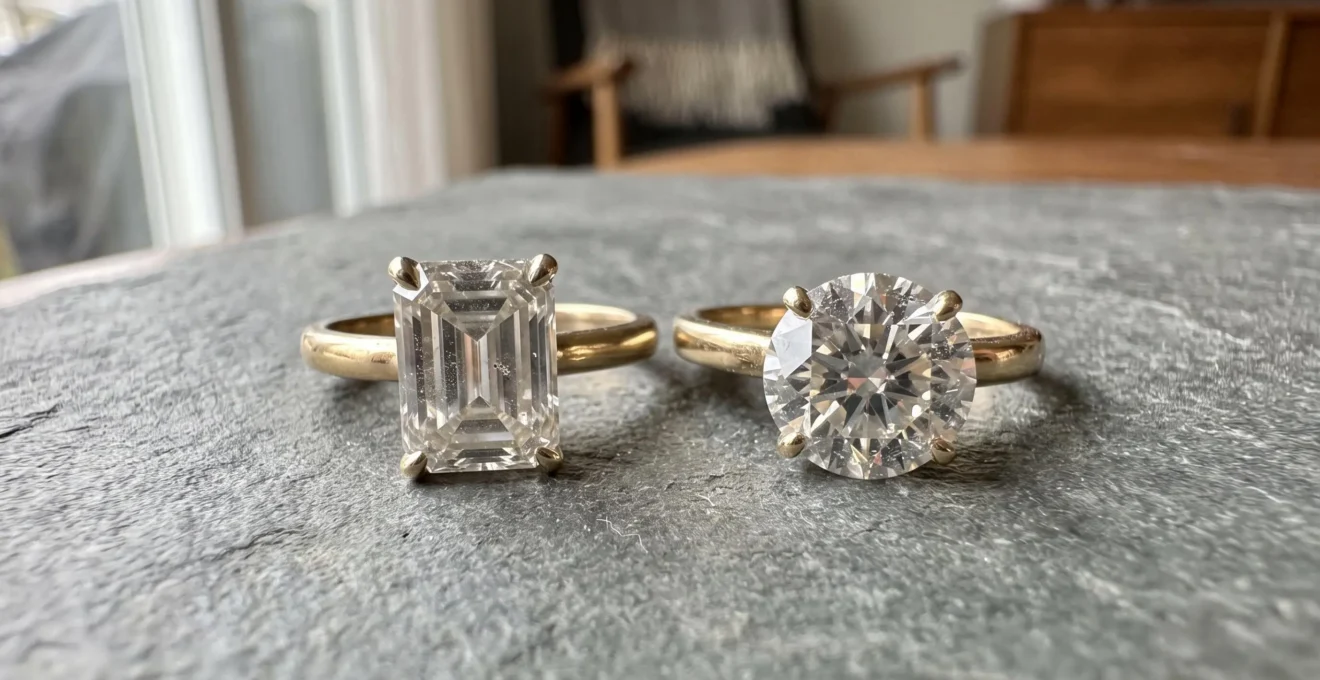
An emerald-cut diamond can look immaculate when you leave home and surprisingly cloudy by lunchtime. A baguette side stone may seem to display every fingerprint, while a round brilliant ring worn through the same morning still looks lively. The difference is not necessarily how much dirt each stone collects. It is how readily its facet pattern reveals surface residue.
Emerald and baguette cuts belong to the step-cut family. Their broad tables and long, orderly facets produce large reflections and a distinctive hall-of-mirrors appearance. That same optical openness makes smudges, body colour and certain inclusions easier to notice. A brilliant cut creates a busier pattern of reflections that can disguise some of these details.
There is no established rule that a step-cut diamond becomes visibly dirty after exactly two hours. Skin oils, lotions, soap residue, lighting and the ring’s setting all affect its appearance. The useful question is whether you enjoy a stone that rewards careful inspection and occasional cleaning—or prefer one that looks consistently sparkling with less attention.
What matters before choosing a step-cut diamond
- Optical openness: Emerald and baguette cuts reveal some inclusions and surface films more readily than brilliant cuts, particularly in subdued lighting.
- Real-world inspection: Compare individual diamonds in diffuse daylight, at normal viewing distances, rather than relying on showroom sparkle or clarity grades alone.
- Everyday practicality: Examine corner protection and girdle condition, and clean residue when it appears instead of following an arbitrary hourly schedule.
- Why Do Step Cuts Make Tiny Inclusions Look Bigger in Normal Indoor Lighting?
- How to Inspect a Baguette or Emerald Cut in 5 Minutes Without Relying on Showroom Lights?
- Emerald Cut or Round Brilliant: Which Should You Choose if You Hate Visible Inclusions?
- The Corner Exposure Mistake That Chips Emerald Cuts After One Hard Knock
- When Should You Clean a Step-Cut Ring if You Want It to Look Crisp Every Day?
- Why Can a Smaller Diamond Look Brighter Than a Larger One in Normal Daylight?
- How to Judge Gem Clarity at 30 cm Without Obsessing Over Microscope Photos?
- Why Does « Eye-Clean » Clarity Matter for Some Gems but Barely Show on Others?
Why Do Step Cuts Make Tiny Inclusions Look Bigger in Normal Indoor Lighting?
Step cuts can make small inclusions seem more prominent because their broad, relatively open facets provide fewer competing reflections to conceal them. In ordinary indoor lighting, a dark crystal or feather beneath the table may stand out against the stone’s restrained reflection pattern. The inclusion has not physically grown; its visibility depends on contrast, position, lighting and the diamond’s individual proportions.
Imagine looking through a large, clean window. A small mark on the glass is easy to locate because the surrounding surface is visually quiet. Now imagine looking at the same mark through a fragmented arrangement of mirrors. Multiple reflections compete for your attention.
That comparison helps explain the difference between step cuts and brilliant cuts, although diamond optics are more complex than ordinary glass. Emerald and baguette cuts use elongated, predominantly parallel facet arrangements to create broad flashes and repeating internal reflections. Round brilliants use many smaller facets arranged to generate more active brightness and scintillation.
The GIA‘s diamond shape and cut-style comparison explains that larger step-cut facets can make colour and clarity characteristics more noticeable, whereas brilliant-cut facet patterns are better able to disguise some inclusions.
Lighting changes the experience. A focused showroom spotlight may produce striking flashes that draw attention away from an inclusion. Beneath diffuse office or household lighting, the reflections can appear calmer, allowing an inclusion to become more apparent. This is not universal: direct illumination can also make certain inclusions conspicuous, depending on the angle.
Position matters as much as the overall clarity grade. An inclusion beneath the central table may be easy to see face-up. Pavilion reflections can create additional images of some inclusions, while a feature near the edge may be less noticeable from a normal viewing position.
A dark crystal, a white feather and a faint internal cloud may look quite different even when they contribute to the same clarity grade. The contrast between each feature and its surroundings is particularly important in an open facet pattern.
The trade-off is aesthetic rather than simply a defect. The uncluttered reflections that reveal inclusions are also responsible for the architectural, icy appearance that attracts buyers to step cuts.
If that quiet, geometric appearance is the reason you love emerald cuts, the sensible next move is to inspect the individual diamond under lighting that resembles your everyday environment.
How to Inspect a Baguette or Emerald Cut in 5 Minutes Without Relying on Showroom Lights?
A useful five-minute inspection combines diffuse daylight, realistic viewing distance, slow rotation and a review of the diamond’s grading report. Examine the stone near a window rather than relying exclusively on jewellery-store spotlights. Look for visible inclusions, colour, transparency, unusual see-through areas and vulnerable corners. This practical test is more informative than judging a stone from one illuminated display angle.
Ask the jeweller to show the diamond outside the brightest display lighting. Overcast daylight near a window is useful because it provides relatively even illumination without the dramatic flashes produced by narrow spotlights.
Start with the diamond at roughly arm’s length, then bring it to approximately 30 cm from your eyes. These are practical viewing distances, not formal laboratory grading standards. Look straight through the table and slowly rotate the stone to see whether a mark remains noticeable.
Next, place a loose stone against plain white paper and a neutral grey background. For a mounted ring, compare its appearance against those backgrounds without trying to remove it from the setting. Different backgrounds can help reveal body colour, transparency differences and obvious windowing, although the results depend on lighting and viewing angle.
If the diamond has a grading report with a clarity plot, use it to identify the types and approximate locations of recorded inclusions. Remember that not every report includes a plot and that plotted symbols do not necessarily reproduce every minute feature or its precise apparent size.
Your five-minute daylight inspection checklist
- Check face-up appearance at arm’s length. Record whether you can identify an inclusion without magnification.
- Repeat at approximately 30 cm. Note the location of any feature that remains visible.
- Rotate over white and grey backgrounds. Record noticeable colour, transparency or windowing differences.
- Compare observations with the grading report. Identify the reported clarity characteristics that appear relevant to what you see.
- Inspect the girdle and corners with the jeweller. Obtain confirmation of any chips, vulnerable thin areas or exposed corners before agreeing to the setting.
The final step concerns durability rather than optical beauty. Emerald cuts have cropped corners, while rectangular baguettes have a different corner arrangement. Both deserve examination for thin or damaged girdle sections, especially where the setting leaves stone edges exposed.
A grading report can provide a general girdle description, but it may not tell you the thickness of each corner. Ask a qualified jeweller to inspect the actual stone rather than assuming that its profile diagram provides all the necessary detail.
A strong candidate should remain appealing when the display lights are switched off. If visible inclusions still trouble you, comparing a step cut with a brilliant cut is the next practical decision.
Emerald Cut or Round Brilliant: Which Should You Choose if You Hate Visible Inclusions?
If visible inclusions bother you more than anything else, a round brilliant is generally the safer starting point. Its active facet pattern can conceal clarity characteristics that might remain noticeable in an emerald cut. An emerald cut can still be eye-clean, but you should examine the actual stone carefully and be prepared to prioritise clarity within your budget rather than assuming a particular grade guarantees the result.
The distinction becomes important when comparing diamonds with identical laboratory clarity grades. A VS2 round brilliant and a VS2 emerald cut are not guaranteed to look equally clean to the unaided eye. Their facet arrangements, inclusion locations and viewing conditions influence the outcome.
GIA’s diamond-shape guidance suggests considering VS2 clarity or higher for emerald-cut diamonds, especially with increasing size. This is guidance, not a universal minimum. VS1 or VVS stones may offer additional reassurance, but an attractive, eye-clean VS2 can be a more sensible purchase than a higher-grade diamond whose extra clarity is invisible during ordinary wear.
There is no established rule that a brilliant cut reliably conceals inclusions one or two clarity grades lower than a step cut. The difference varies too much between individual stones to support that precise conversion.
For buyers making a practical comparison, the trade-offs are easier to see side by side.
| Buying criterion | Emerald cut | Round brilliant |
|---|---|---|
| Reflection pattern | Broad, orderly flashes | Numerous lively reflections |
| Inclusion visibility | Some features are easier to notice | Facet pattern often provides more masking |
| Clarity budgeting | May justify extra attention to clarity | Can offer more flexibility for eye-clean choices |
| Apparent size | Elongated outline can look expansive | More compact circular outline |
| Durability considerations | Corner and girdle protection are important | No corners, but girdle impacts remain possible |
| Visual personality | Quiet, architectural elegance | Bright, active sparkle |
There are alternatives between those appearances. A radiant cut offers a rectangular or square outline with a modified brilliant facet arrangement that can conceal inclusions more effectively than an emerald cut. Some modified brilliant cushions create a similarly busy, crushed-ice appearance.
Antique-style cushions and old mine cuts offer different reflection personalities, but their inclusion visibility must also be assessed individually. An Asscher cut should not automatically be treated as an inclusion-hiding compromise: it is another step cut, with its own broad reflections and clarity considerations.
Carat weight does not establish visible size on its own. An elongated emerald cut may look larger because of its outline, but an equal-weight emerald cut does not always have a greater face-up area than a round brilliant. Depth, proportions and measurements matter.
Once you have chosen the reflection style you prefer, consider what happens when that ring encounters a door frame, countertop or other hard surface during ordinary wear.
The Corner Exposure Mistake That Chips Emerald Cuts After One Hard Knock
The principal setting mistake is leaving a vulnerable corner or thin girdle section insufficiently protected. Diamonds resist scratching exceptionally well, but a concentrated impact can still chip them. Emerald cuts have cropped corners rather than four perfect right-angle points, while baguette cuts have different corner geometry. Both can sustain damage when exposed edges strike hard objects, particularly where the girdle is very thin.
The distinction between hardness and toughness matters. Hardness measures resistance to scratching; toughness concerns resistance to breaking or chipping. A diamond can withstand everyday abrasion remarkably well yet fracture under an unfortunate impact.
In GIA’s technical article on preventing diamond chips, gemologist Al Gilbertson explains why vulnerable girdles, corners and points deserve particular attention. The article includes an example of an emerald-cut diamond with an extremely thin girdle and two chips.
Corner protection begins with the setting. A suitably designed prong arrangement can shield vulnerable areas, while a bezel or partial bezel provides metal coverage along exposed portions of the stone. The correct design depends on the diamond’s precise shape and the location of its vulnerable edges.
Do not assume that four prongs automatically provide sufficient protection. Their positions and shapes determine whether they actually cover vulnerable areas. On an emerald cut, the cropped corner facets and adjoining girdle sections need careful consideration. On a baguette, the straight edges and corners may require a different arrangement.
Girdle thickness deserves specific attention. An extremely thin section can be more susceptible to damage. Ask the jeweller to assess the girdle around the corners and exposed edges of the individual diamond, rather than relying solely on its overall girdle description.
Greater thickness and protective metalwork can reduce susceptibility, but neither makes a diamond impact-proof. An inclusion extending near a vulnerable edge may also matter when assessing the consequences of a hard strike.
Documented example: an emerald cut with two chips
GIA’s article on diamond chipping illustrates an emerald-cut diamond with an extremely thin girdle and two chips.
The example demonstrates that an exceptionally thin girdle can be a significant vulnerability. It does not establish that every thin-girdled diamond will chip or that one particular setting guarantees protection.
Repair is another consideration. Depending on the damage, a jeweller or diamond cutter may recommend leaving a small chip as it is, altering the setting, or evaluating whether repolishing or recutting is appropriate. Material removal can change dimensions and proportions.
Those changes are particularly relevant when a baguette must fit precisely alongside other stones or inside a channel setting. A repaired stone may no longer match its neighbours or fit its original mounting as intended.
Protecting the outline at the design stage is usually more practical than addressing a damaged stone afterward. Once that structural decision is made, everyday cleaning becomes the next maintenance priority.
When Should You Clean a Step-Cut Ring if You Want It to Look Crisp Every Day?
Clean a step-cut diamond when fingerprints, skin oils or product residue noticeably dull its broad facets, particularly after applying lotion, handling greasy food or using soap. There is no verified cleaning interval specific to emerald or baguette cuts, and the idea that they necessarily look dirty after two hours is an exaggeration. Their open reflections simply make some surface films more conspicuous.
A fingerprint can interrupt a large reflection across an emerald cut’s table. On a brilliant cut, smaller reflections and changing sparkle may continue to attract attention even when some residue is present.
This does not mean step cuts necessarily accumulate more dirt. The visible difference comes from how surface contamination interacts with their optical appearance.
Think about what your ring encounters throughout the day. Hand cream leaves an oily film. Cooking can introduce grease. Soap may leave residue if it is not thoroughly rinsed away. A ring that looks crisp at breakfast may appear less transparent after those activities.
For an ordinary, untreated diamond in a secure setting, gentle cleaning with lukewarm water and a small amount of mild dishwashing detergent is a practical option. A soft brush can help remove residue from accessible areas around and beneath the stone, provided the mounting is secure and the jeweller has confirmed the method is suitable.
Clean the ring in a bowl rather than directly over an open drain. Rinse carefully and dry it with a clean, lint-free cloth. Avoid abrasive powders and aggressive scrubbing.
The underside of the diamond deserves attention because residue beneath the table and around the pavilion can interfere with its appearance. However, do not force a brush into tight or delicate settings, particularly around small channel-set baguettes.
GIA’s diamond care recommendations caution against routine home use of ultrasonic and steam cleaners. These devices can loosen stones in their settings, and jewellery professionals assess mounting security before using such equipment.
For included diamonds, stones with significant fractures, or treated gemstones, ask a qualified jeweller before considering machine cleaning. Oil-treated emerald gemstones require different care from emerald-cut diamonds.
Cleaning is also an opportunity to inspect the setting. Look for a visibly raised prong, a displaced stone or a new gap between the gem and its mounting. Ordinary grease is not, by itself, established as a direct cause of loosening prongs. Mechanical wear and damage are more relevant concerns.
If a stone moves or appears loose, stop wearing the ring and arrange a professional inspection rather than repeatedly washing or manipulating it.
A clean diamond should still be judged by the quality of its light return. If it looks glassy or dull even after appropriate cleaning, its proportions and optical behaviour deserve closer examination.
Why Can a Smaller Diamond Look Brighter Than a Larger One in Normal Daylight?
A smaller diamond can look brighter than a larger one when its proportions and facet alignment return more light toward the viewer. Carat weight measures mass, not brightness. A larger diamond with poorly balanced proportions may leak light or display distracting transparent areas, while a smaller, better-cut diamond can produce stronger face-up reflections under the same daylight conditions.
The crucial distinction is between the amount of material in the diamond and the way that material has been shaped.
Light entering a diamond is refracted, reflected internally and returned through its facets. Facet angles, alignment, depth and the observer’s position all affect what reaches the eye. There is no single ideal depth percentage that guarantees maximum brightness across every diamond shape.
For a step cut, this becomes particularly visible through the broad table. A poorly proportioned diamond may exhibit windowing, where part of the stone looks unusually transparent rather than returning appealing reflections.
A practical way to recognise obvious windowing is to view a loose diamond against a plain background or printed material while gently changing its angle. If a prominent area remains see-through from normal face-up positions, ask whether its proportions produce undesirable light leakage.
Seeing through a tilted diamond does not automatically indicate a defect. Diamonds can show transparent areas at certain viewing angles, and text visibility alone is not a definitive cut-quality test. The concern is persistent, distracting windowing during ordinary viewing.
Two stones of similar shape can also differ in contrast pattern. One may display balanced, lively broad flashes; another may appear dark or flat under the same illumination. A larger table or greater spread is not automatically better if the resulting light performance disappoints.
For a useful comparison, place candidate stones beside one another under the same diffuse daylight, with similar orientation and background. Observe them directly first. Then take photographs using consistent camera position, exposure and lighting, avoiding automatic processing differences where possible.
Photographs provide a helpful record, but camera settings can distort apparent brightness. Treat them as supplementary evidence rather than definitive optical measurements.
When choosing between a larger diamond with weak face-up appearance and a smaller one that looks consistently attractive, the better choice depends on whether you value size or light performance more.
Once the stone performs well optically, its clarity should be assessed at a distance that reflects how you will actually see the ring—not solely through magnified photography.
How to Judge Gem Clarity at 30 cm Without Obsessing Over Microscope Photos?
To judge practical eye-clean appearance, look at the diamond with unaided vision at approximately 30 cm, then at a more relaxed arm’s-length distance, under ordinary daylight. If you cannot identify an inclusion at those distances, it may be visually acceptable for your needs even if magnified images reveal numerous details. The result is personal and depends on eyesight, lighting, stone size and viewing angle.
Diamond clarity grading and everyday visual acceptance answer different questions.
Laboratory grading evaluates clarity characteristics under standardised conditions, including 10× magnification. Everyday inspection asks whether those characteristics distract you when the diamond is worn.
The GIA’s explanation of diamond clarity grading identifies five important factors: size, number, location, relief and nature of clarity characteristics.
Relief describes how strongly a feature contrasts with the surrounding diamond. A dark crystal may be more noticeable than a pale inclusion, depending on their respective sizes, locations and viewing conditions.
Position is equally important. A feature directly under the table may catch your attention, especially in a step cut. An inclusion situated elsewhere may be harder to identify during normal face-up viewing. Internal reflections can also affect the apparent number or location of visible characteristics.
Consider a hypothetical comparison: two emerald-cut diamonds share the same laboratory clarity grade. Stone A contains a dark crystal clearly visible beneath the table at 30 cm. Stone B contains a less contrasting characteristic that you cannot identify without magnification. For a buyer seeking an eye-clean appearance, Stone B may be the better fit despite the identical grade.
Magnified retailer photographs can be useful for understanding inclusion types and positions, but they are not a reliable representation of actual viewing size unless the scale is clear. Controlled lighting and image processing can also change the perceived contrast of clarity characteristics.
When shopping remotely, request unretouched video of the exact diamond under neutral or diffuse daylight, ideally showing the entire stone at realistic viewing distance before moving closer. Ask for footage from more than one angle.
Such video is useful supporting evidence, not a perfect substitute for an in-person assessment. Camera lenses, screens and compression can hide or exaggerate details.
Decide your clarity tolerance before inspecting enlarged images. Otherwise, you may become preoccupied with an inclusion that would never have attracted your attention during ordinary wear.
The objective is not to pretend inclusions do not exist. It is to distinguish a genuinely distracting characteristic from a microscopic feature that has little practical consequence.
That distinction becomes even more important when comparing diamonds with coloured gemstones, where the nature and acceptability of inclusions can differ substantially.
Key takeaways before choosing a gemstone
- Define what eye-clean means to you at normal viewing distance before paying for additional laboratory clarity.
- Assess optical appearance and physical durability separately: a visually beautiful stone can still need substantial setting protection.
- Consider the gemstone species, treatments and care requirements alongside the facet style rather than assuming diamond rules apply to every gem.
Why Does « Eye-Clean » Clarity Matter for Some Gems but Barely Show on Others?
Eye-clean clarity matters differently across gemstones because inclusion frequency, optical behaviour, value expectations and treatment practices vary. Diamond buyers often prioritise a clean appearance, especially in open step cuts. Natural emerald gemstones commonly contain visible internal characteristics, so their evaluation also considers colour, transparency, treatment and durability. The appropriate standard depends on the gemstone and its cut, not on clarity alone.
The word emerald introduces an important distinction. An emerald-cut diamond is a diamond shaped with a particular rectangular step-cut arrangement. An emerald gemstone is a green variety of beryl. The same cutting style can be used on different gemstone materials, but their inclusions and care requirements are not interchangeable.
Natural emerald gemstones often contain inclusions described as jardin, referring to their garden-like internal appearance. Such characteristics may be accepted as part of the stone’s natural identity, although their location, visibility and potential effect on durability still matter.
An eye-clean emerald gemstone can be especially desirable, but visual clarity should be weighed alongside colour, transparency, treatment and the overall appearance. Some inclusions are tolerable aesthetically yet warrant closer examination because of possible structural implications.
Facet style adds another layer. A step-cut sapphire or emerald gemstone may expose internal characteristics through broad reflections more readily than a similarly included stone fashioned with a busier brilliant-style arrangement. This is a general optical tendency, not a guarantee that one cut will always look cleaner.
Coloured gemstones also require careful treatment disclosure. Emeralds are commonly clarity-enhanced through fissure filling, including oiling. The presence, nature and extent of treatment can affect purchasing decisions, ongoing care and potentially value.
Oil and other filling materials may be affected by heat, certain cleaning methods or changes over time. Buyers should request available treatment information and obtain gem-specific care advice before using cleaning chemicals, steam or ultrasonic equipment.
For a daily-wear ring, the decision is best made across three practical dimensions:
- Visual tolerance: Do you mind seeing an inclusion during normal wear, or do you prefer a consistently clean-looking table?
- Physical exposure: Will the ring routinely encounter hard surfaces, manual work or situations requiring stronger edge protection?
- Maintenance willingness: Are you comfortable cleaning visible residue and arranging professional setting inspections when appropriate?
A buyer who loves crisp geometry and accepts regular attention may enjoy an emerald-cut diamond enormously. Someone who dislikes visible inclusions, prefers active sparkle and wants a more visually forgiving appearance may find a round brilliant or another brilliant-style cut more satisfying.
For coloured gemstones, add treatment disclosure and material-specific durability to that evaluation. The same attractive outline can behave differently depending on whether it contains diamond, sapphire or natural emerald.
Choose the cut that looks beautiful to you in ordinary daylight, request the grading and treatment information appropriate to the stone, and have its setting assessed for your daily activities. A ring should fit the way you live, not merely the way it looks under perfect display lighting.
Does a cloudy-looking emerald-cut diamond always need cleaning?
No. Surface oils and residue can make an emerald-cut diamond look dull, but cloudiness can also reflect internal characteristics, lighting conditions or the diamond’s proportions. If appropriate gentle cleaning does not improve its appearance, compare it under different lighting and ask a gemologist or jeweller to assess the cause.
Can a VS2 emerald-cut diamond be eye-clean?
Yes. A VS2 emerald-cut diamond can be eye-clean during ordinary viewing, depending on the size, type, contrast and position of its inclusions. The clarity grade does not guarantee that result, however. Examine the individual stone at realistic viewing distances before deciding whether a higher grade is worth the additional expense.
Are baguette diamonds less durable than emerald-cut diamonds?
There is no universal durability ranking based solely on these two cutting styles. Both are diamonds, but their outlines, girdle thicknesses, individual clarity characteristics and mounting designs affect vulnerability. Rectangular baguettes and cropped-corner emerald cuts need protection suited to their specific geometry, particularly where edges or corners remain exposed.
Will a bezel setting make an emerald-cut diamond look less bright?
A bezel changes the way the diamond is framed and may alter the visual impression of its outline. Whether it noticeably changes face-up brightness depends on the stone’s proportions, the setting’s construction and the available light. A properly designed bezel can provide useful edge protection without necessarily sacrificing the diamond’s appealing step-cut reflections.
Should you remove a step-cut engagement ring before applying hand cream?
Removing the ring before applying lotion can reduce oily residue on its table and underside. Keep it in a secure place while doing so. If cream reaches the diamond, gentle cleaning appropriate to the stone and its setting can restore its appearance. Avoid removing or cleaning jewellery where it could be dropped or lost.