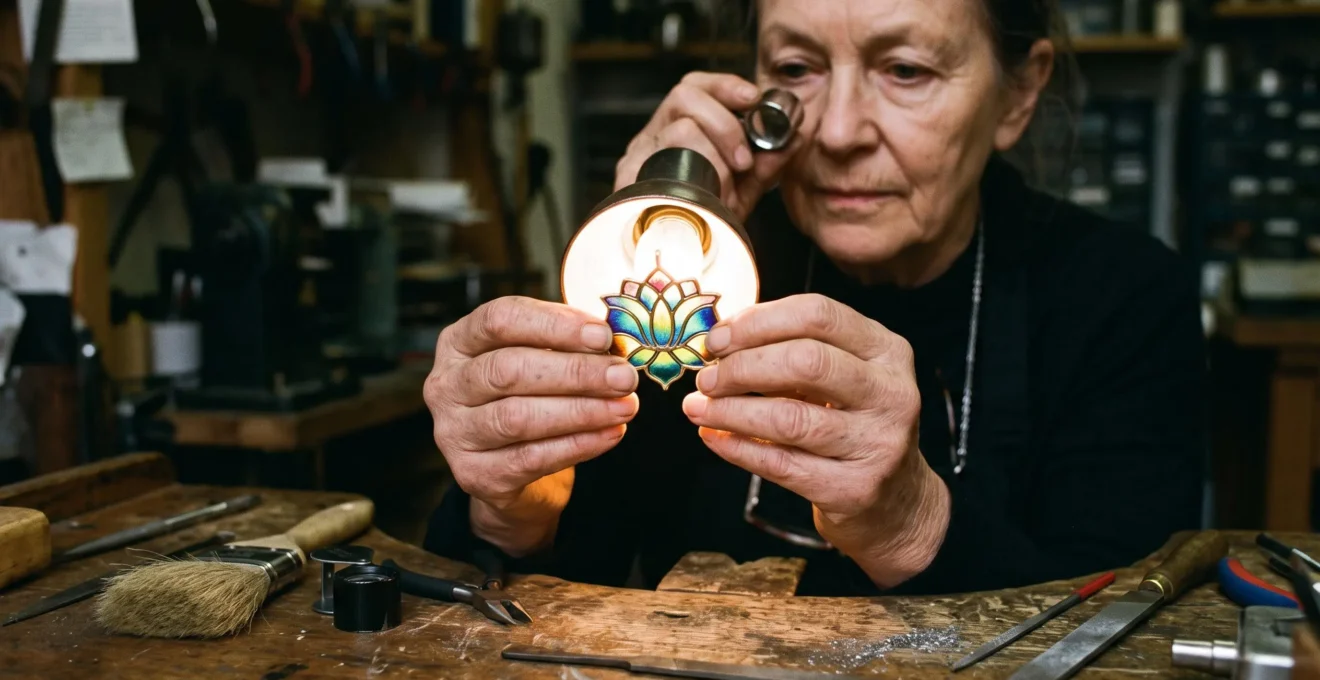
Plique-à-jour enamel occupies an unusual position in fine jewellery: it delivers the luminous colour of stained glass in a miniature, wearable form, yet sacrifices the continuous metal backing that protects many other enamel techniques. That combination explains both its appeal and its vulnerability. The difficulty lies not simply in creating beautiful colour, but in producing and preserving thin, translucent enamel windows supported primarily by their surrounding metal framework.
The price reflects demanding craftsmanship, repeated firing, careful finishing and the risk that a delicate structure may fail during production. However, a high price does not automatically guarantee durability. The maker’s construction choices, the quality of the enamel-to-metal joins, the condition of the finished piece and the owner’s handling habits all influence its practical lifespan.
Collectors can make better purchasing decisions by understanding where the structural risks occur, inspecting the enamel under different lighting conditions and asking specific questions about construction and repair. Appropriate cleaning and storage also matter: a piece that receives careful treatment has a better chance of retaining its clarity than one exposed to repeated impacts, abrasive products or unsuitable cleaning equipment.
What to Know Before Buying Plique-à-Jour Enamel
- Plique-à-jour achieves its stained-glass effect by removing the temporary backing used during construction, leaving delicate translucent enamel windows.
- Its price reflects specialist labour, technical complexity and production risk, not immunity to cracking or a guaranteed level of durability.
- Inspect the piece under transmitted and angled light, avoid impacts and sudden temperature changes, and follow care advice suited to its actual materials and condition.
- Why Can Plique-à-Jour Enamel Crack From a Single Drop Even if the Metal Frame Survives?
- How to Inspect Plique-à-Jour Enamel Quality Using 4 Light Tests Before You Buy?
- Plique-à-Jour or Cloisonné: Which Should You Choose if You Want Something You Can Wear Weekly?
- The Cleaning Product That Can Frost Enamel Surfaces in One Use
- When Should You Avoid Wearing Plique-à-Jour Enamel if You’re Travelling or Very Active?
- Why Can an Organic Material Pendant Start Yellowing After Just 8 Weeks of Sunlight?
- How to Clean Powdered-Glass Jewellery Without Scratching or Clouding the Surface?
- Why Do Powdered-Glass Jewellery Surfaces Chip Around Edges After a Few Wears?
Why Can Plique-à-Jour Enamel Crack From a Single Drop Even if the Metal Frame Survives?
Plique-à-jour enamel can crack while its metal framework remains intact because the translucent glass panels have no permanent metal backing to distribute an impact. A frame may retain its shape after a fall even when one of the delicate enamel windows has fractured. The metal and enamel are different materials, and the survival of one does not establish the condition of the other.
In traditional plique-à-jour, powdered enamel is placed inside metal cells, often using a temporary backing that is removed after firing. The resulting windows transmit light rather than resting on a continuous metal surface. The Gemological Institute of America’s explanation of jewellery enamelling techniques describes the construction that gives plique-à-jour its characteristic translucent appearance.
Glass is hard but brittle. A sharp impact can create a fracture without visibly bending the surrounding frame. The result may be a fine line at a window edge, a crack across a coloured panel or a small area of detached enamel. Some damage is immediately visible; other defects are difficult to detect without magnification and appropriate lighting.
Thermal shock is a separate risk. A sudden temperature change can create internal stress as different parts of an object expand or contract at different rates. Mechanical impact, by contrast, introduces stress through a blow or collision. Both deserve attention, but neither should be assumed to have occurred merely because a crack is discovered.
Firing and cooling also require careful control. Repeated heating, cooling and differences in the behaviour of enamel and metal can influence residual stress. The precise effect depends on the materials and construction; visual inspection alone cannot establish how much internal stress remains in a finished piece.
After a fall, do not assume the jewellery is safe to wear simply because the frame looks undamaged. Avoid shaking or tapping the piece to test it, as this may worsen existing damage. Examine it without applying pressure, using magnification and angled light where possible. Look for new lines, missing fragments, changes around the window edges or movement that can be observed without manipulating the jewellery. If a crack is suspected, ask a qualified enamel specialist or jeweller experienced with plique-à-jour to assess it before further wear.
A delicate enamel window can remain vulnerable even when no damage is obvious. Prevention therefore starts with selecting a well-made piece and continues with conservative handling, rather than relying on the frame to protect the enamel.
How to Inspect Plique-à-Jour Enamel Quality Using 4 Light Tests Before You Buy?
Four complementary lighting tests can help buyers identify visible irregularities in plique-à-jour enamel: transmitted backlighting, raking side light, rotation under a concentrated light source and comparison in natural daylight. Each reveals different details, but none can certify structural strength or guarantee that a piece will withstand an impact. The most useful inspection combines these tests with a close look at the enamel-to-metal joins.
Plique-à-jour is designed to transmit light, so a clear view of its windows matters as much as the appearance of its front surface. Inspect the piece in a neutral setting rather than relying entirely on the warm or dramatic lighting commonly used to display translucent jewellery.
- Test 1 — Backlighting. Hold the piece in front of a diffuse light source or shine a phone flashlight through its windows. Look for conspicuously uneven colour, abrupt differences in opacity and obvious thin or incomplete areas. Colour variations may be intentional, so ask the maker about the design before interpreting every difference as a defect.
- Test 2 — Raking side light. Direct a light across the surface at a shallow angle. This can make pits, bubbles, surface irregularities and some crack lines easier to see. Avoid pressing a loupe or light against the enamel.
- Test 3 — Rotation under a point light. Slowly change the viewing angle while keeping the light source in one position. Watch for fine lines, unusual reflections or a network of visible surface cracks that may be difficult to distinguish when looking straight on.
- Test 4 — Natural daylight. Compare the colour under neutral daylight with its appearance under shop lighting. Note substantial differences in colour distribution or transparency and ask whether the effect is deliberate shading or a production irregularity.
A clean-looking join between enamel and metal is worth examining closely. Look for obvious gaps, missing material, chips or a cloudy border that differs from the surrounding finish. A smooth appearance is encouraging, but it is not proof of complete fusion or internal integrity; the precise construction and finishing method matter.
For online purchases, request close-up photographs in daylight, views of the front and reverse, and images showing the enamel borders. Ask whether the piece has been repaired and what the seller’s return policy covers if a defect is discovered. These questions are particularly useful when studio photography makes every window appear uniformly luminous.
Your Five-Step Pre-Purchase Inspection
- Perform the backlighting test and record any conspicuous differences in transparency or colour in a short inspection note.
- Use raking light and a loupe to check for visible pits, bubbles and crack-like lines; photograph any area of concern.
- Rotate the piece beneath a fixed light and note any additional irregularities that appear as the viewing angle changes.
- Compare its appearance in natural daylight with its appearance under shop lighting, noting colour differences for discussion with the maker.
- Inspect the metal borders and request written confirmation of construction details, repair history if known, and the applicable return terms.
Visible defects deserve discussion, but an apparently flawless surface is not a durability certificate. If the purchase is expensive or the construction is unfamiliar, an independent assessment by a specialist may provide more useful reassurance than additional photographs.
Plique-à-Jour or Cloisonné: Which Should You Choose if You Want Something You Can Wear Weekly?
Cloisonné is generally the more practical choice for frequent wear when durability is the priority, because its enamel typically sits on a supporting metal base. Plique-à-jour is better suited to buyers who value translucent, stained-glass effects and are prepared to handle the piece carefully. The right choice depends on the design, placement, construction quality and the owner’s daily activities.
In cloisonné, thin metal wires form cells that are filled with enamel, and a metal backing supports the enamelled surface. In plique-à-jour, the temporary backing is removed to expose the translucent windows. This difference changes how the two techniques should be considered for regular use.
| Buying consideration | Plique-à-jour | Cloisonné |
|—|—|—|
| Visual effect | Translucent windows that transmit light | Coloured enamel generally supported by metal |
| Structural support | Open windows lack continuous backing | Metal substrate supports the enamel |
| Frequent impacts | Greater concern for unsupported enamel windows | Backing offers additional support, but enamel can still chip |
| Suitable designs | Carefully handled pendants, brooches and earrings | Often a practical option for jewellery intended for more frequent wear |
| Care requirements | Particularly cautious handling and storage | Careful handling remains necessary; backing does not make enamel indestructible |
| Best suited to | Collectors prioritising translucency and specialist craftsmanship | Buyers prioritising a more supported enamel construction |
Plique-à-jour may command a premium because the technique requires specialist skill, meticulous preparation and control over firing. Unsupported windows must remain intact through the production process, and failed work may require substantial reworking or be unusable. However, the available evidence does not establish a universal failure rate or a fixed percentage premium over cloisonné. Price varies with the maker, materials, design, scale and finish.
A higher price therefore reflects the particular work and design, not an automatic guarantee of better resistance to damage. Ask what makes the construction difficult, how the piece is supported and whether the maker has a repair process for damaged windows.
The decision also depends on where the jewellery will be worn. A brooch or pendant used for occasional events may be easier to protect than a ring or bracelet that repeatedly contacts desks, bags and other hard surfaces. Some contemporary designs may incorporate protective bezels or fine reinforcing elements. Such features should be verified with the maker rather than assumed from photographs.
For a collector who loves the stained-glass effect, plique-à-jour can still be a worthwhile purchase when occasional wear and careful storage suit the design. For jewellery expected to withstand regular knocks, a well-made cloisonné piece may be the more sensible option.
The Cleaning Product That Can Frost Enamel Surfaces in One Use
Abrasive household cleaners and unsuitable chemical treatments are poor choices for plique-à-jour enamel because they can scratch, dull or otherwise damage the glass surface and surrounding metal. Chlorine-based bleach, abrasive cream cleaners and toothpaste should not be used as routine jewellery cleaners. The precise effect of a product depends on its formulation, concentration, contact time and the materials in the piece.
Enamel is a glass-based material, so its appearance depends on the way light interacts with its surface and passes through its translucent sections. Fine surface damage can scatter light, making a previously glossy area appear hazy or frosted. This is different from ordinary dirt or skin oil, which may be removable with an appropriate gentle cleaning method.
The distinction matters because permanent surface alteration is not equivalent to tarnish. Metal tarnish may sometimes be treated separately, but polishing compounds intended for metal can scratch or contaminate adjacent enamel. Abrasive products should therefore never be rubbed over the enamel in an attempt to restore its shine.
The Canadian Conservation Institute’s guidance on caring for glass and ceramic objects explains that glass is hard but brittle and that cleaning decisions must account for the object’s condition. Its guidance concerns glass and ceramic objects generally, not a validated cleaning protocol for every plique-à-jour jewel, so particularly delicate pieces warrant additional caution.
For a stable, undamaged piece whose maker permits gentle wet cleaning, use a barely damp, soft, lint-free cloth and minimal lukewarm water. If a small amount of mild, pH-neutral soap is appropriate for the known materials, apply it sparingly and avoid prolonged contact. Dry carefully without pressing against the enamel windows. Do not soak the piece: moisture may affect soldered joints, settings, stringing or other components in a mixed-material design.
Ultrasonic and steam cleaners should also be avoided unless a specialist familiar with the specific construction explicitly confirms that the method is appropriate. Ultrasonic vibration may aggravate an existing defect or loosen a weak component, while rapid temperature changes associated with steam cleaning can introduce thermal stress. Neither method should be presumed safe merely because the jewellery is made with precious metal.
If the enamel is already cloudy, cracked or loose, leave it uncleaned until its condition has been assessed. A conservator or experienced enamel specialist can help distinguish removable deposits from permanent damage and advise whether any treatment is appropriate.
When Should You Avoid Wearing Plique-à-Jour Enamel if You’re Travelling or Very Active?
Avoid wearing plique-à-jour enamel during activities that expose it to impacts, abrasive particles, harsh chemicals or sudden temperature changes. Beaches, swimming pools, gyms, contact sports, gardening and hands-on work all introduce risks that are difficult to control. Travel also creates opportunities for accidental knocks, especially when jewellery is packed loose or placed in checked baggage.
At the beach, sand can scratch surfaces, while saltwater and pool chemicals may affect metal components or other materials in the setting. Moving rapidly between a cold environment and intense heat may also stress delicate glass. Removing the jewellery before swimming or sunbathing reduces these exposures.
Exercise presents a different combination of hazards. Equipment, weights, benches and other hard surfaces can strike the frame or enamel, while sweat and repeated movement can affect settings and components. Gardening, cooking and practical work create similar risks because the hands and jewellery frequently approach hard or abrasive surfaces.
Travel adds handling risks even when the jewellery is not being worn. Luggage may be dropped, compressed or moved abruptly. Carrying a delicate piece in a secure, padded container in hand luggage is generally preferable to leaving it loose in a suitcase, although hand luggage itself does not eliminate the risk of impact.
Storage deserves the same care as transport. Place each piece in its own padded compartment or soft pouch, away from harder gemstones and metal jewellery that could scratch or catch the open windows. Do not stack heavy objects on top of the container.
A practical approach is to carry plique-à-jour jewellery safely and wear it only after reaching the destination and completing activities that pose a risk. For frequent use, a pendant or brooch may be easier to protect than a ring or bracelet, depending on its design and how it sits on the body.
There is no need to treat every outing as unsafe, but valuable translucent enamel deserves deliberate handling. Choosing the right occasion and packing the piece separately can reduce avoidable damage without sacrificing the enjoyment of wearing it.
Why Can an Organic Material Pendant Start Yellowing After Just 8 Weeks of Sunlight?
An organic component in a mixed-material pendant can discolour after prolonged sunlight exposure, but eight weeks is not a universal threshold. The result depends on the material, its previous treatment, the intensity and duration of exposure, and the amount of heat involved. A pendant combining enamel with resin, wood, bone or another light-sensitive component may therefore age differently from a piece made entirely of metal and glass.
The Canadian Conservation Institute explains that ultraviolet radiation can cause yellowing and other deterioration in susceptible materials, while infrared radiation can heat objects and accelerate some forms of ageing. Its guidance on light, ultraviolet and infrared deterioration also makes clear that material composition affects the nature and rate of damage.
The word *organic* covers materials with very different properties. Some resins may change colour as their chemistry changes under light and heat; wood can also change appearance with exposure. Amber, bone, coral and pearl-based components have their own material-specific considerations, so the same time estimate should not be applied indiscriminately to all of them.
Direct sunlight on a south-facing windowsill, exposure inside a hot car or prolonged display under intense lighting may create more demanding conditions than occasional wear. A pendant kept in a closed jewellery box away from light will generally experience much less light exposure than one displayed continuously in a bright window.
Prevention is more reliable than attempting to reverse discolouration after it appears. Store mixed-material jewellery in a closed box away from windows and direct sunlight. Avoid leaving it in a parked car, and do not use a sunlit display surface for long-term storage. If the piece is valuable or its organic components are unidentified, ask the maker for material-specific storage advice.
Not every colour change is caused by ultraviolet exposure, and not every discoloured material is irreversibly damaged. Dirt, coatings, oxidation and other changes can look similar. Avoid polishing or applying solvents to investigate the problem yourself, particularly when the pendant contains fragile enamel windows.
When a pendant begins to yellow, record the affected material and its exposure history, then seek advice before attempting treatment. Identifying the cause is the first step towards choosing an appropriate response without damaging the surrounding enamel.
Key Takeaways
- Identify the material before choosing a cleaning method; powdered-glass jewellery and vitreous enamel are not interchangeable categories.
- Inspect the surface and supporting components before cleaning, especially when the piece includes stringing, surface decoration or vulnerable edges.
- Use gentle handling and separate storage to limit abrasion, impact and avoidable deterioration.
How to Clean Powdered-Glass Jewellery Without Scratching or Clouding the Surface?
Powdered-glass jewellery should be cleaned according to its construction, finish and condition rather than treated automatically like precious-metal jewellery. Some pieces are made from fused crushed glass, including recycled powdered-glass beads associated with West African Krobo-style work. Their surfaces, decorations and supporting materials may behave differently from the fired vitreous enamel used in plique-à-jour and other traditional enamelling techniques.
The first question is whether the surface is stable and whether the jewellery contains vulnerable materials. Glass beads may be combined with threads, leather, painted designs, gilding, adhesives or organic components. A method suitable for one bead may damage another part of the same object.
The Canadian Conservation Institute’s technical note on caring for glass-bead objects recommends assessing the condition of beads and their supporting materials before cleaning. It also warns against immersing composite beadwork in water or cleaning solutions. Although this guidance concerns conservation rather than every type of modern powdered-glass jewellery, its emphasis on construction and material stability is directly relevant to cautious handling.
For a stable, unadorned piece whose maker confirms that wet cleaning is suitable, a gentle method may be appropriate. Use a small amount of lukewarm water and mild soap only when compatible with the glass finish and other components. Clean with light fingertip contact or a very soft cloth, rinse carefully if the construction permits it, and pat dry with a lint-free cloth.
Do not use abrasive polishing cloths, aggressive rubbing, chemical dips or ultrasonic cleaning as default solutions. These methods can damage surface decoration, disturb stringing or create additional wear. If the piece has a dull or hazy appearance, first consider whether the problem is a removable film or actual surface damage. Cleaning may remove deposits, but it cannot be relied on to reverse scratches or deterioration.
Before wet cleaning, examine the stringing holes, painted areas and joins, and test any proposed method on a discreet area only if the material and construction make that appropriate. If the glass is unstable, cracked or shedding material, avoid wet cleaning and consult a qualified conservator or maker.
Gentle cleaning can remove surface dirt from suitable pieces, but a cloudy finish or deteriorating glass calls for diagnosis rather than more friction. Preserving the original surface is usually preferable to pursuing a shine that the material can no longer safely support.
Why Do Powdered-Glass Jewellery Surfaces Chip Around Edges After a Few Wears?
Powdered-glass jewellery often shows chips at exposed edges, around drilled holes or where glass meets stringing, metal fittings or another material. These areas may be vulnerable to repeated knocks and localised stress. However, chipping does not by itself prove that the glass was poorly manufactured: construction, edge finishing, the type of contact and the condition of the piece all contribute to the risk.
An edge has less surrounding material to support it than the centre of a broad surface. A collision with a desk, zip, key or neighbouring piece of jewellery can concentrate force at a small point. Around a hole, the remaining glass may also be exposed to contact with thread or a fitting as the jewellery moves.
The quality of the finished edge is therefore worth checking before purchase. Look for a consistent, smooth rim and inspect the area around holes for visible chips, sharp irregularities or cracks. Avoid pressing hard or running a finger over a potentially sharp defect; visual inspection and magnification are safer when damage is suspected.
Manufacturing and finishing can influence durability. Differences in glass composition, firing, cooling, grinding and polishing may affect the final surface, but the available conservation guidance does not establish that a single production defect explains every chipped powdered-glass bead. It is more accurate to assess the actual condition of the piece than to infer its manufacturing history from one mark.
Repeated contact can also produce cumulative damage. A necklace that rests against a hard surface throughout the day may wear differently from a piece reserved for occasional use. Shared jewellery boxes create another avoidable hazard: harder stones and metal fittings can strike glass surfaces during handling and storage.
For flexible necklaces and bracelets, repeated movement around drilled holes or attachment points may place additional demands on the glass and its supporting thread. If chips appear in the same location, review how the piece moves and where it contacts other objects before wearing it again.
A small chip should not automatically be dismissed as cosmetic. It can create a sharper edge or leave adjacent material more exposed to further damage. Do not attempt to smooth it with household abrasives. A maker or qualified lapidary can assess whether a professional repair or edge treatment is possible without compromising the piece.
Handmade powdered-glass jewellery can be an attractive and meaningful choice, but its expected lifespan depends on the material, finish and use. Choosing protected edges, storing each piece separately and addressing damage promptly can help preserve it without assuming that all handmade glass will wear in the same way.
Is plique-à-jour enamel suitable for everyday wear?
It can be worn regularly when its design and construction suit the wearer’s activities, but it is generally less forgiving of impacts than enamel supported by a continuous metal backing. Pendants and brooches may be easier to protect than rings or bracelets. Ask the maker about reinforcement, care requirements and repair options before deciding.
Does a more expensive plique-à-jour piece guarantee better quality?
No. Price may reflect specialist labour, design complexity, materials and production risk, but it does not establish that a particular piece has fewer defects or greater impact resistance. Inspect the enamel under different lighting conditions, examine its joins and ask about the construction and any known repairs.
Can cracked plique-à-jour enamel be repaired?
Repair may be possible, depending on the crack, the condition of the metal framework and the enamel formulation. Open-window enamel can be difficult to restore without further damage, and not every defect is repairable. Stop wearing a piece with suspected damage and seek an assessment from a specialist experienced in enamel jewellery.
Can I use a jewellery polishing cloth on enamel?
Do not assume that a polishing cloth is suitable for enamel. Some cloths contain compounds intended to polish metal, which can scratch or leave residue on delicate glass surfaces. Ask the maker for care instructions and use a soft, non-abrasive cloth only when the material and construction permit it.
How should I store plique-à-jour jewellery when travelling?
Store each piece in a separate, padded pouch or compartment so it cannot strike other jewellery. Carry delicate pieces securely in hand luggage rather than packing them loose in checked baggage, and avoid pressure from other objects. Wear the jewellery after reaching your destination rather than during activities that increase the risk of knocks or sudden temperature changes.