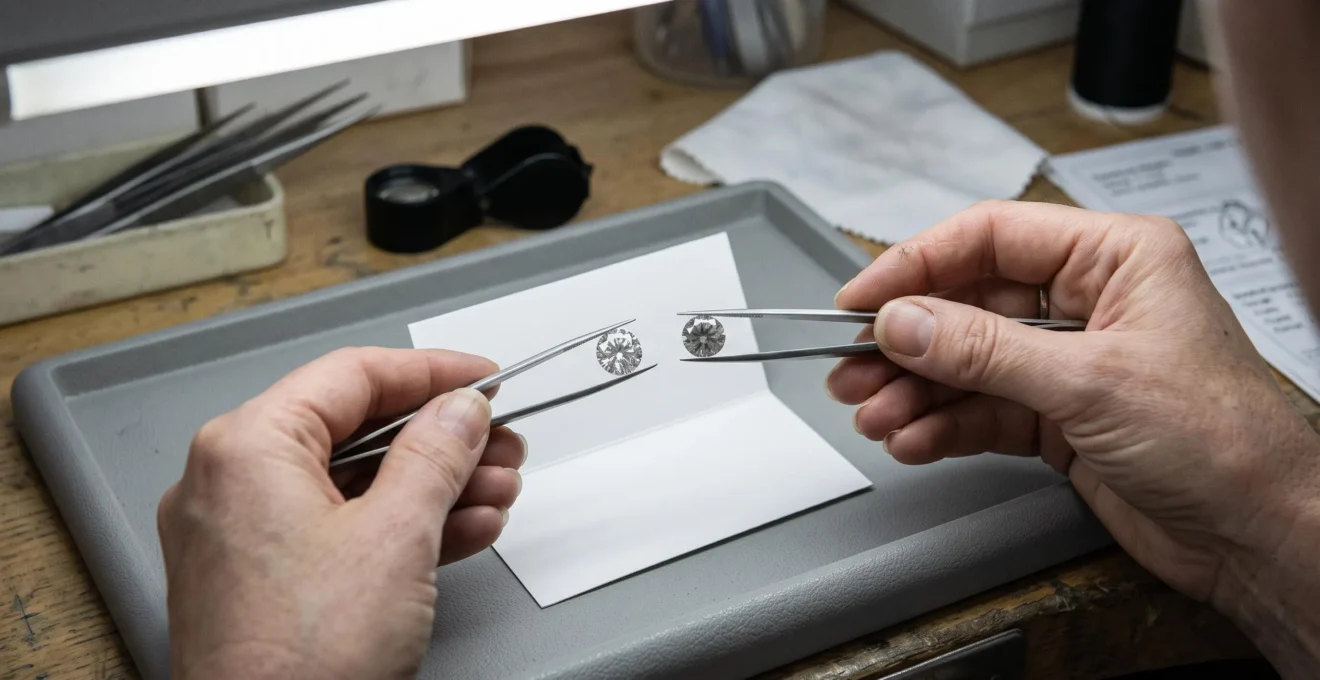
Two diamonds can have the same carat weight, colour and clarity yet look noticeably different because cut precision determines how effectively their facets direct light back toward the observer. Size describes mass, not optical performance. What matters visually is the combination of facet angles, proportions, alignment and the resulting distribution of bright and dark areas.
That distinction explains why a stone can appear lively under jewellery-counter spotlights but less convincing beside a window or under ordinary room lighting. Directional light creates dramatic flashes, while more diffuse illumination makes it easier to judge the overall brightness pattern and notice persistent dark areas. Neither setting tells the entire story on its own.
Precision also needs to be separated from a grading label. A symmetry grade describes aspects of how a diamond’s features align, while light performance describes how the stone handles light. These characteristics interact, but they are not interchangeable. The Gemological Institute of America (GIA) explains the underlying factors in GIA’s explanation of diamond quality factors.
The essentials of cut precision
- Facet proportions and alignment influence how much light returns toward the viewer and where bright and dark areas appear.
- Inspect stones under diffuse daylight or ordinary room lighting, then rotate them slowly to assess how their patterns change.
- Use grading reports to screen candidates, but judge visible performance directly; identical grades do not guarantee identical appearances.
- Why Do Tiny Symmetry Errors Create Dead Spots You Notice in Normal Room Light?
- How to Check Cut Precision Using a Slow Rotation Test in Under 2 Minutes
- Bigger Stone or Better Cut: Which Should You Choose for the Strongest “Wow” Effect?
- The Lab-Grade Trap That Makes People Ignore What Their Eyes Are Telling Them
- In What Order Should You Screen Cut Issues When You’re Comparing 6 Stones Fast?
- Why Can a Smaller Diamond Look Brighter Than a Larger One in Normal Daylight?
- How to Inspect a Baguette or Emerald Cut in 5 Minutes Without Relying on Showroom Lights?
- Why Do Two Diamonds With Similar Specs Look Totally Different From 30 cm Away?
Why Do Tiny Symmetry Errors Create Dead Spots You Notice in Normal Room Light?
Small differences in facet alignment can change how light travels through a diamond, contributing to areas that appear consistently grey or dark. When a facet’s angle or orientation differs from the intended geometry, some light may leave through the pavilion or another side instead of returning toward the observer. The resulting appearance depends on the complete facet arrangement, not on one measurement in isolation.
A dead spot is a useful practical description for an area that repeatedly looks dull as the stone moves. However, darkness alone does not prove a symmetry defect. Proportions, the observer’s position, the direction of incoming light and the stone’s normal contrast pattern can all influence what appears dark. Attractive diamonds need contrast as well as brightness; an entirely uniform field of bright reflections is not the goal.
Three everyday lighting conditions reveal different aspects of performance:
- Diffuse ceiling light: Broad illumination helps reveal whether the face-up pattern has reasonably consistent brightness or contains conspicuous dull patches.
- Window daylight: Diffuse daylight provides another useful viewing environment in which to compare brightness and contrast without depending entirely on display lighting.
- Dim ambient light: Reduced illumination can make overall brightness harder to judge. Observe whether the remaining reflections are balanced, but do not treat darkness in low light as proof of a cutting fault.
Showroom spotlights can create intense flashes that draw attention away from persistent dark zones. A dark wedge or fan-shaped area that remains in the same region of the stone’s visual pattern across repeated observations deserves closer inspection. By contrast, bright and dark facets that change as the stone or observer moves are part of normal scintillation and contrast.
Some elongated brilliant cuts display a bow-tie pattern across the centre, while other diamond shapes may show different characteristic contrast patterns. A bow-tie is not automatically a defect: its prominence, persistence and visual balance matter. These effects are influenced by shape, proportions and facet arrangement, not necessarily by a single alignment error.
Before rejecting a diamond, repeat the observation after checking its cleanliness and changing the lighting. A repeatable pattern is more informative than one dark appearance under one angle of illumination.
How to Check Cut Precision Using a Slow Rotation Test in Under 2 Minutes
A slow rotation test is a quick way to screen for obvious dark zones, uneven visual patterns and abrupt changes in reflected light. Hold the clean stone under one diffuse light source, keep your viewing position steady and rotate the diamond gradually. The test cannot measure exact facet angles or certify a cut grade, but it can help distinguish candidates that deserve closer examination.
Use a window with diffuse daylight or a broad, evenly illuminated indoor setting. Avoid a display case dominated by multiple spotlights, which can produce dramatic flashes and make consistent comparison harder. If the stone is loose, handle it securely with appropriate tweezers or have the jeweller rotate it for you.
Follow this sequence:
- Fix the conditions. Use a clean stone, a neutral background and one diffuse light source. Keep your eyes at approximately the same distance and angle.
- Rotate slowly. Move the stone through a full turn, watching how the bright and dark regions change rather than concentrating on individual flashes.
- Look for persistent darkness. Note any conspicuous grey areas that remain visually dull across several positions. Check whether the pattern changes when you adjust the viewing angle slightly.
- Compare opposite sides. Watch whether the brightness pattern appears reasonably balanced or whether one side repeatedly looks weaker than the other.
- Repeat with a second stone. Use the same light, distance and rotation speed. A side-by-side comparison often makes differences in overall performance easier to recognise.
Three warning signals deserve attention: a dark area that remains conspicuous, a reflection pattern that changes abruptly rather than smoothly, and an obvious imbalance between opposing areas. These are screening observations, not definitive diagnoses. A normal contrast pattern can also create darkness, and not every uneven flash indicates poor workmanship.
The naked eye cannot reliably resolve sub-degree facet-angle deviations or establish exact optical symmetry. If two stones look similar, compare their grading reports, including the available symmetry grade and proportions. Some stones may also have supplementary optical assessments, but these are not available for every shape or diamond.
False readings are common. Oil and fingerprints can reduce brightness; strongly coloured surroundings can reflect into the facets; and overhead spotlights can exaggerate flashes or conceal less attractive patterns. Clean the stone and repeat the test before drawing a conclusion.
Use the result to shortlist stones, not to assign a technical grade. The next decision is whether better optical performance justifies choosing a smaller stone within the same budget.
Bigger Stone or Better Cut: Which Should You Choose for the Strongest “Wow” Effect?
For a diamond that will be worn and viewed in everyday lighting, a well-performing cut is often the more useful priority than a modest increase in carat weight. A larger stone can still look disappointing if its light-return pattern is weak or uneven. Conversely, a smaller diamond with stronger brightness and balanced contrast can attract more attention, although the outcome depends on shape, proportions, lighting and personal preference.
The first distinction is between physical size and perceived presence. Carat measures mass, not face-up diameter. A deeper cut can place more of the stone’s weight below the visible outline, while a shallower cut may spread the weight over a larger face-up area. Neither extreme guarantees good light performance. Two diamonds of equal carat weight can therefore have different apparent dimensions and different optical behaviour.
The viewing environment changes the trade-off. In offices, restaurants and daylight, a stone’s broader brightness pattern and contrast can be more revealing than isolated flashes. Direct lighting and photography may emphasise dramatic reflections, partly masking weaknesses that become easier to notice in diffuse conditions. A photograph alone is therefore an unreliable basis for ranking cut quality.
Budget also matters. When a larger stone costs substantially more, compare the actual visual difference with the benefit of a smaller, better-performing alternative. There is no universal price premium for superior cut quality: value depends on the full combination of weight, colour, clarity, proportions and market pricing.
For coloured-stone buyers, the same buying principle applies—evaluate the stone’s appearance in the intended setting rather than relying on dimensions alone. However, diamond grading terminology should not automatically be transferred to coloured gems, whose colour, transparency and cutting objectives can differ.
Choose the larger option when its extra face-up presence is clear and its optical pattern remains appealing. Choose the better-performing smaller option when it looks consistently more lively under realistic conditions and the size difference is less important to you.
A useful decision starts with how the stone will actually be seen, not with the biggest carat figure on a product page. Once the candidates are shortlisted, the grading report can help explain what the eye has observed.
The Lab-Grade Trap That Makes People Ignore What Their Eyes Are Telling Them
A top cut or symmetry grade is valuable information, but it is not a guarantee that two diamonds will look identical. Grading systems classify measurements and observations within defined categories. Individual stones within the same category can still differ in brightness, contrast, proportions and visual character. The mistake is treating a label as a substitute for inspecting the actual stone.
GIA’s diamond-cut research examined how combinations of table size, crown angle, pavilion angle, star length, lower-half length, girdle thickness, culet size and total depth influence appearance. Its work included computer-based optical modelling and controlled visual observations. The research supports a central principle: cut quality depends on interacting proportions, not one isolated measurement.
As a result, two diamonds with the same grade can occupy different positions within the range represented by that category. That does not mean the grading system is unreliable or that a shared grade is meaningless. It means the grade summarises an assessment rather than describing every visible characteristic of an individual stone. GIA’s research on diamond cut grading explains how the system was developed and evaluated.
Symmetry deserves the same distinction. A symmetry grade assesses aspects of the stone’s physical arrangement and finishing; it does not, by itself, establish superior light performance. GIA’s supplemental AGS Ideal documentation distinguishes physical symmetry, optical symmetry and optical efficiency, and describes the use of ASET mapping to assess light behaviour. The assessment applies only to eligible diamonds and is not a requirement for every purchase.
That distinction prevents two opposite mistakes: dismissing a technically sound stone because its sparkle differs from a personal ideal, and paying extra for a label while overlooking visible problems. A buyer who prefers a particular contrast pattern may also rank two technically similar stones differently from another observer.
Use paperwork to eliminate clear mismatches in specifications and to understand what has been measured. Then examine the actual stone under consistent, realistic lighting. A certificate and a visual inspection answer different questions, and neither should be expected to replace the other.
This approach is especially important when comparing stones with similar reports: the useful question is not which label sounds better, but which candidate delivers the appearance you want within the relevant budget.
In What Order Should You Screen Cut Issues When You’re Comparing 6 Stones Fast?
When six stones are on the counter, screen them in descending order of visible impact: persistent dark zones first, overall brightness consistency second, shape-specific issues third and fine polish details last. This order helps eliminate obvious mismatches before spending time on subtler differences. It also reduces the risk of choosing a stone because of one memorable flash while overlooking a consistently dull area.
Begin by placing every candidate under the same diffuse light and using the same viewing distance. Inspect each face-up before examining it closely. If a stone shows a conspicuous dark area, repeat the observation while rotating it slightly. Do not reject it solely because one facet turns dark momentarily; look for a pattern that remains visually problematic across positions.
Next, compare the overall brightness pattern during slow rotation. Look for balanced changes rather than counting flashes. For elongated brilliant shapes, inspect the central region for a prominent, persistent bow-tie. For step cuts, look for a see-through centre, irregular parallel facets or visibly uneven corner geometry. These are different shape-related observations, so do not apply one universal visual standard to every cut.
Only after the stones have passed these checks should you spend time examining finer finishing details, polish and the grading report. Small surface or finishing differences can matter, but they are unlikely to rescue a stone whose overall appearance already fails your priorities.
Memory becomes less reliable as comparisons accumulate. Keep a short written record immediately after each inspection. Use a neutral background, maintain the same viewing order and avoid changing between bright spotlights and diffuse daylight halfway through the comparison.
A five-step stone-comparison record
- Inspect each stone under the same diffuse light and record whether any persistent dark zones are visible.
- Rotate each candidate slowly and write one observation about the consistency of its brightness pattern.
- Record any shape-specific issue, such as a prominent bow-tie in an elongated brilliant cut or a visible window in a step cut.
- Check the available grading report and note the cut, symmetry and proportion information relevant to that stone.
- Rank the surviving candidates and record the main visual reason for your preferred choice.
If two candidates remain closely matched, prioritise the one with fewer persistent dark areas when that characteristic matters to you. A spectacular flash can be memorable, but it is momentary; a conspicuous dull zone can affect the overall appearance repeatedly. This is a practical tie-breaker, not a universal rule for every cut or aesthetic preference.
Once the strongest candidate emerges, check whether its apparent brightness holds up in daylight. This is a particularly useful comparison when a smaller stone seems more impressive than a larger alternative.
Why Can a Smaller Diamond Look Brighter Than a Larger One in Normal Daylight?
A smaller diamond can look brighter than a larger one because the amount of light returning toward the observer depends on its proportions and facet arrangement, not simply on its mass. A well-proportioned stone may direct more of the available light back toward the viewer, while another may allow more light to escape through the pavilion. The result can be a visible difference in brightness even when the larger stone contains more material.
Think of size and cut as two separate variables. Carat weight tells you how much the diamond weighs; cut influences how incoming light interacts with the stone and where reflections appear. The GIA documentation for the AGS Ideal light-performance assessment describes brightness, fire and contrast as related but distinct aspects of appearance, reinforcing why weight alone cannot predict visual performance.
Daylight can make the difference easier to evaluate because broad illumination offers a different view from a display filled with directional spotlights. Rather than concentrating only on individual flashes, compare the brightness pattern across the stone and look for conspicuous dark regions. A stone that appears exceptionally bright under one spotlight may not maintain the same visual advantage under more diffuse illumination.
The smaller-brighter comparison is a useful buying signal, but not proof that the smaller stone is objectively superior in every respect. Colour, clarity, face-up dimensions, shape, viewing angle and personal preference remain relevant. Nor does every larger diamond have weak light return; the actual stones must be compared under the same conditions.
Before making the trade-off, look at both candidates from the distance at which they will normally be worn and viewed. A modest size difference may be obvious at close range but less important at ordinary viewing distance if one stone has a more appealing overall brightness pattern.
For buyers choosing between similar-looking specifications, the important question is whether the larger stone delivers a meaningful visual advantage. If it does not, a smaller stone with stronger everyday performance may be the more satisfying purchase.
The next step is to adapt the inspection to the stone’s shape. Baguette and emerald cuts, for example, need a different visual checklist from brilliant cuts because their long, parallel facets create a different pattern of reflections.
How to Inspect a Baguette or Emerald Cut in 5 Minutes Without Relying on Showroom Lights?
Baguette and emerald cuts should be inspected for facet uniformity, transparency through the centre and the consistency of their rectangular geometry, rather than judged primarily by the rapid sparkle associated with brilliant cuts. Their broad, parallel step facets create more mirror-like reflections, making windowing, uneven facet spacing and irregular dark bands especially important observations.
Start by viewing the stone from directly above under diffuse light. A window is a see-through area in which the observer can see through the stone rather than seeing a convincing reflected pattern. It can be associated with proportions and the way the pavilion handles light, although the visual impression must be assessed in context. A single dark or transparent region is not sufficient to diagnose a precise cutting fault.
Next, examine the outline. Check whether the long sides appear straight, the four corners look consistent and the concentric step pattern has reasonably even spacing. Rotate the stone slowly and observe whether the long facets change in a balanced way or whether one side repeatedly appears noticeably different from the other.
For elongated shapes, also look for a dark horizontal band across the centre. The bow-tie effect is discussed most commonly in elongated brilliant cuts, including oval, pear and marquise shapes; it should not be treated as an identical phenomenon across all rectangular step cuts. Some dark contrast may be normal. A prominent band that remains visually dominant across multiple viewing positions warrants closer comparison rather than an automatic diagnosis.
A practical five-minute inspection can be organised into four short checks:
- Check the centre. Look straight down under diffuse light and note any obvious see-through window.
- Check the corners. Compare the four corners and the rectangular outline for visible irregularities.
- Check the step pattern. Inspect the spacing and alignment of the long, parallel facets, then tilt the stone slowly to compare the reflections.
- Check the central contrast. View any dark horizontal band from more than one angle and note whether it remains conspicuous.
A single diffuse light source placed at a slight angle is a useful starting point because it helps reveal the facet pattern without the competing flashes of a multi-spotlight display. If possible, inspect the stone near a window or under ordinary room lighting, then compare it with another candidate in the same position.
These observations can reveal visible differences but cannot establish exact facet angles or diagnose every underlying cutting decision. The ideal appearance also depends on the shape and the buyer’s preferences. For step cuts, broad reflections and a clean outline may matter more to the buyer than the number of sparkle flashes.
Once the geometry and light pattern have been examined, compare the candidates at ordinary viewing distance. That final perspective helps determine whether differences in their specifications translate into a meaningful difference in appearance.
Key takeaways
- Compare the complete face-up pattern, not just individual flashes or a single symmetry grade.
- Inspect the actual stone under consistent diffuse lighting and adapt the checks to its shape.
- Use the viewing distance at which the diamond will normally be seen to decide whether specification differences matter visually.
Why Do Two Diamonds With Similar Specs Look Totally Different From 30 cm Away?
Two diamonds with similar carat weight, colour, clarity and cut grades can look different from 30 cm away because their actual facet geometry and resulting brightness patterns are not necessarily identical. At this distance, the eye takes in the overall arrangement of light and dark areas rather than resolving every facet individually. Differences in the consistency of that pattern can therefore influence which stone looks brighter, more balanced or more visually appealing.
Specifications describe important characteristics, but they do not capture every aspect of the finished stone’s appearance. The combination of crown and pavilion angles, table size, facet alignment and proportions affects how light travels through the diamond. Similar measurements or grades do not mean that every facet has been executed identically, nor do they guarantee the same visual result.
It is useful to distinguish measured quality from executed quality. A grading report summarises assessed characteristics and places them within defined categories. The finished stone, however, is what the buyer sees. Optical performance depends on how the stone’s proportions and facet arrangement work together, while personal preferences influence which brightness and contrast patterns are most appealing.
This does not make certificates unimportant. They remain essential for checking identity, weight, colour, clarity and the grading information relevant to the purchase. Instead, they should be combined with direct inspection. Two stones that look similar in a photograph may reveal different contrast patterns when held at the same distance under diffuse lighting.
The practical method is straightforward: view both stones face-up at approximately 30 cm, use the same neutral background and lighting, and rotate each slowly. Note persistent dark areas, overall brightness consistency and whether the appearance remains appealing through several viewing positions. Repeat the comparison if the lighting or viewing angle changes significantly.
When comparing coloured stones, keep the same discipline but adjust the criteria to the gem. Body colour, transparency, extinction, zoning and the intended cut can contribute to appearance in ways that differ from diamond grading. A diamond’s cut grade should not be treated as a universal measure of coloured-stone performance.
Before buying, compare the report, the visible performance and the appearance at normal viewing distance as three complementary pieces of evidence. The strongest choice is the stone that meets your specifications and delivers the visual pattern you actually want—not simply the one with the most impressive label or the largest weight.
Does an Excellent symmetry grade guarantee maximum sparkle?
No. Symmetry is one aspect of a diamond’s finish and physical arrangement. Light performance also depends on proportions and how the facets work together. A high symmetry grade does not, on its own, guarantee the brightest or most appealing appearance.
Can a loupe reveal whether a diamond has good light performance?
A loupe can help you inspect facet junctions, surface condition and visible finishing details, but it does not independently establish light performance. Combine close inspection with face-up viewing under diffuse light, slow rotation and the available grading information.
Is a dark area always evidence of a poorly cut diamond?
No. Diamonds naturally show patterns of contrast, and dark areas can change with the viewing angle, lighting and observer position. A persistent, conspicuous dull zone deserves further investigation, but darkness alone does not establish a cutting defect.
Should the same cut-precision checklist be used for coloured gemstones?
The underlying habit of inspecting a stone in realistic lighting is useful, but the criteria must be adapted to the gem and its shape. Colour distribution, transparency, zoning and the intended cutting style can matter alongside brightness and facet alignment. Diamond-specific grading categories do not automatically apply to coloured stones.
What is the single most useful test when comparing two similar diamonds?
Start with a side-by-side comparison under the same diffuse light, then rotate both stones slowly. This makes it easier to compare persistent dark areas, overall brightness and changes in contrast without relying on showroom spotlights or a grading label alone. Use the results alongside the grading reports rather than treating the test as a substitute for professional assessment.