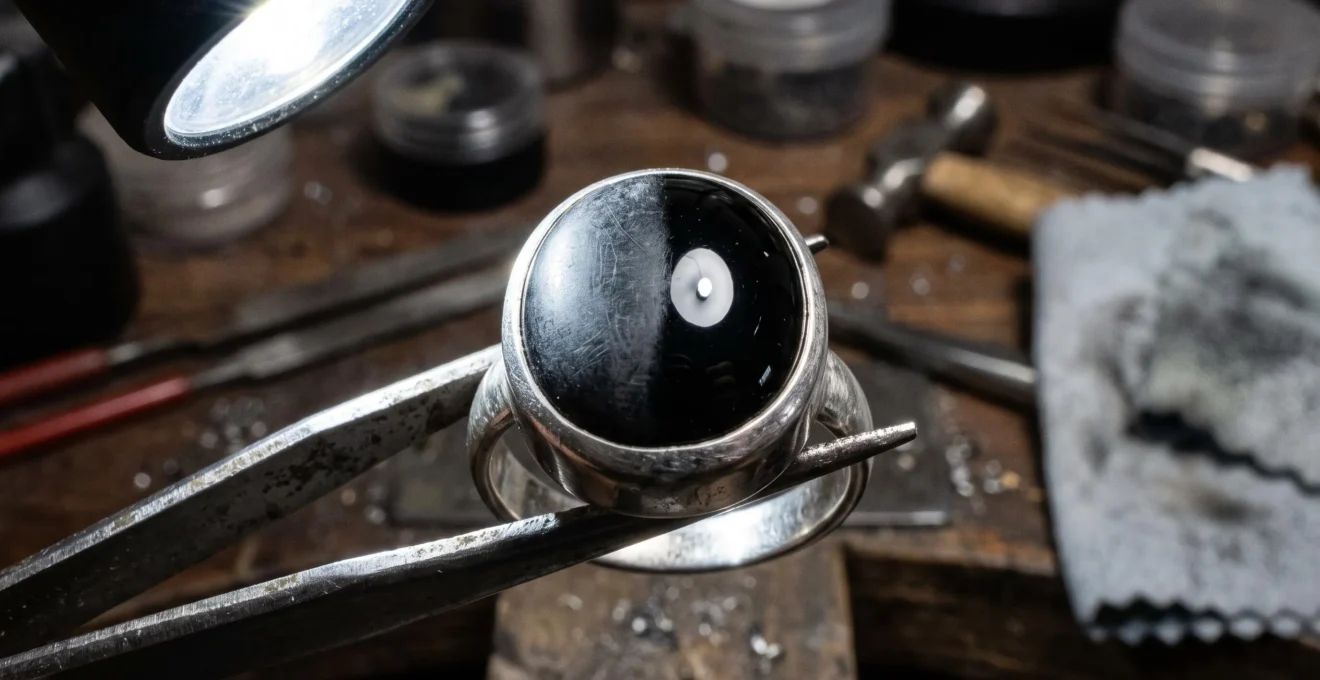
A black onyx ring can start looking grey or cloudy after six weeks of daily wear because its polished surface may develop fine scratches that scatter light. Residue from soap, cosmetics or skin oils can produce a similar appearance. Neither problem automatically means the stone is permanently damaged, but the distinction matters: cleaning removes deposits, whereas restoring a worn polish requires a different intervention.
Onyx is a form of chalcedony, a microcrystalline variety of quartz. It has a Mohs hardness of approximately 7 Mohs and good toughness, making it a practical jewellery material, but it is not scratch-proof. Much of the material sold as black onyx is dyed chalcedony, so treatment history also influences the care routine. A ring’s setting, the surfaces it contacts and the way its metal finish ages all contribute to its appearance.
The six-week timeframe is a useful reason to inspect the ring, not a universal deterioration threshold. Visible wear depends on the wearer’s activities, the condition of the original polish, the stone’s treatment and the amount of friction it experiences. The practical objective is to identify the cause before using a cleaner, abrasive product or polishing service that could make the problem worse.
Black Onyx Ring Care: The Essentials
- Fine scratches can make polished black onyx appear grey by scattering reflected light; a cloudy appearance does not necessarily mean dirt or fading.
- Start with lukewarm water, mild soap and a soft brush or microfibre cloth. Avoid abrasive home remedies and establish the stone’s treatment before choosing stronger cleaning methods.
- If the haze remains after gentle cleaning, ask a jeweller to assess the polish, inspect the setting and explain whether restoration can be performed without compromising the stone or ring details.
- Why Can Dark Onyx Turn Grey-Looking From Micro-Scratches Even if You’re Careful?
- How to Clean Dark Onyx Jewellery at Home Without Dulling the Surface Finish?
- Onyx or Spinel: Which Should You Choose if You Want a Black Stone for Daily Wear?
- The Setting Detail That Makes Dark Onyx Chip at the Edge Without You Noticing
- When Should You Pair Dark Onyx With High-Polish Metal to Avoid a « Flat » Look?
- Pearl Look or Moonstone Glow: Which Is Better if You Want Low Maintenance?
- High Polish or Satin Finish: Which Should You Choose if Scratches Drive You Mad?
- Why Can Professional Polishing Make a Ring Look Worse by Rounding the Details?
Why Can Dark Onyx Turn Grey-Looking From Micro-Scratches Even if You’re Careful?
Dark onyx can look grey after relatively little wear because **micro-scratches interrupt the smooth surface that produces its glossy black reflection**. Instead of reflecting light in a consistent direction, the damaged areas scatter it across a wider range of angles. The eye perceives this diffuse reflection as a grey veil, particularly against the deep black areas that remain highly polished. Individual scratches may be difficult to see without magnification.
The Gemological Institute of America identifies onyx as a form of chalcedony and gives it a Mohs hardness of approximately 7. That hardness provides useful resistance to scratching, but the Mohs scale is comparative rather than a guarantee of immunity. Quartz particles in ordinary dust and sand can abrade a surface, and repeated contact with other jewellery or abrasive materials can gradually change the finish. Careful handling reduces exposure; it cannot eliminate every source of friction.
To distinguish surface wear from residue, examine the ring under a bright, concentrated light. Tilt the stone slowly and watch the reflection. Fine scratches tend to break up the reflected highlight into irregular patches or fine lines. A film of skin oils, soap or wax may instead create a more uniform veil, although deposits and scratches can coexist. Cleaning can remove the former but cannot erase the latter.
The GIA’s wedding anniversary gemstone article explains that much of the material marketed as black onyx is dyed black chalcedony. This matters because a surface change should not automatically be attributed to fading: treatment stability, surface wear and removable deposits are different issues.
There is no reliable rule that every black onyx ring becomes cloudy after six weeks. A ring worn during manual work may accumulate wear faster than one worn mainly at a desk. The original polish, exposure to abrasive particles, contact with other objects and any treatment can all affect the result. Use the six-week observation as a prompt to investigate the actual surface rather than as a deadline for expected damage.
Once the cause is clearer, the next step is to remove any deposits using a method that respects the stone’s treatment and avoids introducing additional abrasion.
How to Clean Dark Onyx Jewellery at Home Without Dulling the Surface Finish?
For routine cleaning, start with lukewarm water, a small amount of mild soap and a soft brush or microfibre cloth. This approach removes ordinary surface deposits without relying on abrasive polishing products. If the stone’s treatment is unknown, keep the routine conservative and avoid assuming that a cleaning method suitable for one gemstone is automatically appropriate for dyed or composite onyx.
Black onyx is frequently dyed chalcedony. The GIA’s reference on gemstone treatments explains that dye stability varies and that some dyes can be affected by solvents such as alcohol and acetone. A treatment may therefore change the care requirements even when the stone looks identical to another piece. Avoid solvents and harsh household chemicals when the treatment is unknown. Do not assume that stronger cleaning will produce a better result.
Use this simple routine:
- Check the ring for loose stones, damaged edges or visible gaps around the setting. If anything moves or catches, stop and ask a jeweller to inspect it before washing.
- Prepare lukewarm water with a small amount of mild soap. Avoid hot water and aggressive cleaning products, particularly when the stone’s treatment or setting construction is unknown.
- Gently clean the stone and accessible parts of the setting with a soft brush or microfibre cloth. Do not scrub forcefully around exposed edges or damaged areas.
- Rinse carefully with clean water, taking care not to lose the ring down a drain, and pat it dry with a soft cloth.
- Inspect the dry surface under a bright light. If the stone is clean but still looks hazy, do not keep repeating the cleaning process in the hope of restoring its original polish.
Abrasive home remedies are a different matter. Toothpaste and baking soda can introduce additional scratching rather than restore a mirror finish. Likewise, avoid using an ultrasonic cleaner or steam treatment on an unidentified treated stone or a ring containing vulnerable adhesives or composite components. These methods are not necessary for ordinary onyx maintenance, and the suitability of specialist cleaning depends on the specific stone and mounting.
Cleaning and polishing solve different problems. Cleaning removes a film; polishing changes the surface itself. A jeweller should assess persistent haze before recommending a mechanical treatment, especially if the onyx is dyed, glued into a composite assembly or mounted close to metal that also needs refinishing.
A five-step onyx care check
- Inspect the ring before cleaning and record any loose setting, edge damage or visible gaps.
- Confirm the stone’s treatment with the seller or jeweller and retain the answer with the purchase documents.
- Clean using lukewarm water, mild soap and a soft brush or microfibre cloth; record the products used.
- Dry the ring and examine it under a concentrated light; note whether the haze disappears or remains.
- If the haze persists, request an assessment of the stone’s polish and setting before authorising any abrasive or machine treatment.
If gentle cleaning does not restore the reflection, the sensible next step is a professional assessment rather than a stronger household cleaner. For buyers choosing a new ring, the stone itself can also make a meaningful difference to long-term scratch resistance.
Onyx or Spinel: Which Should You Choose if You Want a Black Stone for Daily Wear?
Choose black spinel if resistance to scratching is a leading priority and the budget accommodates it; choose black onyx if its particular depth, polished appearance and accessible price suit the design. Spinel has a Mohs hardness of 8, compared with approximately 7 for onyx, so it offers greater relative scratch resistance. Neither stone is immune to damage, and a ring’s long-term performance also depends on its setting and how it is worn.
Onyx is a form of chalcedony characterised by parallel colour bands, although the material sold as black onyx is commonly dyed. A polished black cabochon can create a strong, uninterrupted visual field, especially when the stone’s reflective surface is well maintained. Its appeal is primarily aesthetic: a bold, dark focal point that works with both understated and graphic designs.
Spinel offers a different balance of properties. The GIA’s spinel care and cleaning guide gives it a Mohs hardness of 8 Mohs and describes it as having good toughness. These characteristics make spinel a strong candidate when a black stone will experience frequent contact with objects. Greater hardness improves relative resistance to scratching, but it does not guarantee that a particular ring will never chip or that every spinel mounting will outperform every onyx mounting.
| Criterion | Black onyx | Black spinel |
|---|---|---|
| Mohs hardness | Approximately 7 | 8 |
| Relative scratch resistance | Good, but susceptible to abrasive wear | Higher relative resistance |
| Visual character | Deep, polished black; chalcedony may have banding | Vitreous brilliance and reflective depth |
| Maintenance consideration | May need professional re-polishing if the surface becomes worn | Still needs protection from impact and appropriate cleaning |
| Best purchasing priority | Appearance, design and budget | Greater scratch resistance |
The distinction is not simply that one stone is good and the other bad. Onyx can be a sensible purchase when the buyer accepts occasional professional refinishing and chooses a protective setting. Spinel is a better starting point for someone who wants to reduce the likelihood of visible scratching, but the complete ring still needs a suitable design and realistic care expectations.
Before purchasing either material, ask whether the black colour is natural or treated, what cleaning methods are appropriate and whether the seller can identify the stone reliably. The answer matters because treatment influences maintenance, while the mounting influences impact protection. Compare the complete ring rather than judging durability from the gemstone’s name alone.
Once the stone is selected, its setting becomes the next practical consideration: a durable gem can still be damaged when its edges are unnecessarily exposed to knocks.
The Setting Detail That Makes Dark Onyx Chip at the Edge Without You Noticing
The setting detail to watch is **an exposed stone edge**. A protruding rim, an elevated cabochon or prongs that leave much of the perimeter uncovered can allow everyday knocks to reach the onyx directly. Although onyx has good toughness, it is not indestructible. Small chips can develop around an exposed edge and remain difficult to spot against a black surface until they catch the light or begin collecting residue.
For a ring intended for frequent wear, examine how the stone sits relative to the surrounding metal. A raised profile may look striking, but it creates more opportunities for contact with hard surfaces. A bezel, which surrounds the stone’s perimeter with metal, can provide greater edge coverage. A halo can also offer a protective border, depending on its design and the height and shape of the central stone.
Protection comes with a visual trade-off. A bezel can make the visible stone appear smaller and conceal part of its outline. A high setting may create a more prominent silhouette, but it also exposes the stone to knocks. Neither design is automatically superior in every circumstance: the right choice depends on the stone’s shape, the setting’s construction and how the ring will be used.
Check the ring periodically for signs of edge damage. Under good light, examine the perimeter closely, using magnification if available. A soft fingertip or a piece of fine fabric may reveal roughness or snagging, but neither method proves that the stone is undamaged. Do not force fabric against the edge or probe a potentially loose setting. If a snag, chip or movement is detected, stop wearing the ring until it has been inspected.
Small rim chips matter for more than appearance. Damaged edges can retain residue and become harder to clean, contributing to an uneven or cloudy look. An early inspection may allow a jeweller to discuss a limited repair or a change in protection before the damage becomes more extensive. Whether repair is feasible depends on the chip’s position, depth and the stone’s remaining dimensions.
A protective setting addresses the physical risk, but the ring’s visual impact also depends on how the black stone interacts with the surrounding metal and its finish.
When Should You Pair Dark Onyx With High-Polish Metal to Avoid a « Flat » Look?
Pair dark onyx with high-polish metal when the goal is a reflective, layered appearance rather than a deliberately muted design. A polished black surface can mirror its surroundings; bright metal adds another reflective plane and can make the composition feel more dimensional. Brushed or matte metal creates a quieter contrast and may make the stone read as a more uniform black shape. Neither combination is inherently wrong, but the difference should be intentional.
Consider the entire ring rather than the stone alone. A glossy onyx cabochon against mirror-polished metal can produce a coherent, formal look, especially in a simple setting. Satin or brushed metal can work well when the design depends on texture, understated contrast or a less reflective frame. The stone’s shape, its profile and the amount of visible metal all influence the final result.
High polish also creates a maintenance obligation. Metal that reflects light sharply can reveal fine scratches, fingerprints and small surface irregularities. If the stone and setting are both highly reflective, wear on either surface can disrupt the overall impression of depth. Keeping the ring looking rich therefore involves protecting the onyx and accepting that the metal may eventually need refinishing too.
Check the ring in more than one lighting environment before buying it. Examine it under warm indoor lighting and in daylight. Look at the stone from different angles, and pay attention to whether its surface continues to look reflective or becomes visually flat. A store’s lighting can make a polished stone appear more dramatic than it does in ordinary conditions.
Ask the jeweller whether the chosen metal can be finished in the desired way and how the finish can be maintained. The answer will depend on the alloy and construction. A design with contrasting textures may be more practical than trying to keep every surface mirror-bright indefinitely, particularly if visible scratches are a major concern.
If a reflective finish still feels too demanding, compare it with softer visual effects such as pearl lustre or moonstone’s glow—but assess those alternatives by their physical durability, not just their appearance.
Pearl Look or Moonstone Glow: Which Is Better if You Want Low Maintenance?
Neither pearl nor moonstone is an obvious low-maintenance substitute for a dark onyx ring worn every day. Pearls are organic gems with a Mohs hardness of approximately 2.5–3, while moonstone ranks 6–6.5 and has poor toughness. Both require careful handling, and an exposed ring setting can leave them vulnerable to the kinds of contact that are difficult to avoid during ordinary activities.
Pearls create a soft lustre rather than the mirror-like black reflection of polished onyx. Their organic structure and low hardness make them particularly susceptible to scratching. The GIA advises storing pearls separately from harder gemstones and metal jewellery, applying perfume and cosmetics before putting them on, and cleaning them with a soft, damp cloth. These precautions are relevant to a ring because its stone may encounter surfaces and objects throughout the day.
Moonstone offers a different visual effect: adularescence, a characteristic glow that appears to move across the stone. It is harder than pearl, but hardness alone does not describe its durability. The GIA identifies moonstone as having poor toughness and advises against ultrasonic and steam cleaning. Warm, soapy water and a soft brush are recommended for routine cleaning. High heat can also cause moonstone to crack.
The comparison therefore depends on the type of risk. Pearl is especially vulnerable to surface abrasion and certain products; moonstone combines moderate hardness with limited toughness. Onyx is harder than either pearl or moonstone according to their stated Mohs values, but it can still develop scratches and edge chips. None should be treated as maintenance-free in an exposed ring worn continuously.
The GIA’s June birthstone reference provides care guidance for pearls and moonstone, illustrating why these stones need different handling despite both offering a softer, luminous appearance.
A useful way to compare candidate stones is to consider three separate factors: resistance to scratching, tolerance of impact and sensitivity to cleaning products or treatments. Then match those factors to the frequency of wear. A stone chosen for occasional occasions may be perfectly suitable even when it would be impractical as an everyday ring.
Once the stone’s needs are understood, the finish of the surrounding metal can be chosen to complement its appearance without making every small surface mark the dominant feature.
Key Takeaways
- Choose the metal finish according to how visible you find everyday scratches, rather than assuming one finish eliminates wear.
- Consider a contrasting finish if you want the black stone to remain the visual focal point while accepting some metal surface changes.
- Before commissioning refinishing, ask how the jeweller will preserve the stone, engraving, edges and other details that define the ring’s design.
High Polish or Satin Finish: Which Should You Choose if Scratches Drive You Mad?
Choose a satin or brushed metal finish if you want fine scratches to be less visually prominent; choose high polish if you prefer a mirror-like surface and accept that wear may be easier to see. A high-polish finish reflects light sharply, so even small interruptions can become noticeable. A satin finish diffuses reflections through its texture, helping minor marks blend into the surface. Neither finish prevents scratches from occurring.
The difference is largely one of appearance. A small scratch on a mirror-bright band can interrupt a clear reflection and attract attention immediately. On brushed metal, a fine mark may blend into the existing lines. However, a deep scratch can still stand out against satin texture, and an isolated damaged area may require re-texturing the surface to restore a consistent appearance.
High-polish metal can often be refinished to restore reflectivity, but repeated polishing removes material. The amount removed depends on the metal, the tool and the extent of the work. Intricate engraving, sharp edges and decorative milgrain details can gradually soften if they are polished repeatedly. Satin finishes avoid the need to maintain a mirror shine, but a damaged section may require more comprehensive reworking to match the surrounding texture.
| Consideration | High polish | Satin or brushed |
|---|---|---|
| Appearance | Bright, reflective and formal | Soft, muted and textured |
| Fine scratches | Can be conspicuous in broken reflections | May blend into the existing texture |
| Restoration | May require re-polishing | May require re-texturing for a uniform result |
| Design details | Repeated polishing can soften edges and engraving | Re-texturing must preserve the intended surface pattern |
| Practical choice | For wearers who value shine and accept periodic maintenance | For wearers who prefer less reflective surfaces and can tolerate texture |
For a black onyx ring, a mixed finish can be a sensible compromise. A polished stone paired with satin metal keeps attention on the onyx while making small marks on the band less obvious. Alternatively, a polished metal frame can emphasise the stone’s reflection if maintaining a bright appearance is worth the additional attention.
Before purchasing, ask the jeweller which finish is suitable for the selected alloy, how it is produced and what refinishing would involve. Request a clear explanation of whether a future service would restore the surface locally or require work across the whole ring. The answer helps establish realistic expectations for both cost and appearance without assuming that every scratch can be removed without consequences.
Whichever finish you choose, restoration should be planned around the ring’s construction. Repeated polishing can alter details that cannot simply be returned by making the surface shinier.
Why Can Professional Polishing Make a Ring Look Worse by Rounding the Details?
Professional polishing can make a ring look worse when it removes material from the very details that give the design its definition. Every abrasive polishing process removes a small amount of the worked surface. On engraved lines, sharp corners, faceted edges and milgrain decoration, repeated refinishing can soften boundaries and gradually reduce their clarity. A ring may become shinier while losing some of its original geometry.
The risk is not limited to decorative metalwork. When an onyx ring is polished with the stone still in place, a tool that reaches the stone’s edge can affect the stone’s shape or surface. A low-set stone may sit close to the surrounding metal, leaving little clearance for aggressive machine polishing. Whether the stone can safely be removed depends on the mounting and any adhesive or treatment involved.
Before authorising a full polish, ask the jeweller to identify which surfaces need work and whether the stone should be removed or protected. The safest method depends on the specific ring. A stone that is glued or part of a composite assembly may present a different risk from a securely mounted, untreated stone. Removing a stone is not automatically safer if the setting or treatment makes removal hazardous.
It is also important to distinguish surface restoration from structural repair. Polishing can restore reflectivity, but deep scratches or substantial chips may require removing more material than is appropriate. A jeweller should explain the likely trade-off before proceeding. Depending on the damage, alternatives may include limited hand-finishing, reshaping the surface, resetting the stone or replacing it.
A responsible polishing brief should be specific. Ask the jeweller to preserve the design’s sharp lines, use hand-finishing around delicate details where appropriate, and explain how the stone will be protected. If previous polishing history is known, share it so the jeweller can assess how much material may already have been removed. A request to restore shine alone is not enough when the ring contains fine decoration or a vulnerable stone edge.
After inspection, agree on the desired outcome before work begins. The priority may be to remove a distracting surface mark, improve the metal’s reflectivity or protect the onyx from further damage. Those goals can require different interventions. A clear assessment helps avoid unnecessary polishing that improves one feature at the expense of the ring’s original shape.
If a ring has become cloudy, the most useful next step is to identify whether the cause is residue, surface wear or edge damage, then ask a qualified jeweller for a treatment plan that protects both the stone and the design.
Can black onyx become cloudy after only six weeks?
Yes, visible haze can develop within weeks under some wearing conditions, but six weeks is not a universal timeframe. Fine scratches, deposits, the original surface finish, treatment and exposure to abrasive materials all affect how quickly a ring changes appearance. Inspect the surface before deciding whether cleaning or professional polishing is appropriate.
Will cleaning restore the original shine of a scratched onyx ring?
Cleaning restores the appearance only when removable residue is responsible for the dullness. If fine scratches have disrupted the polish, additional washing will not remove them. A jeweller can assess whether professional re-polishing is suitable and explain the potential effects on the stone’s shape and surface.
Is black onyx suitable for an everyday engagement or fashion ring?
Onyx can be suitable for everyday jewellery because it has good toughness and a Mohs hardness of approximately 7, but it is not scratch-proof or immune to chipping. A protective setting, sensible wearing habits and gentle cleaning improve its prospects. If maximum scratch resistance is the priority, consider comparing it with black spinel, which has a Mohs hardness of 8.
Can toothpaste or baking soda make black onyx shiny again?
They are not recommended for restoring a polished onyx surface. Their abrasive action can introduce further scratches and make the stone appear duller. Begin with mild soap, lukewarm water and a soft cloth or brush. If the surface remains hazy after cleaning, ask a jeweller to assess the polish instead of escalating to abrasive home remedies.
Should a jeweller remove the onyx before polishing the ring?
Not in every case. The appropriate approach depends on the setting, the stone’s treatment and whether it is glued or part of a composite assembly. Ask the jeweller how the stone will be protected and whether removal would create additional risk. The agreed method should preserve the stone’s edge, the metal finish and any delicate design details.