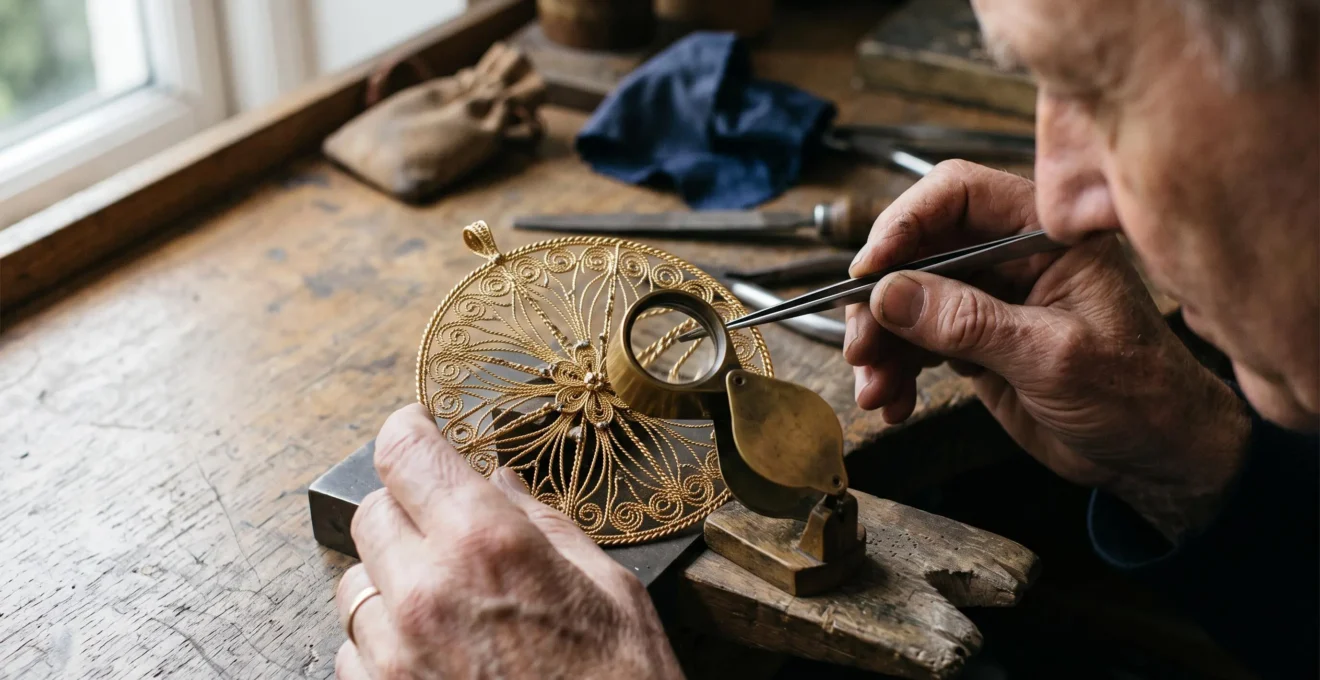
Filigree jewellery can be made from genuine gold and still bend, snag or suffer permanent damage during ordinary daily activities. The apparent contradiction disappears once purity is separated from construction: gold content describes the metal’s composition, while a piece’s geometry, wire dimensions, joins and supporting structure determine how it responds to pressure.
Open wirework creates an intricate, lightweight appearance, but its fine strands and small connections can leave it vulnerable to concentrated force. A solid-looking piece made with cast metal may behave very differently from one assembled from individually shaped and soldered wires, even when both carry the same gold-carat stamp.
For vintage-inspired jewellery lovers, the practical question is not simply whether a piece is genuine gold. It is whether its construction suits the way it will actually be worn, stored, cleaned and repaired. A pendant protected on the body may be perfectly suitable for occasional wear, yet a delicate ring exposed to repeated knocks can become an expensive frustration.
The distinction matters because **gold purity is not a guarantee of structural durability**. The World Gold Council‘s explanation of gold purity and caratage clarifies that alloying can improve durability, but the finished design remains a separate consideration. Understanding that distinction helps buyers choose jewellery for real life rather than appearance alone.
Filigree Jewellery: What to Know Before Wearing It
- Fine gold describes composition, not resistance to bending. Open wirework, thin sections and vulnerable solder joints can make a piece fragile.
- Gentle cleaning, protected storage and suitable repair work help reduce avoidable damage, but no care routine can make every delicate design suitable for daily contact.
- Choose between true wire filigree and cast filigree-style construction according to your lifestyle, repair options and willingness to handle the piece carefully.
- Why Can Filigree Deform From Light Pressure in a Pocket or Handbag?
- How to Clean Filigree Jewellery Without Pulling Wires or Trapping Gunk in the Gaps?
- Cast Filigree Look or True Wire Filigree: Which Should You Choose for Weekly Wear?
- The Resizing Mistake That Collapses Filigree Structure During Workshop Work
- When Should You Walk Away From a Filigree Piece Even if You Love the Design?
- Why Does a Small Knock Permanently Warp a Linear Necklace Bar?
- How to Choose a Linear Jewellery Piece That Won’t Warp After 30 Commutes?
- Why Do Linear-Structure Jewellery Pieces Bend Out of Shape So Easily in Bags and Pockets?
Why Can Filigree Deform From Light Pressure in a Pocket or Handbag?
Filigree can deform under light pressure because many true-wire designs rely on slender, shaped metal strands connected at relatively small soldered joints rather than a continuous sheet. When pressure reaches a narrow section, there may be little surrounding metal to distribute it. The result depends on the wire’s shape, thickness, alloy, manufacturing history and the direction of the force, not just the gold’s purity.
Two different kinds of damage explain why a piece may look fine one day and remain crooked the next.
**Gradual bending** happens when pressure is maintained or repeated. A phone resting against a pendant in a crowded handbag, for example, can press a section out of its original alignment. The change may initially be subtle.
**Local kinking** occurs when a concentrated force acts on one small point. A coin edge, key or zip pull can press against a single strand, producing a sharp bend rather than a smooth curve. Such damage is more difficult to reverse cleanly because the wire may no longer return to its original shape without professional reshaping or replacement.
Repeated flexing can also place stress on solder joints. An intact-looking piece does not prove that every joint is undamaged, although appearance alone cannot establish whether hidden fatigue has occurred.
For travel, avoid deliberately flexing a valuable piece to test its limits. If gentle everyday handling reveals visible movement in a wire section, treat that as a warning against loose-bag storage. Use a rigid jewellery case, a fitted pendant tray or a stiff protective pouch that prevents the piece from being compressed.
A piece that survives one journey may still be unsuitable for repeated exposure to keys, phones and bag contents. Protection is more reliable than relying on the jewellery to spring back after every knock.
How to Clean Filigree Jewellery Without Pulling Wires or Trapping Gunk in the Gaps?
The safest cleaning method for many uncomplicated filigree pieces is gentle cleaning with lukewarm water, mild soap and a soft brush, followed by careful drying. The important qualification is that the complete piece must be suitable for water: gemstones, coatings, adhesives, old repairs and loose components can change the answer. Ultrasonic cleaning, steam and vigorous brushing should not be treated as universally safe shortcuts.
The first challenge is removing residue without catching the wirework. Skincare products, lint and soap film can accumulate underneath raised motifs and inside narrow openings. Pulling a brush across a lifted strand can snag it, while aggressive rubbing may disturb a fragile connection.
For a suitable piece, use this conservative approach:
- Inspect the jewellery under good light before cleaning. Look for loose stones, lifted wires, cracked joins or areas that already move.
- Prepare lukewarm water with a small amount of mild, neutral soap. Avoid prolonged soaking, especially when the materials or previous repairs are uncertain.
- Hold the piece securely and use a soft-bristled brush with light pressure. Work along the direction of the wires rather than dragging bristles sideways across them.
- Rinse gently if the piece is water-safe, without forcing the jewellery against a hard surface or pulling at trapped fibres.
- Allow it to dry thoroughly. A gentle hand-operated bulb blower can help clear accessible gaps; do not use forceful air or assume that every internal cavity has been dried.
The Gemological Institute of America‘s jewellery-care guidance advises caution with ultrasonic cleaners because vibration can damage some settings. It also recommends accounting for the materials and treatments present. That is a reason for assessment, not proof that every ultrasonic machine or every filigree piece will fail.
The same distinction applies to steam. A professional may have suitable equipment and experience, but the appropriate method depends on the piece’s condition and construction. If grime is firmly trapped, or if a wire appears lifted, ask a jeweller to inspect it before attempting stronger cleaning.
A clean finish is not worth weakening the structure to achieve it. Abrasive polishing cloths and chemical dips can also be unsuitable for delicate or treated jewellery, so remove visible residue only by methods appropriate to the complete piece.
Cast Filigree Look or True Wire Filigree: Which Should You Choose for Weekly Wear?
For weekly wear, cast filigree-style jewellery is often the more practical starting point when the design contains relatively continuous, solid sections and is exposed to knocks. True wire filigree offers a lighter, more intricate appearance, but its durability depends on the individual strands, their joins and any supporting structure. Neither construction is automatically better in every design; the right choice balances appearance, weight, budget, wear frequency and repairability.
The first task is to identify what the piece is actually made from. Under magnification, true wirework may reveal twisted strands, small soldered contact points and slight irregularities. Cast filigree-style jewellery may show repeated motifs, a more continuous surface or mould-related features. These are useful clues, not conclusive tests: finishing can disguise construction, and an individual piece may combine both methods.
Historical filigree also need not be completely unsupported. The Metropolitan Museum of Art documents an 11th-century Egyptian gold ring made with wire filigree and granulation, with a thin gold sheet lining the interior. Its catalogue entry for the historical gold filigree ring illustrates why the presence of supporting metal matters when assessing a particular design. It does not establish the strength of every antique or modern piece.
| Purchase consideration | Cast filigree-style construction | True wire filigree |
|—|—|—|
| Appearance | Often more uniform, with a more continuous surface | Often finer, more open and visibly strand-based |
| Weight and metal use | May use more metal in solid sections | Can be lighter, depending on its backing and overall design |
| Everyday knocks | Continuous sections may resist local wire movement better | Individual strands and joints can be vulnerable to concentrated pressure |
| Repair | A damaged area may be suitable for conventional repair, depending on the design | Matching the wire’s gauge, twist, profile and colour can be challenging |
| Best fit | Designs intended for frequent contact, if their actual construction is robust | Protected wear, special occasions or carefully selected pieces with sound structure |
Construction technique also matters within true filigree. In Ganoksin‘s technical article on platinum wire filigree, jeweller Bradney W. Simon describes flattening wire to create additional depth and strength in a specific platinum fabrication method. That example shows how wire geometry can influence construction; it does not provide a universal durability ranking for gold filigree.
The practical decision is therefore to ask the seller which construction was used, whether there is a backing or supporting frame, and how the piece can be repaired. If the seller cannot establish these details, treat the uncertainty as part of the purchase risk.
True wirework can be a rewarding choice when its delicacy is intentional and manageable. For a piece that will regularly meet bag zips, doorframes or hard surfaces, a more substantial construction may be the better compromise.
The Resizing Mistake That Collapses Filigree Structure During Workshop Work
The critical resizing mistake is treating an openwork filigree ring or bracelet as though it were an ordinary solid band. Resizing may require cutting, reshaping and soldering near delicate decorative elements. Heat, mechanical force and changes to the band’s shape can affect nearby wires and joints, particularly when the openwork is integral to the piece’s structure. The feasibility of resizing must be assessed before work begins.
A solid-band ring often has a relatively clear section where material can be removed or added. Filigree may have no equivalent safe zone. Stretching the band can distort the surrounding geometry, while compression can buckle an open gallery or alter the spacing between decorative elements. Soldering introduces heat into nearby metal, and a design with previous repairs may respond differently from an undamaged one.
This does not mean every filigree ring is impossible to resize. Some designs include a substantial, accessible section that allows a more controlled operation. Others are poor candidates for resizing, or require specialist work that is disproportionate to the piece’s value.
Before authorising a workshop, ask:
- Has the jeweller worked on comparable openwork filigree, rather than only solid bands?
- Can the alteration be carried out at a solid section without disturbing the decorative framework?
- How will the surrounding structure be supported and protected during heating and reshaping?
- Will the jeweller inspect the solder joints and alignment under magnification before and after the work?
- What repair options exist if the structure moves or a joint fails during the operation?
Size verification before purchase is especially important for vintage and imported jewellery. Measure the intended finger or wrist accurately, and confirm the fit with the actual piece where possible. Finger size can vary during the day, so an end-of-day measurement can be a useful additional check, not a substitute for professional sizing.
After work, request an inspection under magnification and a clear explanation of any limitations. A piece may look aligned while a joint or nearby wire still requires attention; no visual check can guarantee that future damage will never occur.
A confident assurance that a piece can always be resized is not enough. A design that fits correctly from the beginning can save the cost and structural risk of a later intervention.
When Should You Walk Away From a Filigree Piece Even if You Love the Design?
Walk away when the piece’s condition, construction or repair requirements are incompatible with the way you intend to wear it. Fine wirework is not automatically a bad purchase, and age alone does not make a piece unsuitable. The warning signs are evidence of existing weakness, uncertainty about important repairs, or a design that cannot reasonably withstand your everyday routine.
Start by inspecting the jewellery in person or requesting detailed, well-lit photographs. Look closely at the areas where wires meet, where a pendant attaches to its chain, and where the framework joins a band or backing. Missing elements, visibly lifted wires, unexplained solder blobs, discolouration around joins and irregular areas that may have been repaired all deserve further investigation.
A piece that moves under normal handling needs particular caution. However, do not repeatedly flex it to see how far it will go: that test can itself cause damage. Long unsupported spans and an absence of a backing may also matter, depending on how the jewellery is intended to be worn.
For online and vintage purchases, condition information is as important as the seller’s description. Request photographs from multiple angles, including the back, attachment points and any previously repaired areas. Ask for a written condition report and check the return terms before paying. Photographs cannot reveal every hidden defect, and a seller’s description cannot replace a physical inspection.
A Five-Step Filigree Purchase Checklist
- Identify the construction. Record whether the piece is true wire filigree, cast filigree-style or a combination, and note any backing or supporting frame.
- Inspect the joints. Make a written list of visible gaps, lifted strands, solder irregularities and possible repairs; photograph each concern.
- Match the design to your routine. Write down whether it will encounter bags, zips, seatbelts, work surfaces or frequent hand contact.
- Verify repairability. Ask a jeweller whether the specific construction can be repaired and record any limitations or specialist requirements.
- Confirm the purchase terms. Save the condition report, photographs, seller’s written answers and applicable return policy before completing the transaction.
The decision should also account for how often the jewellery will be worn. A fragile-looking pendant may be entirely reasonable for occasional protected use. A delicate ring that will be worn during manual work or frequent handling faces a different risk profile. The question is not whether the piece is delicate, but whether its delicacy matches the owner’s habits.
If the construction remains unclear, visible defects are unexplained or a suitable repairer cannot be found, postponing the purchase is sensible. If the piece passes inspection and its limitations are acceptable, careful wear can still make a delicate design worthwhile.
Why Does a Small Knock Permanently Warp a Linear Necklace Bar?
A linear necklace bar can warp after a small knock because a long, thin section concentrates bending around its length instead of distributing the force through a closed or substantially supported form. A bar may look sturdy when viewed from the front, yet its thickness and cross-section determine how much force it can tolerate before taking a permanent set. Gold purity alone cannot predict that outcome.
The damage usually falls into two broad categories. A smooth bow affects a longer section of the bar and may sometimes be corrected by an experienced bench jeweller. A sharp crease or local kink is more concerning because the metal has folded at a concentrated point. Depending on the material, construction and extent of the damage, the repair may require reshaping, reinforcement or replacement rather than simple straightening.
Hollow and solid bars can behave differently. A thin-walled hollow tube may dent or kink locally, while a solid bar’s resistance depends heavily on its dimensions and geometry. Neither label guarantees durability: a very slender solid bar can still be vulnerable, and a well-designed hollow piece may perform adequately under suitable conditions.
Storage and wear habits influence the risk. A rigid bar should not be coiled into a small pouch or left loose with keys and coins. When removing a necklace, lay the bar flat or place it in a rigid slot, keeping the chain from twisting around it. Putting the necklace on last and removing it first can also reduce contact with clothing, zips and accessories.
If a bar is already bent, avoid repeatedly bending it in the opposite direction to straighten it. Reversing the deformation can create additional stress and make a clean repair more difficult.
A smooth curve and a sharp crease are not equivalent repair problems. If the bar has a kink, a split or a damaged chain attachment, professional assessment is preferable to repeated home adjustments.
How to Choose a Linear Jewellery Piece That Won’t Warp After 30 Commutes?
No linear jewellery piece can be guaranteed to survive 30 commutes without warping, but construction and fit can reduce the risk. Choose a bar with a suitable thickness-to-length proportion, inspect whether it is solid or hollow, and assess the chain attachment. Then consider where the piece will sit in relation to clothing, bags and other objects during the journey.
The daily commuter environment creates repeated opportunities for contact: coat zips, bag zippers, seatbelt straps, doorframes and the edges of hard objects can all strike or press against a pendant. A long, rigid bar hanging outside clothing is exposed differently from a shorter, articulated design that sits close to the body beneath a collar.
A useful comparison focuses on construction rather than appearance alone.
| Feature | What to look for | Why it matters |
|—|—|—|
| Solid bar or hollow tube | Ask the seller to identify the construction and inspect the underside | Hollow sections can be more susceptible to local denting when their walls are thin |
| Thickness relative to length | Compare the bar’s proportions and ask about its cross-section | Long, slender sections are generally more vulnerable to bending than appropriately reinforced designs |
| Fixed or articulated connection | Inspect how the bar joins the chain and whether the joint moves abnormally | The attachment can be a weak point even when the bar itself remains straight |
| Position during wear | Check whether the bar will sit under clothing or hang freely | Less exposure to direct impacts can reduce avoidable contact |
| Metal and alloy | Confirm the stated metal, caratage and any relevant construction details | Composition affects properties, but it cannot replace an assessment of the actual geometry |
In a shop, ask the jeweller to inspect the bar’s cross-section, underside and attachment under magnification. Do not force the pendant against a hard surface or deliberately bend it to test its limits. If visible flex occurs during ordinary handling, treat it as a warning and ask whether a more substantial alternative is available.
Metal choice is another consideration. Alloying gold can improve durability, but the precise effect depends on the alloy and the finished piece. A lower-carat item is not automatically stronger than every higher-carat alternative, just as a solid bar is not automatically resistant to all deformation.
The best choice is the one that balances the appearance you want with realistic exposure to daily contact. If a delicate linear design requires careful handling that your routine cannot accommodate, a shorter, thicker or better-protected alternative is likely to be the more satisfying long-term purchase.
Key Takeaways
- Repeated contact in bags and pockets can gradually deform long, slender jewellery even when no single impact appears serious.
- Storage, construction and attachment quality are practical purchasing criteria; a karat stamp cannot establish whether a bar will stay straight.
- For daily commuting, favour a design whose dimensions, position and construction suit your actual routine rather than relying on careful handling alone.
Why Do Linear-Structure Jewellery Pieces Bend Out of Shape So Easily in Bags and Pockets?
Linear jewellery pieces are especially vulnerable to deformation when their length is large relative to their thickness and they lack a closed or adequately supported structure. Bags and pockets combine sustained pressure with sudden, concentrated impacts, creating conditions in which a slim bar, pendant or openwork element can bend, kink or twist. The metal’s purity is only one part of the explanation; geometry and exposure are equally important.
Different objects can leave different patterns of damage. A phone pressing against a pendant may produce a gradual bow. A key, coin edge or zip pull can concentrate force at one point and leave a local kink. Twisting a necklace into a tight coil may introduce a curve or twist that was not present when the piece was stored correctly.
The damage can accumulate without being obvious after each journey. Repeated handling and small movements can gradually change the shape of a vulnerable section. A visible bend that seems to have appeared overnight may therefore reflect earlier stress rather than one dramatic incident. That does not mean every commute causes damage; the outcome depends on the design, materials, contact and storage conditions.
This explains why the practical buying decision should begin with intended use. True wire filigree may be appropriate for protected, occasional wear, while cast filigree-style construction may suit some more exposed designs. For linear pieces, a thicker or shorter bar, a suitable articulated connection or a protective storage case may be more important than a difference in karatage alone.
Storage deserves the same attention as wear. Keep delicate pieces separate, avoid coiling rigid bars tightly, and use a case that prevents pressure from other objects. If a piece becomes visibly bent, do not attempt repeated counter-bending; have the deformation assessed before it worsens.
Before buying a filigree pendant or a linear necklace bar, consider where it will spend most of its time, how often it will encounter hard surfaces and whether suitable repairs are available. A realistic match between construction and lifestyle is the most dependable way to enjoy intricate jewellery without turning every day into a durability test.
Does 18-carat or 24-carat gold make filigree jewellery more durable?
No. Caratage describes gold purity, not the bending resistance of a finished piece. Alloying gold can improve durability, but the result also depends on the specific alloy, wire dimensions, construction and condition. A delicate design in a higher-carat alloy may still be vulnerable to pressure and impact.
Can bent filigree jewellery always be repaired?
No. A gentle deformation may be repairable, while a sharp kink, snapped wire or damaged solder joint can require more extensive work or replacement. The outcome depends on the construction, metal, location of the damage and previous repairs. A jeweller experienced with openwork should assess the piece before any attempt to straighten it.
Is an ultrasonic cleaner safe for gold filigree?
Not in every case. Suitability depends on the jewellery’s condition, setting, gemstones, treatments and construction. Delicate, vintage or previously repaired pieces deserve particular caution. If the piece has loose wires or uncertain repairs, seek professional advice before using an ultrasonic cleaner.
How should delicate filigree jewellery be stored when travelling?
Use a rigid, padded jewellery case or a protective tray that prevents compression and keeps the piece separate from keys, coins and other jewellery. Store rigid linear bars flat or in a suitably sized slot rather than tightly coiled. A soft pouch alone may not provide enough protection against pressure from objects in a crowded bag.
Is true wire filigree a poor choice for everyday wear?
Not necessarily. Everyday suitability depends on the specific design, the quality and condition of its joins, any supporting structure and the activities involved. A well-made piece worn in a protected position may be suitable, while a delicate ring exposed to frequent knocks may not be. Ask about construction and repair options before buying.