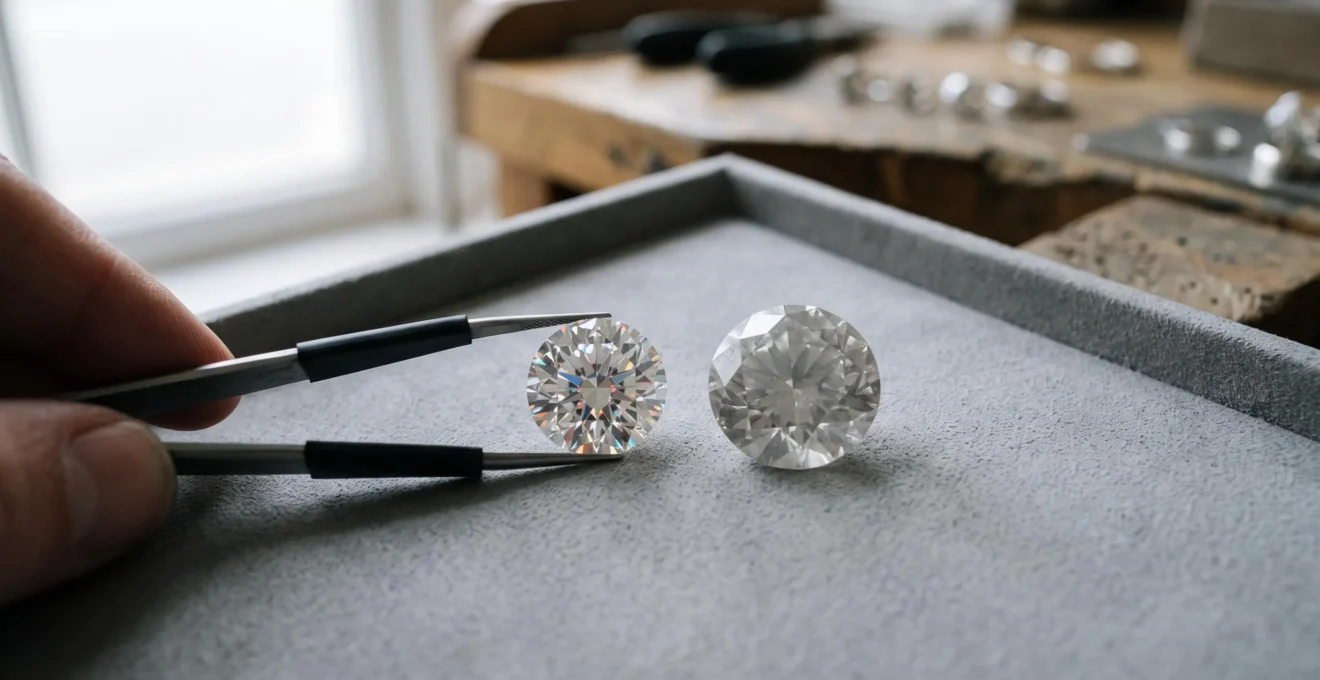
Two diamonds can have nearly identical carat weights, colour grades and clarity grades yet look strikingly different when viewed from 30 cm away. One may produce crisp flashes and a lively pattern of bright and dark facets. The other may appear comparatively flat, even when both carry impressive grading reports.
The difference often comes from how facet proportions work together to return light, how the diamond responds to movement, and how its reflections interact with the surrounding environment. Carat weight measures mass, not sparkle. A certificate describes important characteristics, but it cannot fully reproduce the experience of wearing a diamond in daylight, an office or an ordinary living room.
Setting design, cleanliness and viewing angle also change the result. For engagement-ring shoppers, the practical question is not simply which stone has the highest specifications. It is which stone looks attractive under the conditions in which it will actually be worn, without paying for improvements that remain invisible to the wearer.
What matters most when comparing diamonds at 30 cm
- Cut proportions, facet patterns and lighting can make a smaller diamond look more lively than a larger one.
- Compare actual stones side by side under neutral lighting, not only beneath jewellery-counter spotlights.
- Prioritise visible performance, sensible setting design and realistic resale expectations before paying for higher certificate grades.
- Why Can a Smaller Diamond Look Brighter Than a Larger One in Normal Daylight?
- How to Check a Diamond’s Sparkle in Store Without a Loupe or Fancy Lighting
- Lab-Grown or Natural Diamond: Which Should You Choose if Resale Value Matters?
- The Upgrade Trap That Adds 20% to Diamond Cost With Almost No Visible Difference
- When Should You Secure the Diamond if Your Ring Setting Takes 6+ Weeks to Make?
- Why Do Tiny Symmetry Errors Create Dead Spots You Notice in Normal Room Light?
- How to Inspect a Baguette or Emerald Cut in 5 Minutes Without Relying on Showroom Lights?
- Why Do Baguette and Emerald Cuts Show Every Speck of Dust After 2 Hours of Wear?
Why Can a Smaller Diamond Look Brighter Than a Larger One in Normal Daylight?
A smaller diamond can look brighter than a larger one because brightness depends on how effectively the stone returns available light toward the observer, not simply on its weight. Well-coordinated crown and pavilion angles, table size and facet arrangements can produce stronger visible light return than less successful proportions in a heavier stone.
Consider two round brilliant diamonds: one weighing slightly less but showing distinct white reflections across its crown, and another carrying more weight while appearing relatively glassy. The larger stone may have a greater face-up diameter, yet that does not guarantee stronger brightness. Some poorly proportioned diamonds also retain excess weight in their depth rather than translating it into visible spread.
The interaction between crown angle, pavilion angle and table percentage is particularly important. A steep crown is not automatically better, and a large table does not necessarily cause light leakage. An optical result that works for one combination may perform poorly when a different pavilion angle is introduced.
GIA’s research on diamond cut grading examines this interaction across numerous proportion combinations and incorporates assessments of brightness, fire and scintillation. Its findings explain why stones within the same broad cut grade can still have noticeably different appearances.
70,000+ observations
GIA’s cut-grade research included more than 70,000 observations of over 2,300 diamonds, helping evaluate how combinations of proportions affect appearance. These findings relate to round brilliant diamonds, not every fancy shape.
Gemological Institute of America, diamond cut-grade research.
Lighting changes the comparison. Strong directional spotlights create intense flashes, even in diamonds that look less lively under diffuse illumination. Ordinary daylight and room lighting may reveal more subtle differences in the arrangement of bright and dark reflections.
When comparing two weights, evaluate three characteristics: the distribution of bright reflections, the changes in those reflections as the stone moves, and whether broad areas remain comparatively inactive. A larger diamond offering more visible area may still be the right choice if its appearance is appealing. Size and visual liveliness are separate priorities.
Bright reflections can also make some small inclusions harder to notice, particularly when those inclusions are low contrast. This is not a reliable guarantee of eye-clean appearance: inclusion position, size and lighting still matter.
The best comparison is between the actual stones, at the same distance, in the same light. That makes an uncomplicated in-store viewing test more valuable than another round of filtering by carat weight alone.
How to Check a Diamond’s Sparkle in Store Without a Loupe or Fancy Lighting
You can check a diamond’s everyday sparkle by comparing two clean stones under the same neutral lighting, slowly moving each one and observing changes in brightness, coloured flashes and dark reflections. A window or softly illuminated area is more informative for normal wear than relying exclusively on intense showroom spotlights.
Begin by asking the jeweller to move away from dedicated diamond-display lighting. Examine the loose diamond near a window with indirect daylight, or under ordinary, reasonably even ceiling illumination. Hold it securely with the jeweller’s assistance and keep the comparison distance consistent.
Rotate or tilt the stone slowly rather than shaking it. Look for changes in the pattern of white reflections, occasional spectral colours and the contrast between illuminated and darker facets. A lively diamond should produce changing reflections as the viewing relationship shifts, although the exact pattern depends on the cut style and environment.
White flashes are associated with brightness, coloured flashes with dispersion or fire, and shifting light-and-dark patterns with scintillation. Neither a particular number of flashes nor a fixed mixture of colours provides a scientifically established pass-or-fail test.
A broad grey reflection is not, by itself, proof of light leakage. It might reflect the room, the observer’s face or a normal contrast pattern. Similarly, holding a hand or pen above the diamond can demonstrate how obstruction changes its appearance, but that informal experiment cannot diagnose a defective cut.
Repeat the comparison at approximately 30 cm, then at a comfortable arm’s length. Observe the stones face-up and at modest angles. If one looks consistently more engaging under several ordinary lighting conditions, that is a practical reason to prefer it, even when its certificate specifications are less impressive.
Your five-step in-store diamond comparison checklist
- Request two clean, individually identified diamonds and record their grading-report numbers.
- Move both into the same neutral lighting and note the viewing location used for comparison.
- Compare their face-up brightness at approximately 30 cm and record which looks brighter.
- Tilt both slowly through similar angles and note their changing white flashes, coloured flashes and contrast patterns.
- Ask to see each stone again in its intended setting style and record a final preference with the quoted prices.
Use the same observation method for every candidate. Do not allow a salesperson to compare one stone under favourable lighting while showing another in an ordinary corner of the shop. An honest comparison requires consistent conditions.
Once the preferred stone has been identified visually, the next decision is financial: whether its natural or laboratory-grown origin makes sense for the intended ownership period and possible resale.
Lab-Grown or Natural Diamond: Which Should You Choose if Resale Value Matters?
If future resale matters, compare natural and laboratory-grown diamonds using realistic second-hand offers rather than retail valuations. Natural diamonds may provide more established resale opportunities, but neither category guarantees recovery of its purchase price. Laboratory-grown diamonds usually offer a lower initial cost, which can be advantageous for a ring intended primarily to be worn rather than sold.
Laboratory-grown diamonds are real diamonds manufactured through technological processes rather than formed naturally. Their relevant chemical, physical and optical properties correspond to those of natural diamonds. Origin alone therefore does not explain why two similarly cut diamonds look different at 30 cm.
The principal differences for shoppers involve pricing, supply, personal preference and the opportunities available after purchase. A lower-priced laboratory-grown stone may allow a buyer to select a larger size or different specifications while leaving more of the overall budget for the setting.
Resale should be separated into three distinct financial mechanisms:
| Mechanism | What it represents | What buyers should verify |
|---|---|---|
| Open-market resale | The amount an independent buyer is willing to pay for the actual stone. | Written offers, transaction costs and whether the buyer accepts that diamond category. |
| Jeweller trade-in credit | Credit offered by a retailer toward another purchase. | Eligibility, minimum spending, exclusions and whether the credit is based on original expenditure. |
| Insurance replacement value | The valuation or cost framework used for an insured replacement under a particular policy. | Coverage terms, valuation assumptions, limits and possible deductibles. |
These amounts are not interchangeable. A high insurance valuation is not a realistic resale offer, and a generous store credit may require another purchase costing substantially more than the original ring.
The decision also changes with the buyer’s intentions. Someone purchasing a lifetime keepsake may reasonably prefer a laboratory-grown diamond for its initial affordability. Someone expecting an upgrade should examine the jeweller’s written trade-in policy before deciding. Someone purchasing with an investment objective should recognise that retail diamonds generally involve transaction costs, uncertain resale demand and substantial price differences between buying and selling.
Some jewellers offer upgrade arrangements linked to the original purchase, but such programmes are not universal. Even an attractive credit percentage may be less valuable if the replacement purchase is restricted or overpriced.
The FTC consumer advice on buying diamonds and gemstones recommends confirming gemstone origin and recording important transaction details. Its consumer-protection guidance applies to the United States; buyers elsewhere should verify their own local rights and retailer terms.
The more important financial mistake may be paying for unnecessary upgrades in either category. Once the buyer understands the intended ownership period, the remaining budget should be directed toward visible improvements rather than impressive-sounding grades.
The Upgrade Trap That Adds 20% to Diamond Cost With Almost No Visible Difference
A diamond’s price can rise sharply when its weight crosses a popular carat threshold, even though the visible increase in size is difficult to detect. Paying for substantially higher clarity beyond the point where inclusions are visible without magnification can create a similar problem: more money spent without an equally noticeable improvement at normal viewing distance.
The most familiar example involves diamonds immediately below and above one carat. Carat weight measures mass, and a small weight difference does not translate into an equally noticeable difference in face-up diameter. A diamond can also carry extra weight in its depth, reducing the visible benefit.
GIA’s explanation of diamond carat weight and magic sizes compares diamonds weighing 0.96 and 1.02 carats. It describes the apparent size difference as almost imperceptible while illustrating how the stone above the threshold might cost as much as 20% more.
Up to 20%
Illustrative price difference cited by GIA for a diamond just above the one-carat threshold compared with one just below it. This is not a verified current or universal retail premium.
Gemological Institute of America, 2017 educational comparison of carat-weight thresholds.
The same logic applies to clarity, although the mechanisms differ. Clarity grades describe internal and external characteristics under standard grading conditions. Once a diamond is genuinely eye-clean for its intended observer and viewing conditions, moving to a much higher clarity grade may not change what can be seen at 30 cm.
Eye-clean is a practical viewing description, not a universal laboratory grade. The observer’s eyesight, lighting, inclusion placement and diamond shape all affect the result. A grade that is satisfactory for one round brilliant may not be satisfactory for a step-cut diamond with a broad open table.
Hypothetical buying decision: where could the upgrade budget go?
Suppose a diamond is quoted at $5,000 and crossing a popular weight threshold increases the price by 20%, bringing the quote to $6,000. This is a mathematical illustration, not a current market quote or a claim that the premium always applies.
The $1,000 difference could instead remain in the buyer’s budget or be considered for a setting improvement, a cut-quality comparison or other visible preferences. The better allocation depends on actual quotations and the observed performance of the individual stones.
During a sales conversation, useful questions include: « Can I compare the stone just below this weight? », « Is the clarity difference visible without magnification? » and « Can both stones be assessed under ordinary light? » These questions redirect the discussion toward observable value without rejecting legitimate quality considerations.
A sensible purchase does not require selecting the cheapest certificate. It requires paying knowingly for the characteristics that matter. This becomes especially relevant when the ring is custom-made and the stone must be secured before the setting is ready.
When Should You Secure the Diamond if Your Ring Setting Takes 6+ Weeks to Make?
For a custom engagement ring requiring six or more weeks of production, secure the diamond once the actual stone, price, setting compatibility and written transaction terms are confirmed. Buying it outright and reserving it with a deposit are both possible approaches, but they create different payment, cancellation and custody risks during the manufacturing period.
Buying the stone immediately may protect the buyer from losing access to that particular diamond. It can also mean paying the full amount before the completed ring is available for inspection.
A reservation arrangement may reduce the initial outlay, but its value depends on whether the jeweller genuinely commits to holding the identified stone, for how long and under what conditions. A verbal statement that a diamond is « reserved » provides less certainty than a written agreement identifying the stone and payment terms.
Before making either commitment, obtain the grading-report identification, documented weight and measurements, quoted price and any identifying laser inscription where present. Ask the jeweller to explain how the loose diamond will be stored, handled and tracked while the setting is manufactured.
Insurance requires particular attention. Do not assume that a jeweller’s general business insurance covers a customer-owned diamond throughout storage, bench work, transport or transfer to an outside workshop. Request written confirmation of applicable coverage, exclusions and responsibility if the stone is damaged or lost.
The production schedule should distinguish between the setting’s expected completion date and the promised delivery date of the finished ring. Workshop delays, fitting adjustments and final inspections may change the practical timetable.
| Decision factor | Full purchase upfront | Deposit-based reservation |
|---|---|---|
| Initial payment | Entire agreed stone price. | Contractually agreed portion of the price. |
| Stone availability | Purchase identifies the chosen stone, subject to the contract. | Depends on the retailer’s reservation commitment. |
| Cancellation exposure | Potentially larger amount tied up before completion. | Depends on deposit refundability and order terms. |
| Custody and damage | Written responsibility and insurance terms remain essential. | Written responsibility and insurance terms remain essential. |
Ideally, inspect the loose diamond and verify its identifying details before mounting. This creates a useful record of the stone’s condition and appearance. Once set, certain areas can become harder to examine, although a mounted diamond can still be assessed by a qualified professional.
Custom-order cancellation rights, refundable deposits and delivery remedies differ across the United States, United Kingdom, Canada, Australia and other markets. Never presume that one country’s consumer rules apply to another retailer or that every made-to-order ring is automatically non-refundable.
After securing the stone, its grading report remains useful for identification and documentation. However, the report’s symmetry grade should not be treated as a substitute for observing the diamond’s actual face-up appearance.
Why Do Tiny Symmetry Errors Create Dead Spots You Notice in Normal Room Light?
Facet alignment and proportions can influence how light returns through a diamond, potentially creating uneven bright and dark areas. However, small symmetry deviations do not automatically produce visible dead spots. A diamond’s appearance depends on the combined geometry of its facets, its viewing angle and the lighting conditions, not the symmetry grade alone.
In a round brilliant diamond, crown and pavilion facets work together to direct light toward the observer. When facets differ in alignment or shape, they can alter the distribution of reflections. Proportion combinations can also create undesirable optical effects even when the facets are arranged with relatively high manufacturing precision.
The word « symmetry » needs clarification because buyers often use it to describe different things. A grading report evaluates specified features of the diamond’s manufacturing symmetry. An observer looking face-up may instead be judging whether its pattern of light and dark regions appears visually balanced.
Those assessments are related but not identical. Excellent symmetry does not guarantee a beautiful contrast pattern, and a Very Good or Good symmetry grade does not automatically mean the diamond will show objectionable darkness.
In ordinary room light, strong reflections may become less intense than those visible under a jewellery spotlight. This can make some uneven patterns easier to notice, but dark facets are not inherently defects. Healthy contrast contributes to the changing patterns that make brilliant-cut diamonds appear lively.
During an inspection, rotate the specific diamond slowly in diffuse lighting. Observe whether darker areas move, appear and disappear as its orientation changes. Reflections from the observer’s head and body can create dark regions through obstruction, so stationary darkness should not automatically be blamed on faulty symmetry.
If a substantial area repeatedly appears dull compared with similar diamonds, ask the jeweller to explain the likely cause. Further examination by a qualified gemologist, potentially using appropriate light-performance tools, is more reliable than diagnosing a defect from a casual reflection.
The practical minimum symmetry grade is not a universal cutoff. It depends on the individual stone, its proportions and the buyer’s sensitivity to visible differences. Paying a premium to move from one high grade to another is difficult to justify solely on visual grounds when the stones look equally attractive under consistent conditions.
This distinction becomes even more important with emerald and baguette cuts. Their broad step facets create a different visual language, demanding a more deliberate inspection than the lively sparkle expected from a round brilliant.
How to Inspect a Baguette or Emerald Cut in 5 Minutes Without Relying on Showroom Lights?
To inspect an emerald or baguette-cut diamond in five minutes, examine its broad facets under neutral light, check for visible inclusions, compare its reflections as it tilts and inspect its edges and corners. Unlike brilliant cuts, step cuts emphasise clarity, broad reflections and a hall-of-mirrors appearance rather than dense, rapidly changing sparkle.
Emerald and baguette cuts belong to the step-cut family. Their relatively broad, elongated facets create orderly reflections that allow the viewer to look more clearly into the stone. This can make colour, inclusions and certain cutting characteristics more apparent than in many brilliant cuts.
GIA’s comparison of diamond shapes and cut styles explains why step cuts demand particular attention to clarity and colour. This is guidance for evaluating appearance, not a guarantee that every inclusion or colour difference will be visible without magnification.
A practical five-minute inspection can be divided into short observations:
- First minute — face-up appearance: view the clean stone from approximately 30 cm in neutral light. Look for broad, organised reflections and an overall appearance you find attractive.
- Second minute — gentle tilting: rotate the diamond slowly to observe the hall-of-mirrors effect. Note whether its reflections change naturally and whether any central transparency or dullness is visually distracting.
- Third minute — visible clarity: look through the open table without magnification. Check whether dark inclusions, feathers or other internal characteristics catch your eye.
- Fourth minute — outline and corners: inspect the shape from above and at an angle. Look for visually consistent corners and obvious chips or abrasions; request magnified professional inspection for subtle damage.
- Fifth minute — comparison: place the stone alongside another of similar shape and approximate size under the same lighting. Choose based on its overall appearance rather than a single grade.
Emerald cuts typically have cut corners, while narrow baguettes may have more exposed corner geometry. Setting design should account for these differences. A bench jeweller can help determine whether a particular corner is sufficiently protected and whether the setting accommodates the stone’s actual measurements.
Elongated step cuts may also display different degrees of transparency through their centre. A conspicuous window-like area can be aesthetically distracting, but its presence cannot be diagnosed solely from a single face-up photograph. Similarly, the term bow-tie is not a universal or inevitable defect of elongated step cuts.
Do not judge these shapes by whether they produce the same coloured flashes as a round brilliant. Their appeal lies in broader reflections, geometric structure and transparency. A clean, elegant step cut can be an excellent choice even if it looks less sparkly than a brilliant-cut alternative.
An attractive step cut should also fit the wearer’s daily habits. Broad facets make surface smudges easier to notice in some lighting conditions, so long-term satisfaction depends partly on how the ring will be cleaned and worn.
Key takeaways before choosing a step-cut ring
- Prioritise a pleasing hall-of-mirrors appearance and acceptable visible clarity over brilliant-cut sparkle expectations.
- Inspect corner protection and setting access before approving an emerald or baguette design.
- Consider daily exposure to hand cream, cooking oils and soap residue when deciding how much maintenance is acceptable.
Why Do Baguette and Emerald Cuts Show Every Speck of Dust After 2 Hours of Wear?
Emerald and baguette cuts can make fingerprints, oils and surface films particularly noticeable because their broad, relatively open facets depend on clean reflections and transparency. Dirt disrupts those smooth reflections and can make the stone appear hazy. However, there is no established universal rule that step cuts become visibly dirty after precisely two hours of wear.
The difference is partly visual. Round brilliant diamonds contain numerous smaller facets that create complex patterns of reflected light. Step cuts have broader facet surfaces and fewer abrupt changes in reflection, so a fingerprint or thin film may interrupt a larger continuous area of the visible pattern.
Daily activities produce the material that interferes with diamond appearance. Skin oils, hand cream, soap residue and dust can accumulate on exposed surfaces and around the setting. Diamonds also attract greasy films, which can reduce apparent brightness even when the underlying stone has excellent optical characteristics.
The speed of buildup depends on activity, contact with products and the design of the ring. Someone applying hand cream regularly may notice haze sooner than someone who removes the ring during messy tasks. This is a lifestyle consideration, not an inherent optical failure of a step-cut diamond.
A simple cleaning routine can restore much of the stone’s original appearance. For an otherwise sound diamond ring with a setting suitable for water exposure, use lukewarm water, a small amount of mild dish soap and a very soft brush. Gently clean accessible areas, rinse carefully in a secure container rather than over an open drain, and dry with a clean lint-free cloth.
The appropriate frequency depends on how quickly the ring becomes visibly soiled. Light surface marks may be removed with a suitable jewellery cloth, while accumulated residue around the setting may require more thorough cleaning. Ask a jeweller before soaking rings that contain other gemstones, adhesives, delicate components or potentially loose settings.
Setting design adds another trade-off. A bezel can protect vulnerable edges and corners from some forms of impact. Channel settings can provide edge protection for baguette accents. However, metal surrounding a stone may also restrict access to certain surfaces during cleaning.
It would be inaccurate to assume that every bezel or channel setting traps more dirt than an open prong setting. The actual cleaning difficulty depends on construction, clearances and whether residues can collect beneath or beside the stone.
For someone whose work involves frequent contact with oils, lotions or other residues, a low-profile setting with accessible cleaning areas may be more practical than a delicate design that is difficult to maintain. Low-set protection and easy cleaning are both worth discussing with the bench jeweller before production.
Before ordering the ring, ask to inspect the chosen diamond in everyday light, discuss cleaning access with the jeweller and confirm the finished setting will suit the wearer’s routine. A diamond that looks beautiful when clean and remains practical to care for offers more lasting satisfaction than a higher grade that delivers no visible advantage.
Can two diamonds with the same GIA cut grade look different?
Yes. GIA’s round brilliant cut-grade research demonstrates that diamonds within the same grade can differ in appearance. Their facet proportions and resulting optical effects are not identical, and observers may prefer different brightness, fire or contrast patterns. Comparing actual stones under the same lighting remains worthwhile.
Is a diamond with more sparkle automatically better quality?
No. Sparkle depends on cut style, lighting, movement and viewing conditions. A round brilliant is designed to produce a different visual effect from an emerald cut. Strong flashes under spotlights are not sufficient evidence of superior overall quality, and attractive contrast patterns should not be mistaken for defects.
Should engagement-ring shoppers compare diamonds loose or mounted?
Both views are useful. Loose-stone inspection makes it easier to examine facets, visible inclusions and certain identifying characteristics. Viewing a diamond in its intended setting, or in a representative setting where available, helps assess the finished ring’s proportions, appearance and practicality. The actual stone should be identified throughout the comparison.
Does a diamond grading report guarantee that the stone will look eye-clean?
No. Laboratory clarity grading and naked-eye visibility are different assessments. Inclusion size, placement and contrast, along with diamond shape, lighting and the observer’s eyesight, determine whether a feature is noticeable. Inspecting the individual diamond at a normal viewing distance is the most practical way to assess eye-clean appearance.
Can cleaning make a dull-looking diamond sparkle again?
Cleaning can improve appearance when oils, soap residue or surface dirt are interfering with reflections. It cannot repair poor proportions, chips, internal inclusions or other permanent characteristics. If a properly cleaned diamond still looks unusually dull, have a qualified jeweller examine the stone and setting before assuming the problem is dirt.