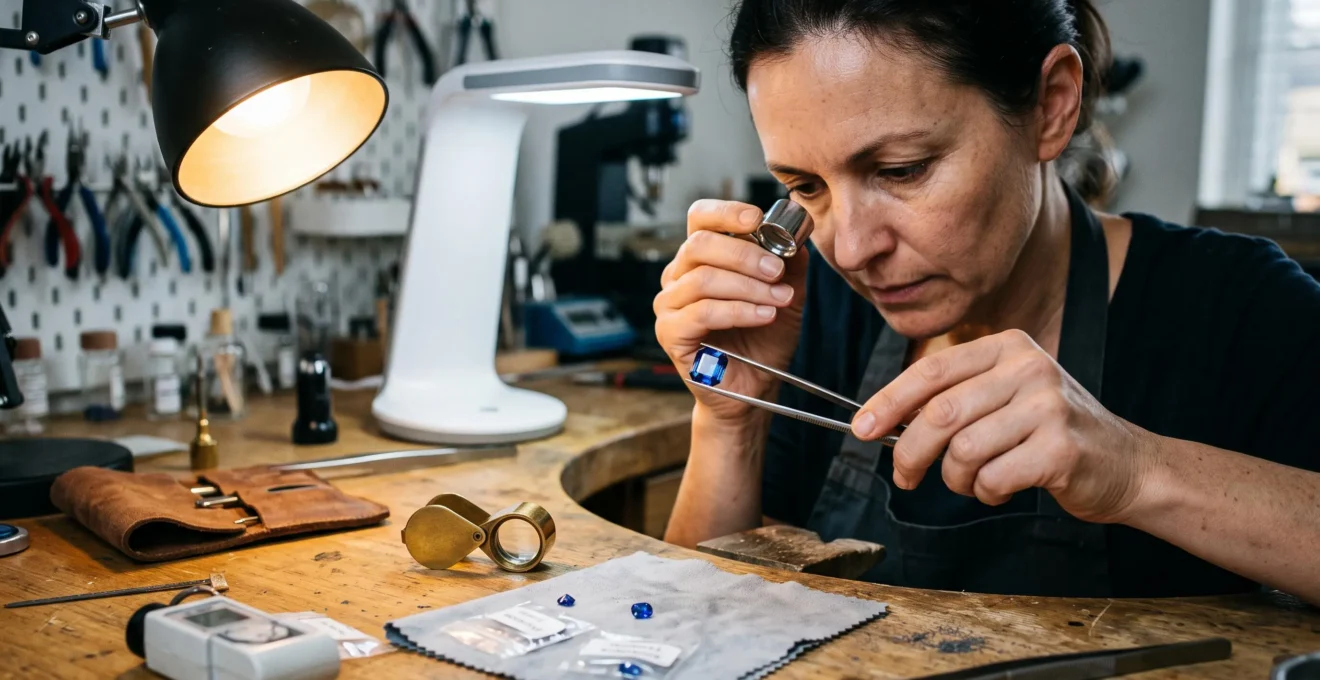
A gemstone’s geological history influences far more than its colour. The conditions under which its crystals formed help determine their chemical composition, internal structure, natural inclusions and optical behaviour. These characteristics influence whether a finished gem resists scratches, survives accidental impacts, maintains its appearance and performs attractively under everyday lighting.
But geological origin is not a complete durability forecast. A diamond may have exceptional scratch resistance yet chip after a sharply directed blow. A topaz can look flawless but remain vulnerable along its cleavage planes. Meanwhile, a comparatively less scratch-resistant jadeite may withstand impacts remarkably well.
For jewellery buyers, particularly those selecting coloured gemstones for daily-wear rings, the useful question is not simply whether a gem formed under pressure or deep underground. It is how its crystal structure, toughness, stability, cutting proportions and treatment history translate into practical performance.
Understanding those connections makes it possible to compare gemstones beyond conventional colour and clarity descriptions, without needing to become a professional gemologist.
What geological properties reveal about gemstone performance
- Hardness is not toughness: scratch resistance cannot reliably predict whether a gemstone will chip, fracture or survive an accidental knock.
- Crystal structure and inclusions matter: cleavage, internal fractures and vulnerable edges can influence suitability for rings, pendants and earrings.
- Appearance depends on more than the rough material: trace elements, cut proportions, treatments and lighting determine how a finished gemstone looks in everyday environments.
- Why Do Some Gems Chip Easily Even When They Look « Perfect » in the Display Case?
- How to Translate Gemology Terms Into Daily-Wear Rules in 15 Minutes
- Ring, Pendant, or Earrings: What Should You Choose if Your Gem Has Cleavage Risk?
- The Hardness-Only Mistake That Leads to Regret After the First Knock on a Doorframe
- In What Order Should You Check Colour, Clarity, and Cut When You Only Have 7 Minutes?
- Why Can a Vibrant Gemstone Suddenly Look Grey Under LED Lights at Home?
- Why Does a Sapphire Sometimes Show a See-Through Window Under Desk Lighting?
- Why Do Some Gemstones Look Electric in Store but Dull in Office Lighting 2 Weeks Later?
Why Do Some Gems Chip Easily Even When They Look « Perfect » in the Display Case?
A gemstone can look perfect yet chip easily because visual beauty does not reveal its resistance to fracture. Its crystal structure may contain cleavage planes, and internal fractures or brittle behaviour may make it vulnerable to impact. A polished surface can conceal these risks, even when its colour, transparency and proportions appear excellent.
Gemstone durability combines three separate characteristics: hardness, toughness and stability. As explained in GIA‘s explanation of gemstone durability beyond the Mohs scale, evaluating only scratch resistance leaves important causes of damage unexamined.
| Property | What it measures | Why it matters in jewellery |
|---|---|---|
| Hardness | Resistance to scratching and abrasion | Influences surface wear from contact with abrasive materials |
| Toughness | Resistance to chipping, cracking and breakage | Influences the consequences of accidental impacts |
| Stability | Resistance to environmental influences | Determines sensitivity to heat, light, chemicals and other conditions |
Consider topaz. Its Mohs hardness of 8 suggests relatively strong scratch resistance, yet its perfect basal cleavage creates a potential plane of weakness. A blow in an unfavourable direction may cause damage that its hardness rating does not predict.
Diamond provides another important example. Its exceptional hardness does not eliminate cleavage. Conversely, jadeite and nephrite demonstrate that materials with lower Mohs hardness can possess outstanding toughness.
Geological formation helps explain these differences, but not through a simple rule such as “greater formation pressure means a stronger gemstone”. Diamond forms under high-pressure conditions, while minerals such as topaz and fluorite can crystallise in different geological environments. Their resulting crystal structures, chemical bonding and defects matter more to durability than formation depth alone.
Natural fractures, growth features and residual stresses may also influence fracture behaviour. Some are visible under magnification; others require specialist examination. A stone’s survival in its geological environment does not guarantee resistance to a sudden impact after cutting and setting.
Once beauty and durability are treated as separate questions, technical gemological descriptions become useful tools rather than confusing labels.
How to Translate Gemology Terms Into Daily-Wear Rules in 15 Minutes
Gemology becomes practical when each technical property is connected to a specific wearing or care decision. Hardness helps assess abrasion, cleavage indicates potential breakage directions, and stability informs cleaning and exposure precautions. Refractive index explains aspects of light behaviour, while specific gravity mainly assists identification rather than predicting everyday durability.
A buyer does not need to memorise mineralogical terminology. The faster approach is to translate a small number of properties into decisions based on the intended jewellery and daily habits.
| Gemology term | Meaning | Practical interpretation |
|---|---|---|
| Mohs hardness | Relative resistance to scratching | Consider exposure to abrasive dust, harder jewellery and repeated surface contact |
| Cleavage | Tendency to split along particular crystallographic planes | Protect vulnerable directions and exposed edges from impacts |
| Toughness or tenacity | Resistance to fracture or deformation | Evaluate whether the stone suits an impact-prone ring |
| Stability | Response to environmental conditions | Check sensitivity to cleaning products, heat, light and moisture |
| Refractive index | How strongly a material refracts light | Use alongside cut proportions to understand optical performance |
| Specific gravity | Density relative to water | Useful for identification, but not a direct wear-risk rating |
For example, Mohs hardness around 7–8 may provide useful resistance to many everyday scratches, but it does not make the stone immune to abrasive particles or impacts. Quartz-rich dust can abrade softer materials, and harder gemstones can scratch softer stones when stored together.
Similarly, routine hand-washing is not primarily a hardness question. The gemstone species, possible treatments, cleaning products and security of the setting determine whether particular cleaning practices are appropriate.
Three questions can make a brief conversation with a jeweller considerably more useful:
- Does this gemstone have significant cleavage, fractures or other structural vulnerabilities?
- Are ultrasonic cleaning, household chemicals or temperature changes potentially harmful to this gemstone or its treatments?
- Could harder neighbouring stones scratch it in the proposed jewellery design?
Prioritise the properties that match actual exposure. Someone frequently handling equipment may focus on toughness and setting protection. Someone regularly using cleaning products may need more information about chemical stability and treatment sensitivity.
Fifteen minutes is enough to identify relevant questions, not to verify every gemological characteristic. Where the gemstone’s identity, treatment or structural condition is uncertain, professional assessment remains valuable.
These rules become particularly important when deciding where on the body a vulnerable gemstone should be worn.
Ring, Pendant, or Earrings: What Should You Choose if Your Gem Has Cleavage Risk?
A gemstone with significant cleavage risk is generally better suited to earrings or a pendant than to a ring worn continuously. Rings encounter frequent accidental impacts, while earrings usually experience much less mechanical contact. A protective setting can reduce exposure, although it cannot remove the material’s underlying susceptibility to fracture.
The same topaz or moonstone may therefore be a reasonable choice for occasional earrings but require more caution in an everyday ring.
| Jewellery type | Typical exposure | Practical implication |
|---|---|---|
| Ring | Frequent contact with doors, work surfaces, equipment and other objects | Prioritise toughness, protected edges and a low-profile design |
| Bracelet | Frequent contact with desks and surrounding objects | Limit exposed corners and protruding stones |
| Pendant | Usually less impact exposure, depending on length and activities | Can accommodate some more vulnerable gemstones |
| Earrings | Generally low accidental impact exposure | Often suitable for gems requiring greater protection |
Setting design is the second part of the decision. A bezel surrounds the gemstone’s perimeter with metal and can help shield vulnerable edges. Partial bezels and carefully positioned prongs may also provide targeted protection.
V-shaped prongs are especially relevant to exposed corners and points. However, a prong that protects a corner does not necessarily protect every susceptible direction within the crystal.
Before selecting a setting, consider an everyday exposure audit:
- Which hand will wear the jewellery, and how often does that hand contact hard objects?
- Does work involve tools, lifting, sports equipment or repetitive contact with desks?
- Will the jewellery remain on during household cleaning or physical activities?
- Is the gemstone raised above the setting or protected within a lower profile?
A buyer who already owns a cleavage-prone gemstone does not necessarily need to stop enjoying it. A jeweller may be able to redesign the mounting, add protection around vulnerable edges or convert a ring gemstone into a pendant.
Any redesign requires professional assessment because removing and resetting a brittle or fractured stone can itself introduce risk.
Although mounting reduces exposure, the fundamental distinction between resisting scratches and resisting impacts remains central to gemstone selection.
The Hardness-Only Mistake That Leads to Regret After the First Knock on a Doorframe
The hardness-only mistake is assuming that a gemstone with a high Mohs rating is automatically safe from impacts. Hardness measures scratch resistance, not resistance to fracture. A diamond can cleave after a sufficiently severe, favourably oriented blow, while a lower-hardness jadeite may be exceptionally resistant to breakage.
The Mohs scale ranks minerals according to their ability to scratch one another. It is a relative scale rather than a linear measurement of overall strength.
That distinction matters when jewellery encounters a hard object unexpectedly.
Imagine a hypothetical situation: a ring catches the edge of a doorframe as its wearer turns quickly. Whether its gemstone survives depends on several interacting factors, including impact energy, direction, geometry, existing defects and how the stone is supported by its setting.
If the force acts unfavourably relative to a cleavage plane, even a very hard gemstone may fracture. By contrast, a less scratch-resistant but highly tough material may distribute or withstand the impact more effectively.
This does not mean a diamond will commonly split whenever it hits a doorframe. It means exceptional scratch resistance is not a guarantee against impact damage.
Consider these contrasting examples:
- Diamond: Mohs hardness 10, exceptional resistance to scratching, but distinct cleavage directions and potential vulnerability to sufficiently forceful impacts.
- Topaz: Mohs hardness 8, good resistance to many scratches, yet perfect cleavage requiring care around accidental blows.
- Jadeite: approximately Mohs 6.5–7, with remarkable toughness that can make it more resistant to certain breakage mechanisms despite lower scratch resistance.
These materials are not interchangeable in appearance, value, treatment or intended use. Their contrast illustrates why a single hardness number cannot predict every type of jewellery damage.
The better purchasing question is: How does this gemstone break, and what could expose it to that mechanism?
A mineral’s cleavage and toughness characteristics are a starting point. Its particular fractures, orientation, cut and setting then determine how those general properties apply to an individual piece.
With mechanical risk understood, a buyer can evaluate the finished gemstone’s appearance without overlooking defects that may also affect durability.
In What Order Should You Check Colour, Clarity, and Cut When You Only Have 7 Minutes?
For a quick assessment focused on daily wear, inspect cut and exposed edges first, clarity-related structural concerns second, and colour under realistic lighting third. This prioritises potentially important damage or durability risks before subjective appearance. It is a practical screening sequence, not a universal grading standard or a substitute for gemological examination.
Cut deserves early attention because it influences both optical performance and the vulnerability of exposed points, corners and thin girdles. An attractive colour cannot compensate for damage or a setting that leaves a fragile edge unprotected.
Clarity should then be considered in relation to structural condition. Not every inclusion weakens a gemstone, and natural inclusions are common in many coloured stones. However, an open fracture or a surface-reaching feature near a vulnerable edge deserves closer examination.
Colour remains essential to personal satisfaction, but it should be judged under lighting that resembles the conditions in which the jewellery will actually be worn.
A seven-minute inspection can allocate approximately two minutes to cut and edges, two minutes to visible inclusions and fractures, and three minutes to colour under alternative illumination.
During the first stage, look at the girdle, facet junctions and exposed corners. Ask the seller to point out existing chips or areas where the setting may offer insufficient protection.
During the second stage, examine the stone with a jeweller’s loupe where available. A phone macro photograph can help record visible features, but it cannot reliably establish the depth, nature or significance of an inclusion.
During the final stage, compare the gemstone under display lighting and a more neutral or naturally lit environment. If the shop permits, examine it near a window rather than relying entirely on concentrated counter spotlights.
Your five-action gemstone inspection checklist
- Inspect the cut and edges for two minutes. Record whether the girdle, corners and facet junctions show visible damage or unusual exposure.
- Check visible inclusions for two minutes. Note their approximate locations and ask whether any are surface-reaching fractures.
- Compare lighting for three minutes. Record how the gemstone’s colour and brightness change between counter lighting and neutral or daylight conditions.
- Confirm material and treatment information. Obtain the seller’s identification, disclosed treatments and any relevant laboratory documentation.
- Match the result to the intended jewellery. Write down whether the proposed mounting protects vulnerable areas and whether a professional inspection is needed before purchase.
The timing is a suggested decision aid rather than a scientifically validated examination protocol. A seven-minute assessment can identify reasons to ask further questions, but cannot certify authenticity, treatment status or long-term durability.
That final lighting check is particularly revealing because even an undamaged, naturally coloured gemstone may behave very differently beneath household LEDs.
Why Can a Vibrant Gemstone Suddenly Look Grey Under LED Lights at Home?
A gemstone may look grey or less saturated under an LED because its perceived colour depends on the wavelengths emitted by the light source and absorbed by the stone. Different lamps can produce different colour impressions without changing the gemstone itself. LED colour temperature alone does not reliably predict this effect.
Gemstone colour often originates in the mineral’s chemistry. Trace elements, crystal defects and interactions between atoms influence which wavelengths of visible light are absorbed and which reach the observer.
In corundum, the mineral family containing ruby and sapphire, chromium can contribute red or pink colour, vanadium can contribute several colours, and interactions involving iron and titanium can produce blue.
GIA’s scientific study of colour formation in corundum demonstrates how chromophore identity, concentration and optical path length influence absorption and perceived colour. It also examines changes in appearance under different illumination conditions.
This provides a direct connection between geological formation and everyday appearance. Trace elements incorporated during crystal growth influence how the finished gem interacts with the light available in a particular room.
However, the relationship is not simple enough to predict a gemstone’s appearance from geological locality alone. Individual chemical composition, cutting orientation, colour zoning and the actual lamp spectrum all contribute.
Two LED lamps described as cool white may have different spectral distributions. Likewise, a warm LED is not necessarily equivalent to traditional tungsten or halogen lighting.
To assess a gemstone before purchase, compare its appearance under daylight, warm artificial light and cool artificial light where practical. Look for changes in brightness, hue and saturation rather than assuming one lighting environment reveals its only true colour.
Photographs can help document the comparison, but smartphone processing, automatic white balance and screen characteristics may alter the results. Direct visual comparison under controlled conditions is preferable.
There is also an important distinction between temporary changes in perceived colour and actual deterioration. A stone that looks duller under a different lamp has not necessarily faded.
Some gemstone treatments do introduce additional stability considerations. GIA’s reference on gemstone treatments explains that certain enhancements, including surface coatings and some irradiation-induced colours, can have particular care or stability limitations.
Those limitations depend on the material and treatment. Heat treatment or irradiation should not automatically be interpreted as evidence that a gemstone will fade during normal use.
Lighting also interacts with the gemstone’s cut, and an unfavourable cut can create a separate problem that appears especially noticeable in diffuse indoor light.
Why Does a Sapphire Sometimes Show a See-Through Window Under Desk Lighting?
A sapphire may display a transparent window when its cutting proportions allow light to pass through the pavilion rather than returning towards the viewer. The centre can appear pale, dull or see-through, especially against a visible background. This is an optical cutting issue, not automatic evidence of poor clarity, treatment or inauthenticity.
Windowing occurs when light travels through a faceted gemstone without producing the internal reflections needed to return sufficient light towards the observer.
Shallow pavilion proportions are a common cause. If the cutter selects a relatively shallow design to preserve a larger face-up size or retain weight from thin rough material, the resulting gem may sacrifice optical performance.
This is where geological growth and commercial cutting decisions intersect. Natural rough crystals vary in shape and dimensions. A cutter must work within those constraints while balancing size, weight retention, colour distribution and appearance.
As detailed in GIA’s technical analysis of coloured gemstone darkness and brightness, windowing and extinction are distinct optical phenomena.
A window is an area where insufficient light is returned because light escapes through the gemstone. Extinction, by contrast, involves dark regions where light is not directed back towards the observer, despite internal reflection.
Darkness is not always a defect. Some contrast between bright and dark facets contributes to a gemstone’s visual depth and brilliance. Persistent, extensive dead-looking regions are more concerning than normal contrast patterns.
For a loose sapphire, positioning the stone above printed text can provide an informal visual check. If the background appears clearly through a central area when viewed face-up, this may indicate significant windowing.
The result is not a definitive diagnostic test. The gemstone’s transparency, refractive index, viewing angle, background and proportions all affect what is visible. Mounted stones can be especially difficult to assess this way.
A second useful observation is to tilt the gemstone gently under diffuse light. Watch whether a pale transparent area persists or changes, and whether neighbouring dark regions brighten as the viewing direction changes.
Colour zoning, extinction, observer reflections and windowing may coexist, so the tilt test helps describe what is happening without always identifying a single cause.
Neither a vivid colour grade nor an authenticity report guarantees ideal light return. A sapphire can be genuine and desirable while still displaying windowing that some buyers find distracting.
The broader lesson is that cut geometry must be assessed alongside colour chemistry and lighting, rather than treated as a secondary detail.
What to establish before judging everyday brilliance
- Separate a gemstone’s inherent structural and optical properties from the effects of its setting and lighting environment.
- Inspect light return under diffuse illumination, not only under bright directional spotlights.
- Ask whether visible changes reflect lighting, cutting proportions or a documented treatment issue before assuming permanent deterioration.
Why Do Some Gemstones Look Electric in Store but Dull in Office Lighting 2 Weeks Later?
Gemstones can look spectacular in a jewellery shop but subdued at the office because the two environments illuminate them differently. Directional spotlights create bright reflections and flashes, while diffuse office lighting often produces less dramatic contrast. Cut proportions, colour absorption and the observer’s expectations can amplify the difference without any physical change to the stone.
The effect combines several mechanisms rather than a single defect.
First, store lighting is frequently arranged to highlight jewellery through concentrated illumination. Faceted gemstones can produce prominent flashes as the light, stone or observer moves. Under broader, diffuse office lighting, those individual flashes may become less noticeable.
Second, the gemstone’s cut determines how efficiently light returns towards the eye. A stone with strong light return can remain appealing in varied conditions, while significant windowing or extinction may become more apparent when flattering display lighting is removed.
Third, chemical composition determines which wavelengths the gemstone absorbs. A ruby, sapphire or other coloured gemstone can display different perceived saturation under different illumination spectra.
Fourth, treatment history can affect care requirements or, in some circumstances, actual colour stability. But a change in appearance immediately after moving between lighting environments is not sufficient evidence of treatment-related fading.
These mechanisms can interact. A gemstone with an attractive saturated colour but weak light return may look impressive beneath focused spotlights and comparatively flat under diffuse illumination.
The two-week element introduces another consideration: visual adaptation. Familiarity with a new piece of jewellery may change the wearer’s subjective impression of its brilliance. However, there is no basis for assuming that gemstones ordinarily deteriorate or lose optical performance within two weeks.
A practical decision rule is to examine the gemstone under at least two different lighting environments, including one diffuse source that approximates normal daily conditions.
If the gemstone looks attractive only beneath concentrated spotlights, consider whether that appearance matches the environments in which it will actually be worn. This is a question of personal expectations and optical behaviour, not necessarily authenticity or quality.
It is equally important to distinguish an optical concern from a durability concern. A gemstone can return light beautifully yet remain vulnerable to fracture, while another may be structurally suitable for everyday wear but display less dramatic brilliance.
For coloured-stone rings, the strongest purchasing decision therefore combines three assessments: resistance to physical damage, stability under anticipated conditions and attractive appearance under realistic illumination.
Before purchasing, ask to examine the gemstone away from display spotlights, confirm its identification and disclosed treatments, and discuss whether its setting suits the intended wearing habits. A gemstone that performs satisfactorily under those realistic conditions is a more informed choice than one selected from a single flattering first impression.
Can a gemstone’s country or mine of origin tell you whether it will be durable?
Geographical origin may provide geological context, but it does not establish the durability of an individual gemstone. Mineral species, crystal structure, fractures, treatments, cutting proportions and setting design provide more directly useful information. Stones from the same locality can have different inclusions and structural conditions.
Can a gemological certificate guarantee that a gemstone will not chip?
No. A laboratory report may establish gemstone identity and describe selected characteristics or treatments, depending on its scope. It does not guarantee survival against accidental impacts. Jewellery design and wearing conditions must also be considered, and the report should be checked for exactly which characteristics were examined.
Does an inclusion always make a gemstone less suitable for daily wear?
No. Inclusions differ in nature, size, position and structural significance. Many natural inclusions have little practical effect on durability, while fractures that reach the surface or intersect vulnerable edges can require additional consideration. Assessing the individual feature is more useful than treating all inclusions as equivalent.
Is a heat-treated gemstone necessarily less stable than an untreated gemstone?
No. Treatment effects vary substantially by gemstone species and enhancement method. Some treatments produce stable changes, while others introduce particular cleaning, abrasion or light-exposure sensitivities. The relevant question is which treatment was applied and what care requirements apply to that specific material.
Can a protective setting make a fragile gemstone suitable for everyday use?
A protective setting can reduce the likelihood of impacts to exposed edges, points and corners, but it cannot change the gemstone’s intrinsic cleavage or toughness. A bezel or low-profile design may improve suitability for certain wearing habits, although some particularly vulnerable materials remain better suited to occasional-wear jewellery.