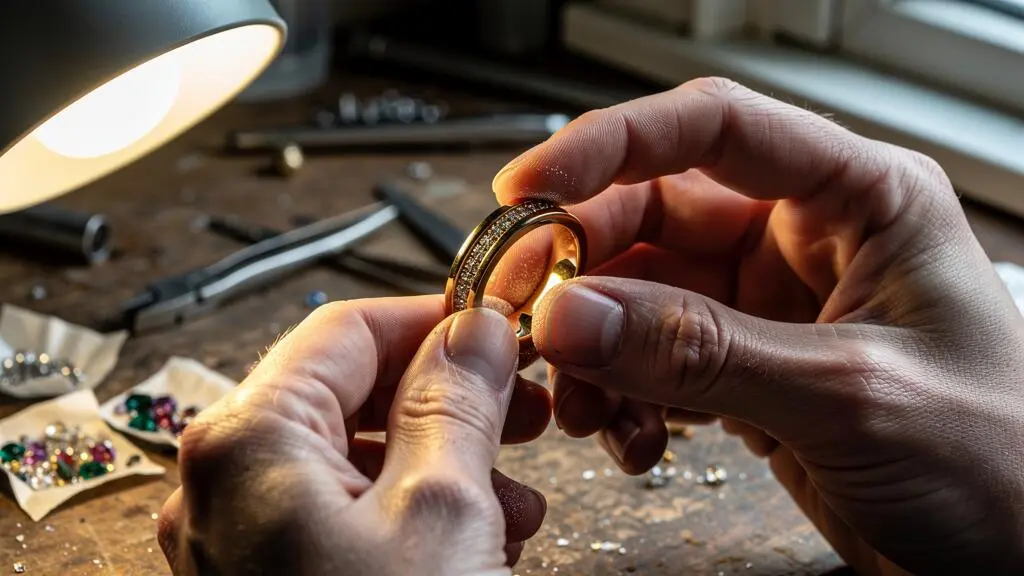
A ring covered in uninterrupted gemstones can appear remarkably simple. From above, the diamonds seem to float against one another, with little or no metal interrupting the surface. Yet the structure responsible for that effect is often the most technically demanding part of the jewelry.
In a true invisible setting, precision-cut grooves beneath the gemstones engage with concealed metal rails or a supporting gallery. The result is an almost continuous gemstone surface, but the same hidden construction can restrict access when a stone becomes loose, the mounting deforms, or the ring needs resizing.
Repair difficulty depends on the setting’s construction, not simply its appearance. A precisely engineered invisible setting may perform well for years, whereas an inadequately supported design can become expensive to restore because conventional tightening or replacement techniques may not be suitable.
Before buying, it is worth understanding how the concealed rails retain each stone, which visible details indicate manufacturing quality, and whether a qualified jeweler can service the ring without rebuilding part of the setting.
Hidden Rail Settings: What Buyers Need to Know
- Seamless appearance requires precision: concealed rails engage with specially prepared gemstone grooves, making accurate stone cutting and alignment essential.
- Repairs can be more complicated: a damaged rail or missing stone may require specialist work, a precisely matched replacement gemstone, or assistance from the original manufacturer.
- Serviceability should influence the purchase: inspect alignment, discuss resizing restrictions, and confirm who can maintain the setting before committing.
- Why Can Invisible Rail Settings Loosen Over Time Even Without Any Big Impact?
- How to Inspect Hidden Rail Settings Using 5 Visual Clues Before You Commit?
- Hidden Rails or Channel Setting: Which Should You Choose if You Want Easier Repairs?
- The Resizing Mistake That Can Crack Stones in Hidden Rail Settings Without Immediate Warning
- When Should You Service an Invisible-Style Rail Setting if You Want to Avoid Stone Loss?
- Why Can a Stone Start Moving Long Before You Notice Anything Is Wrong?
- The Setting Choice That Looks Sleek but Becomes a Repair Nightmare Later
- Which Stone Setting Technique Is Best if You Catch Your Ring on Everything You Wear?
Why Can Invisible Rail Settings Loosen Over Time Even Without Any Big Impact?
Invisible rail settings can loosen without a dramatic impact when repeated wear, small structural distortions, or an imperfectly fitted stone compromise the engagement between its grooves and the concealed metal rails. The process is not inevitable: a correctly manufactured setting provides mechanical retention, and the likelihood of loosening depends on construction quality, wear conditions, and previous damage.
Unlike a conventional prong setting, where metal claws visibly secure a gemstone, a true invisible setting relies on carefully positioned grooves cut into the lower portions of the stones. These grooves engage with a hidden metal framework. Retention therefore depends on the geometry and integrity of the rail-and-groove connection, rather than friction against polished metal walls alone.
As explained in Jewelers of America’s professional article on invisible settings, consistent stone dimensions, accurately placed grooves, and proper gallery alignment are essential to secure construction.
Everyday activities can expose a ring to incidental knocks, pressure, and some degree of band flexing. If those forces deform the framework or aggravate an existing manufacturing weakness, the rail may no longer engage the stone as intended. However, ordinary handwashing or temperature changes should not be assumed to loosen every properly made invisible setting.
The concealed structure complicates early detection. A damaged connection can remain hidden beneath an apparently continuous gemstone surface. Owners may notice a changed stone position or movement before seeing an obvious defect in the metal.
Several manufacturing details influence how well the mounting tolerates wear:
- Rail dimensions: insufficient supporting metal leaves less material available to maintain the designed connection or accommodate future repairs.
- Groove precision: incorrectly positioned or inconsistent gemstone grooves can prevent reliable engagement.
- Stone seating: unevenly seated gemstones may experience undesirable localized pressure.
- Metal and framework design: alloy properties, cross-section, fabrication quality, and overall mounting geometry affect resistance to deformation.
A newly made ring may also have tiny manufacturing clearances that do not represent damage. What matters is whether the stones remain securely seated. Progressive movement, an increasingly uneven row, or a confirmed loss of retention is different from a stable, properly constructed assembly.
Since much of the structure cannot be seen directly, the next practical safeguard is a careful inspection of the visible stone arrangement before purchase.
How to Inspect Hidden Rail Settings Using 5 Visual Clues Before You Commit?
Before buying a hidden rail ring, inspect five features under magnification: stone alignment, visible metal consistency, spacing between gemstones, finishing marks, and light return. These clues cannot prove that the concealed structure is secure, but they can reveal irregularities worth investigating with the jeweler before accepting the piece.
Ask the retailer to provide a jeweler’s loupe and view the ring under bright, even lighting. Examine it from directly above, then tilt it to inspect the edges and visible portions of the mounting. Compare adjacent stones rather than evaluating each one in isolation.
1. Alignment of the stone line. Look for a gemstone sitting noticeably higher, lower, or more tilted than its neighbors. Uneven alignment may indicate differences in stone dimensions or seat preparation. Some variation can be intentional, so ask whether the stones were designed to sit at different heights.
2. Consistency of the visible metal. Depending on the design, a narrow metal edge or part of the supporting structure may be visible from the side. Compare its thickness and continuity. An irregular or distorted edge deserves closer examination, although a true invisible setting may conceal the retaining rails completely from above.
3. Symmetry of the spaces between stones. Look for inconsistent junctions, unexpected gaps, or corners that do not meet cleanly. Invisible settings require closely matched gemstone dimensions. A gap does not automatically mean a stone is loose, but irregular spacing can reveal fitting or alignment problems.
4. Tool marks and finishing quality. Examine accessible metal surfaces for rough burrs, accidental cuts, or inconsistent finishing. Such marks may reflect workmanship, but superficial marks alone do not establish that a rail is structurally defective. Their significance should be evaluated by an experienced setter.
5. Consistency of light return. Observe the row while slowly tilting the ring. One noticeably dull or dark stone may have a different orientation, cut, or level of cleanliness. Lighting variations and individual gemstone characteristics can produce similar effects, so this is a prompt for closer inspection rather than a diagnosis.
A professional may also assess suspicious movement with controlled examination techniques. A faint buzz during gentle handling can raise concern, and fine fabric may reveal an exposed edge that catches. Neither is a validated stand-alone test for rail security. Avoid striking the ring, pressing on stones, or deliberately snagging its setting to test durability.
Five Checks to Complete Before Buying
- Examine the complete stone row under a loupe: record any visibly raised, tilted, or uneven stones in a short inspection note.
- Compare the stone junctions and accessible metal edges: take a clear close-up photograph showing any irregular gaps or finishing concerns.
- Request a professional retention check: obtain the jeweler’s assessment of whether each stone is secure, preferably recorded on the sales paperwork.
- Confirm the repair procedure: ask whether an individual gemstone can be replaced and obtain a written explanation of any manufacturer-only servicing restrictions.
- Review the warranty and first-year service terms: retain written confirmation of inspection, tightening, accidental damage, and stone-loss coverage or exclusions.
Even a flawless-looking surface can conceal a problem in the underlying gallery. Visual examination is therefore a screening tool, not a substitute for professional assessment. Warranty terms should be checked particularly carefully, because an attractive finish cannot guarantee future repairability.
Once the craftsmanship appears satisfactory, the more consequential buying decision is whether this concealed construction fits your expectations for future maintenance and repairs.
Hidden Rails or Channel Setting: Which Should You Choose if You Want Easier Repairs?
A channel setting is generally the more practical starting point for buyers who prioritize accessible maintenance, while a true invisible rail setting prioritizes an uninterrupted gemstone surface. Both require skilled repairs, but hidden rails can impose additional constraints because replacement stones must fit precision-cut grooves and damaged concealed components may be difficult to reach or reconstruct.
In a channel setting, gemstones sit inside a groove between two visible metal walls. The walls retain and protect the stones, particularly around their girdles. Depending on the construction and damage, a jeweler may be able to work on the walls or individual seats without reconstructing an extensive concealed gallery.
In a true invisible setting, the gemstones conceal much of the retaining framework. A loose stone may require specialized access to the rail, precise adjustment of the existing groove engagement, or replacement of damaged metal components.
GIA’s article on engagement ring side-stone settings describes channel-set gemstones as sitting low within a protective mounting, making that design particularly relevant for active wearers. It also characterizes invisible settings as somewhat fragile and advises considering the owner’s lifestyle.
The practical differences become clearer when assessed across everyday ownership requirements.
| Criterion | Hidden rail / invisible setting | Channel setting |
|---|---|---|
| Appearance from above | Continuous-looking gemstone surface with concealed retention | Gemstone row framed by visible metal walls |
| Access to retaining metal | Often restricted by the concealed construction | Walls are visible and may be accessible for repair |
| Replacement gemstone | May require closely matched dimensions and specially prepared grooves | Must fit the channel and seat, but does not generally require invisible-setting grooves |
| Repair complexity | Can involve specialist rail work or replacement of structural components | May permit localized wall or seat repair, depending on damage |
| Suitability for active wear | Requires careful assessment of construction and lifestyle | Often a practical choice because the walls protect gemstone edges |
| Resizing flexibility | Potentially restricted, especially with extensive gemstone coverage | Also restricted in some designs, but may offer more options |
Neither category guarantees an inexpensive repair. A severely damaged channel, worn walls, or an intricate eternity design can also require substantial reconstruction. Actual costs depend on labor, material, replacement stones, and whether the mounting can be repaired without disturbing adjacent gemstones.
For a hands-on wearer, channel setting often offers a sensible balance between a low profile and serviceability. Invisible rails remain appealing when a continuous gemstone surface matters more, provided the buyer accepts additional inspection and potential specialist servicing.
There is also a middle ground. Some modified or partially concealed designs retain more accessible metal around the gemstones while preserving a relatively uninterrupted top view. Ask the jeweler whether individual stones can be serviced without dismantling the entire row rather than relying on a product label such as « semi-invisible. »
The choice becomes especially important if the ring may need resizing, because changing its circumference can place the concealed framework under stresses it was not designed to tolerate.
The Resizing Mistake That Can Crack Stones in Hidden Rail Settings Without Immediate Warning
The critical resizing mistake is bending or stretching a gemstone-bearing section of an invisible-set ring without protecting its concealed framework. Changing the band’s curvature can distort the rails, compromise their engagement with the stone grooves, or introduce damaging pressure. Cracks and loosened stones are possible consequences, although damage is not inevitable and cannot be predicted without inspecting the specific mounting.
Invisible settings depend on the relative positions of the gemstones and supporting rails. Altering that geometry can be more consequential than it would be in a plain metal band. A repair that changes the curvature of the setting may cause some stones to lose retention while others experience excessive pressure.
The distinction between resizing methods matters. Stretching changes the band’s shape through deformation, while cutting and adding or removing metal can allow a jeweler to control where the dimensional change occurs. Nevertheless, cutting and joining may also introduce heat or other hazards, and neither method is automatically safe for every invisible-set ring.
Some specialists use techniques designed to isolate the gemstone-bearing area from deformation. Others may recommend partial disassembly, gemstone removal where feasible, or declining the job entirely. The appropriate method depends on the mounting design, metal, gemstones, and extent of the proposed size change.
Particular caution is warranted with gemstones that have fractures, inclusions, or treatments affecting durability. Diamonds can resist scratching exceptionally well but are not immune to chipping or fracture under concentrated pressure. Emeralds and other gemstones with vulnerable internal features may require additional precautions.
Technical bench guidance explains why the gemstone-bearing section should be protected from bending. In Ganoksin’s technical article on invisible-setting ring repairs, jeweler Robert Gravley describes the precision required for rail adjustment and a resizing approach intended to avoid distorting the supported gemstones. His methods concern particular constructions and should not be treated as a universal procedure.
The absence of obvious damage when a ring is collected does not guarantee that every stone is secure. Tiny fractures or rail distortions may escape casual observation. However, a claim that resizing routinely produces fractures that emerge weeks later would require evidence that the available technical sources do not establish.
Before authorizing resizing, ask the jeweler to document the original condition, explain how the setting will be protected, and identify any gemstones that should be removed. Request a post-repair magnified examination, including a check of stone security, and retain a record of the work performed.
If a ring contains extensive invisible-set gemstone coverage, the safest financial decision may be to choose the correct size from the beginning and confirm whether resizing is realistically possible before purchase.
When Should You Service an Invisible-Style Rail Setting if You Want to Avoid Stone Loss?
An invisible-style rail setting should be professionally inspected whenever a gemstone appears displaced, moves, or shows another sign of compromised retention. For frequently worn rings, an annual professional examination is a reasonable preventive starting point, with more frequent checks when wear conditions justify them. No universal inspection interval has been established for every invisible-setting construction.
Daily-wear rings experience different conditions from pieces reserved for special occasions. Physical work, exercise, repeated impacts against hard surfaces, and previous repairs can increase the need for monitoring. A ring worn infrequently and stored carefully may require less frequent attention, although storage alone does not guarantee continued security.
The most important distinction is between routine scheduling and an immediate warning sign. Do not wait for the next planned appointment if you observe:
- A gemstone that sits noticeably higher, lower, or at a different angle than before.
- Movement or a suspicious sound during normal, gentle handling.
- An exposed edge that has begun catching on clothing.
- A new gap between adjacent gemstones or a visible change in their alignment.
- Damage to the mounting after a knock, resizing, or previous repair.
Changes in sparkle may also justify inspection, but dirt, lighting, and surface contamination are common explanations. Reduced brilliance alone does not demonstrate that the rail is loose.
Professional servicing should begin with magnified inspection of the stones and accessible mounting. The jeweler can then determine whether retention is compromised, whether local tightening is possible, or whether a structural repair is necessary.
Some invisible settings permit precise adjustments to the rails. Others require more extensive intervention, especially when a rail is broken or the gemstone groove is damaged. A competent assessment should distinguish simple dirt accumulation from a mechanical problem and explain the proposed work before proceeding.
Cleaning also requires care. Ultrasonic equipment exposes mounted stones to vibration and other conditions that can be unsuitable for some gemstones or already compromised settings. A jeweler should examine stone security and gemstone characteristics before choosing a cleaning method.
The financial benefit of preventive inspection is straightforward, although not quantifiable from the available evidence. Identifying a retention problem before stone loss may preserve the original gemstone and avoid the difficulty of matching a replacement or rebuilding damaged rails. Inspection does not eliminate all risk, but it gives the owner an opportunity to act before a defect becomes more extensive.
Keeping dated photographs and service notes also makes it easier to notice subtle changes that everyday familiarity with the ring might otherwise conceal.
Why Can a Stone Start Moving Long Before You Notice Anything Is Wrong?
A stone can begin moving before its owner notices because the displacement may be extremely small and partially concealed by neighboring gems and the metal gallery. An initial loss of secure engagement does not necessarily produce an obvious gap or an immediately missing stone. Continued wear can then expose the weakened connection to further movement and potential damage.
The key issue is the difference between a gemstone remaining in place and being mechanically secure. An invisible-set stone may still appear aligned with its neighbors even if its groove-to-rail connection has been compromised. Adjacent stones or remaining portions of the framework may temporarily limit visible movement without restoring proper retention.
Visual familiarity can delay recognition. Owners see the same ring every day, often under changing lighting conditions and without magnification. Skin oils and accumulated dirt can also make small junctions harder to assess.
One useful monitoring technique is to photograph the ring periodically under consistent conditions. Use a phone’s macro capability or a suitable close-focus lens, position the ring similarly each time, and capture the complete stone row from above and at a shallow side angle.
Compare those photographs for changes in alignment, spacing, or visible metal edges. This is an observational aid rather than a validated measurement method, and differences in focus or camera angle can create false impressions.
Pay particular attention to the ends of gemstone rows and areas near the shoulders of the ring. Depending on the design, these locations may be exposed to changes in curvature or local stress. However, the most vulnerable position cannot be determined reliably from location alone; the framework and previous damage matter more than a universal rule.
A loose gemstone may also cause secondary problems. Movement against a retaining component can contribute to abrasion or further deformation, potentially making repair more involved. This is a plausible mechanical concern, not evidence that every moving gemstone will inevitably damage neighboring stones.
For example, consider a hypothetical ring in which one stone has begun to shift slightly while remaining in its row. If an experienced jeweler can restore the existing rail engagement without damage, the repair may be limited. If the ring continues to be worn until the rail fractures or the stone is lost, matching and reconstructing components may become necessary.
The two situations illustrate why an apparently small defect deserves timely assessment. A favorable outcome depends on the specific damage and the jeweler’s ability to restore secure retention.
These warning signs are particularly important for designs that combine minimal visible metal with limited access to the underlying structure.
The Setting Choice That Looks Sleek but Becomes a Repair Nightmare Later
A sleek invisible setting becomes especially difficult to repair when its concealed rails are too delicate to restore, its gemstones require unusual precision cuts, or its construction prevents straightforward access to a damaged component. The greatest ownership risk is not visual minimalism itself, but purchasing a specialized mounting without confirming how replacement stones and structural repairs will be handled.
Some invisible settings are manufactured with sufficient supporting metal, accurately prepared gemstones, and a repairable framework. Others prioritize a nearly uninterrupted surface while leaving little practical room for future adjustment.
Thin supporting rails warrant particular attention. If the remaining metal is insufficient or has already been distorted, normal tightening may not restore the designed connection. Repair may require replacing part of the framework rather than simply repositioning an existing component.
Very small gemstones arranged in long continuous rows can create additional service challenges. Each stone depends on accurate positioning relative to neighboring stones and the concealed support. The difficulty increases when the mounting prevents a jeweler from reaching one defective area without disturbing other components.
Replacement stones are another important consideration. Invisible settings commonly require gemstones with tightly controlled dimensions and specially prepared grooves. A visually similar commercially available gemstone may not fit the original mechanism. Matching its cut and mechanical connection can require specialist preparation.
Repair access also depends on the manufacturer. Some constructions use distinctive mounting systems or components that independent workshops may not be equipped to restore. If the original maker is unavailable, the owner could face reduced repair options.
Before choosing a ring, ask four specific questions:
- Can a single stone be replaced? Request an explanation of whether adjacent gemstones or framework components must be removed.
- Is the supporting metal repairable? Ask whether future tightening is possible and what happens if a rail becomes distorted or fractured.
- Who performs specialist servicing? Establish whether the retailer has an experienced bench jeweler, uses an external specialist, or relies on the original manufacturer.
- How are replacement stones sourced? Confirm whether compatible stones can be obtained or prepared if an original gemstone is lost.
The answers should be considered alongside written warranty terms and the retailer’s practical ability to provide ongoing service. A general promise that jewelry can be repaired is less useful than a clear explanation of the work this particular construction permits.
Well-executed invisible settings are not inherently defective, and a high-quality example can remain satisfactory for many years. Equally, a low purchase price does not prove poor craftsmanship. The critical factors are construction quality, appropriate materials, accurate cutting, and access to qualified repair services.
Once repairability is understood, the remaining question is whether the setting’s appearance matches how the ring will actually be worn.
Key Takeaways Before Choosing a Setting
- Evaluate snag resistance and stone retention separately: a smooth gemstone surface does not automatically mean the underlying construction withstands repeated knocks.
- Consider both initial comfort and future servicing, especially if the ring will be worn during active or hands-on tasks.
- Ask whether a lower-profile alternative or a carefully engineered hybrid can deliver the desired appearance with more accessible gemstone retention.
Which Stone Setting Technique Is Best if You Catch Your Ring on Everything You Wear?
For someone whose ring frequently catches on clothing or strikes surrounding objects, a well-made bezel or flush setting is generally a sensible starting point. Both can provide a smooth exterior with relatively protected gemstones. Channel settings are another practical option, while invisible rails require more careful consideration because their concealed retaining structure can be difficult to repair after damage.
Snagging and impact resistance are related but different concerns. Snagging occurs when an exposed feature catches on fabric or another surface. Impact resistance concerns how the setting and gemstone respond to knocks, pressure, or deformation. A ring can be smooth enough to resist snagging while still containing a mechanically delicate stone-retention system.
Bezel settings surround a gemstone with a metal rim. When properly designed and finished, the metal provides a smooth transition around the stone and helps shield vulnerable edges. Repairability depends on the metal, bezel thickness, gemstone condition, and available access.
Flush settings position gemstones within prepared seats in the metal surface. Their low profile can reduce protruding features, making them attractive for people who frequently catch jewelry on clothing. Their suitability depends on the stone dimensions, the amount of surrounding metal, and the quality of the setting work.
Channel settings place a row of gemstones between protective metal walls. They offer a relatively smooth profile and are often suitable for active wear, although sharp or damaged wall edges can still snag fabric. Longer stone rows and some resizing situations can make repairs more complicated.
Invisible rail settings deliver the greatest impression of uninterrupted gemstones among these options, but concealing the retention system introduces specialist service requirements. A smooth surface from above should not be mistaken for immunity to lateral impacts.
No universal laboratory ranking for snag resistance among these four setting categories is established by the supplied references. Their relative suitability is therefore a practical design assessment rather than a statistically proven hierarchy.
For buyers attracted to the floating-stone appearance, a modified design may offer a compromise. Possibilities include partially concealed supporting metal, more substantial protective edges, or a hybrid construction with securely framed end stones. Such modifications must be evaluated individually, because a thicker rim or alternative support does not automatically correct weaknesses elsewhere in the mounting.
The most useful buying test is an honest assessment of daily wear. Someone who works frequently with tools, handles heavy objects, exercises while wearing a ring, or regularly catches jewelry on clothing should prioritize secure retention and accessible repair over visual continuity alone.
Ask an experienced jeweler to compare actual bezel, flush, channel, and invisible-set examples under magnification. Choose the design whose stone retention, comfort, resizing limitations, and documented service options suit your daily activities—not merely the one that looks smoothest in a display case.
Can an invisible-set diamond be replaced without rebuilding the ring?
Sometimes. If the concealed rail remains intact and a correctly dimensioned replacement diamond can be prepared with compatible grooves, a specialist may be able to replace the individual stone. If the rail or supporting framework is damaged, more extensive reconstruction may be required. The jeweler must inspect the construction before recommending a procedure.
Are all rings advertised as invisible settings built with the same rail system?
No. Different manufacturers use distinct rail geometries, mounting structures, and proprietary methods. Some jewelry described commercially as having a hidden or invisible appearance may use a different retention mechanism altogether. Buyers should request a construction explanation rather than relying exclusively on the product name.
Can a jeweler clean an invisible-set ring with an ultrasonic cleaner?
Only after evaluating the gemstones and the security of the setting. Ultrasonic cleaning may be inappropriate for loose stones, fracture-sensitive materials, or certain treated gemstones. The jeweler should examine the mounting first and select a cleaning method suitable for the specific piece.
Does a platinum invisible setting always last longer than a gold one?
No. Metal choice influences deformation and wear, but alloy composition, rail dimensions, fabrication quality, gemstone preparation, and mounting geometry all affect performance. Platinum does not compensate for an inaccurately prepared groove or poorly aligned rail. No universal lifespan comparison between gold and platinum invisible settings is established by the supplied sources.
What should a repair estimate for an invisible setting include?
A useful estimate should identify the condition of the rails, whether a gemstone or structural component needs replacing, any specialist stone preparation, expected work on neighboring stones, and the proposed post-repair security inspection. Ask for clear pricing, identified exclusions, and written documentation of what the repairer can realistically guarantee. The technical sources do not establish a standard repair price or fixed price premium for invisible settings.