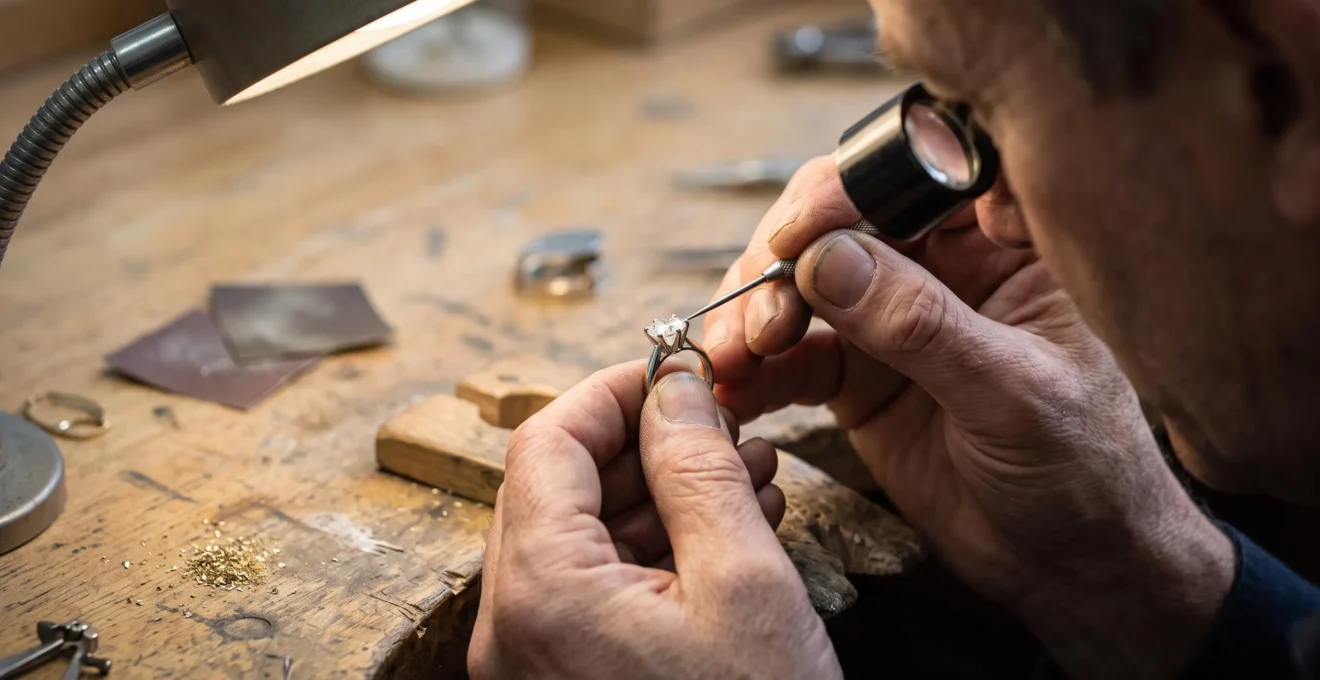
A gemstone can look perfectly centred, brilliant and undamaged while the metal holding it has already started to fail. The problem is often hidden at the bearing, where a prong contacts the stone, or beneath the visible setting. An attractive top view cannot establish whether those contact points still provide adequate support.
A professional stone setter controls more than appearance. The depth and shape of each bearing, the amount of metal remaining in each prong, the alignment of the stone and the construction of the supporting gallery all influence security. Wear, accidental impacts and unsuitable alterations can compromise that work without producing an obvious change in the ring’s appearance.
Understanding these details helps owners distinguish ordinary maintenance from urgent repair. It also gives buyers and aspiring jewellers a practical way to assess workmanship, compare setting designs and describe exactly what needs checking before a stone disappears.
What determines whether a ring keeps its stone secure?
- Contact matters more than appearance: a stone must fit its bearings correctly, with sufficient metal supporting it and no gaps that permit movement.
- Setting design must match daily wear: low profiles, protected edges and well-proportioned prongs often matter more than appearance alone.
- Inspection prevents avoidable losses: check for visible damage or movement, arrange professional examinations approximately every six months for frequently worn prong-set rings, and seek additional checks after impacts or alterations.
- Why Can a Stone Start Moving Long Before You Notice Anything Is Wrong?
- How to Spot a High-Quality Setting Using 5 Details You Can See Without Tools?
- Four-Prong or Six-Prong: Which Should You Choose if You’re Hard on Your Hands?
- The Resizing Mistake That Weakens Stone Security Even if the Ring Looks Fine Afterward
- When Should You Get Your Stones Checked if You Wear the Ring Every Day?
- Prongs, Bezel, or Channel: Which Setting Should You Choose if You Wear Gloves Daily?
- How to Choose a Setting Technique Using a 3-Question Lifestyle Test?
- Which Stone Setting Technique Is Best if You Catch Your Ring on Everything You Wear?
Why Can a Stone Start Moving Long Before You Notice Anything Is Wrong?
A gemstone can become loose because its metal supports gradually wear, deform or lose effective contact with its edges. The first changes may occur at the bearings beneath the visible prong tips. Since those contact surfaces are difficult to inspect from above, a ring may look unchanged while its stone is no longer held securely.
In a traditional prong setting, each prong contains a small shaped recess called a bearing or seat. This recess supports the gemstone near its girdle, the outer boundary between the crown and pavilion. The prong tip is then formed over the stone’s edge to retain it.
A properly fitted bearing must follow the gemstone’s contour. If a recess is too deep, leaves a gap or fails to support the stone correctly, the visible prong tip cannot compensate reliably for that defect. GIA’s prong-setting quality assurance benchmarks describe precise bearing contact, level seating and consistent prong finishing as essential workmanship criteria.
Stone security can deteriorate through three different processes:
- Progressive mechanical loosening: repeated contact, wear or small impacts may gradually change prong geometry or reduce effective contact with the stone. Existing gaps and weak bearings can make movement more likely.
- Sudden displacement or fracture: a single impact can bend or damage a prong, leaving the stone inadequately restrained even if the prong appears present from above.
- Metal deterioration: corrosion in susceptible alloys, porosity or an existing structural defect can weaken a supporting component. The precise mechanism requires inspection rather than assumption.
These failures need different responses. A displaced but otherwise sound prong may be suitable for professional adjustment. An excessively thin or fractured prong may require rebuilding or replacement. A compromised head or gallery may need more extensive work.
The distinction matters because a gemstone does not have to rotate visibly to be insecure. A small change in the relationship between the girdle and bearing can be important before obvious movement develops.
Some owners attempt a paper or fabric test, lightly bringing a ring into contact with a soft surface to detect catching or movement. However, this is not a validated test for stone security. Fabric catching can result from rough metal rather than a loose stone, and deliberate rubbing risks stressing an already weakened prong. A safer home check is to observe the stone and its supports without applying force.
If a stone clicks during ordinary handling, appears to move or shows a visible gap against a prong, stop wearing the ring until a professional examines it. Never attempt to reproduce movement by twisting the gemstone.
The next step is learning which visible details reveal careful setting work and which require closer professional examination.
How to Spot a High-Quality Setting Using 5 Details You Can See Without Tools?
A well-made setting generally has evenly finished prongs, balanced alignment, consistent stone height, clean metalwork and a stable supporting gallery. These five details can be assessed initially with the naked eye, although small defects may require magnification. Visual inspection can reveal poor workmanship, but it cannot certify that every hidden bearing is secure.
Begin by placing the ring on a stable surface under a bright, directional light. View it from directly above, from each side and against a lighter background. Compare corresponding features rather than relying on whether the gemstone looks attractive overall.
Five details deserve particular attention:
- Prong tip thickness and finish. Tips should appear properly formed, smooth and proportionate. Extremely thin, uneven or visibly worn tips merit inspection because too little remaining metal can compromise retention.
- Prong symmetry. Comparable prongs should have consistent placement and finishing. Obvious differences in height or contact may indicate uneven workmanship, deformation or previous repairs. Asymmetry alone does not establish the cause.
- Stone seating at the girdle. The stone should appear level and properly supported. A visible unsupported gap is concerning, while a stone positioned unusually deep may indicate excessive metal removal or an inappropriate design. Correct seating depends on the particular setting.
- Clean bearing and surrounding metalwork. Look for cracks, ragged tool marks, unexpected indentations or distorted prong bases. Decorative finishing should not be confused with structural damage, but unexplained defects deserve clarification.
- Gallery alignment. Viewed against the light, the supporting structure beneath the stone should appear intentional and consistent. Bent gallery wires, irregular connections or apparent structural separation require assessment.
The purpose of this inspection is not to demand perfect visual symmetry from every handmade ring. Different stone shapes and setting constructions may legitimately require different prong positions. The question is whether each contact point provides appropriate support for the design.
A 10× loupe or a smartphone macro camera can make these observations easier. The loupe is especially useful for distinguishing a normal reflection from a genuine space between the gemstone and its support. Move the light rather than manipulating the prongs.
For aspiring setters, the important lesson is that polishing does not correct poor bearing geometry. A polished prong can still be structurally weak if its bearing is excessively deep or incorrectly shaped.
40–50%
GIA’s technical benchmark specifies removing this proportion of the original prong thickness when preparing a bearing in its illustrated traditional angled-prong construction. This is a design-specific workmanship reference, not a universal cutting depth for every gemstone or setting.
Gemological Institute of America, Bench Tip #17: Avoid Stone Loss with Quality Assurance Benchmarks.
If a new ring shows an obvious gap, a damaged prong or uneven seating, request a professional explanation and, where necessary, correction before accepting the finished piece. A secure fitting should be demonstrated through proper bench inspection rather than reassurance based solely on appearance.
Once workmanship is satisfactory, the next decision concerns the construction itself: how much metal should hold the stone, and where should that metal be positioned?
Four-Prong or Six-Prong: Which Should You Choose if You’re Hard on Your Hands?
For a round gemstone exposed to frequent knocks, a well-built six-prong setting can provide additional retention points if one prong becomes damaged. However, six prongs do not automatically make a ring durable. The height of the stone, remaining prong thickness, bearing quality and protection against sideways impacts can matter more than prong count.
A four-prong setting leaves more of the gemstone’s perimeter visible and creates a relatively open appearance. A six-prong design distributes retention around more contact points, provided all six are properly formed and positioned.
The trade-off becomes clearer when considering how the ring will be worn. GIA‘s guide to engagement ring settings explains that additional prongs can improve security, while fewer prongs leave more of the stone exposed. The guide also identifies snagging and maintenance considerations for different setting designs.
For a wearer who frequently catches a ring on clothing, the relevant question is not simply whether four or six prongs are present. A high six-prong head with thin, projecting tips may be more exposed to accidental contact than a compact four-prong design with a lower profile.
The following comparison helps separate useful design differences from assumptions about durability.
| Decision factor | Four prongs | Six prongs |
|---|---|---|
| Stone visibility | More of the perimeter remains exposed. | Additional metal covers more of the perimeter. |
| Retention points | Fewer points support the gemstone. | More points can provide additional retention. |
| After one damaged prong | Loss of a retention point is particularly concerning. | Other prongs may continue supporting the stone, but security still requires immediate examination. |
| Exposure to knocks | Depends strongly on head height and prong geometry. | Also depends strongly on head height and prong geometry. |
| Maintenance | Each prong requires individual examination. | All six contact points require examination. |
Gemstone size also changes the decision. A larger stone generally requires a setting engineered for its dimensions, weight and exposed profile. Adding prongs is not a substitute for sufficient metal thickness or a correctly designed head.
Stone shape is equally important. Princess-cut and other angular gemstones present vulnerable corners. A setting must protect those corners without creating excessive pressure or exposing them to direct impacts. Appropriately constructed V-prongs or protective corner designs may be more suitable than conventional rounded tips.
Six prongs are not universally appropriate for every fancy-shaped stone. Their placement must follow the stone’s geometry, and the setter should choose a design that supports its actual outline.
For gardening, manual work or frequent sport, lowering the head and reducing exposed edges may offer a more practical improvement than increasing the number of prongs. Remove fine jewellery for tasks where crushing, direct impacts or equipment entanglement are foreseeable.
Even a carefully selected setting can become less secure after alteration, which makes the resizing method an important part of long-term stone protection.
The Resizing Mistake That Weakens Stone Security Even if the Ring Looks Fine Afterward
The critical resizing mistake is choosing a method that changes the shape or strength of gemstone supports without checking them afterward. Mechanical stretching is especially unsuitable for many stone-set bands because it can deform the metal around gemstones. Cutting, soldering and other alterations also require planning around the ring’s construction and a final security inspection.
Resizing changes the geometry of a metal band. The consequences depend on its alloy, stone arrangement, original thickness, head construction and the amount of adjustment required.
A plain band may tolerate a procedure that would be inappropriate for a ring carrying gemstones along its shoulders or circumference. In a stone-set band, altering the shank can affect the alignment and support of nearby settings.
GIA’s technical benchmark for ring enlargement by stretching specifically warns against stretching bands containing gemstones. Its example shows that deformation can increase spaces between stones and compromise supporting channel walls.
“Do not stretch bands containing stones. It can weaken the areas between or under stones and lead to stone loss.”
The other concern is an alteration involving cutting, soldering or heat near sensitive components. Heating can affect metal properties, while mechanical work may distort a thin head or adjacent supports. However, the effects vary by alloy, temperature, technique and construction. It would be incorrect to assume that every heated resize damages prongs or that heat necessarily hardens or cracks their bearings.
Two resizing situations deserve particular discussion:
- A substantial size reduction: removing metal and closing the shank can alter ring geometry, especially where the design includes stones near the work area.
- Enlargement by stretching: deformation can reduce material thickness or disturb stone-supporting structures. This is particularly problematic in gemstone-set bands.
Before authorising the work, ask the jeweller how the proposed technique will affect the head, gallery, shoulders and stone seats. Confirm whether a bench inspection of each setting is included after resizing.
For extensive size changes, a jeweller may recommend restructuring the shank, replacing part of the mounting or remaking the ring instead. Such decisions require examination of the actual piece; there is no universal number of ring sizes beyond which a particular repair becomes unsuitable.
After resizing, check that the ring remains round and comfortable, and ask the jeweller to verify gemstone seating, prong condition and any newly created gaps. Tightening or retipping should be performed only if the inspection identifies a need.
Resizing is a useful example of why setting maintenance should respond to specific events rather than follow a calendar alone.
When Should You Get Your Stones Checked if You Wear the Ring Every Day?
For a frequently worn prong-set engagement ring, professional inspection approximately every six months is a sensible baseline. Arrange an additional examination after a significant impact, suspected stone movement or major alteration. At home, look for visible gaps, damaged prongs and changes in how the stone sits, without trying to force movement or tighten metal yourself.
GIA’s diamond ring protection and inspection advice recommends checking prongs approximately every six months. It also identifies visible gaps and gemstone movement as warning signs and suggests a 10× loupe for closer observation.
That interval is guidance, not a guarantee. A ring exposed to heavy daily contact may need more frequent professional attention, while an occasionally worn piece has a different exposure pattern. Insurance policies may also impose their own inspection conditions.
The strongest reason to book an early assessment is a change in the ring’s condition. Examples include catching a prong sharply, noticing a new rough edge, discovering a missing accent stone or collecting the ring after substantial repair work.
Changes in finger size can alter fit and how a ring moves during wear. Seasonal swelling or weight changes do not, by themselves, prove a setting is loose, but they can justify checking both fit and security when the ring begins shifting or striking objects differently.
A useful monthly home check can be completed in roughly a minute. This is a practical observation routine, not a professionally validated diagnostic test.
Although paper or fabric tests are sometimes discussed as ways to notice snagging or movement, their reliability for detecting a loose stone has not been established by the supplied technical guidance. A ring that catches fabric may simply have a rough prong, while a loose stone may produce no detectable sound. Avoid deliberate rubbing or probing when damage is suspected.
Your five-step home setting inspection
- Record the inspection date. Add today’s date to a jewellery maintenance note so the next professional check can be planned.
- Photograph the ring from above. Save one clear image showing the gemstone’s apparent position and the arrangement of its prongs.
- Inspect the side profile. Use a small light and, if available, a 10× loupe. Record any visible gap, bent tip or unusual change in stone height.
- Examine the gallery and prong bases. Turn the ring gently in your hand without applying pressure to its settings. Note any visible crack, deformation or missing component.
- Decide whether professional attention is needed. Write down any change, previous impact or suspected movement. If a concern exists, stop wearing the ring and arrange a bench inspection.
A professional can examine bearing contact, metal thickness, hidden cracks and the condition of the gallery using appropriate magnification and bench equipment. When necessary, the jeweller can test retention under controlled conditions and recommend tightening, retipping or replacement of weakened components.
Home tools, including tweezers and pliers, should not be used to manipulate prongs. Applying pressure in the wrong direction can increase a gap or fracture weakened metal.
Preventive repair may be simpler when sufficient sound metal remains, but the cost and feasibility depend on the setting and damage. No inspection schedule can eliminate the possibility of stone loss.
The same prevention principle should guide the original setting choice, particularly for wearers whose daily work involves gloves, friction and repeated contact with equipment.
Prongs, Bezel, or Channel: Which Setting Should You Choose if You Wear Gloves Daily?
For frequent glove use, a smooth, low-profile bezel setting is often a practical starting point because it reduces exposed edges that can catch fabric. Channel settings can protect smaller stones along a band, while raised prongs are more likely to snag. The best choice depends on whether gloves create friction, direct impacts or workplace-specific hazards.
Glove use presents two distinct challenges: friction as fabric slides across the ring, and pressure when a hand presses against objects or equipment. A setting that performs well under one condition may still be exposed under the other.
Traditional prong settings hold stones with individual metal tips. When those tips extend beyond the surrounding ring surface, they can catch woven fibres or experience sideways contact. A low, well-finished prong setting reduces some exposure but does not eliminate it.
A full bezel surrounds the gemstone with a continuous metal rim, creating a smoother perimeter and protecting much of its edge. A partial bezel provides some protection while retaining more visible stone, though exposed areas remain.
Channel settings hold stones between metal walls, generally allowing a smoother band profile than prominent individual prongs. Their performance depends on sound walls, correct stone seating and the absence of deformation. A strong impact against the channel can still compromise retention.
For someone regularly wearing thick work gloves, a low bezel is worth considering because it reduces projecting metal and exposed stone edges. However, hard impacts, crushing and equipment entanglement remain hazards regardless of the setting.
For precision gloves, the main concern may be repeated rubbing and the need for a smooth exterior. A low-profile bezel or appropriately designed channel can be more comfortable than a tall head.
Medical and laboratory glove use requires an additional distinction: a smooth ring does not automatically make jewellery acceptable under workplace hygiene or safety policies. Glove integrity, cleaning requirements and possible chemical exposure must be considered separately. Jewellery removal may be required regardless of setting design.
A bezel introduces its own inspection limitations. Because more of the gemstone’s perimeter is covered, some bearing and edge conditions are less visible to the owner. This does not mean bezel settings necessarily hide all early problems, but they still require professional checks.
Repair access also differs. Adjusting a bezel may involve reshaping or rebuilding its rim rather than simply repositioning an exposed prong. The appropriate method depends on metal thickness, stone type and the original construction.
That same reasoning can be applied more broadly through a short lifestyle assessment before selecting a setting technique.
How to Choose a Setting Technique Using a 3-Question Lifestyle Test?
Choose a setting by answering three questions: Are your hands exposed mainly to impacts or friction? How much maintenance are you willing to arrange? Is maximum stone visibility more important than edge protection? These answers help narrow the options, but the final choice must also account for gemstone shape, metal construction and professional setting quality.
The test is a practical decision aid rather than a scientifically validated scoring system. Its purpose is to translate everyday activities into requirements a jeweller can use when designing or modifying a ring.
Question 1: Do your hands experience impacts or repeated friction?
Think about how often the ring strikes hard surfaces, catches fabrics or contacts equipment. These are different exposure patterns. Impacts suggest a need for protected edges and reduced head height, whereas repeated fabric contact particularly favours smooth surfaces with few projecting details.
Question 2: Are you comfortable with periodic setting maintenance?
All gemstone settings need appropriate care. However, exposed prong tips may require monitoring for bending and wear, while bezels and channels have different repair and inspection requirements. A preference for minimal maintenance should favour robust, accessible construction rather than the assumption that any setting is maintenance-free.
Question 3: Which matters more: open stone presentation or physical protection?
Prongs leave much of a gemstone visible, while bezels cover more of its edge. That difference affects appearance, but greater exposed surface does not guarantee a measurable improvement in brilliance. Gemstone cut, proportions and lighting also influence optical performance.
Use the combined answers to guide a conversation with the setter:
| Lifestyle combination | Setting direction | Important limitation |
|---|---|---|
| Frequent contact, minimal maintenance preference, protection first | Low full bezel or suitably constructed partial bezel | Requires inspection and may limit certain repairs or alterations. |
| Frequent fabric friction, accepts maintenance, open appearance preferred | Low-profile prongs with smooth, substantial tips | Prongs remain exposed and require monitoring. |
| Low impact exposure, open stone appearance preferred | Well-constructed four-prong or six-prong head | Security still depends on bearing quality and geometry. |
| Small stones across a band, smooth surface preferred | Appropriately engineered channel or flush setting | Stone arrangement may restrict resizing options. |
These combinations are starting points, not guarantees. A poorly constructed bezel can be less secure than a correctly executed prong setting. Likewise, a low-profile design does not make a ring suitable for every physical task.
When speaking with a setter, describe the required head height, the desired relationship between the stone and the finger, the thickness of exposed prongs and the need to protect vulnerable corners or edges.
For example, instead of requesting only a six-prong solitaire, a wearer who frequently catches clothing might ask for a compact head, carefully finished prong tips and a stone position as low as the design safely permits.
That request is more technically useful because it identifies the actual problem. The setter can then explain whether the existing stone, ring shoulders and gallery will accommodate the proposed construction.
The final decision should address the most common frustration directly: a ring that repeatedly catches on clothing, even when its gemstone appears secure.
Key takeaways before choosing a low-snag setting
- Prioritise the ring’s overall height and exposed edges before assuming that a particular number of prongs will solve snagging.
- Match the setting to both gemstone geometry and daily contact patterns; a smooth surface is not automatically impact-proof.
- Ask a qualified setter to evaluate bearing contact, metal thickness, gallery construction and future repair options before modifying an existing ring.
Which Stone Setting Technique Is Best if You Catch Your Ring on Everything You Wear?
If your ring repeatedly catches on clothing, a low-profile full bezel is often one of the most practical alternatives to a tall prong setting. Flush settings can offer an even smoother surface where the design allows. The essential objective is to reduce exposed height, projecting metal and vulnerable edges without compromising gemstone support.
Snagging is often treated as a problem with prongs alone, but the ring’s complete profile matters. A tall head, protruding prong tips, open gallery details or exposed corners can all create points of contact.
A setting may therefore require a change in proportion rather than simply a different number of prongs. Lowering the head or replacing an exposed mounting with a smoother design can sometimes address the cause more effectively.
The main low-snag options have different consequences:
- Low full bezel: a continuous rim offers a smooth exterior and protects much of the stone’s perimeter. It also conceals more of the gemstone’s edge and requires suitable metalwork for future adjustments.
- Partial bezel: retains some protective metal while leaving portions of the gemstone exposed. Its snagging performance depends on the shape and finish of those exposed sections.
- Flush setting: places a suitable gemstone within the surface of the metal, allowing a particularly low profile. Stone dimensions, available metal thickness and design requirements limit its applicability.
- Compact prong setting: preserves a more open appearance while reducing head height and exposed tip length. It can improve wearability but does not eliminate prong snagging.
- Engineered tension setting: may offer a distinctive appearance with fewer traditional prongs, but its retention depends on precisely controlled metal pressure. It is not inherently the lowest-snag option and can significantly restrict resizing.
For someone who catches a ring on sleeves or knitwear every day, the first discussion with a jeweller should focus on where the contact occurs. A projecting tip may be suitable for professional refinishing or repair if the original construction remains sound. A structurally high mounting may instead require redesign.
Before converting an existing ring, the setter must consider gemstone dimensions, existing damage, available metal, potential heat sensitivity and whether the proposed new head can be securely integrated with the band.
Not every ring can be safely converted into a bezel or flush design. Likewise, not every low-profile mounting can be resized easily afterward. A practical modification needs to preserve future serviceability as well as immediate comfort.
If continuous daily wear is unavoidable but the original design is too exposed, another solution is to separate roles. A simpler everyday band can be worn during routine activities, while the original gemstone ring is reserved for less demanding occasions.
Depending on the piece and the owner’s preferences, remounting the gemstone in a pendant may also reduce exposure to hand-related impacts. Protective accessories should not be assumed to eliminate snagging or mechanical risk, especially around equipment.
For wear involving machinery, heavy tools or tasks that could trap or crush a ring, removing jewellery is generally safer than relying on a stronger setting. The appropriate choice should also follow workplace rules.
The most useful next step is to have a qualified stone setter inspect the existing head and explain whether refinishing, repair, lowering or remounting would address the actual snagging points. Request a clear description of the proposed changes and a final stone-security check before the ring returns to daily wear.
Can a diamond fall out even if every prong looks intact?
Yes. A prong can appear intact while its bearing no longer fits the gemstone correctly. Excessively deep cuts, gaps or changes in alignment can reduce support without creating obvious damage when viewed from above. A professional inspection is needed to determine whether the stone is properly seated and retained.
Should you keep wearing a ring if the stone makes a clicking sound?
No. If the sound appears to come from gemstone movement, stop wearing the ring and arrange an inspection. A clicking sound does not identify the exact defect, and its absence does not prove that the setting is secure. Do not deliberately shake, twist or press the gemstone to confirm looseness.
Can a jeweller tighten a loose stone without replacing the setting?
Sometimes. If the metal remains sound and the bearing geometry is suitable, controlled prong adjustment may restore retention. Worn or thin prongs may require retipping, while damaged bearings, fractured supports or distorted heads can require more extensive repair or replacement. The decision depends on the actual defect and gemstone characteristics.
Does a bezel setting mean a gemstone can never fall out?
No. A bezel protects much of the gemstone’s edge and generally creates a smoother exterior, but its security still depends on adequate metal thickness, correct stone seating and sound construction. Severe impacts, metal deformation or defective workmanship can compromise a bezel. Periodic inspection remains advisable.
What should you ask a stone setter before accepting a repaired ring?
Ask what caused the problem, which components were repaired, whether the stone now sits correctly in its bearings and whether surrounding prongs or the gallery show additional wear. Request confirmation that stone security was checked after the work and ask when the setting should next be inspected. A satisfactory repair addresses the underlying weakness rather than appearance alone.