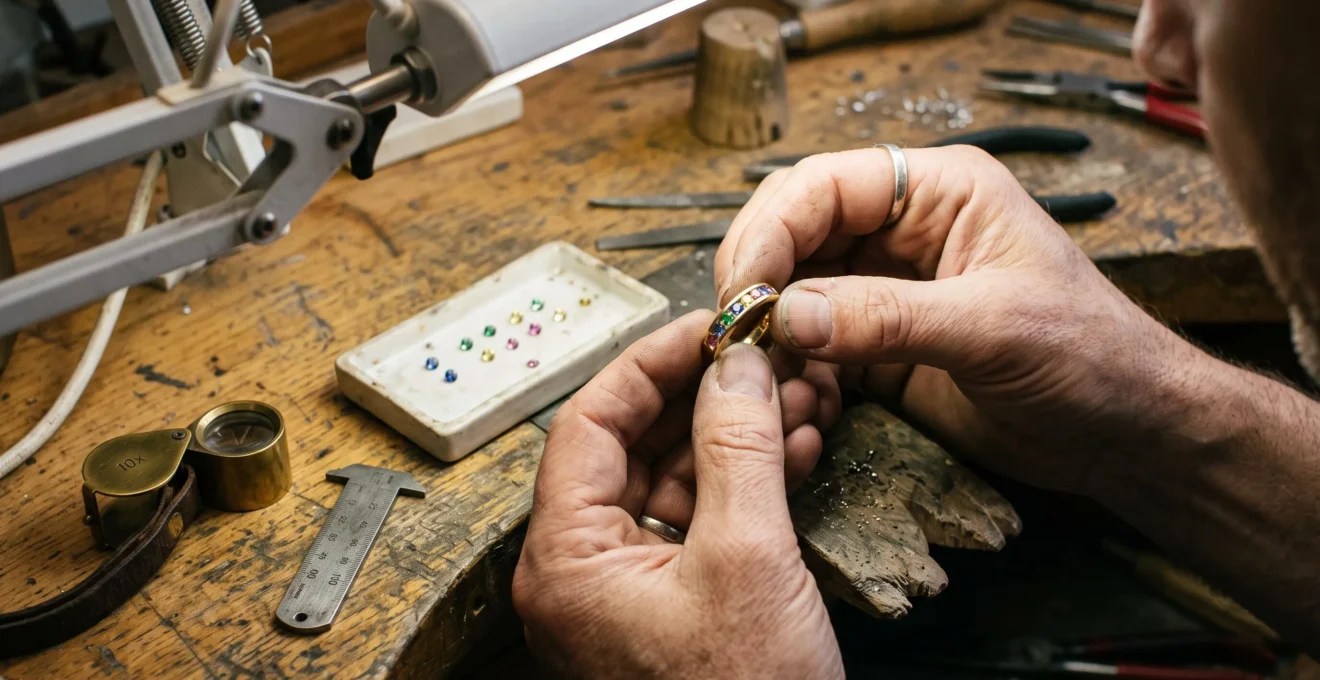
A row of small coloured gemstones can look more carefully made than a ring containing a much larger central stone. The difference often comes down to something less glamorous than carat weight: how consistently the stones have been cut, matched and fitted into their settings.
Calibrated coloured stones are cut to specified dimensions, typically expressed in millimetres. This makes them particularly useful for Art Deco jewellery, geometric mosaics, halos and channel-set designs, where neighbouring gemstones need to form a coherent pattern. Their appeal lies not in size alone but in the precision of the finished arrangement.
However, calibrated does not mean mathematically identical. Manufacturing tolerances, differences in cutting proportions and variations between suppliers can still affect the finished piece. Those differences also influence production costs, future stone replacement and whether a ring can safely be resized.
Understanding these practical details helps buyers distinguish genuinely well-executed multi-stone jewellery from designs that merely look symmetrical under showroom lighting.
What matters most in calibrated gemstone jewellery
- Consistent dimensions create visual refinement. Small variations become noticeable when repeated stones form straight lines or geometric patterns.
- Actual measurements matter more than labels. A nominal stone size does not guarantee that every gemstone will fit the same seat.
- Plan for repairs before buying. Standard-size stones can simplify replacement, but setting design, colour matching and future resizing remain important considerations.
- Why Do 0.2 mm Size Differences Create Visible Gaps in Calibrated Stone Designs?
- How to Spot Poorly Calibrated Stones in a Multi-Stone Ring Before You Buy?
- Calibrated Stones or Custom Cuts: Which Should You Choose if You Might Need Repairs Later?
- The Resizing Mistake That Can Crack Calibrated Stones or Make Replacements Impossible to Match
- In What Order Should You Source Calibrated Stones and Build the Setting to Avoid a 2-Month Delay?
- High Saturation or High Brightness: Which Looks Better in Daylight for Most Skin Tones?
- How to Inspect a Baguette or Emerald Cut in 5 Minutes Without Relying on Showroom Lights?
- Why Do Baguette and Emerald Cuts Show Every Speck of Dust After 2 Hours of Wear?
Why Do 0.2 mm Size Differences Create Visible Gaps in Calibrated Stone Designs?
A 0.2 mm difference can become noticeable in calibrated gemstone jewellery because neighbouring stones provide immediate visual reference points. In a tightly arranged channel, halo or mosaic, inconsistent widths may alter the spacing between stones or the alignment of their edges. Whether the difference is visible depends on the setting, stone shape, orientation and construction tolerances.
Calibrated gemstones are manufactured to nominal dimensions, such as 3 mm rounds or 4 × 6 mm ovals. These dimensions identify the intended size, not necessarily a promise of zero variation. Actual width, length, depth and outline may differ within an accepted manufacturing tolerance.
In GIA’s field study of Jaipur’s gemstone manufacturing industry, researchers documented coloured-stone production in standardised millimetre dimensions. One manufacturer reported that its customers typically accepted a 0.2 mm size tolerance.
0.2 mm
A customer tolerance reported by one calibrated-gemstone manufacturer in GIA’s Jaipur field research. This is not a universal tolerance requirement for jewellery settings.
Gemological Institute of America, Gems & Gemology, Winter 2016; field investigation conducted in 2015.
Consider a hypothetical straight row of stones intended to be identical. If one is slightly wider than its neighbours, a setter may need to adjust its seat, the surrounding metal or the spacing. A single isolated variation may attract little attention. Several inconsistent stones can interrupt the visual rhythm of the entire row.
The effect is especially apparent in geometric jewellery. The eye follows repeated table edges, corners and metal partitions as continuous lines. When these lines change direction or spacing unexpectedly, the pattern can appear less precise, even if the individual gemstones are attractive.
Poor fitting has consequences beyond appearance. Excessive clearance can leave visible gaps or dirt-catching recesses. Compensating with wider bezels or heavier-looking metal may obscure the stones and change the intended proportions. Conversely, a seat made too tight can place undesirable pressure on a gemstone.
There is no single appropriate millimetre tolerance for every setting. A tightly fitted baguette channel has different requirements from a design with individually constructed bezels.
Before commissioning a piece, ask the supplier for the nominal size, permitted dimensional variation and measurement method. The bench jeweller should then confirm what the actual setting can accommodate. A written specification is considerably more useful than a verbal assurance that the stones are calibrated.
Once the acceptable fit has been established, the next question is whether the jewellery in front of you actually meets it.
How to Spot Poorly Calibrated Stones in a Multi-Stone Ring Before You Buy?
Inspect a multi-stone ring from directly above under diffused white light, following the edges of the gemstones rather than their sparkle. Look for uneven gaps, wandering table outlines and irregular metal partitions. Then change the lighting angle and examine the setting from the side. Visual inspection reveals potential problems, while measurements confirm their cause.
Start with a clean ring. Oils and fingerprints can make some stones appear darker or smaller, confusing the assessment. A neutral background and ordinary diffuse lighting make the arrangement easier to judge without the distracting reflections of a showroom spotlight.
A practical inspection sequence is:
- Look straight down the centre of the gemstone row and identify the line formed by neighbouring table edges.
- Check whether stones of the same intended shape have consistent spacing and orientation.
- Inspect the surrounding metal for unusually wide sections, asymmetrical bezels or abrupt changes in channel width.
- Tilt the ring under a single directional light to see whether reflections reveal height differences or uneven seating.
- Examine the side profile and ask the jeweller about any visible variation before purchasing.
Not every apparent zig-zag proves that the stones were cut to different dimensions. A tilted stone, uneven setter’s work or deliberate design variation can produce similar effects. The inspection identifies where closer examination is needed.
Setting style also changes what can be seen. A substantial bezel may conceal slight differences around a gemstone’s outline. A recessed or flush setting can similarly hide portions of the girdle. An open gallery or closely fitted channel exposes more of the relationship between adjacent stones.
For this reason, a visually regular ring does not prove that every gemstone has identical measurements. It demonstrates that the combined cutting and setting work produces an orderly appearance.
Ask whether the stones came from one matched production lot or multiple suppliers. Cutting houses may work with different nominal tolerances, proportions and sorting practices. Two groups described as calibrated to the same size may therefore require additional matching before they can be combined successfully.
For a commissioned ring, request a measurement record listing each stone’s actual dimensions and assigned position. A buyer inspecting a finished piece can instead ask the jeweller to confirm whether the stones were individually checked for fit.
Even a beautifully matched row deserves one further consideration: how straightforward will it be to restore that appearance if a stone is damaged years later?
Calibrated Stones or Custom Cuts: Which Should You Choose if You Might Need Repairs Later?
Choose calibrated stones when future replacement and access to compatible dimensions are important priorities. Choose custom cuts when the design requires an unusual shape, exact geometric fit or distinctive arrangement that standard stones cannot achieve. Neither option guarantees simple repairs: gemstone availability, colour matching and the construction of the setting remain decisive.
Standard sizes can make sourcing a replacement more practical because jewellers may be able to search existing dealer stock rather than commission an entirely new cut. Common round sizes are particularly useful in designs that repeat the same stone shape across several positions.
However, identical measurements do not make two coloured gemstones visually identical. Their hue, tone, saturation, transparency, proportions and treatments can differ. A replacement sapphire may fit the seat perfectly but still look noticeably different from neighbouring stones.
Custom cutting offers a different advantage. A lapidary can work toward the dimensions required by a particular design, including elongated shapes, unusual angles or tightly integrated mosaic elements.
The trade-off is future dependence on a compatible stone and someone capable of reproducing the cut. The original lapidary may be an obvious contact, but is not necessarily the only cutter capable of making a replacement.
The following comparison helps clarify the practical choice.
| Decision factor | Calibrated stones | Custom-cut stones |
|---|---|---|
| Dimensions | Nominal standard measurements with agreed tolerances | Dimensions specified for the individual design |
| Design flexibility | Best suited to arrangements compatible with available sizes | Suitable for unusual outlines and highly tailored layouts |
| Replacement options | Potential access to existing supplier inventory | May require specialist sourcing or further cutting |
| Colour matching | Still requires careful matching of individual stones | Still requires suitable material and optical matching |
| Future maintenance | Often easier to plan when specifications are retained | Benefits especially from spare stones and cutting records |
Gemstone species also matters. Sapphire, ruby and garnet are found in calibrated commercial assortments, although availability varies by colour, grade, shape and size. Tanzanite, spinel and fine emerald can also be sourced in standard dimensions in some markets; their availability should be checked rather than assuming that these materials are exclusively free-size.
For an unusual custom mosaic, consider ordering one or two spare gemstones from the original matched lot. This does not eliminate future repair costs, but it can remove the need to find material with a closely comparable appearance later.
Ask for a record of the gemstones’ measurements, positions and relevant treatment information. Keep photographs showing the original alignment and colour arrangement.
Replacement planning becomes particularly important for rings, because changes to the band’s size can affect the setting itself.
The Resizing Mistake That Can Crack Calibrated Stones or Make Replacements Impossible to Match
The principal resizing mistake is treating a stone-set ring like an ordinary plain band. Changing the circumference of a ring can alter the geometry of its stone-bearing section, especially where channel-set or pavé gemstones continue around the shank. That movement may loosen stones, increase pressure on them or make subsequent repairs more complicated.
Conventional ring resizing can involve cutting the band, adding or removing metal, reshaping the shank and joining it again. The work is not confined to the cut: reshaping can transmit movement into other sections of the ring.
In a channel setting, gemstones sit between metal walls that help secure them. If the geometry of those walls changes, the original fit may be affected. Pavé arrangements have their own vulnerabilities because small stones depend on accurately positioned seats and metal beads or prongs.
GIA specifically warns in GIA’s ring sizing and resizing advice that pavé- and channel-set rings are generally difficult to resize. Rings carrying stones around their full circumference present additional challenges.
The potential consequences depend on the design and the work performed. A competent jeweller may be able to resize a particular ring without disturbing its gemstones, while another design may require extensive rebuilding or may be unsuitable for conventional resizing.
Calibrated dimensions do not protect a stone from mechanical stress. Precision cutting is useful only while the setting retains an appropriate relationship to the stone.
If a seat changes shape, a replacement gemstone matching the original nominal size may no longer fit without adjustment. It would be inaccurate to assume this happens after every resize, but it is a legitimate risk to assess in tightly constructed designs.
Before ordering a multi-stone ring, ask the maker to explain the following:
- Whether the ring has a plain metal section suitable for future sizing.
- Whether resizing would disturb the stone-bearing channel or pavé area.
- Whether a sizing bridge or another structural solution is possible.
- Which repairs or setting adjustments might be required afterward.
For a full eternity ring or strongly tapered design, obtaining the correct finger size at purchase is especially important. If the ring already fits poorly, have the structure assessed before attempting an alteration.
Once the sizing requirements are settled, the production sequence can be planned around real gemstone measurements rather than nominal dimensions alone.
In What Order Should You Source Calibrated Stones and Build the Setting to Avoid a 2-Month Delay?
Source and measure the gemstones before finalising the setting dimensions, then have the setter confirm the required seats before metal construction proceeds. This sequence reduces the risk of receiving finished settings that cannot accommodate the stones. It cannot guarantee a particular delivery date, but it makes dimensional problems easier to identify before expensive fabrication begins.
The difficulty usually arises when a design is approved using nominal stone specifications without confirming the actual stock that will be installed.
For example, a CAD model might be prepared for a repeated row of nominal 3 mm stones. If the delivered gemstones differ in diameter, depth or outline, the prepared seats may need adjustment. In a closely fitted geometric arrangement, accommodating one stone can also affect its neighbours.
This is why the setter needs the actual gemstones or verified measurements, not only the description on a supplier invoice. A dimensional drawing may describe the intended design, but the stones determine the practical fitting requirements.
Where stones must be imported or sourced from limited stock, consider reserving spare pieces from the same matched lot. Colour consistency may be difficult to reproduce after that lot has sold out.
A successful production handover also requires agreement about responsibility. The gemstone supplier, designer, metalworker and setter may be different businesses. If the stones are outside the stated tolerance, the parties should already know whether replacement, recutting or seat modification is the agreed remedy.
There is no documented universal two-month correction period. A delay of that length is a possible project scenario, not an established industry average. Lead times depend on stock, international shipping, cutting requirements and workshop availability.
Five checks to complete before authorising the setting
- Confirm the stone inventory. Obtain a lot sheet identifying gemstone species, shapes, quantities and nominal sizes.
- Record actual measurements. Request a dimensional record for each stone, including length, width and depth where relevant.
- Approve the matching layout. Have the stones assigned to their intended positions and retain a photograph or annotated layout.
- Obtain setter approval. Ask the bench jeweller to confirm the acceptable dimensional variations and intended seat construction in writing.
- Release fabrication with clear responsibilities. Keep a written approval recording the agreed specifications, spare-stone arrangements and process for resolving a fit mismatch.
For a commission, this documentation is not unnecessary administration. It prevents important technical decisions from being left until the point at which changing them is most disruptive.
Accurate construction establishes the geometry of the piece. The next consideration is whether the chosen gemstones will deliver the desired colour and brightness outside the workshop.
High Saturation or High Brightness: Which Looks Better in Daylight for Most Skin Tones?
For jewellery intended for everyday daylight wear, a bright-looking stone with attractive, moderate-to-strong saturation may be more versatile than an extremely dark, highly saturated stone. The better choice depends on the gemstone, its cut and the lighting conditions rather than skin tone alone. Buyers should compare colour and light return directly against their own skin.
Saturation and brightness describe different aspects of appearance. Saturation concerns the intensity or richness of a colour, while brightness concerns how much light appears to return toward the viewer. Tone describes how light or dark the gemstone looks.
These characteristics interact. A deeply coloured sapphire may have strong saturation but a dark tone that makes parts of it appear almost black in subdued light. A somewhat lighter stone can show more visible colour and lively reflections, even when its saturation is less intense.
As explained in GIA’s analysis of coloured gemstone value factors, gemstone appearance depends on colour characteristics together with cutting proportions, symmetry and optical performance.
Daylight therefore provides a useful reality check. Compare gemstones in open daylight and in shade, without relying on direct sunlight alone. A stone that looks exceptionally vivid under concentrated illumination may appear much darker under less favourable conditions.
Skin tone can also change the visual impression of a gemstone through contrast with surrounding colours. Some buyers prefer the harmony of warm orange-red or golden stones against warmer-looking skin; others enjoy the contrast of deep blue, green or teal stones.
These are aesthetic preferences, not established rules assigning specific gemstone colours to particular complexions. There is no reliable universal ranking of saturation versus brightness for most skin tones.
A practical comparison involves viewing the same stone against the hand in several ordinary environments:
- Indirect outdoor daylight, to assess natural colour and overall light return.
- Open shade, to identify excessive darkness or areas with little visible colour.
- Warm indoor lighting, to see how the gemstone behaves during ordinary evening wear.
When selecting stones for a mosaic, assess the group as well as the individual gems. Even if the dimensions match perfectly, one unusually dark or bright stone can interrupt the visual consistency of the pattern.
Once colour has been judged realistically, step-cut stones deserve a particularly close inspection because their broad facets make the quality of the cut easier to evaluate.
How to Inspect a Baguette or Emerald Cut in 5 Minutes Without Relying on Showroom Lights?
A useful five-minute inspection of a baguette or emerald cut focuses on symmetry, windowing, light return and visible inclusions. Examine the gemstone from above and from the side under ordinary diffused light, then tilt it gently to observe changes in brightness. A focused flashlight can supplement the inspection, but it should not replace neutral lighting.
Baguette and emerald cuts are step-cut styles, usually displaying relatively broad facets arranged in orderly rows. Their visual appeal depends heavily on geometry, clarity of facet reflections and the relationship between the stone’s proportions and its light performance.
Those broad facets can make some inclusions, colour zoning and cutting irregularities easier to notice than they would be in a more visually busy brilliant cut. Visibility still depends on the particular gemstone, inclusion and lighting, so this is not an absolute rule.
The following routine divides the inspection into five practical stages.
- Minute one — establish neutral lighting. Put the stone against a plain background and view it under diffused daylight or even white indoor illumination.
- Minute two — examine its outline. Compare opposite sides, corners and facet rows. Look for unintended asymmetry or misaligned steps.
- Minute three — check for windowing. View the stone face-up and look for a central area where the background seems unusually visible through the gem.
- Minute four — tilt the gemstone. Observe how light and dark reflections move across its facets. Look for large areas that remain persistently lifeless through modest changes in angle.
- Minute five — assess the intended setting. Compare the stone with its neighbours and inspect how its outline, dimensions and colour fit the proposed design.
Windowing can occur when gemstone proportions allow light to pass through the stone rather than returning in a visually satisfying way. This is particularly relevant when the buyer expects the gemstone to display an even field of colour.
Dark facet reflections are not automatically defects. Step cuts naturally create patterns of light and dark as they move. The concern is an unappealing combination of persistent darkness, weak colour return or conspicuous transparency through the centre.
There is also no universal ideal length-to-width ratio for every coloured baguette or emerald cut. Suitability depends on the specific design, the gemstone material and the desired outline.
For an Art Deco channel, pay attention to parallel facet rows and consistently aligned corners. A small asymmetry in one stone can become more obvious when repeated beside several straight-edged neighbours.
A gemstone that passes this inspection may still require more frequent attention during wear, because the clean geometric look of step cuts can make surface contamination especially noticeable.
Key takeaways before choosing step-cut jewellery
- Large, orderly facets create the geometric character of baguette and emerald cuts, but can make surface marks visually distracting.
- Choose a setting that allows suitable access for cleaning without sacrificing secure gemstone support.
- Confirm the gemstone species and treatment before selecting a cleaning method; appearance alone cannot establish what cleaning is safe.
Why Do Baguette and Emerald Cuts Show Every Speck of Dust After 2 Hours of Wear?
Baguette and emerald cuts can make fingerprints, oils and surface residue particularly noticeable because their broad, relatively uninterrupted facets display changes in clarity and reflection clearly. However, they do not necessarily collect dirt faster than other cuts, and there is no established rule that they become visibly dirty after two hours of wear.
The distinction is between how quickly contamination accumulates and how readily the eye detects it. Skin oils, hand creams and everyday residue can settle on the exposed surfaces of many gemstones, regardless of facet style.
On a step cut, a thin film may interrupt the broad, orderly reflections that define the stone’s appearance. Brilliant cuts have more numerous facets and complex reflection patterns, which can sometimes make an equivalent surface mark less immediately conspicuous.
That does not mean step cuts lack brilliance or that their surface chemistry makes them inherently more attractive to dust. The visible effect depends on the stone, its polishing, lighting and exposure to oils or other substances.
In a channel of closely arranged baguettes, contamination may become apparent across multiple stones after activities such as applying hand cream. The repeated geometry can make uneven reflections particularly distracting, especially when some stones are clean and others are coated with residue.
The practical solution is a gemstone-appropriate cleaning routine, rather than accepting dullness as an unavoidable feature of the design.
For many coloured gemstones, gentle cleaning with warm water, mild dish soap and a soft brush is appropriate. A soft, lint-free cloth can help with careful drying or light surface cleaning.
These methods are not universally safe. Certain gemstones, treatments and damaged settings require special precautions. Heat, steam, ultrasonic cleaning and some chemicals can affect sensitive materials or loosen vulnerable stones.
Check the gemstone’s identity, treatments and condition before washing it. If the information is unknown, obtain advice from a qualified jeweller or gemmologist rather than experimenting with cleaning products.
GIA’s jewellery care guidance also explains why ultrasonic cleaning deserves caution, particularly where vibrations may affect stones or their settings.
In everyday use, several habits can help preserve the appearance of a geometric multi-stone ring:
- Apply hand cream and cosmetics before putting on the ring, allowing products to absorb.
- Remove the jewellery during activities likely to expose it to grease, abrasive dirt or unsuitable cleaning chemicals.
- Wipe accessible surfaces gently with a clean, suitable cloth when fingerprints become visible.
- Arrange periodic professional inspections to check gemstone security and accumulated dirt beneath the settings.
Raising the gemstone table or changing the gallery can affect access for cleaning, but there is insufficient evidence to claim that a slightly raised table reliably prevents oil and dust accumulation. Any setting adjustment should therefore consider mechanical security, appearance and maintenance together.
Before buying, ask the jeweller to demonstrate how the finished piece should be cleaned and inspected. A design that combines accurately matched stones, accessible maintenance and a realistic repair plan is more likely to retain its intended appearance through regular wear.
Does calibrated mean that every gemstone is exactly the same size?
No. Calibrated stones are cut to specified nominal dimensions, but actual measurements can vary within manufacturing tolerances. GIA documented a manufacturer whose customers typically accepted a 0.2 mm tolerance, without establishing that figure as an industry-wide standard. Ask for actual measurements when precise fitting is important.
Can a replacement gemstone have the correct dimensions but still look wrong?
Yes. Correct dimensions establish potential physical compatibility, not visual equivalence. Differences in colour, tone, saturation, transparency and cutting proportions may make a replacement conspicuous beside the original stones. Matching under ordinary lighting is essential.
Are small calibrated gemstones always cheaper than custom-cut stones?
No. Standard sizes may reduce the need for individual cutting and simplify sourcing, but the finished cost also depends on gemstone quality, matching requirements, availability, setting complexity and labour. A very demanding calibrated mosaic can require substantial sorting and precision setting.
Should spare stones be included when commissioning an Art Deco mosaic ring?
Spare stones are worth considering when the design uses unusual dimensions, distinctive colours or a matched production lot that may be difficult to source again. Keep them securely labelled with the original measurements and design documentation. They may simplify future repairs, although a jeweller must still confirm their suitability before installation.
What should a jeweller confirm before accepting gemstones for a channel setting?
The jeweller should assess actual gemstone dimensions, cutting consistency, depth, girdle characteristics, the intended alignment and the available seat geometry. The acceptable tolerance must be established for that specific design rather than assumed from a supplier’s calibrated-size description.