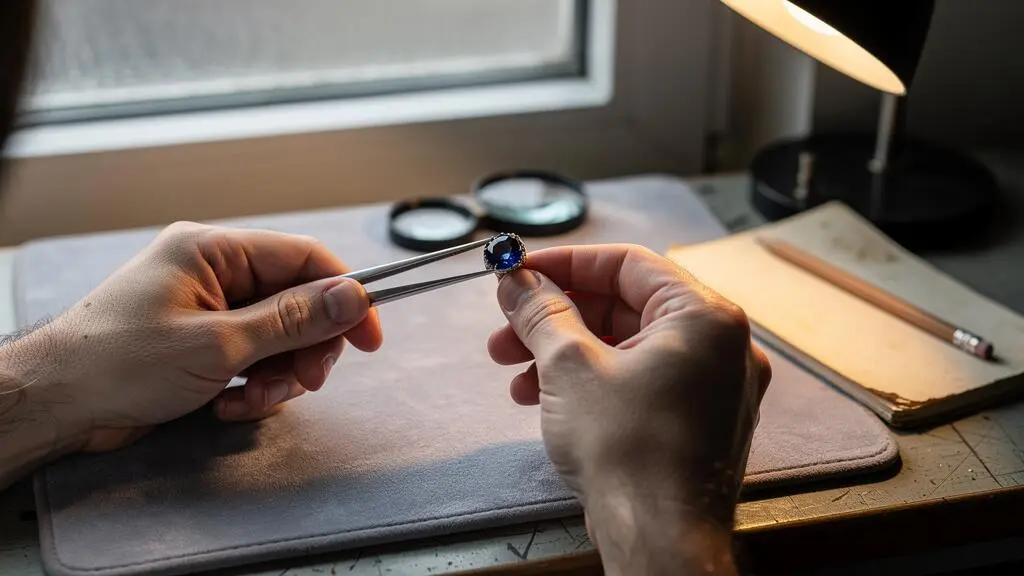
A sapphire or ruby that looks spectacular in direct sunlight but nearly black under ordinary indoor lighting is not necessarily defective. The difference often comes from the interaction between **colour saturation, tone, transparency, cutting proportions and available light**. A deeply coloured corundum absorbs a substantial amount of incoming light, and when less light reaches the stone, its colour may become difficult to distinguish.
However, not every dark appearance has the same explanation. A gemstone can show optical extinction, have an excessively dark body colour, contain inclusions that scatter light, or suffer from poor cutting proportions. These characteristics should not be confused with a transparent window, which is a different optical problem.
For anyone buying a coloured-stone engagement ring or everyday ring, the important question is not whether a sapphire or ruby looks impressive under jewellery-shop spotlights. It is whether the stone retains attractive, recognisable colour under the lighting conditions in which it will actually be worn.
Understanding treatment disclosures, evaluating stones in several lighting environments and checking their physical suitability for a ring are therefore essential before committing to a purchase.
What to Know Before Buying a Sapphire or Ruby
- A highly saturated gemstone can look almost black indoors because its body colour absorbs light that is already limited in dim environments.
- Cutting, transparency, inclusions and tone influence brightness just as much as colour intensity. A slightly lighter, well-cut stone can outperform a darker, more saturated alternative.
- Heat treatment is not automatically a durability problem, but glass filling, certain diffusion treatments and undisclosed enhancements require careful evaluation and appropriate documentation.
- Why Does a Sapphire Sometimes Show a See-Through Window Under Desk Lighting?
- How to Ask About Heat Treatment on Sapphires and Rubies Without Sounding Suspicious?
- Sapphire or Ruby: Which Should You Choose if You Plan to Wear It Every Day?
- The Enhancement Red Flag That Should Make You Walk Away From a « Bargain » Ruby
- The Setting Detail That Protects Sapphire and Ruby Edges After 100+ Wears
- High Saturation or High Brightness: Which Looks Better in Daylight for Most Skin Tones?
- Why Can High Saturation Make a Gem Look Too Dark Indoors After 6 pm?
- Why Does « High Saturation » Sometimes Look Fake Once You Wear the Stone Outside?
Why Does a Sapphire Sometimes Show a See-Through Window Under Desk Lighting?
A sapphire can look dark in the centre under a desk lamp because its saturated body colour absorbs much of the available light, while its cutting proportions may also direct light away from the viewer. A transparent window is different: it allows background light to pass through rather than returning a strong coloured reflection. Distinguishing these effects matters when evaluating a seemingly lifeless stone.
The first optical phenomenon to understand is **extinction**. In a faceted gemstone, some areas can appear unusually dark when their facets do not return sufficient light towards the observer. Deep body colour and limited illumination can make this effect more noticeable. A sapphire with strong saturation and a medium-dark or dark tone may therefore appear considerably darker indoors than it does outside.
A window, by contrast, is generally associated with cutting proportions that allow light to escape through the pavilion rather than being reflected back through the crown. It can make the centre look pale, transparent or washed out, sometimes allowing the background to show through.
These are not interchangeable problems. A stone with a window can look too light in its centre, whereas extinction creates dark areas.
The Gemological Institute of America identifies tone, saturation, cutting orientation and inclusions as important sapphire quality factors. It also notes that excessively dark colour can reduce a sapphire’s desirability, even when its saturation is strong. Its discussion of GIA’s sapphire quality factors is particularly useful when comparing stones that look attractive under different lighting conditions.
A practical comparison can help narrow down the cause:
- Under a single desk lamp: Observe whether the centre becomes dark while other facets remain bright.
- Near a window: Check whether the centre opens up and displays its blue or other body colour more clearly.
- Against a neutral background: Look for areas that appear transparent rather than simply dark.
- When tilting the stone: Notice whether dark patches move with the viewing angle or remain visually dominant.
This is a useful screening exercise, not a definitive gemological diagnostic test. A change in appearance does not independently establish whether the cause is extinction, windowing or absorption.
Inclusions add another variable. Fine rutile needles, commonly called silk, scatter light and can create an attractive velvety appearance in some sapphires. Excessive silk, however, can reduce transparency and make colour appear less clean or bright. Colour zoning can also influence the face-up appearance, depending on how the crystal was oriented and cut.
A clean examination with a 10x loupe can help identify visible inclusions and zoning, but professional assessment may be necessary to understand their significance.
The most useful purchase decision is based on the stone’s overall performance rather than one dramatic lighting test. A well-balanced sapphire should retain enough visible colour and brightness to remain attractive outside the jewellery showroom.
How to Ask About Heat Treatment on Sapphires and Rubies Without Sounding Suspicious?
The simplest way to ask about sapphire or ruby treatment is to request a precise description of every enhancement rather than asking whether a stone is simply natural. A natural gemstone can still be heated, diffusion-treated or fracture-filled. Reputable sellers should be able to explain what has been done, what remains permanent and whether the treatment changes the stone’s care requirements or value.
Heat treatment is an established practice in the coloured-stone trade. It can improve colour or apparent clarity, and its presence does not automatically make a sapphire or ruby unsuitable for everyday jewellery.
The important distinction is between different enhancement processes.
| Treatment | What it involves | What buyers should consider |
|—|—|—|
| Unheated | No heat enhancement has been applied, according to the stated treatment assessment. | Potentially valuable when supported by appropriate documentation and desirable natural colour. |
| Heat only | Heating is used to modify colour or improve apparent clarity. | Often compatible with everyday wear, although the stone’s overall condition still matters. |
| Lattice diffusion | Elements are introduced into the crystal lattice during heat treatment to modify colour. | Treatment depth and identification should be assessed; beryllium diffusion can penetrate deeply. |
| Glass filling | Glass is introduced into fractures to improve apparent clarity and appearance. | Requires special care and can significantly affect durability and value. |
The distinction between diffusion and fracture filling is particularly important. Beryllium diffusion can modify sapphire colour throughout much of the stone, rather than necessarily being limited to a thin outer layer. It can also accentuate ruby colour. Glass filling, on the other hand, introduces another material into fractures and may make a heavily fractured ruby appear considerably cleaner.
The Gemological Institute of America explains these processes in GIA’s introduction to gemstone treatments, including why some enhancements are difficult to identify conclusively without qualified laboratory examination.
A straightforward conversation with a seller can begin with:
« Could you clarify whether this sapphire or ruby has been heated only, or whether any additional treatment has been used, such as beryllium diffusion, lattice diffusion or glass filling? »
Follow this with more specific questions:
- Is the stone natural, laboratory-grown or an imitation?
- Has it received any treatment beyond conventional heating?
- Does the treatment require special cleaning or maintenance?
- Is the treatment status confirmed by an independent gemological report?
- Can the treatment description be included in the written sales documentation?
The distinction between a verbal assurance and documented information is important. For a significant purchase, request an independent report from a recognised gemological laboratory, such as GIA, Gübelin, SSEF or Lotus, where appropriate. Check that the report concerns the exact gemstone being purchased and read its comments rather than relying on a seller’s summary.
The US Federal Trade Commission also advises gemstone buyers to ask about treatments and explains that certain enhancements should be disclosed when they are non-permanent, require special care or significantly affect value. Its FTC consumer advice on buying gemstones provides useful purchasing guidance, although applicable legal disclosure requirements vary between countries.
A missing treatment statement on an invoice does not prove that a gemstone is untreated. It does, however, mean the buyer lacks useful written confirmation.
Five Checks to Complete Before Paying for a Coloured Stone
- Ask the seller for the treatment history and record the exact answer in writing.
- Request the independent laboratory report, if available, and retain its report number and identification details.
- Confirm whether the stone is heated, diffusion-treated, fracture-filled or described as untreated.
- Obtain written confirmation of any special cleaning, repair or maintenance restrictions.
- Keep the final treatment disclosure, invoice and return policy together as a verifiable purchase record.
A seller who welcomes informed questions is generally easier to work with than one who relies on vague descriptions such as « natural colour » or « premium quality ». Treatment itself is not the red flag; evasiveness, contradictions and missing identification are much more concerning.
Sapphire or Ruby: Which Should You Choose if You Plan to Wear It Every Day?
Both sapphire and ruby are varieties of corundum, with a Mohs hardness of 9, excellent toughness and no cleavage. Both can therefore be suitable for everyday rings. The better choice depends less on the gemstone’s name than on its treatment, transparency, cut, colour behaviour and the protection provided by its setting.
From a mineralogical perspective, ruby and sapphire share the same fundamental durability characteristics. Red corundum is classified as ruby, while other colours are classified as sapphire.
This means that a well-selected blue sapphire is not automatically more durable than a well-selected ruby. Nor is a ruby necessarily too delicate for daily wear.
The differences become more relevant when considering real-world appearance and treatment history.
**Colour behaviour under changing light** deserves particular attention. Blue sapphires can become darker or less vivid under certain indoor conditions, depending on their tone, saturation, inclusions and cut. Rubies may also change noticeably because chromium can produce red fluorescence when suitable ultraviolet-rich light is present. This can make some rubies appear more vivid in daylight than under certain indoor lighting.
Neither behaviour is universal. Individual stones should be evaluated rather than relying on broad claims about how every blue sapphire or ruby performs.
| Buying consideration | Blue sapphire | Ruby |
|—|—|—|
| Mineral hardness | Mohs 9 | Mohs 9 |
| Cleavage | None | None |
| Everyday-wear potential | Very good when appropriately selected and set | Very good when appropriately selected and set |
| Common appearance concern | Excessive darkness, zoning or visible extinction | Uneven colour, excessive darkness or visible treatment-related features |
| Treatment concerns | Heat and lattice diffusion, among others | Heat, diffusion and potentially significant glass filling |
| Budget considerations | Fine larger stones are comparatively more available | Fine untreated material can be particularly scarce and expensive |
Price is another meaningful distinction. GIA notes that fine-quality blue sapphires in larger sizes are more available than comparable large rubies. Consequently, a buyer seeking a substantial, clean, richly coloured gemstone may find that the ruby budget requires more compromise.
For example, a buyer might have to choose between a smaller or treated ruby and a larger sapphire with stronger transparency and brightness. Neither option is automatically better: the correct decision depends on the importance of colour preference, treatment tolerance and budget.
There is also a specific risk worth considering when evaluating inexpensive rubies. Some heavily fractured material is improved with high-lead-content glass filling. Such stones may look exceptionally attractive in a shop but require substantially more care than untreated or heat-treated ruby.
This does not mean every inexpensive ruby is glass-filled. It means that unusually low prices should prompt a closer examination of treatment disclosures rather than an assumption that a bargain has been found.
For a daily ring, both varieties benefit from a protective setting, sensible handling and periodic inspection. Mohs hardness measures scratch resistance, not immunity to impact damage.
A beautiful ruby or sapphire can be an excellent everyday choice, provided its actual condition is suitable for the intended use. The most reliable strategy is to prioritise a transparent, well-cut and appropriately treated stone over a particular gemstone name or carat weight.
The Enhancement Red Flag That Should Make You Walk Away From a « Bargain » Ruby
The treatment that deserves the greatest caution in a ruby intended for a daily-wear ring is **significant lead-glass fracture filling**. This process can make a heavily fractured ruby look dramatically cleaner and more attractive, but the filler is more vulnerable than corundum to certain chemicals and other damaging conditions. Its appearance should never be mistaken for the durability of a comparable untreated ruby.
Ruby naturally develops fractures and inclusions. In some heavily fractured material, manufacturers introduce high-lead-content glass into surface-reaching fractures to improve apparent transparency and colour.
The visual transformation can be striking. A ruby that previously looked cloudy or heavily fractured may become bright red and commercially attractive after filling.
The difficulty is that the improvement does not remove the underlying fractures. Instead, it changes how they appear.
GIA specifically identifies the vulnerability of fracture-filled ruby to chemicals, including relatively mild acidic substances. Its care guidance recommends cleaning fracture-filled, cavity-filled and dyed ruby with a damp cloth rather than using ultrasonic or steam cleaning.
Several visual clues may justify further investigation:
- Flash effects: Blue-orange or other contrasting flashes may appear along internal fractures when the stone is moved under suitable lighting.
- Gas bubbles: Small bubbles may sometimes be visible within glass-filled fractures.
- Unusual fracture appearance: Filled areas can have a different visual character from the surrounding corundum.
- Unusually attractive colour at an unexpectedly low price: This is a reason to request further information, not proof of a specific treatment.
These clues are not conclusive identification methods. Some treatment features are difficult to establish with the naked eye, and a loupe examination cannot replace a qualified laboratory assessment.
The consequences extend beyond cleaning. High-lead-glass-filled ruby can be vulnerable to household chemicals, heat and certain jewellery workshop processes. A jeweller may need to take special precautions before attempting repairs, resizing or other work involving heat.
This does not justify claiming that every glass-filled ruby will fail during ordinary wear or that every repair is impossible. The important point is that its maintenance requirements differ substantially from those of untreated and heat-treated corundum.
The distinction also affects long-term purchasing decisions. A heavily filled ruby should not be valued or presented as though its apparent clarity were equivalent to naturally clean material.
By comparison, GIA considers untreated and heat-treated ruby very durable. A buyer who accepts ordinary heat enhancement can still obtain a beautiful, practical gemstone without necessarily accepting the additional vulnerabilities associated with extensive fracture filling.
A useful rule is to walk away when a seller cannot clearly identify the treatment of a remarkably inexpensive, exceptionally attractive ruby, particularly when the stone is being promoted as a durable heirloom.
The objective is not to reject every treated gemstone. It is to avoid paying for an appearance that hides limitations incompatible with the intended ring, maintenance routine and long-term expectations.
The Setting Detail That Protects Sapphire and Ruby Edges After 100+ Wears
The most important setting detail for protecting a sapphire or ruby is **proper girdle support combined with protection for vulnerable facet edges and corners**. Corundum is hard, but its hardness does not make it immune to chipping. A protective setting should distribute support appropriately and reduce exposure to everyday impacts.
The girdle is the narrow perimeter separating the crown from the pavilion. It is particularly important because the stone’s setting holds and supports the gemstone around this area.
Facet junctions and sharp corners can also be vulnerable. Emerald-cut sapphires, for example, have clipped or defined corners that may be more exposed than the rounded outline of an oval stone. Princess-style cuts can have particularly vulnerable corners if the setting does not protect them adequately.
A jeweller should therefore consider the gemstone’s outline and construction rather than applying the same setting approach to every stone.
Several setting styles offer different levels of protection:
| Setting style | Edge protection | Practical considerations |
|—|—|—|
| Full bezel | High around the perimeter | A continuous metal rim surrounds the gemstone, shielding much of its edge. |
| Half bezel | Partial perimeter protection | Offers a more open appearance while covering selected vulnerable areas. |
| Prong setting | Depends on prong placement | Allows more light exposure but leaves sections of the girdle and corners exposed. |
| Tension setting | Requires specialist engineering | Holds the stone through carefully calculated pressure and provides limited conventional edge coverage. |
A full bezel is often a practical choice for someone who regularly uses their hands or prefers a more protected ring design. However, a well-designed prong setting can also be suitable when its placement and construction are appropriate for the stone.
The details discussed with a bench jeweller should include:
- Whether the entire girdle has adequate support within the setting.
- Whether vulnerable corners are protected by prongs or metal shoulders.
- Whether the gemstone sits at a height that reduces unnecessary exposure to impacts.
- Whether the setting avoids concentrating excessive pressure on a small part of the gemstone.
- Whether the design permits inspection and maintenance without unnecessary risk to the stone.
A setting should not simply clamp a gemstone at a vulnerable point. Its seat must be accurately matched to the stone’s dimensions and outline.
Maintenance also matters. Even a protective bezel or carefully designed prong setting can become compromised if the ring receives repeated impacts or the metal wears down.
A practical inspection routine includes checking for loose movement, displaced or worn prongs, visible chips and changes in the setting’s alignment. Annual professional inspection is a reasonable maintenance habit, with an additional check after a significant knock.
A ring should also be removed when practical during activities involving heavy impact, machinery or harsh chemicals.
A sapphire or ruby ring is a combination of gemstone and metalwork. The quality of the stone matters, but so does the way it is secured. Appropriate construction and regular inspection help preserve both appearance and structural integrity.
Key Decisions Before Choosing a Coloured Stone
- Do not select a gemstone on saturation alone: a bright, transparent stone with balanced tone can perform better in everyday lighting.
- Establish the treatment history before comparing prices, especially when a ruby looks unusually clean or vivid for its asking price.
- Choose the setting according to the stone’s outline, vulnerable edges and the practical demands of everyday wear.
High Saturation or High Brightness: Which Looks Better in Daylight for Most Skin Tones?
For most everyday jewellery buyers, a gemstone with strong brightness and good saturation is often more versatile than one selected for maximum saturation alone. Saturation describes the intensity or purity of colour, while brightness describes how much light the gemstone appears to return to the eye. A rich colour is desirable, but it should not come at the expense of visible brilliance and transparency.
These characteristics are related but not interchangeable.
A sapphire can have extremely strong blue saturation while appearing dark because its tone is too deep. Another sapphire may have slightly less saturated colour but return more light through its facets, producing a brighter and more lively appearance.
This distinction is especially important when moving between sunlight and indoor environments.
Under bright natural light, a deeply saturated stone can display impressive colour. Under weaker illumination, however, its absorption characteristics may become more obvious and the gemstone can look considerably darker.
Skin tone introduces another personal consideration. Warm yellow or golden undertones can complement blue sapphires with balanced blue colour and rubies with warmer red or orange-red appearances. Cooler pink undertones may work particularly well with violetish-blue sapphires or cooler red rubies.
These are aesthetic starting points, not scientific rules. The actual interaction depends on the individual gemstone, the wearer’s skin, surrounding colours and lighting conditions.
Fluorescence also deserves attention when evaluating ruby. Some rubies appear more vivid in sunlight because of their response to ultraviolet-rich illumination. A ruby that looks relatively subdued indoors may become more visually intense outside.
The best way to assess this interaction is to compare candidate stones against the skin rather than relying on product photographs.
A practical daylight evaluation should involve more than looking at a stone outdoors once.
- View it outside in natural light around midday.
- Hold it against the wrist and near the face.
- Compare it on a sunny day and an overcast day when possible.
- Check whether the colour remains attractive when the stone is tilted.
- Look for a balance between visible colour, transparency and returning light.
The final choice should also reflect personal preference. Some buyers deliberately prefer a darker, more dramatic sapphire, while others want a brighter stone that remains visibly blue in every setting.
Neither preference is inherently wrong. The key is knowing what the stone will actually look like in the conditions where it will be worn.
A gemstone should complement its wearer without requiring ideal lighting to look attractive. For most everyday rings, colour intensity that remains readable across changing environments is a more useful objective than maximum saturation on a grading card.
Why Can High Saturation Make a Gem Look Too Dark Indoors After 6 pm?
A highly saturated sapphire or ruby can appear almost black indoors after 6 pm because less light is available to illuminate the gemstone and return visible colour to the eye. A dark body tone and strong absorption can amplify this effect. The result is often a combination of illumination, cut, transparency and saturation rather than a problem caused by colour intensity alone.
The time itself is not the determining factor. A gemstone does not suddenly change at 6 pm. What changes is the lighting environment: daylight may fade, artificial lighting may become dominant and the amount of useful light reaching the stone can decrease.
A deeply coloured corundum absorbs a significant proportion of incoming light. When the illumination becomes weaker, the remaining light returned to the observer may not be sufficient to reveal the gemstone’s full colour.
This can make a rich blue sapphire look blackish or cause a ruby to lose some of its visible red character.
Several characteristics can intensify the effect:
- Dark tone: A stone that already sits towards the darker end of its colour range has less room to lose brightness before appearing nearly black.
- Cutting proportions: Facet angles and pavilion proportions influence how much light returns to the observer.
- Transparency: Heavy silk, cloudiness and other inclusions can reduce the clarity of the colour appearance.
- Extinction: Certain areas of the gemstone may remain dark because their facets do not return light effectively.
- Metal and setting design: The surrounding structure can influence the visual contrast and perceived openness of the gemstone.
This is why two sapphires with similar colour descriptions can perform very differently indoors.
A slightly lighter stone with better transparency and a well-balanced cut may look more attractive under ordinary household lighting than a darker, more saturated alternative.
The same principle applies to ruby. A vivid red gemstone should still retain a recognisable red appearance in the lighting where the ring will spend most of its time.
The most reliable test is to evaluate the actual stone under realistic indoor lighting before purchasing. Jewellery-shop spotlights can be exceptionally flattering to dark coloured gemstones, so a counter inspection alone is insufficient.
For a meaningful comparison, request to see the candidate under warm domestic lighting, including bulbs around 2700K where possible. Then compare it with the same stone under natural daylight.
Do not assume that a photograph taken under a spotlight accurately represents the gemstone’s everyday appearance. Camera exposure, white balance and image processing can further exaggerate colour differences.
A useful purchasing strategy is to favour:
- A medium or moderately dark tone rather than an excessively dark body colour.
- Good transparency without excessive cloudiness or distracting inclusions.
- Balanced cutting proportions that avoid unnecessary extinction or windowing.
- A setting that does not unnecessarily obstruct light entering the gemstone.
- Colour that remains identifiable under both daylight and warm indoor lighting.
The strongest everyday choice is not necessarily the palest or least saturated gemstone. It is the one whose tone, cut and transparency work together to preserve attractive colour when the lighting becomes less favourable.
Why Does « High Saturation » Sometimes Look Fake Once You Wear the Stone Outside?
A gemstone’s intense colour can look less convincing outdoors when the appearance created by shop lighting does not translate into natural daylight. Treatment, colour distribution, transparency and the relationship between saturation and brilliance all influence the result. However, unusually vivid or uniform colour does not independently prove that a sapphire or ruby has been treated.
The first distinction is between naturally occurring colour and enhanced colour.
Natural sapphires and rubies can display extremely vivid saturation. Their colour is influenced by trace elements and the conditions under which the crystals formed. Some exceptional stones are naturally intense without requiring colour enhancement.
At the same time, enhancement processes can significantly alter a gemstone’s appearance.
Beryllium diffusion, for example, can modify the colour of corundum by introducing an element into its crystal structure. Fracture filling can make ruby fractures less visible, improving apparent transparency. Dyeing and coatings are other enhancement techniques used across the gemstone trade, although they should not be assumed to be present in a particular corundum simply because its colour looks unusual.
The problem for buyers is that an attractive appearance does not reveal the complete treatment history.
Certain visual observations can justify closer inspection:
- Unusual colour distribution: Look for colour concentrations or irregularities that deserve professional examination.
- Fracture-related colour: Colour or visual effects associated with surface-reaching fractures may warrant further investigation.
- Unexpected appearance: Consider whether the stone’s colour, transparency and brilliance look balanced rather than relying on saturation alone.
- Price and provenance inconsistencies: An unusually low price combined with an exceptional origin or colour claim should prompt verification.
It is important not to turn these observations into false diagnostic rules. Uniform colour is not proof of treatment, and natural gemstones can have relatively even colour distribution. Likewise, visible inclusions are not mandatory evidence of natural origin.
Origin terminology can make the purchasing decision more complicated.
Descriptions such as « pigeon blood » for ruby and « cornflower blue » for sapphire are used in the coloured-stone market to communicate particular colour appearances. They should not be treated as automatic proof of geographical origin, treatment status or independent quality certification.
A seller’s claim that a ruby is pigeon blood red does not establish that it comes from a particular mining region. Nor does a cornflower-blue description prove that a sapphire is untreated.
Origin and treatment are separate questions. A laboratory may be able to assess both, but its conclusions depend on the stone, the available evidence and the scope of its examination.
The financial implications are important. A genuinely exceptional natural gemstone can command a substantial price, but price alone cannot establish authenticity or quality. Conversely, a lower-priced stone is not automatically synthetic, treated or unsuitable.
Buyers should therefore compare several stones side by side and evaluate their colour under consistent lighting.
A practical comparison involves looking at the same candidate in natural daylight, neutral indoor illumination and warm domestic lighting. Check whether the colour remains attractive, whether the stone appears transparent and whether its brightness supports its saturation.
The following distinction is useful:
| Observation | What it may indicate | Appropriate response |
|—|—|—|
| Exceptionally vivid colour | Potentially natural colour or enhancement | Verify treatment rather than assuming either. |
| Very uniform colour | Possible natural or treated colour distribution | Request professional assessment if concerned. |
| Colour concentrated around fractures | Possible treatment-related feature | Ask for laboratory identification. |
| Exceptional origin claim at a low price | Potentially misleading marketing or an attractive opportunity | Verify origin and treatment independently. |
| Strong colour with poor indoor brightness | Excessive tone, absorption or optical limitations | Compare the stone in realistic lighting. |
For significant purchases, request an independent report that identifies the gemstone and comments on treatment. Where geographic origin is important to the purchase price, ask whether the laboratory offers an origin opinion for that particular stone.
The most important distinction is between a gemstone that is genuinely vivid and one whose appearance has been improved through an enhancement that has not been properly disclosed.
A buyer does not need to become a gemologist to make a sensible decision. A consistent lighting comparison, a clear written treatment statement and appropriate independent documentation provide a much stronger basis for purchasing than colour terminology alone.
Ultimately, the best sapphire or ruby is not simply the one with the most intense colour under showroom lighting. It is the one whose colour remains appealing in real life, whose treatment history is understood and whose physical characteristics suit the demands of the ring it will become.
Why does my blue sapphire look black indoors but bright blue outside?
A sapphire may look almost black indoors because its dark, saturated body colour absorbs much of the available light. Under stronger daylight, more light reaches the gemstone and its blue colour becomes easier to distinguish. Cutting proportions, extinction, transparency and inclusions can intensify the difference. Evaluate the stone under both natural and warm domestic lighting before buying.
Does an unheated sapphire always look brighter than a heated sapphire?
No. Unheated status does not automatically mean greater brightness, better transparency or more attractive colour. Both unheated and heat-treated sapphires can be beautiful. The final appearance depends on the natural material, colour distribution, tone, saturation, cut and inclusions. Treatment status should be considered alongside the gemstone’s actual visual quality.
Can a glass-filled ruby be worn every day?
Some glass-filled rubies can be worn, but they require considerably more care than untreated or heat-treated ruby. High-lead glass filling can be vulnerable to chemicals, heat and certain cleaning methods. GIA recommends cleaning fracture-filled ruby with a damp cloth. Buyers should disclose the treatment to any jeweller before repairs or maintenance and consider whether the additional restrictions suit their intended use.
Is a darker sapphire more valuable because its colour is more saturated?
Not necessarily. Saturation is only one part of sapphire quality. Excessively dark tone can reduce desirability because the gemstone may lose visible brightness and colour under ordinary lighting. A well-balanced sapphire with strong saturation, good transparency and a suitable tone can be more attractive than a darker stone with limited light return.
Which gemstone is better for an everyday engagement ring: sapphire or ruby?
Both are suitable candidates because sapphire and ruby are varieties of corundum with Mohs hardness of 9 and no cleavage. The better choice depends on treatment history, transparency, cut, colour preference and setting protection. For daily wear, prioritise a well-documented stone without problematic enhancements and choose a setting that protects its vulnerable edges.