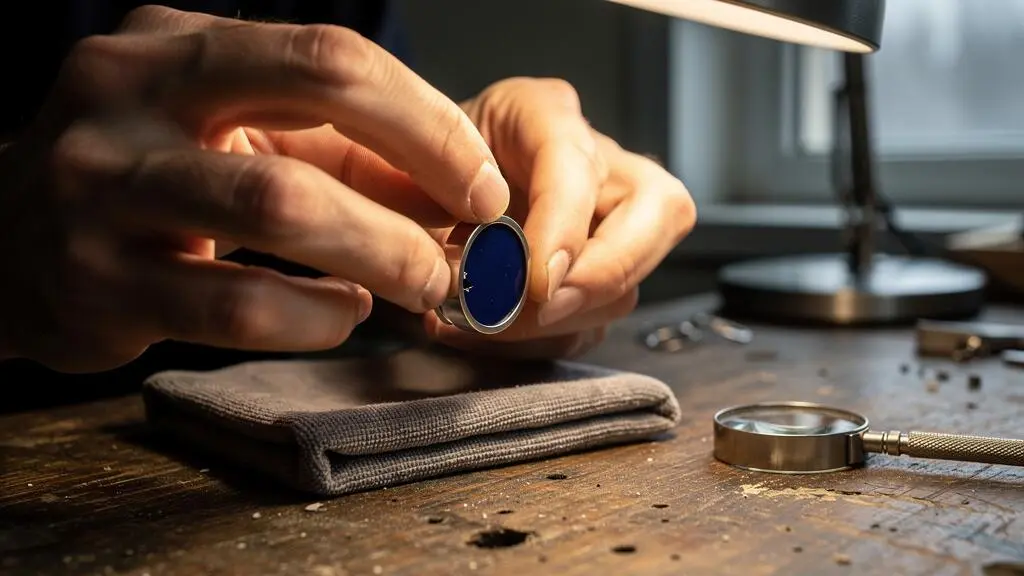
A brilliant blue ring can look flawless in its box and develop a tiny rough patch along the setting after only a few wears. That does not automatically mean its owner handled it carelessly. Glass is hard enough to resist many everyday contacts, yet brittle enough to fracture when force concentrates at a vulnerable edge.
Powdered-glass jewellery also covers more than one construction. Traditional vitreous enamel is powdered glass fired onto metal, whereas a separate glass inlay is manufactured independently and secured within a setting. Both can chip, but their attachment, support and potential repair methods differ. Some decorative surfaces sold under similar descriptions may also contain resin or incompletely fused glass particles.
To understand an early chip, examine where it formed, how the coloured surface is supported and whether a crack extends beyond the missing fragment. These observations are more useful than assuming that every mark is either a manufacturing defect or ordinary wear. Careful cleaning, inspection and realistic wearing habits can help preserve the finish without treating a fragile material as indestructible.
What matters most about glass-surface jewellery
- Edge chips can result from concentrated impact, inadequate edge protection or weaknesses in the original construction; the location alone cannot establish responsibility.
- Use a soft cloth, mild soap and limited moisture when appropriate for the complete piece. Avoid abrasive polishing and aggressive cleaning equipment.
- A superficial chip and a spreading crack require different responses. Stop wearing a cracked or unstable piece until a qualified jeweller examines it.
- Why Are Powdered-Glass Inlays Most Likely to Chip at the Border, Not the Centre?
- How to Clean Powdered-Glass Jewellery Without Scratching or Clouding the Surface?
- Vitreous Enamel or Glass Inlay: Which Should You Choose if You Wear Jewellery Weekly?
- The Wear-Context Mistake That Creates Micro-Chips You Only Notice in Sunlight
- When Should You Stop Wearing a Chipped Glass-Surface Piece to Prevent a Full Crack?
- Why Can an Organic Material Pendant Start Yellowing After Just 8 Weeks of Sunlight?
- Why Can Plique-à-Jour Enamel Crack From a Single Drop Even if the Metal Frame Survives?
- Why Does Plique-à-Jour Enamel Cost So Much, and Why Can It Still Crack Easily?
Why Are Powdered-Glass Inlays Most Likely to Chip at the Border, Not the Centre?
Powdered-glass jewellery can be especially vulnerable along its perimeter because the glass meets a metal setting, changes thickness or loses some of the protection available across its central surface. A knock against this junction may concentrate stress in a small region. However, edge chipping is not inevitable, and a chip’s position does not prove that the glass was poorly manufactured.
Glass and metal respond differently to applied force. A relatively ductile metal rim may deform slightly under an impact, while the adjacent brittle glass cannot accommodate the same movement without developing tensile stress. If the glass edge is exposed or pressed against a hard part of the setting, a small fragment may detach.
The centre of a well-supported inlay can distribute some contact forces through its underlying support. That does not make the centre impact-proof: a sharp blow can fracture glass anywhere. The more useful distinction is between a protected, adequately supported surface and a thin, exposed or tightly constrained border.
Manufacturing technique matters just as much as geometry. As The Metropolitan Museum of Art‘s explanation of champlevé enamelling describes, powdered glass, called frit, is placed into a recess in metal, fired and subsequently finished. Properly fired vitreous enamel forms a consolidated glass layer; it should not be assumed to remain a porous collection of loosely bonded grains.
A separately made, partially sintered glass component is different. Depending on its firing conditions, it may retain pores or weakly bonded regions. An incompletely consolidated or excessively thin edge could then be more vulnerable to fracture. Establishing whether that condition exists requires examination rather than visual speculation.
Thermal expansion adds another consideration. Glass and metal have different coefficients of thermal expansion, and manufacturers must account for their compatibility. Poorly matched materials can develop residual stresses during cooling after manufacture. Everyday temperature variations may affect an already stressed assembly, although ordinary hand warmth or washing does not, by itself, demonstrate progressive damage.
A simple inspection can reveal a developing problem:
- Place the clean, dry piece beneath a bright lamp or near a window.
- Angle the light across the glass rather than directly onto its face.
- Rotate the piece slowly and inspect the entire glass-to-metal junction.
- Look for tiny missing fragments, irregular reflections or lines extending inward.
- Where the edge is intact and safe to touch, gently move a clean fingernail along it without pressure. Stop if it catches on a sharp point.
A snagging edge may indicate a chip, raised metal, adhesive residue or another surface irregularity. It is a reason to inspect further, not a definitive fracture diagnosis.
If a new piece chips quickly despite limited exposure to knocks, photograph the damage and ask the seller about its manufacturing method and edge protection. Cleaning the remaining glass correctly is the next essential step, because abrasion can make an already damaged boundary harder to assess.
How to Clean Powdered-Glass Jewellery Without Scratching or Clouding the Surface?
Clean glass-surface jewellery with a clean, soft microfibre cloth and, where the entire construction tolerates moisture, a little lukewarm water with mild soap. Remove loose grit before wiping, avoid scrubbing chipped edges and dry the piece promptly. Never assume that a cleaning method suitable for solid glass is safe for adhesives, coatings, porous materials or gemstones nearby.
Ordinary dust can contain hard mineral particles, including quartz. Quartz is harder than many jewellery glasses, so rubbing contaminated dust across a surface can produce fine scratches. Dry buffing with a dirty cloth may therefore be more damaging than a gentle damp clean.
Use this sequence for a sound, water-compatible piece:
- Inspect the setting for loose glass, open seams, cracks or unstable decorative components.
- Remove visible loose dust with a clean, soft, dry brush or a very gentle movement of a clean cloth.
- Dampen a soft microfibre cloth with lukewarm water and a small amount of mild soap.
- Wipe the intact glass face lightly without pressing into the perimeter.
- Remove soap with a second cloth lightly dampened with clean water, then pat dry immediately.
Do not immerse a piece merely because its coloured surface looks waterproof. Moisture may reach adhesive joints, absorbent backings or other materials. If the maker specifies dry cleaning only, follow that instruction instead.
Ultrasonic machines and steam cleaners are poor default choices for unknown glass-surface constructions. Their vibration, heat or moisture exposure can threaten existing cracks, insecure attachments and sensitive adjoining materials. Ammonia-based cleaners and silver dips should also be avoided unless the manufacturer explicitly confirms compatibility.
Not every cloudy surface is chemically etched glass. A dull appearance may come from fine scratches, soap deposits, altered coatings, surface corrosion in susceptible glass compositions or contamination beneath a transparent layer. The appropriate treatment depends on the cause. Repeated attempts to polish away cloudiness can permanently remove decorative material.
For tarnished metal, keep the treatment strictly on the metal whenever possible. A suitable jewellery polishing cloth may be used carefully on accessible metal areas, without rubbing the coloured insert. Protective tape can sometimes help shield a stable glass surface during professional metal finishing, but adhesive tape should not be applied indiscriminately to delicate coatings, cracked glass or fragile enamel.
Finish by placing the piece on a clean, soft cloth until fully dry. Store it separately in a padded compartment so its glass face cannot rub against chains, clasps or other jewellery. Clean storage surfaces matter: accumulated grit can abrade jewellery during movement even when no other piece touches it.
If cloudiness remains after a gentle clean, stop experimenting with stronger products. A jeweller or enamel specialist can assess whether the problem is removable residue, permanent surface damage or deterioration in another component.
Vitreous Enamel or Glass Inlay: Which Should You Choose if You Wear Jewellery Weekly?
For weekly wear, choose according to construction quality, edge protection and the types of contact the jewellery will encounter—not colour alone. Vitreous enamel is glass fired directly onto metal, while a separate glass inlay is secured within a setting. Either can be durable in an appropriate design, and either can fail if exposed to concentrated impacts or inadequate support.
Traditional enamel techniques include champlevé, in which powdered glass is fired inside recesses in metal, and cloisonné, where fine metal partitions define coloured cells. These are not equivalent to inserting a separately formed glass cabochon or pane into a bezel.
The construction changes the possible repair. A localised enamel chip may sometimes be repaired by specialist enamelling, but refiring introduces heat-related risks and is not always feasible on a completed piece. A fractured separate inlay may instead need replacement or specialised restoration, particularly if the glass has split across its full thickness.
The following comparison is a practical purchasing guide rather than a measured ranking of impact resistance.
| Consideration | Vitreous enamel | Separate glass inlay |
|---|---|---|
| Construction | Glass fused directly to a metal substrate or framework | Preformed glass secured within a setting |
| Typical damage concerns | Chips, cracks or loss of adhesion under unfavourable stresses | Chipped edges, cracks, loosening or detachment |
| Potential repair | Specialist filling, restoration or possible re-enamelling | Re-securing or replacing the glass where feasible |
| Rings and bracelets | Potentially suitable when well supported and protected | Best with protective settings and secure retention |
| Pendants, brooches and earrings | Suitable with appropriate handling | Often practical because routine impact exposure may be lower |
| What to ask the seller | Firing method, substrate, edge protection and repair options | Glass type, retention method, replacement availability and care restrictions |
A ring worn during desk work or exercise experiences more frequent hard-surface contact than an earring worn away from the hands. A well-protected inlay in a recessed setting may therefore outperform an enamel design whose glass projects above its metal rim. Design and wearing context can matter more than the technique’s name.
At the point of purchase, inspect the profile of the decorative surface. A smooth transition into the metal can be consistent with enamel, while a visible retaining bezel or separate level may suggest an inlay. Neither observation is conclusive: enamel can be recessed or raised, and a separate inlay can be carefully fitted flush.
Ask whether the glass was fired onto the metal, mechanically set or bonded using an adhesive. Then ask what happens if it chips. A seller who can identify the technique, explain expected care and discuss repair availability offers more useful information than a general promise that the surface is hard-wearing.
Once the construction is understood, ordinary habits become easier to assess. Small, repeated contacts—not necessarily a memorable accident—can account for damage that seems to appear unexpectedly.
The Wear-Context Mistake That Creates Micro-Chips You Only Notice in Sunlight
The overlooked mistake is wearing brittle glass-surface jewellery through repeated contact with hard objects simply because none of the contacts seems forceful. Desk edges, car fittings, handbag hardware and gym equipment can all strike exposed glass. Small chips may remain unnoticed indoors until low-angle sunlight highlights their rough edges, making old damage appear sudden.
Consider a ring worn while typing. The glass may never hit the keyboard directly during ordinary keystrokes, yet the hand can brush a desk edge, laptop housing or another rigid surface many times. A bracelet may contact a metal seatbelt buckle, while a pendant may swing against a handbag clasp.
These activities do not automatically cause damage. Risk depends on contact geometry, force, surface protection and the glass’s existing condition. But repeated exposure creates more opportunities for an unfavourable impact than occasional, carefully controlled wear.
Lighting also changes perception. A small missing fragment alters the way light reflects from the edge. Under diffuse indoor illumination, that irregularity may blend into the setting. Under raking light, the damaged area can produce a sharp highlight, contrasting reflection or tiny shadow.
This explains why discovering a chip outdoors does not establish when it formed. Sunlight may reveal damage that was previously too small or poorly illuminated to notice. It does not prove that the material has suddenly deteriorated in the sun.
Five actions for a practical glass-jewellery wear check
- Inspect the perimeter: rotate the clean piece beneath a bright, low-angle light and record whether any edge looks irregular.
- Check the setting: look for lifted metal, visible gaps or movement without pressing on the glass; record any suspected looseness.
- Document the condition: take a clear, dated photograph of the full piece and a close-up of each suspicious area.
- Identify contact risks: write down the two routine activities most likely to bring the piece against hard surfaces.
- Set a wear rule: decide when to remove the piece and note whether the next monthly inspection shows a change.
A monthly light inspection is a useful personal-care habit, not a scientifically established safe inspection interval. Pieces that have suffered a knock or already show damage should be checked immediately rather than waiting for the next scheduled review.
More importantly, choose a wear rule that removes predictable hazards. Take off exposed glass rings before weight training, manual work or other repetitive-contact activities. Keep a pendant away from hard closures and avoid placing delicate jewellery loosely inside a handbag.
If inspection reveals a new edge defect, the next decision is whether it remains a minor surface loss or indicates a crack capable of extending through the glass.
When Should You Stop Wearing a Chipped Glass-Surface Piece to Prevent a Full Crack?
Stop wearing glass-surface jewellery when a crack extends inward from a chip, the glass moves within its setting, or any fragment appears ready to detach. A tiny, stable chip may be primarily cosmetic, but sharp edges and poorly visible cracks still warrant caution. The decision should depend on structural condition, not merely the size of the missing piece.
Glass fracture is governed partly by stress concentration. A crack creates a sharp tip at which local stresses can become substantially greater than those acting on the surrounding material. Another impact, movement of the setting or unfavourable thermal stress may extend that crack.
An isolated chip without a continuing fracture line is a different condition. Removing a tiny corner does not necessarily mean the remaining glass is about to split. Nevertheless, a chip can conceal very fine cracking, and its new edge may be more exposed to future impacts.
Use the following framework for initial assessment:
| Observed condition | Possible significance | Recommended response |
|---|---|---|
| Small, smooth edge flake; no visible crack or movement | Possibly cosmetic damage | Avoid further impacts; seek assessment if sharp, worsening or uncertain |
| Fine line extending from the chip toward the centre | Possible fracture capable of propagating | Stop wearing and arrange specialist inspection |
| Crack crossing the glass surface | Potentially compromised structural integrity | Stop wearing; do not attempt home repair |
| Glass moving, lifting or separating from the bezel | Risk of detachment or fragment loss | Remove immediately and secure the piece for assessment |
Inspect suspicious lines under angled light, but do not push on the glass to find out whether it moves. Pressure applied during an informal test can worsen an existing defect.
A jeweller may be able to correct an insecure setting, replace a damaged component or refer the piece to a specialist enameller. Whether that is possible depends on how the glass is held, the nature of the damage, and how much intervention the surrounding decoration can tolerate.
Do not use household glue to conceal a fracture. Adhesives may alter the appearance, contaminate the junction and complicate subsequent repair. They also do not necessarily restore the mechanical integrity of the original material.
Until inspection, place the piece flat in a soft, individual compartment. Keep damaged surfaces away from chains, gemstones and clasps. A cracked object can be subjected to further stress through movement or pressure inside a jewellery box even when it is no longer being worn.
Not every change in a coloured jewellery surface is mechanical, however. Yellowing points toward a different set of material questions, especially when the object includes polymers or other organic components.
Why Can an Organic Material Pendant Start Yellowing After Just 8 Weeks of Sunlight?
An organic-material pendant can begin yellowing after several weeks of sun exposure because light, particularly ultraviolet radiation, can trigger chemical changes in certain polymers, resins and colourants. Eight weeks is a possible observation, not a universal deterioration threshold. The speed and appearance of yellowing depend on the material, formulation, accumulated exposure and environmental conditions.
Many synthetic resins contain polymer structures that can change when exposed to ultraviolet radiation and oxygen. Depending on the chemistry, these reactions may produce coloured degradation products or alter the material’s optical properties. Some formulations also become brittle or lose strength over time.
The Canadian Conservation Institute‘s guidance on caring for plastics and rubbers identifies light-related discolouration, yellowing and embrittlement among the deterioration processes affecting susceptible materials. It also identifies natural resins as potentially sensitive to sunlight.
This does not mean all organic jewellery components behave identically. Synthetic resin, amber, dyed wood and bone have different compositions and degradation mechanisms. It would be misleading to apply the same photochemical explanation or eight-week timeline to every one of them.
Conventional, uncoated vitreous enamel and many jewellery glasses are generally much more resistant to sunlight-induced yellowing than vulnerable organic polymers. However, yellowing alone cannot establish that a pendant is not glass. Transparent adhesives, resin backings, surface coatings or decorative layers can change colour while the glass itself remains intact.
Examine the distribution of discolouration before attempting to remove it:
- Uniform yellowing: may be consistent with material ageing, broadly distributed light exposure or a formulation-related change.
- Yellowing concentrated on one side: may suggest uneven exposure, a local coating difference or a neighbouring material.
- Marks around contact areas: may point toward transferred residues, surface contamination or reactions involving cosmetics, skin oils or fragrance.
These patterns suggest questions to investigate rather than providing a definitive diagnosis. Cleaning will not reverse every chemical change, and aggressive solvents can further damage sensitive materials.
For a composite pendant, inspect the cord, resin backing, adhesive and wooden elements as well as the visible glass. One deteriorating component can make an otherwise intact piece unsuitable for wear.
Reducing unnecessary sunlight exposure and storing susceptible pieces away from direct light can help limit deterioration. Avoid leaving resin-rich jewellery on a sunny windowsill or inside a hot vehicle.
Glass is comparatively colour-stable, but that stability does not imply exceptional resistance to impact. The distinction becomes especially important in plique-à-jour enamel, where decorative glass can lack an underlying metal support.
Why Can Plique-à-Jour Enamel Crack From a Single Drop Even if the Metal Frame Survives?
Plique-à-jour enamel can crack after one drop because its coloured glass spans openings in a metal framework without a permanent supporting metal plate underneath. During impact, the frame may flex or transmit force into the brittle enamel windows. The metal can remain visibly intact while the glass develops a fracture that is difficult to detect without careful inspection.
Unlike champlevé enamel, which occupies recesses in a metal substrate, plique-à-jour creates translucent openings resembling miniature stained-glass windows. The effect depends on transmitting light through the glass, so the completed structure does not have the same continuous backing as conventional recessed enamel.
The Journal of the American Institute for Conservation article on historical enamelling techniques describes this defining construction. It explains that a temporary backing can support the enamel during firing and is subsequently removed.
Two mechanical routes can explain damage following a fall. The first is direct contact: a hard surface strikes an enamel window or its edge, initiating a fracture. The second is transmitted deformation: the metal framework moves under impact, and the rigid glass cannot follow that movement without experiencing stress.
Neither outcome is guaranteed after every drop. The result depends on the object’s geometry, enamel thickness, metal properties, existing flaws, landing surface and orientation at impact.
After a drop, place the piece on a padded surface and inspect it against a steady, bright light. Look for thin dark or bright lines inside individual cells, sudden changes in transparency, missing fragments and separation along the metal partitions.
Rotate the object slowly to distinguish surface reflections from apparent cracks. Do not bend the framework or press on a transparent window to test its strength. If the piece has fallen onto a hard surface and its condition is uncertain, avoid wearing it until a specialist has assessed it.
Repair can be difficult because work on one glass cell may affect neighbouring enamel and the metal framework. Heat-based intervention also creates risks for adjacent decoration, finishes and components. A specialist must determine whether consolidation, partial replacement or a more extensive restoration is technically appropriate.
The historical conservation literature establishes the construction and fragility of this technique, but it does not provide a universal probability of fracture after a particular drop. Visible survival of the metal frame is therefore reassuring only about the frame’s immediate appearance, not proof that every enamel window is undamaged.
This vulnerability creates an important purchasing distinction: a technically demanding enamel object can be expensive to make without being suitable for frequent contact, travel or everyday handling.
Key decisions before buying delicate enamel jewellery
- Check whether the glass is supported by a continuous metal substrate or suspended between metal partitions.
- Evaluate the actual wearing environment rather than treating price, hardness or craftsmanship as guarantees of impact resistance.
- Ask about inspection, specialist repair and protective storage before committing to a complex glass-surface piece.
Why Does Plique-à-Jour Enamel Cost So Much, and Why Can It Still Crack Easily?
Plique-à-jour enamel can be expensive because producing transparent glass windows within a fine metal framework requires demanding preparation, controlled firing and careful finishing. Its price reflects skilled labour, complexity and production risk rather than exceptional toughness. Even a beautifully executed piece retains the mechanical vulnerability of brittle glass spanning unsupported openings.
Producing these windows requires the enamel worker to control how powdered glass behaves inside small metal cells. The material must be fused into a coherent translucent surface while maintaining the intended colour, shape and relationship with neighbouring cells.
Multiple applications and firings may be needed, depending on the design and technique. Each additional intervention requires care because heat can affect glass already present in the object. The risk of faults, distortion or unsuccessful firing contributes to the difficulty of production.
The Victoria and Albert Museum‘s guide to metalworking techniques identifies plique-à-jour as a demanding technique and explains how removing the temporary backing produces the finished translucent effect. This supports the craftsmanship distinction, although it does not provide specific workshop failure rates, firing counts or manufacturing costs.
Claims that every cell must always be fired separately, or that a fixed proportion of pieces fails during manufacture, should not be treated as universal rules. Workshop methods and design complexity vary, and the available institutional sources do not establish such figures.
The apparent contradiction between high cost and fragility disappears when price and durability are assessed as separate properties. A complex glass window can demand considerable expertise to create while remaining vulnerable to bending or concentrated impact once finished.
That distinction should shape the purchasing decision. A plique-à-jour pendant reserved for occasional wear may be easier to protect than a ring worn through everyday work, travel and exercise. A protective box can reduce accidental contact during storage, but it cannot change the structural design of the enamel itself.
Before buying, consider the full ownership requirements:
- Intended use: whether the piece will be worn occasionally or exposed to regular movement and contact.
- Protection: whether its glass windows are recessed, guarded or otherwise shielded by the design.
- Inspection: how easily the cells can be checked for hairline cracks or loose fragments.
- Maintenance: which cleaning methods the maker approves for the entire construction.
- Repair feasibility: whether an experienced enameller can assess or restore the specific piece and whether an estimate is available.
- Storage: whether it has an individual padded compartment that prevents pressure on unsupported glass.
These considerations apply beyond plique-à-jour. Fired champlevé enamel, separately seated glass and partially sintered glass components each present a different combination of edge geometry, support, attachment and vulnerability. Identifying the construction is the starting point for meaningful care.
Edge chips should be investigated rather than automatically blamed on the owner or the maker. A poorly protected edge can increase susceptibility to knocks, while ordinary wear may expose brittle glass to contacts its design cannot withstand. If damage develops unusually quickly, documentation and an informed professional assessment are more useful than assumptions.
For existing pieces, a simple routine is enough to make better decisions: remove loose grit before cleaning, avoid unnecessary impacts, inspect the perimeter in angled light, and stop wearing anything cracked or insecure. Specialist intervention becomes especially important when the glass is unsupported or the original technique is difficult to reproduce.
Before the next purchase—or the next wear of a damaged favourite—identify the construction, photograph any existing defects and ask a qualified jeweller about repair options. Choose the piece whose beauty, protection and maintenance requirements genuinely fit the way it will be worn.
Does an edge chip mean the jewellery was defective when purchased?
Not necessarily. A chip can result from impact, inadequate protection, pre-existing damage or a manufacturing weakness. Its position alone cannot identify the cause. Photograph the defect, record when it appeared and ask the seller or a qualified jeweller to examine the glass and setting.
Can a jeweller polish a chip out of coloured enamel?
Sometimes specialist finishing can improve a minor surface irregularity, but polishing removes material and may worsen thin enamel or expose the underlying metal. A deep chip generally cannot be made structurally sound simply by polishing. An enamel specialist should assess whether restoration or replacement is appropriate.
Is waterproof glass-inlay jewellery safe to wear in the shower?
Glass itself may tolerate water, but the complete jewellery construction may contain adhesives, coatings, vulnerable metals or absorbent materials. Shower products and repeated moisture exposure can also complicate maintenance. Unless the manufacturer explicitly approves shower wear, removing the piece is the more cautious choice.
Can transparent nail varnish or clear resin protect a chipped enamel edge?
Applying a clear coating is not a reliable structural repair. It may change the appearance, age differently from the glass, contaminate the damaged area or interfere with professional restoration. If the edge is sharp, cracked or unstable, stop wearing the piece and request a specialist assessment rather than applying a household coating.
What information should you request when buying handmade enamel jewellery?
Ask for the specific enamelling technique, whether the glass has a metal backing, how exposed edges are protected, which cleaning methods are recommended and whether repairs are possible. For a separate inlay, ask how the glass is retained and whether a replacement can be made. These answers help establish realistic expectations before regular wear.