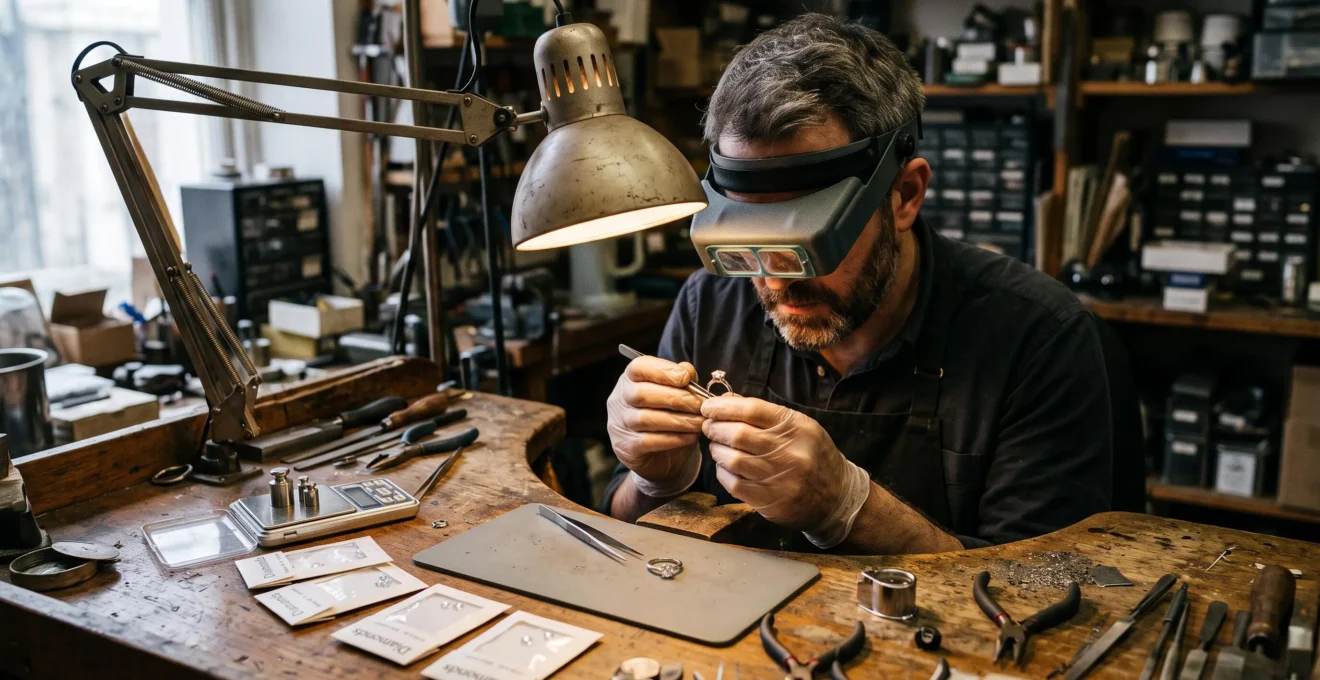
A ring needs resizing. A stone feels loose. A chain has broken at one link. To its owner, the problem looks obvious, and the solution ought to be quick. Yet the bench jeweller asks when the damage appeared, whether the piece has been repaired before, what metal it contains, and how frequently it is worn.
Those questions are not an attempt to complicate a straightforward job. They establish whether the visible problem is the entire problem. A loose stone may sit in worn claws. A broken joint may be surrounded by weakened metal. A ring that looks suitable for resizing may contain settings that cannot tolerate the distortion involved.
A bench jeweller works directly on jewellery: examining, shaping, soldering, welding, setting stones, rebuilding components and finishing metal. Unlike a sales consultation, a bench assessment must account for what the object can physically withstand.
Understanding that distinction helps jewellery owners describe problems accurately, compare repair options and recognise when a cautious estimate is more useful than an immediate promise.
What to know before asking for a jewellery repair
- Detailed questions help identify vulnerable settings, previous repairs and structural weaknesses before work begins.
- Photographs can support an initial estimate, but a reliable final quotation may require examining the piece under magnification.
- The right decision may be a small repair, substantial reconstruction, a remake or deliberately limited wear without immediate intervention.
- Why Can a “Quick Resize” Turn Risky Once a Bench Jeweller Asks About the Setting?
- How to Describe a Jewellery Problem So a Bench Jeweller Can Quote Accurately From Photos?
- Repair, Remake, or Leave It: Which Should You Choose if the Ring Is Worn Thin?
- The Cheap Repair Choice That Often Leads to a Second Failure Within 12 Months
- When Should You Book a Bench Jeweller if You Need Work Done Before a Major Event?
- When Should You Take Fine Jewellery Back to the Bench for a Check-Up After Heavy Wear?
- Wax Prototype or Straight to Metal: Which Should You Choose for a Simple Solitaire?
- Why Do Wax Prototypes Save People From Expensive Regret in Custom Jewellery?
Why Can a “Quick Resize” Turn Risky Once a Bench Jeweller Asks About the Setting?
A quick ring resize becomes risky when changing the band’s circumference also changes the pressure on its gemstone settings. Pavé shoulders, tension settings, alternating metals and existing repairs can complicate what looks like a small adjustment. A bench jeweller asks about these features to determine whether the ring can be resized safely, needs reconstruction or should not be altered by conventional methods.
Resizing is not simply stretching or squeezing a circle. Depending on the construction and size adjustment, the jeweller may cut the shank, remove or insert metal, join the ends and restore the shape. Altering the circumference can also redistribute stress through the shoulders and head of the ring.
Consider a ring with small diamonds set along its shoulders. As the shank changes shape, the metal holding those diamonds can move. A previously secure stone may become loose, particularly where the beads or claws retaining it are already worn.
In a true tension setting, the metal’s engineered pressure helps retain the gemstone. Changing that structure requires a different assessment from resizing a conventional plain band. Mixed-metal rings bring additional complications because their alloys may behave differently during heating, joining and deformation.
The GIA‘s guide to engagement ring settings explains the structural roles of setting components and why delicate arrangements require attention to security and maintenance. The type of setting matters, but its actual condition and workmanship matter as well.
A practical inspection can lead to three different approaches:
- Direct resize: Adjust the circumference using a suitable standard technique when the construction and condition permit it.
- Resize with partial reconstruction: Add or remove metal while rebuilding an affected section or correcting setting distortion.
- Renewal of the affected area: Replace a weakened shank section or perform more extensive work when an ordinary resize would leave the ring vulnerable.
Questions about side stones, alloy, previous resizing and visible cracks help distinguish these options. A jeweller may also inspect gemstones for existing chips or fractures before applying pressure or heat.
The technical complexity is illustrated by GIA’s technical benchmark for laser resizing a diamond-set ring. For a specific platinum-cobalt construction, the documented procedure addresses joint preparation, compatible metal, welding and careful reshaping around set diamonds.
That procedure does not mean every stone-set ring requires laser welding. It demonstrates why a resize should be selected according to the ring rather than a fixed shop routine.
A jeweller who asks detailed questions before accepting the work is identifying potential failure points. That is generally more reassuring than an unconditional promise made without seeing the piece, although the quality of the eventual workmanship still matters.
How to Describe a Jewellery Problem So a Bench Jeweller Can Quote Accurately From Photos?
To obtain a useful jewellery repair estimate from photographs, describe where the problem is, what happened before it appeared, what you can actually observe and what you know about the piece’s history. Add sharply focused photographs showing the damaged area, the complete item, its scale and its profile. Expect a provisional estimate rather than a guaranteed price before physical inspection.
Start with the location. Instead of writing “the setting is broken”, identify the affected part: “One claw on the side nearest my palm catches on fabric when I wear the ring.” A clear orientation helps the jeweller match your description to the photographs.
Next, explain the trigger. Did the ring hit a doorframe? Has the stone gradually begun to move? Was the problem noticed immediately after a previous repair? These details help separate a sudden impact from progressive wear.
Then describe the symptom without attempting a technical diagnosis. “The stone moves when I gently change the ring’s position” is more useful than confidently declaring that the mounting needs replacing.
Finally, provide the known history: the metal, approximate age, previous sizing or setting work, any gemstone documentation and whether the piece is worn daily. Unknown details can simply be marked as unknown.
Useful photographs should include the whole item, a focused close-up of the problem, a side profile, the inside of the band where relevant, and a scale reference such as a small ruler. Diffuse daylight, a plain background and a steady camera help reveal the shape and boundaries of damage.
Flash reflections and blurred close-ups can hide tiny cracks or distort the apparent thickness of metal. A photograph composed to show a ring attractively on the hand is not necessarily suitable for evaluating its condition.
More importantly, a photograph cannot establish the condition of every hidden surface. Internal wear, damaged seats beneath gemstones and weaknesses around previous joints may remain invisible until inspection.
That is why a responsible photographic estimate describes its assumptions. For example, replacing a single claw tip and rebuilding an entire worn setting involve different work, even when the customer’s initial complaint is identical.
Prepare a repair enquiry that a jeweller can assess
- Identify the problem’s exact position and write a one-sentence location description.
- Record when the problem appeared and what preceded it in a short damage timeline.
- Describe only observable symptoms, producing a factual two- or three-sentence account.
- Take a set of clear images showing the overall piece, damage, scale and relevant profiles.
- List known materials, prior repairs and your required date, then send one complete enquiry requesting a conditional estimate.
If a stone is clearly loose, avoid repeatedly testing it or wearing the piece while arranging an inspection. Good communication should not create additional damage.
Better information can reduce unnecessary exchanges, but it cannot replace the final examination. The most trustworthy quote is the one that clearly states what has and has not yet been assessed.
Repair, Remake, or Leave It: Which Should You Choose if the Ring Is Worn Thin?
Choose between repairing, remaking and leaving a thin ring unchanged according to its remaining structural strength, its sentimental or historical importance and how often it will be worn. A daily-wear ring with a weakened shank may justify substantial reconstruction. An inherited ring worn occasionally may deserve minimal intervention, provided its limitations and risks are understood.
The bottom of a ring’s shank often experiences repeated contact with desks, handles and other hard surfaces. Over time, that area can become thinner or develop a flattened profile.
Thickness cannot be judged reliably from an attractive exterior photograph. A bench jeweller needs to examine the metal at its weakest location, assess deformation and look for damage near previous joints. There is no single safe minimum thickness applicable to every ring design and alloy.
Three questions determine the direction of the discussion: how much usable metal remains, what characteristics must be preserved, and what demands future wear will place on the piece.
| Option | When it may make sense | Principal trade-off |
|---|---|---|
| Repair existing metal | Localised wear with enough sound surrounding material | Other weakened areas may still need attention later |
| Replace or remake the shank | Substantial wear on a ring intended for frequent use | Greater intervention and possible loss of original features |
| Leave unchanged | Historically important or occasionally displayed jewellery | Wear must be restricted if the structure is vulnerable |
Repairing preserves more of the existing structure; remaking replaces or recreates components that can no longer perform their intended function. A shank replacement may retain the original setting and gemstone, whereas a complete remake can involve producing a substantially new piece.
This distinction matters with antique jewellery. Replacing the band could remove hallmarks, maker’s marks, original tool marks or construction details relevant to authenticity and collectability. Such work should be discussed before cutting or polishing begins.
Consider two hypothetical rings with comparable wear. One is an engagement ring used every day; the other is a family heirloom worn only at special occasions. The first may benefit from replacing its weakened shank. The second may be better preserved through careful storage and limited handling, especially where originality matters.
Leaving a ring unchanged is not permission to ignore an imminent structural failure. If the jeweller identifies a likely bending or fracture point, continued wear may be unsafe. The appropriate recommendation could be to stop wearing the ring altogether until its condition changes or a conservation decision is made.
The best outcome is not necessarily the most extensive intervention. It is the one that respects the jewellery’s purpose, original character and realistic future use without disguising structural weakness.
The Cheap Repair Choice That Often Leads to a Second Failure Within 12 Months
A low-cost repair can fail again when it corrects visible damage without addressing the structural weakness that caused it. Reattaching a stone while leaving worn claws untouched, or joining a broken section surrounded by weakened metal, may postpone rather than resolve the problem. A second failure within 12 months is possible, but it is not an established universal failure rate.
Imagine a ring with four claws securing a gemstone. One claw has worn thin enough to lose contact with the stone, while the other three are also approaching the end of their useful life.
Rebuilding only the visibly damaged tip may be appropriate if the other claws are sound. If they are all badly worn, that limited intervention leaves the same underlying risk distributed around the stone.
Similar reasoning applies to broken shanks. A clean break in otherwise sound metal is different from a fracture surrounded by porous, deeply worn or repeatedly repaired material.
The technique itself is not necessarily the problem. Laser welding, conventional soldering and other specialised methods can all have legitimate applications. What matters is whether the selected technique produces a sound result for that specific construction.
GIA’s technical guidance on laser resizing, discussed earlier, describes deliberate joint preparation and the use of compatible metal. It does not support the claim that laser welding is inherently a temporary or inferior repair.
Likewise, adhesive is not a structural substitute for rebuilding worn precious-metal claws in a conventional gemstone setting. But adhesive can be appropriate in certain jewellery constructions originally designed to use it. The context determines the treatment.
A documented case of visible repair versus structural condition
In GIA’s report on jewellery workmanship and structural defects, a professional examination identified extensive porosity in a ring’s metal. The inspecting professional recommended remaking the ring because the problem extended beyond the visibly affected areas.
The reported case describes subsequent attention to visible defects rather than immediate replacement of the entire deficient structure. It illustrates the distinction between treating what can be seen and addressing a more extensive underlying defect. It does not establish a general repair-failure rate or a particular recurrence period.
When comparing quotations, ask each jeweller to identify the condition of the surrounding metal and settings. One estimate might include a local repair; another might include replacing worn metal, rebuilding several claws or correcting the surrounding structure.
Ask for the minimum viable intervention and a more comprehensive alternative to be described separately, where both are technically reasonable. Then compare what each option actually accomplishes rather than focusing only on the initial amount charged.
The less expensive intervention can also create additional work if it later needs to be removed or revised. Repeatedly handling vulnerable gemstones introduces further risk, even when each operation is performed carefully.
A durable repair does not require rebuilding every part of every piece. It requires identifying the failure mechanism, selecting proportionate work and explaining the remaining limitations before proceeding.
When Should You Book a Bench Jeweller if You Need Work Done Before a Major Event?
Book a bench jeweller as soon as the event date is known, and arrange an inspection before relying on any promised completion time. The required schedule depends on the repair, gemstone sensitivity, workshop workload and availability of materials. Allow additional time for unexpected findings, finishing and a final fitting rather than planning collection immediately before the event.
Workshop calendars are shaped by more than the time spent physically working on an item. An initial examination may reveal that parts must be made, stones temporarily removed, settings rebuilt or another specialist consulted.
A straightforward polishing job is not equivalent to rebuilding a shank or reconstructing a complex pavé setting. Rhodium plating, re-tipping and stone tightening also have different preparation requirements depending on the construction and condition.
Seasonal demand can affect availability. Workshops may be particularly busy around wedding periods and major gifting holidays, although actual lead times vary by business and location.
A sensible plan works backwards from the event:
- Set the date by which the jewellery must be ready for comfortable, reliable use, not simply collected.
- Arrange an inspection early enough to receive a diagnosis and approve the proposed work.
- Ask the workshop to explain dependencies, including gemstone assessment, replacement materials and specialist operations.
- Reserve additional time for unexpected damage and possible changes in scope.
- Collect the completed piece sufficiently early to assess fit, comfort, finish and gemstone security.
A resizing appointment is particularly important before a wedding or formal event. Finger size can vary with temperature and temporary swelling. A ring that fits during a brief cold-weather appointment may feel different in warmer conditions or after prolonged wear.
Fragile or treatment-sensitive materials demand additional caution. Emeralds, opals, peridot and enamelled components can require special handling. Their particular vulnerabilities depend on the material, treatments, construction and operation proposed.
Urgency does not remove material limitations. A competent workshop may decline an express repair where safe handling or adequate finishing cannot be accommodated. That is a professional judgement, not necessarily poor service.
If the inspection reveals a cracked shank or insecure gemstone close to the deadline, the responsible alternative may be to wear a different piece rather than attempt a rushed structural repair.
Once the jewellery is returned, wear it briefly in ordinary conditions and report any discomfort or unexpected movement promptly. The final check is part of preparing for the occasion, not an optional afterthought.
When Should You Take Fine Jewellery Back to the Bench for a Check-Up After Heavy Wear?
Take fine jewellery for an inspection after a significant impact, when a gemstone appears loose, when a claw catches on clothing or when the metal shows unusual deformation or deep wear. Frequently worn jewellery merits more regular professional attention than occasional pieces. There is no single inspection interval that replaces checking the condition and exposure of each item.
Jewellery often develops warning signs before complete failure. A familiar ring might begin snagging knitwear, a gemstone may produce an unfamiliar faint rattle, or the underside of the band may show flattening and deep scoring.
These observations do not diagnose the defect. A catching claw may be displaced or worn, while a clicking sound could indicate movement somewhere in the setting. Either deserves examination rather than repeated home testing.
Visible wear also needs interpretation. Ordinary superficial scratches are not equivalent to significant metal loss. A bench jeweller can distinguish cosmetic damage from changes affecting structural integrity.
A meaningful professional check-up may include:
- Magnified examination of claws, beads, bezels and gemstone seats.
- Assessment of gemstone security using methods suitable for the setting.
- Inspection of the shank, shoulders, joints and previously repaired areas.
- Evaluation of metal wear, deformation and possible fatigue.
- Appropriate cleaning, with tightening or repair recommended separately when needed.
Not every piece should undergo the same cleaning process. Insecure stones and certain gemstones require particular care. GIA’s educational guidance cautions that ultrasonic cleaning can dislodge stones that are already loose.
Daily activities influence inspection needs. Manual work, weight training, gardening and repeated contact with hard surfaces can place extra loads on rings. Chlorinated environments may also be relevant to some jewellery alloys and finishes, while water and temperature changes can affect how securely a ring fits on the finger.
For these reasons, occupational exposure and actual wear patterns are often more informative than a calendar alone. Someone who removes jewellery before demanding activities has a different exposure profile from someone who wears it continuously.
Early detection protects more than the setting. Replacing a worn claw tip may prevent the loss of a gemstone that would be difficult to match. This is particularly important for older hand-cut stones and unusual shapes that are not readily available in standard calibrated sizes.
A useful check-up should leave the owner with a clear explanation: what was examined, whether any intervention was performed, what concerns remain and when the piece should be reassessed.
Routine inspection cannot guarantee that jewellery will never break or lose a stone. It can, however, identify accessible weaknesses before they become more serious and help owners decide how safely the piece can continue to be worn.
Wax Prototype or Straight to Metal: Which Should You Choose for a Simple Solitaire?
Choose a wax prototype for a solitaire when height, band width, proportions or comfort are still uncertain. Going directly to metal may be reasonable when the design reproduces an existing, well-understood model or an approved specification. Wax provides a physical representation of the design, but it cannot reproduce the final metal’s shine, weight, strength or every visual characteristic of the finished ring.
A solitaire appears simple because it usually centres attention on one gemstone. Its wearability, however, depends on several interacting dimensions: the shank’s width and profile, the height of the head, the gallery’s shape and the relationship between the setting and the finger.
Small changes to these proportions can alter how the ring feels. A high setting may catch on clothing or interfere with gloves, while a very low arrangement may create other practical constraints around the stone or a neighbouring wedding band.
A physical model lets the client inspect those proportions at actual scale. The ring can be viewed from above, from the side and on the finger, revealing details that may be difficult to judge from enlarged digital renders.
But a wax model is not a finished-metal performance test. Its fragility does not predict the strength of the properly engineered final ring, and its surface does not reproduce polished metal or actual gemstone reflections.
The choice also depends on how the design was developed. In a CAD-based workflow, the jeweller may create a digital three-dimensional model and use it to produce a physical prototype. Wax and CAD are therefore complementary rather than competing methods.
This relationship is documented in GIA’s field report on jewellery manufacturing in Shenzhen, which describes a production process in which digital design files were used to make wax models before subsequent metal production.
The report documents the manufacturing method, not a universal rule that every customer needs a wax prototype. For a familiar standard solitaire with agreed dimensions, direct production may avoid an unnecessary stage. For a ring designed around distinctive finger proportions or a specific stacking requirement, physical validation can be more useful.
It is also possible to approve a CAD design digitally and later review a physical prototype. Additional stages generally involve further work and scheduling, so their value should be measured against the uncertainty they resolve.
Before approving production, identify what still feels uncertain. If the answer involves how the ring sits or moves on the hand, a physical model may be worth discussing. If the proportions are already proven, a well-specified direct build may be sufficient.
Key takeaways before approving a custom design
- Use a physical prototype to evaluate scale and fit, not to judge final metal brilliance or structural strength.
- Decide which design details must be fixed before fabrication and which are still open to revision.
- Consider the consequences of a change after metalwork begins, particularly when it affects the shank or setting architecture.
Why Do Wax Prototypes Save People From Expensive Regret in Custom Jewellery?
Wax prototypes can reduce expensive design regret by revealing problems with scale, proportions and wearability before the jeweller commits to final metalwork. A physical model gives the customer an opportunity to request changes while the design is still comparatively flexible. The benefit is greatest where dimensions or comfort remain uncertain, although wax cannot guarantee satisfaction with the finished piece.
A jewellery design often looks convincing on a screen because digital presentations can enlarge details and display the object under carefully controlled lighting.
That image is not the same as the experience of wearing the ring. The relationship between the gemstone and hand, the height of the gallery and the distance a setting projects above the finger become more apparent at physical scale.
Even a detailed CAD render cannot perfectly reproduce the sensation of a band against the finger or show how proportions appear from every natural viewing angle. A physical prototype adds information that the image does not provide.
It can also reveal aesthetic surprises. A customer may discover that the shoulders look heavier than expected or that the setting feels visually dominant when seen on their own hand.
The financial advantage comes from the stage at which changes are made. Adjusting a design before final fabrication may avoid removing finished metal, rebuilding components or manufacturing a replacement part. The actual savings depend on the workshop’s design process and the requested revision; no universal cost percentage is established by the available evidence.
A useful physical review should be organised around three questions rather than a general impression that the model looks attractive.
- Are the overall proportions right? Examine the ring from above and from the side while it is on the intended finger. Check the width of the band, position of the stone and visual balance of the setting.
- Is the intended profile practical? Consider normal hand movements, clothing and the fit alongside any existing band. Use gentle, workshop-approved handling rather than subjecting a fragile model to physical stress.
- Are the setting details understood? Confirm the proposed gemstone position, claw arrangement, gallery clearance and any decorative features, recognising that the prototype may not reproduce every finished detail.
Physical validation also has limitations. A model without the actual gemstone cannot fully demonstrate sparkle, colour, optical appearance or how prominent the finished stone will seem in different lighting. Wax also feels different from metal, so weight and long-term comfort cannot be judged conclusively from the prototype alone.
For very fine wedding bands, small earrings or minor alterations, a wax stage may introduce little additional insight. Extremely delicate prototypes may feel alarmingly fragile even where the final metal construction is intended to be durable. This can create unnecessary concern rather than improve the decision.
The relevant question is therefore not whether wax is always better. It is whether the prototype will reveal a consequential uncertainty before the workshop begins a less reversible stage of production.
Before authorising the finished piece, ask the bench jeweller to confirm the approved dimensions, setting design, material and remaining limitations in writing. When the questions concern comfort or scale, request a physical review; when they concern structure or durability, ask how those properties will be achieved in metal. That conversation is the final opportunity to align the design with what will actually be made.
Can a bench jeweller refuse to repair a valuable ring?
Yes. A jeweller may decline work when the metal is too weak, the gemstones are unusually vulnerable, the required technique is unsuitable or the workshop lacks the necessary equipment or specialist expertise. A high monetary or sentimental value does not automatically make a repair technically safe. Ask which condition prevents the work and whether specialist assessment, conservation or a different intervention is appropriate.
Should a jeweller document the condition of a ring before repairing it?
Photographs and written condition notes are useful, especially for jewellery with existing damage, valuable gemstones or previous repairs. They help establish what was visible when the piece was received and which work was authorised. For significant interventions, request a description of existing defects and the proposed scope before work begins. Documentation supports clearer communication but does not eliminate all repair risk.
Can a jeweller guarantee that a repaired gemstone will never come loose again?
No responsible assessment can eliminate future wear, impacts or every possible failure. A properly executed repair should address the identified problem, but gemstone security also depends on surrounding metal, setting construction and subsequent use. Ask what the repair covers, whether adjacent components were inspected and what maintenance is recommended. Any offered workmanship warranty should be understood according to its actual terms.
Does a more expensive jewellery repair always last longer?
No. Price alone does not establish durability. A higher quotation may reflect more extensive rebuilding, specialist labour or different materials, but it may also reflect workshop costs unrelated to the repair’s effectiveness. Compare the condition being addressed, the actual work proposed, the metal and setting involved, and the limitations explained by the jeweller. A precise small repair can be entirely appropriate when the surrounding structure is sound.
What should you ask when collecting repaired jewellery?
Ask what was repaired, whether the work changed during inspection, which areas remain worn and whether any special care is needed. Check the finish and fit, and ask the jeweller to confirm gemstone security using appropriate methods. Keep the repair description and any relevant documentation for future assessments. If something feels different or uncomfortable, raise it before resuming regular wear.