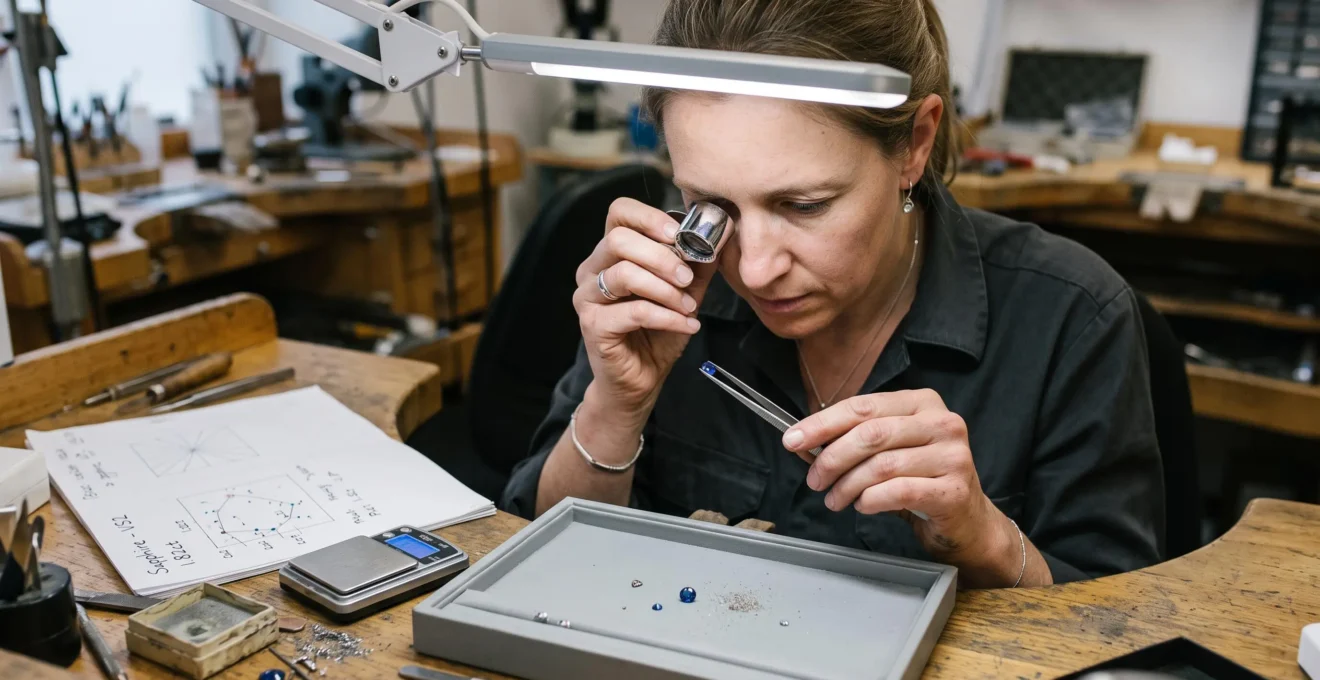
Two gemstones can have noticeably different clarity characteristics under magnification yet look almost identical when worn. Another pair may receive similar clarity descriptions, although one contains an internal feature that makes it considerably more vulnerable to damage.
This is why eye-clean clarity is not a universal measure of gemstone quality. The term generally means that inclusions cannot be detected without magnification under specified viewing conditions. It does not guarantee that a gem is internally flawless, structurally sound, or worth a higher price.
The distinction matters especially when shopping online. Enlarged photographs reveal details that may never be noticeable in jewellery, while flattering studio lighting can conceal features that become obvious in daylight. Gem species also differ: visible inclusions are common and accepted in emeralds, whereas buyers generally expect transparent aquamarine or topaz to look clean.
A better purchasing decision separates three questions: what can actually be seen, what could affect durability, and what the market reasonably values in that particular gemstone. Those answers are often more useful than pursuing the highest available clarity designation.
Eye-clean gemstone clarity: the essential buying rules
- Judge clarity face-up at approximately 30 cm in ordinary lighting before paying for improvements visible only under magnification.
- Check the nature and location of inclusions. A hidden fracture near an exposed edge can matter more than an obvious but harmless internal crystal.
- Compare clarity with colour, cut, transparency, durability and price. An eye-clean upgrade is worthwhile only when its benefits justify the premium.
- Why Can One Inclusion Be Harmless While Another Makes a Stone Likely to Crack?
- How to Judge Gem Clarity at 30 cm Without Obsessing Over Microscope Photos?
- Higher Clarity or Better Colour: Which Should You Choose if Your Budget Is Fixed?
- The Clarity Oversight That Turns a “Good Deal” Stone Into a Constant Repair Problem
- When Should You Request Extra Clarity Photos to Avoid a Return Battle Later?
- The Upgrade Trap That Adds 20% to Diamond Cost With Almost No Visible Difference
- Why Does a Flaw Look Huge Under 30x but Disappear at Arm’s Length?
- Why Do Jewellers Use High-Magnification Microscopes if You’ll Never See Those Flaws in Real Life?
Why Can One Inclusion Be Harmless While Another Makes a Stone Likely to Crack?
An inclusion can be harmless when it remains stable inside a gemstone and does not interfere significantly with its appearance or strength. Another inclusion may increase the likelihood of cracking because it reaches the surface, concentrates stress or interacts unfavourably with the host mineral. Its type, size and position matter more than its mere presence.
Gemstones contain different kinds of internal features. These include mineral crystals, healed fractures, fluid-filled cavities and open fissures. They do not all respond to physical stress in the same way.
A small crystal enclosed within sapphire may be primarily a visual characteristic. However, some mineral inclusions have different thermal expansion properties from their host. Under certain conditions, such differences can contribute to localised stress. The presence of a crystal alone does not establish that damage is likely.
Likewise, a healed fingerprint inclusion in ruby may remain stable, while a fracture extending to an exposed surface deserves closer examination. A diamond feather is not automatically dangerous either: its significance depends on its dimensions, orientation and position.
Location is particularly important near the girdle, the narrow perimeter separating a faceted gem’s crown from its pavilion. This area can receive concentrated forces during setting or an accidental impact.
According to GIA’s diamond engagement-ring protection advice, certain inclusions near a diamond’s girdle can increase its vulnerability to damage. Surface-reaching feathers may create a chipping risk when the affected area is struck. This does not mean every feather will develop into a crack.
The distinction becomes more important when comparing gemstone species. Sapphire and ruby combine high hardness with generally good toughness, making many ordinary internal features mainly an appearance consideration. Emeralds, opals and tanzanite can require more caution because their fracture characteristics, cleavage or structural features make certain forms of mechanical stress more consequential.
Hardness and toughness should not be confused. Hardness describes resistance to scratching; toughness concerns resistance to breaking or chipping. A gem can resist scratches yet remain vulnerable to impacts.
Before buying, ask three questions: What is the inclusion, where is it located, and how does this gem species tolerate it? A close examination of an exposed fracture may provide more practical information than a small difference between two clarity descriptions.
Once structural concerns have been separated from cosmetic ones, the next decision becomes simpler: determine whether the remaining inclusions are actually visible under normal viewing conditions.
How to Judge Gem Clarity at 30 cm Without Obsessing Over Microscope Photos?
Judge a gemstone face-up at approximately 30 cm from your eyes, using ordinary indoor lighting and diffuse daylight. Look for inclusions without deliberately hunting for them, then compare the loose stone with its appearance in a setting. This practical test measures visible beauty rather than laboratory-level internal perfection.
Thirty centimetres is a useful reference distance for comparison, not an internationally standardised eye-clean grading distance. Consistency matters: compare stones at roughly the same distance, in similar lighting, and without magnification.
A straightforward examination follows four steps:
- Hold the stone face-up at approximately 30 cm and note any immediately visible internal marks.
- Rotate it slowly under diffuse daylight to see whether an inclusion appears, disappears or changes contrast.
- Repeat the observation under ordinary indoor lighting rather than relying on a bright inspection lamp.
- Consider the intended setting. Prongs, bezels, background colour and mounting depth can change the visibility of inclusions.
Pay attention to whether an inclusion distracts from colour, transparency or overall appearance. A mark that requires prolonged searching may have little effect on the enjoyment of a gem in everyday wear.
Gem species changes the standard of comparison. Emeralds frequently contain visible internal features, sometimes described as a jardin. Such characteristics may be accepted provided the gem retains attractive transparency and does not present unacceptable durability concerns.
By contrast, transparent aquamarine, topaz and spinel are generally expected to show fewer obvious inclusions. An easily visible dark crystal that might be tolerated in an emerald may be less desirable in a comparable clean-looking specimen of these materials.
Diamond clarity introduces another distinction. The GIA grading system evaluates internal and external characteristics at 10x magnification. As explained in GIA’s round brilliant diamond buying advice, most VS2 diamonds do not have eye-visible inclusions, and some SI1 diamonds also appear clean without magnification.
These observations explain why a certificate grade should be treated as technical information rather than an exact prediction of what a buyer will see.
Online images create additional uncertainty. Enlarged videos can make tiny features prominent, while bright studio lighting may make others difficult to detect. Request footage filmed at a realistic viewing distance, ideally in more than one lighting environment.
A stone that looks clean in everyday conditions may already meet your visual requirements. The remaining question is whether a different allocation of the budget could deliver more noticeable beauty.
Higher Clarity or Better Colour: Which Should You Choose if Your Budget Is Fixed?
With a fixed budget, better colour is often the more noticeable investment in a coloured gemstone, provided its inclusions do not seriously reduce transparency or compromise durability. For diamonds, an eye-clean lower clarity grade may leave room for better cut quality or size. Neither rule overrides individual examination of the stone.
In coloured gems, hue, tone and saturation strongly influence visual appeal. An inclusion that blends into a saturated sapphire may be less distracting than a washed-out colour across an otherwise exceptionally clean stone.
Emerald provides a useful example. GIA’s emerald buyer’s guide identifies colour as the leading quality factor and explains that inclusions visible to the unaided eye are typical. Exceptionally clean emeralds are rare and can be particularly valuable, but rarity alone does not make them the best purchase for every budget.
A buyer seeking an attractive emerald should compare colour, transparency and inclusion character together rather than assuming that the least included option automatically offers the best value.
For diamonds, the trade-off works differently because established clarity grades influence market pricing. A VS2 round brilliant diamond that looks clean may deliver a similar naked-eye clarity impression to a VVS2 diamond. The higher grade can remain valuable for rarity and personal preferences, but the improvement may not be apparent when worn.
The released budget could instead be compared against differences in cut, colour or carat weight. Better cut performance may produce a more obvious improvement in brilliance and sparkle, although the result depends on the individual diamonds.
Some gemstones break the usual preference for colour over microscopic cleanliness. A fracture reaching an emerald’s surface can raise durability concerns. Conversely, certain inclusions are desirable features: aligned inclusions create star effects in some sapphires, rutile needles define the appearance of rutilated quartz, and distinctive horsetail inclusions may appeal to collectors of demantoid garnet.
The following comparison helps separate a worthwhile clarity upgrade from an unnecessary one.
| Buying criterion | When to prioritise clarity | When to prioritise other qualities |
|---|---|---|
| Face-up appearance | An inclusion visibly distracts from the stone. | Both stones look equally clean at normal distance. |
| Durability | A fracture threatens an exposed edge or setting area. | Inclusions are internal and assessed as structurally acceptable. |
| Gem species | A visible feature is unusually distracting for that material. | The species commonly contains acceptable inclusions. |
| Overall appearance | Improved clarity substantially restores transparency or brilliance. | Better colour, cut or proportion makes a clearer visual difference. |
Use three practical questions: Is the flaw visible face-up at wearing distance? Does it reach a vulnerable surface? Is the gem species normally expected to appear clean? When all three answers are no, paying more for clarity may offer little personal benefit.
Value becomes harder to judge when an inexpensive gemstone appears attractive but contains a hidden weakness. That is where repair exposure, not just initial appearance, should influence the purchasing decision.
The Clarity Oversight That Turns a “Good Deal” Stone Into a Constant Repair Problem
The most costly clarity oversight is confusing an attractive appearance or acceptable clarity description with structural durability. A gemstone may look clean while containing a surface-reaching fracture, vulnerable edge or treated cavity that complicates setting and maintenance. A discounted purchase becomes less attractive when those conditions require specialist care or restrict future repairs.
Consider a hypothetical emerald sold at an appealing price. Its face-up colour is attractive, and no major inclusion distracts the eye. Under examination, however, a fracture extends to the girdle near the intended prong position.
Even if the stone looks beautiful, the setting process may place pressure on a vulnerable area. Later impacts or jewellery servicing could also require additional caution. The risk is conditional, not a prediction that the emerald will inevitably break.
Existing fractures and treatments can change cleaning requirements. GIA’s emerald care guidance explains that heat may extend fractures, ultrasonic vibrations can weaken already-fractured emeralds, and steam can affect material used to fill fractures. Gentle cleaning with warm, soapy water is generally the safer approach for emeralds.
This is an important distinction because a gem’s Mohs hardness is not a promise of resistance to chipping. Emerald, for example, has a hardness of 7.5–8 but requires more careful handling than ruby or sapphire.
The same practical issue can arise during repairs. Retipping a prong, resetting a gem or polishing a damaged edge may involve forces or conditions unsuitable for certain stones. A jeweller may recommend a protective setting, modify the work or decline a risky procedure.
A bezel can help shield some exposed edges, but it cannot eliminate internal structural weaknesses. Setting design must account for the specific stone and its vulnerabilities.
The financial consequences are difficult to quantify without knowing the individual gem, mounting, treatment history and repair options. There is no reliable universal figure for the future maintenance cost or resale discount associated with a particular clarity feature.
Nevertheless, the total cost of ownership matters more than the advertised discount. Potential specialist servicing, limited cleaning options, possible repolishing and a smaller pool of interested resale buyers can all influence practical value.
Before purchase, obtain answers to three questions: Does the gemstone have surface-reaching fractures? Which cleaning methods are safe for this exact stone and its treatments? What setting offers appropriate protection?
If a seller cannot explain the structural condition or suitable care of a valuable gem, additional photographs and documented answers become especially important before payment.
When Should You Request Extra Clarity Photos to Avoid a Return Battle Later?
Request additional clarity photographs whenever a listing relies on an undefined eye-clean claim, omits useful views of the gemstone or shows only heavily magnified or studio-lit imagery. Extra documentation is particularly valuable for expensive purchases, inclusion-rich gemstone species and stones with unclear reports. The objective is to agree on observable condition before the transaction.
An online description of « eye-clean » is incomplete unless the seller explains the viewing conditions used. What one seller considers clean at ordinary distance may differ from what a buyer expects under bright lighting or closer inspection.
This ambiguity becomes important if the delivered stone contains an inclusion that was not obvious in the listing. Without a written definition, both parties may believe their interpretation was reasonable.
The best evidence combines visual material with explicit seller statements. Ask for a short face-up video at ordinary viewing distance, additional footage in diffuse daylight and standard indoor light, and close photographs of any potentially vulnerable areas.
If a relevant laboratory report or inclusion plot exists, request it as well. Not all gemstone reports provide inclusion plotting or standardized quality grades, so the absence of a plot should not automatically be interpreted as a defect.
For emeralds and other gems commonly containing inclusions, insist on sufficient imagery to judge transparency and the position of visible fractures. For high-value diamonds, compare the report details with natural-distance images and any available inclusion diagram.
Five checks to document before buying a gemstone online
- Define eye-clean. Ask the seller to confirm the viewing distance, orientation, lighting and magnification standard in writing. Save the reply.
- Obtain realistic footage. Request a short face-up video at approximately 30 cm under diffuse daylight and ordinary indoor light. Save the original video.
- Document significant inclusions. Request clear images of any visible marks, the girdle and relevant facet junctions. Keep the photographs with the listing.
- Verify supporting documents. Obtain the available laboratory report, identification details and inclusion plot if one exists. Record the report number or relevant identification information.
- Confirm the return conditions. Save the listing, seller assurances and applicable return policy before payment. Keep a dated copy of the complete purchase record.
These records help establish what was represented before shipping. Listing content may change, and undocumented verbal statements can be difficult to substantiate later. Written correspondence creates a more reliable reference.
Return rights and dispute procedures vary by seller, transaction platform and jurisdiction. Documentation can support a claim of misdescription, but it does not guarantee a particular legal outcome or refund.
Once the stone’s visible and structural condition is documented, price comparisons become more meaningful. Diamonds offer a particularly clear example of how grading premiums may exceed the improvement a buyer can actually see.
The Upgrade Trap That Adds 20% to Diamond Cost With Almost No Visible Difference
A diamond clarity upgrade can increase the price without producing an obvious improvement in appearance when both stones are already eye-clean. A hypothetical 20% premium illustrates the potential trade-off, but that percentage is not a standard market rate. The actual difference depends on the diamonds, their specifications and prevailing prices.
Diamond clarity grades describe the visibility and characteristics of inclusions and blemishes under standardised examination. Moving from VS2 to VVS2 represents a meaningful improvement on the grading scale, but both diamonds may appear equally clean to the unaided eye.
This creates two distinct thresholds. The first concerns what a trained grader can distinguish under magnification. The second concerns what a buyer can detect in ordinary viewing. They do not necessarily occur at the same grade.
As GIA explains in its guidance for round brilliant diamonds, most VS2 stones and some SI1 stones have no eye-visible inclusions. This makes individual examination important: an SI1 label does not guarantee visible flaws, just as a VS2 label does not guarantee an identical experience in every viewing condition.
Hypothetical comparison: paying for a clarity upgrade
Suppose two round brilliant diamonds have comparable carat weight, colour, cut quality and overall appearance. Diamond A is VS2, while Diamond B is VVS2 and costs 20% more. At normal viewing distance, neither shows visible inclusions.
In this illustrative scenario, the additional expenditure buys a higher laboratory clarity grade rather than a perceptible reduction in flaws. The buyer might instead compare options offering better cut performance, a preferred colour or greater size. The example does not establish a general 20% price difference between these grades.
The comparison becomes particularly relevant because cut quality influences the brilliance, fire and scintillation of round brilliant diamonds. When clarity is already visually satisfactory, a better-performing cut may produce a more noticeable difference than further microscopic refinement.
Diamond shape and size affect the decision. Broad, open facets in step cuts can reveal inclusions differently from the complex reflections of a round brilliant. Larger stones can also make some clarity characteristics easier to notice. Consequently, a grade that appears satisfactory in one diamond cannot be transferred automatically to another.
Compare individual stones, not grade labels alone. Hold other specifications as constant as possible, then determine whether the more expensive clarity grade delivers a visible advantage under realistic conditions.
The principle extends beyond diamonds. Paying an exceptional premium for an eye-clean emerald may make sense for a collector who values rarity, yet may be unnecessary for a buyer primarily seeking vivid colour and attractive transparency.
To make that judgement reliably, it helps to understand why a feature that dominates a magnified photograph can become almost impossible to locate when the same stone is viewed normally.
Why Does a Flaw Look Huge Under 30x but Disappear at Arm’s Length?
A tiny inclusion looks larger under 30x magnification because the optical system enlarges its image and makes fine detail easier to resolve. At normal viewing distance, the feature occupies much less of the observer’s visual field. Lighting, contrast and reflections within the gemstone can further reduce its visibility.
Magnification changes the apparent scale of an inclusion, not its physical dimensions. A feather or crystal that seems to occupy a substantial part of a microscope image may represent only a very small area of the actual stone.
Human vision also has limits. Fine details that can be resolved under magnification may become indistinguishable at approximately 30 cm. The ability to detect a particular feature depends on its size, contrast, the observer’s eyesight and the surrounding gem material.
Gemstone optics add another layer. Facets redirect light, produce reflections and create changing patterns of brightness. A small internal feature may blend into these patterns when the gem is moved.
Magnified imaging can have the opposite effect. Dark-field illumination may help reveal inclusions against a darker background, while fibre-optic lighting can increase the contrast of selected internal details. These methods are useful for inspection but are not designed to reproduce ordinary wearing conditions.
Imagine a sapphire with a small internal crystal visible in an enlarged inspection video. Under concentrated illumination, the crystal appears distinct. In diffuse daylight, the sapphire’s body colour and reflections may make it difficult to find without prior knowledge of its location.
The inclusion has not disappeared. Only the conditions determining its visibility have changed.
For buyers, this distinction can prevent unnecessary disappointment. A microscope image is evidence of an internal feature, but it does not independently establish that the feature reduces the gem’s everyday beauty.
A practical self-test is to view the stone face-up in diffuse daylight at normal wearing distance and try to locate the feature without magnification. If it cannot be detected, it may deserve little weight in an appearance-based comparison.
There is one crucial exception: visual invisibility does not establish structural harmlessness. A fine fracture extending to the girdle may remain difficult to see yet still warrant professional examination.
Magnification is therefore neither misleading nor unnecessary. It becomes valuable when used for its proper purpose: revealing characteristics that a gemmologist needs to identify, grade or assess, rather than deciding beauty on behalf of the wearer.
Key takeaways before a professional clarity inspection
- A microscope reveals more detail, but it does not tell you automatically which inclusions will affect ordinary appearance.
- Internal features may provide evidence of gemstone identity, treatment or structural condition even when they are invisible without magnification.
- Ask a jeweller to distinguish visual imperfections from characteristics that could influence setting, cleaning or durability.
Why Do Jewellers Use High-Magnification Microscopes if You’ll Never See Those Flaws in Real Life?
Jewellers and gemmologists use microscopes because gemstone examination involves much more than judging visible beauty. Magnification helps identify internal characteristics, investigate treatments, assess possible damage and document inclusions. These tasks require detail that everyday viewing cannot provide, even when the resulting features have little effect on the stone’s appearance when worn.
One important application is gemstone identification. Internal growth structures, mineral inclusions and other microscopic features can provide clues about a stone’s nature or formation history.
Microscopy may also help distinguish certain natural, laboratory-grown or treated materials. Features such as curved growth patterns, residues associated with fracture filling or characteristic inclusion arrangements can be diagnostically useful.
However, a microscope does not resolve every identification question. Some determinations require advanced instruments, laboratory testing or a combination of methods. A single observed inclusion is rarely sufficient grounds for broad conclusions about origin or treatment.
Another application is the inspection of mechanical condition. A professional can examine the girdle, exposed corners, facet junctions and areas near a setting for chips, fractures or other potentially significant features.
These observations can influence whether a gem should be mounted in a particular design, cleaned with a specific method or handled cautiously during repair.
Clarity grading is a separate purpose. In GIA’s diamond grading system, characteristics are evaluated at 10x magnification so that trained graders can compare stones under established conditions. Higher magnification may assist detailed investigation, but the diamond clarity grade is based on the specified grading standard rather than unrestricted enlargement.
This technical framework creates a communication gap. A jeweller may discuss feathers, crystals, clouds or needles that are easy to recognise through an instrument. A buyer may reasonably wonder why any of them matter when the gem looks perfectly clean at normal distance.
The answer depends on the purpose of the observation. Microscopic visibility, naked-eye appearance and durability are different questions. A feature can matter for identification while contributing little to appearance. Another can be visually insignificant yet structurally important.
Buyers can make professional examinations more useful by asking the jeweller to demonstrate the gem under normal conditions after the magnified inspection. Request an explanation of which inclusions are merely identifying characteristics and which, if any, affect setting suitability or long-term care.
Where possible, ask for the findings to be documented in plain language. That information can remain useful when comparing stones, choosing a mounting or planning future maintenance.
Before paying a clarity premium, examine the gemstone face-up at normal distance, confirm that significant fractures have been assessed and compare the visible benefits of alternative stones. The best choice is not automatically the cleanest under a microscope, but the one whose appearance, condition and price match your priorities.
Does eye-clean mean a gemstone has no inclusions?
No. Eye-clean generally means inclusions are not visible to the unaided eye under specified conditions. A gemstone may contain numerous microscopic features and still look clean during ordinary wear. The expression does not guarantee freedom from internal fractures, treatments or durability concerns.
Can a gemstone be eye-clean from the top but included from the side?
Yes. Facet orientation, depth, light reflections and body colour can conceal inclusions when the stone is viewed face-up. Features may become apparent from the pavilion or side. Ask whether an eye-clean description refers specifically to face-up viewing, and consider side views when assessing structural condition.
Should an engagement-ring gemstone meet a stricter clarity standard?
An engagement-ring gemstone should be assessed carefully for durability because it may be worn frequently. That does not necessarily require exceptionally high optical clarity. A visually acceptable sapphire or diamond with suitable structural condition may be preferable to a higher-clarity stone with vulnerable fractures or an unsuitable setting.
Does an independent gemstone report guarantee that a stone is eye-clean?
Not necessarily. Reports vary by laboratory, gemstone type and service. A diamond clarity report describes characteristics according to a grading system, while many coloured-stone identification reports do not assign an overall clarity grade. Buyers should check what the report actually covers and examine realistic images or the stone itself.
Is an eye-clean gemstone always worth more at resale?
No universal resale premium applies. Market demand depends on gemstone species, colour, size, cut, treatments, overall condition, rarity and documentation. Exceptional clarity can increase desirability in some categories, but it does not guarantee that the premium paid at retail will be recovered. Resale expectations should be evaluated separately from personal enjoyment.