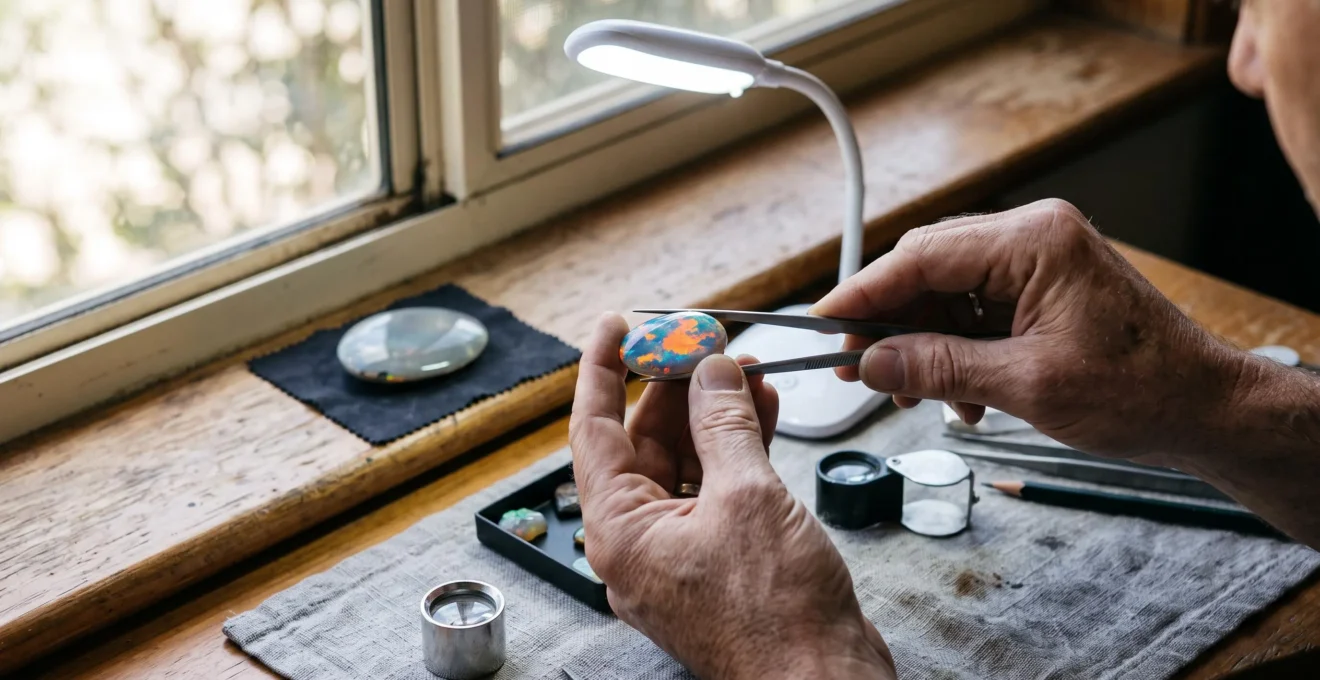
An opal that flashes brilliant green, orange and red in a jewellery shop can look almost grey under the lights at home. That contrast is unsettling, especially when the stone was expensive. Yet a change in appearance does not necessarily mean the opal has faded, dried out or become defective.
Precious opal produces its distinctive play-of-colour through interactions between light and microscopic structures inside the gemstone. Change the illumination, viewing angle or surrounding environment, and the visible colours can change dramatically without any physical alteration to the stone.
Durability is a separate concern. Opals can scratch, fracture or develop fine cracks known as crazing, and assembled stones such as doublets and triplets have additional vulnerabilities. Understanding the difference between an optical disappointment and genuine damage makes buying, wearing and maintaining these gemstones considerably easier.
The practical goal is to choose an opal whose appearance suits your everyday lighting and whose construction can withstand the way you intend to wear it.
Opal fire, durability and buying decisions at a glance
- Lighting changes appearance: an opal may look vibrant in daylight but subdued under certain LEDs because its visible colours depend on illumination and viewing angle.
- Construction affects durability: solid opals, doublets and triplets have different repair possibilities and sensitivities to moisture, heat and abrasion.
- Test before committing: examine the stone under multiple realistic lighting conditions, inspect for existing cracks and confirm its construction and return terms.
- Why Can an Opal Look « Dead » Under Office LEDs but Incredible Near a Window?
- How to Wear and Store Iridescent Opals Without Triggering Crazing or Cracks?
- Solid Opal, Doublet, or Triplet: Which Should You Choose if You Want 3+ Years of Regular Wear?
- The 2-Minute Cleaning Mistake That Can Crack an Opal Without Warning
- When Should You View an Opal Before Buying to Avoid Lighting Regret Later?
- Why Can a Vibrant Gemstone Suddenly Look Grey Under LED Lights at Home?
- How to Clean Organic-Material Jewellery at Home Without Causing Micro-Cracks?
- Why Do Organic Jewellery Materials Warp, Crack, or Yellow Within 90 Days?
Why Can an Opal Look « Dead » Under Office LEDs but Incredible Near a Window?
An opal can look dull under office LEDs but brilliant near a window because its play-of-colour depends on the wavelengths of light reaching the gemstone and the angles between the light, stone and observer. Different lighting conditions reveal different colour flashes. A muted appearance under one lamp does not, by itself, indicate deterioration.
Precious opal contains microscopic structures that diffract visible light. In many precious opals, regularly arranged silica spheres create the conditions for this effect. The resulting flashes are not simply pigments embedded in the stone: they arise from the interaction of light with its internal structure.
A scientific review published in Gems & Gemology in 2025 describes these optical effects through photonic structures and diffraction. GIA‘s 2025 scientific review of gemstone optical effects explains why orientation and microscopic arrangement matter to the colours observed.
Daylight generally provides a broad range of visible wavelengths. Artificial lighting varies considerably. Some LED lamps have spectral characteristics that make particular colours less prominent, although LED lighting does not universally suppress opal fire. Light direction, brightness, spectral distribution and viewing position all contribute.
A single overhead office light can also illuminate an opal from an unfavourable angle. Near a window, moving the stone through changing light directions may reveal flashes that were difficult to see at a desk.
Try a straightforward comparison:
- Observe the opal near a window in indirect daylight.
- Rotate it slowly while keeping track of the colours and their positions.
- Repeat under a warm domestic lamp.
- Check it beneath the cool LED lighting you normally encounter.
- Compare the strength, distribution and consistency of the visible colour.
If bright flashes repeatedly return under different conditions, the stone’s optical effect is still present. Areas that never display play-of-colour may instead represent colourless regions within the opal, sometimes called dead spots.
Body tone, colour-bar thickness and the distribution of colour-producing material affect the overall appearance. Dark body colour is not automatically a defect: dark backgrounds can actually increase the perceived contrast of vivid flashes.
Retail spotlights and carefully directed photography may showcase an opal at particularly flattering angles. That is not proof of misrepresentation, but it explains why evaluating only a display image can produce unrealistic expectations.
Once lighting has been separated from genuine quality concerns, the next priority is protecting the stone from physical damage that cannot be corrected simply by changing rooms.
How to Wear and Store Iridescent Opals Without Triggering Crazing or Cracks?
Protect iridescent opals by avoiding intense heat, sudden temperature changes, hard impacts and unsuitable storage conditions. Some opals are vulnerable to moisture-related instability, while composite stones have glued layers that require additional care. Gradual environmental changes and gentle handling are more reliable precautions than routinely immersing gemstones in water.
Opal is hydrated amorphous silica. Its water content and internal stability vary according to the material and its formation history. Some specimens are particularly susceptible to cracking as they dry, while others remain stable through ordinary household conditions.
Crazing describes a network of fine fractures that can interrupt an opal’s appearance and structural integrity. It may be associated with dehydration, heat and instability within the gemstone, but moisture loss is not the sole possible cause.
According to GIA’s opal care and cleaning recommendations, intense heat and sudden temperature changes can cause fractures or crazing. These risks make windowsills exposed to prolonged direct sunlight, hot vehicles and heating appliances poor places to leave jewellery.
For everyday storage, choose a protected location away from direct heat and frequent humidity or temperature extremes. A soft-lined jewellery compartment helps limit scratches and accidental impacts. Avoid placing opals directly against harder gemstones or metal objects.
Be cautious about storing vulnerable specimens with desiccants intended to maintain unusually dry conditions. Equally, do not assume every airtight box is harmful. The appropriate storage environment depends on the opal’s stability, construction and any specialist advice supplied with it.
Bathrooms and kitchens are often less suitable because temperature and humidity can fluctuate substantially. An ordinary room with relatively consistent conditions is generally more practical.
Composite stones require particular attention. Doublets contain a thin opal layer attached to a backing, while triplets add a transparent protective cap. Prolonged water exposure and excessive heat can compromise assembled components or their adhesive bonds.
Do not try to prevent cracking by automatically keeping opal jewellery submerged. A documented Gems & Gemology case study, GIA’s Opals Revisited case study, describes how liquid storage did not stabilize susceptible specimens or repair existing internal cracks. These observations concern particular opals and should not be generalized to every variety.
Before adopting a special storage routine, determine whether the stone is solid, assembled, unusually porous or known to be unstable. Some hydrophane opals also change appearance after absorbing liquids, making routine soaking an especially poor assumption.
Preventing environmental stress matters, but the choice between a solid stone and an assembled opal also determines what can realistically be repaired after years of use.
Solid Opal, Doublet, or Triplet: Which Should You Choose if You Want 3+ Years of Regular Wear?
A sound solid opal is generally the more flexible choice for long-term ownership because it contains opal material throughout and may allow professional repolishing. A doublet can provide attractive colour at a lower cost, while a triplet offers a protected thin colour layer. None guarantees three years of trouble-free wear.
The distinction concerns construction rather than colour intensity alone. A solid opal consists of natural opal material without an added backing or cap. A doublet joins a thin layer of precious opal to a supporting material. A triplet sandwiches a thin opal layer between a backing and a transparent dome.
As described in GIA’s opal quality and evaluation criteria, these constructions can produce very different appearances and practical limitations. A dark backing may improve the visual contrast of play-of-colour, while a transparent cap influences how a triplet’s colour is seen.
For a buyer planning at least three years of regular wear, the following comparison is useful.
| Decision factor | Solid opal | Doublet | Triplet |
|---|---|---|---|
| Best-fitting use | Regular wear with appropriate protection | Regular or occasional wear with careful moisture control | Occasional, carefully protected wear |
| Construction | Natural opal material throughout | Opal layer attached to a backing | Opal layer between backing and transparent cap |
| Moisture concerns | Varies by opal variety and stability | Adhesive and layered construction require care | Layer boundaries and adhesive require care |
| Wear and abrasion | Opal surface can scratch | Exposed opal surface needs protection | Cap can scratch or become worn, depending on its material |
| Repair potential | Repolishing may be possible if sufficient sound material remains | Repair options are more restricted | Cap or adhesive damage may be difficult to remedy |
| Ownership consideration | Greater flexibility for potential future restoration | Colour impact with construction-related limitations | Attractive presentation with limited restoration options |
Regular wear does not necessarily mean constant exposure. An opal pendant protected beneath clothing faces different hazards from a ring worn during housework, gardening or frequent handwashing.
Setting design matters as much as gemstone type. A protective bezel can shield vulnerable edges, while a high-profile ring setting may expose the stone to repeated knocks.
Repairability also changes the ownership calculation. A solid stone with adequate thickness may sometimes be refinished by a specialist. A damaged composite may require replacement rather than conventional recutting, although repair possibilities depend on the exact defect and construction.
Resale value cannot be inferred from construction alone. Natural colour quality, condition, treatments, size, provenance and buyer demand also influence how a particular opal is valued.
Before paying a premium for impressive fire, inspect the edges and underside where possible, ask for the construction to be stated in writing and consider whether the jewellery setting suits your routine.
A durable purchase is not simply the brightest stone in the display. It is the combination of suitable material, thoughtful setting and maintenance habits that you can realistically sustain.
The 2-Minute Cleaning Mistake That Can Crack an Opal Without Warning
The most dangerous quick-cleaning mistake is exposing an opal to excessive heat or a sudden temperature change, particularly through steam cleaning or unsuitable hot-water treatment. Ultrasonic cleaning is also inappropriate for a fragile opal. Gentle hand-cleaning with mild soap and comfortably warm water is a safer approach for suitable stones and settings.
A cleaning session does not need to last long to create risk. Rapid heating or cooling can introduce stress into an already vulnerable gemstone, potentially contributing to fractures.
There is no established universal two-minute threshold at which an opal cracks. The problem is the cleaning method and the stone’s condition, not a specific elapsed time.
Opal has a Mohs hardness of approximately 5 to 6.5, with toughness ranging from very poor to fair according to GIA. This means abrasive cleaning and physical impacts deserve attention alongside thermal exposure.
For a sound solid opal that is suitable for ordinary hand-cleaning, use a small amount of mild soap with comfortably warm water. Gently remove surface dirt with a soft cloth or very soft brush, without scrubbing or soaking unnecessarily. Rinse cautiously when appropriate and dry with a clean, soft cloth.
Composite and hydrophane opals may need a more conservative approach. Avoid immersion unless the seller or a qualified gem professional confirms it is appropriate. A slightly damp cloth can be preferable when the stone’s construction or treatment is uncertain.
Cleaning also involves the jewellery setting. Water or residue trapped around damaged adhesive joints can create problems for assembled stones, while loose claws or worn bezels increase the chance of impact damage or loss.
Do not compensate for a loose setting by pressing harder while cleaning. Have the mounting checked by a jeweller. A cracked opal and an insecure mounting are distinct problems requiring different remedies.
Household cleaners, solvents, perfume and hairspray should also be kept away from opal jewellery. Their effects depend on the stone, treatments and setting materials, but unnecessary chemical exposure provides no cleaning benefit.
A practical habit is to put jewellery on after applying cosmetic products and remove vulnerable rings before cleaning, bathing or activities involving repeated knocks.
If a stone already shows cracks, cloudy patches or an unfamiliar surface change, avoid additional cleaning experiments. Professional inspection is safer than trying progressively stronger methods.
When Should You View an Opal Before Buying to Avoid Lighting Regret Later?
View an opal under several lighting conditions before purchase, ideally including daylight, the shop’s display lighting and illumination resembling your home or workplace. For online orders, repeat the inspection promptly after delivery. Confirm the stone’s construction, treatments and return conditions before making a decision based on its brightest photographed appearance.
The best moment to evaluate colour is when the purchase can still be reconsidered. Once a gemstone has been permanently mounted, worn or altered, return and exchange options may become more complicated.
In a shop, ask to see the stone away from highly directional display spotlights. Indirect window daylight can provide an additional perspective, although it is not a universally superior grading condition.
Rotate the opal gently and observe both the brightest flashes and areas with little visible colour. Consider whether the play-of-colour covers much of the surface or appears only from a narrow viewing angle.
Next, compare the stone under the lighting you actually use. Someone who spends most of the day under office LEDs may reasonably prefer an opal that remains appealing indoors, even if another stone appears more spectacular in direct sunlight.
Ask whether the opal is solid, a doublet or a triplet. Request disclosure of known treatments, including impregnation or colour-enhancing processes, and whether an artificial backing contributes to the appearance.
For online purchases, videos showing slow rotation under more than one light source are often more informative than a single studio photograph. Request clear views of the face, edges and underside when available.
Check the stated body tone, disclosed origin, measurements, treatments and construction. Origin is useful provenance information, but it does not independently establish stability or quality.
A loose gemstone may also look different once mounted. Metal surrounds, backing materials and the amount of light reaching the stone can influence the final presentation. If possible, inspect a comparable mounted stone or discuss the proposed setting before committing.
Your five-step opal buying inspection
- Record the daylight appearance: rotate the stone near a window and note which colours appear prominently. Your deliverable is a short colour-and-angle description.
- Test everyday lighting: inspect the opal under a warm lamp and a cool LED. Your deliverable is a comparison of the three lighting conditions.
- Inspect physical condition: look for visible fractures, crazing, chips and persistent colourless areas. Your deliverable is a written condition note.
- Confirm construction and treatments: request an identification of solid, doublet or triplet construction and any disclosed enhancements. Your deliverable is written seller confirmation.
- Check purchase protection: review the return deadline, inspection restrictions and proposed setting. Your deliverable is a copy of the applicable return conditions.
When purchasing remotely, perform the same checks as soon as the item arrives, within the seller’s applicable return period. Photograph any visible condition concerns before making changes to the jewellery.
A confident purchase does not require the stone to look equally brilliant everywhere. It requires knowing when its colours appear, whether that behaviour suits you and whether the physical condition matches the seller’s description.
Why Can a Vibrant Gemstone Suddenly Look Grey Under LED Lights at Home?
A gemstone can look grey beneath home LEDs because its optical effect depends on the illumination spectrum, direction and viewing geometry. Colour temperature alone does not explain the change. If vivid colours return after rotating the stone or moving into different lighting, the apparent dullness is likely optical rather than evidence of damage.
This behaviour is not exclusive to opals. Several gemstone and jewellery materials display special optical effects that change with movement and illumination, although their underlying mechanisms differ.
Precious opal produces play-of-colour through diffraction. Moonstone displays adularescence, a soft moving glow associated with light scattering within its internal structure. Labradorite produces labradorescence through interference effects involving its layered structure. Iridescent pearls show colour effects related to the layered structure of nacre.
These materials should not be treated as optically identical. Their responses to specific lamps vary, so a lighting observation made for one gemstone cannot automatically predict the appearance of another.
Three lighting characteristics are especially relevant:
- Spectral distribution: the wavelengths present in the light influence which colours can be strongly visible.
- Colour rendering: the ability of a light source to reveal colours naturally affects the overall appearance of jewellery and surrounding objects.
- Direction and geometry: the angle of illumination and observation can make an optical effect appear or disappear.
Colour temperature describes whether light appears warmer or cooler. It is not a complete measure of spectral quality. Two lamps with the same nominal colour temperature can produce different visual results.
To investigate a disappointing stone, rotate it slowly beneath the existing lamp. Then move to another room, try indirect daylight and compare with a different artificial source.
A phone flashlight may provide another useful comparison, but it is not a calibrated gemological light source. Its brightness and geometry can exaggerate certain flashes, so it should not be treated as a definitive quality test.
If the colour repeatedly returns under alternative illumination, that observation supports a lighting-based explanation. If the gem remains dull everywhere, further examination may be appropriate, especially when its previous appearance is well documented.
Lighting itself does not normally erase an opal’s underlying colour-producing structure. However, intense heat associated with certain lighting environments can be a physical hazard, so perceived optical change and heat damage must remain separate considerations.
If a change persists across lighting conditions, focus next on the surface, treatments and condition of the gemstone rather than attempting to restore colour through stronger illumination.
How to Clean Organic-Material Jewellery at Home Without Causing Micro-Cracks?
Clean delicate organic-material jewellery with a soft cloth, minimal moisture and methods suited to the individual material. Avoid steam, ultrasonic equipment, abrasives and unnecessary soaking. Opal is not an organic gemstone, but its relatively modest hardness, hydrated composition and susceptibility to damage make similarly cautious handling appropriate.
Pearl, amber, coral and jet are examples of organic gems or gem materials associated with biological origins. Opal differs chemically and structurally: it is a hydrated silica gemstone rather than an organic material.
That distinction matters because no single cleaning formula is equally suitable for every delicate gemstone. Pearl nacre, amber, coral, jet and opal have different responses to water, chemicals, abrasion and heat.
They nevertheless share practical vulnerabilities compared with harder materials such as corundum. Abrasive brushes, gritty cloths and aggressive polishing can damage susceptible surfaces, even when no obvious crack forms immediately.
For routine care, wipe jewellery gently after wearing it using a clean, soft, dry cloth. Where the material and construction permit, a slightly damp cloth can help remove surface residue.
For opal jewellery, mild soap and comfortably warm water may be suitable for sound solid stones. Avoid prolonged soaking, particularly when dealing with composite construction, uncertain treatments or porous material.
Dry the piece gently at room temperature and make sure moisture is not left trapped around vulnerable components. Do not accelerate drying with a radiator, hairdryer or direct intense sunlight.
Micro-scratches should be distinguished from crazing. Scratches affect the surface through abrasion, whereas crazing involves fractures within the material. A cloudy appearance may have several causes and is not enough to identify either problem without inspection.
If a previously polished opal has become visibly scratched, specialist repolishing may sometimes improve its surface. Existing internal fractures cannot simply be washed away, and polishing may be unsuitable for a thin or unstable stone.
Organic gem materials require their own assessments. For example, a cleaning method tolerated by a sound solid opal should not automatically be used on pearl or amber jewellery.
When jewellery is already cracked, unusually cloudy or structurally fragile, professional identification and assessment should come before further cleaning attempts.
What to remember before choosing a delicate gemstone
- Visible deterioration does not follow a universal timetable; material stability and exposure conditions matter more than the age of the purchase alone.
- Cracking, warping, surface dullness and yellowing are different problems, so each requires identifying the material and likely cause.
- A realistic assessment of heat, sunlight, moisture and daily wear is more useful than expecting a delicate stone to behave like a harder, more durable gem.
Why Do Organic Jewellery Materials Warp, Crack, or Yellow Within 90 Days?
Organic jewellery materials can deteriorate relatively quickly when exposed to unsuitable heat, light, moisture or chemicals, but 90 days is not an established universal failure period. Warping, cracking and yellowing arise through different material-specific processes. Opal is not organic, although certain environmental risks overlap with those affecting delicate organic gems.
The time required for visible damage depends on the material’s composition, existing condition, treatments and exposure history. A well-preserved piece may remain attractive for years, while a vulnerable object subjected to harsh conditions may deteriorate much sooner.
Warping typically concerns materials or components susceptible to dimensional changes under heat, moisture or mechanical stress. It is not the usual description for damage to solid opal. Opal is more commonly discussed in terms of fractures, crazing and changes in visible appearance.
Cracking can result from physical impact, thermal stress or material instability. In susceptible opal specimens, drying can also contribute to fracture development. Existing internal flaws may influence how readily a stone deteriorates.
Yellowing is a separate issue. Certain organic materials, coatings or adhesives may discolour through ageing, light exposure or chemical interaction. The relevant mechanism depends on the material involved.
It would therefore be misleading to claim that all opals yellow under ultraviolet light or that every organic gem follows the same ageing pattern.
For precious opal, the most relevant long-term concerns are generally scratching, impact damage, cracking, crazing and the condition of any treatment or assembled layers. These risks are not interchangeable with the deterioration mechanisms of amber, coral or pearls.
Consider a hypothetical buyer choosing between a solid opal pendant and a triplet ring. The pendant might encounter fewer knocks and less frequent water exposure, while the ring may be subjected to repeated handwashing and contact with hard surfaces. The difference in expected wear comes from the use and construction, not from a predetermined number of days.
Before purchasing a delicate gemstone, evaluate your habits against four practical questions:
- Will the jewellery be worn during activities involving impacts, repeated friction or contact with hard surfaces?
- Will it regularly encounter direct sunlight, strong heat or sudden temperature changes?
- Can it be stored in relatively consistent conditions without unsuitable moisture exposure?
- Are you willing to use gentle cleaning methods and arrange professional assessment when damage appears?
The answers help establish whether the gemstone suits your lifestyle. A delicate stone may be an excellent choice for someone prepared to protect it, while another material or a more sheltered setting may be preferable for demanding daily use.
For an opal that has become visibly damaged, do not assume the solution is to add moisture, apply oil or polish more aggressively. Those interventions can introduce further complications, especially if the stone has been treated or assembled.
Before buying, inspect the stone in representative lighting, confirm its construction and condition, and choose a setting that protects it during the activities you actually perform. These checks offer a more dependable basis for ownership than any fixed prediction of how long a delicate gemstone should last.
Can an opal permanently lose its play-of-colour?
Changing lighting does not normally remove an opal’s underlying play-of-colour. However, fractures, crazing, surface deterioration or changes affecting treatments and assembled components may permanently alter its appearance. If the stone remains dull under multiple lighting conditions, a qualified gemologist can help determine whether physical damage is involved.
Does a brighter opal always indicate better quality?
No. Brightness is an important quality factor, but colour range, distribution, pattern, body tone, condition, thickness and stability also matter. An opal showing brilliant flashes only at a very narrow angle may be less satisfying for a particular buyer than one displaying appealing colour across a wider range of everyday viewing positions.
Can a scratched solid opal be polished again?
Some solid opals can be professionally repolished when sufficient sound material remains. The result depends on the depth of the scratches, stone thickness, existing cracks and setting. Repolishing removes some material and cannot reliably repair internal crazing. Doublets and triplets generally present more restricted restoration possibilities.
Should an opal be kept in water to stop it from cracking?
No universal water-storage recommendation applies to opals. Some particularly unstable specimens have historically been stored in liquid, but immersion does not heal cracks or guarantee stability. Water may also create problems for assembled stones or affect the appearance of certain porous opals. Ask a knowledgeable gem professional about the particular material before attempting water storage.
What should you ask for when buying an expensive opal online?
Request clear photographs and rotating videos under more than one lighting condition, along with written information about construction, disclosed treatments, dimensions and visible condition. Ask for close-ups of the edges and underside where possible, and review the return policy before purchase. For a high-value stone, an independent gemological report may provide additional assurance about identity and construction, although it cannot guarantee future durability.