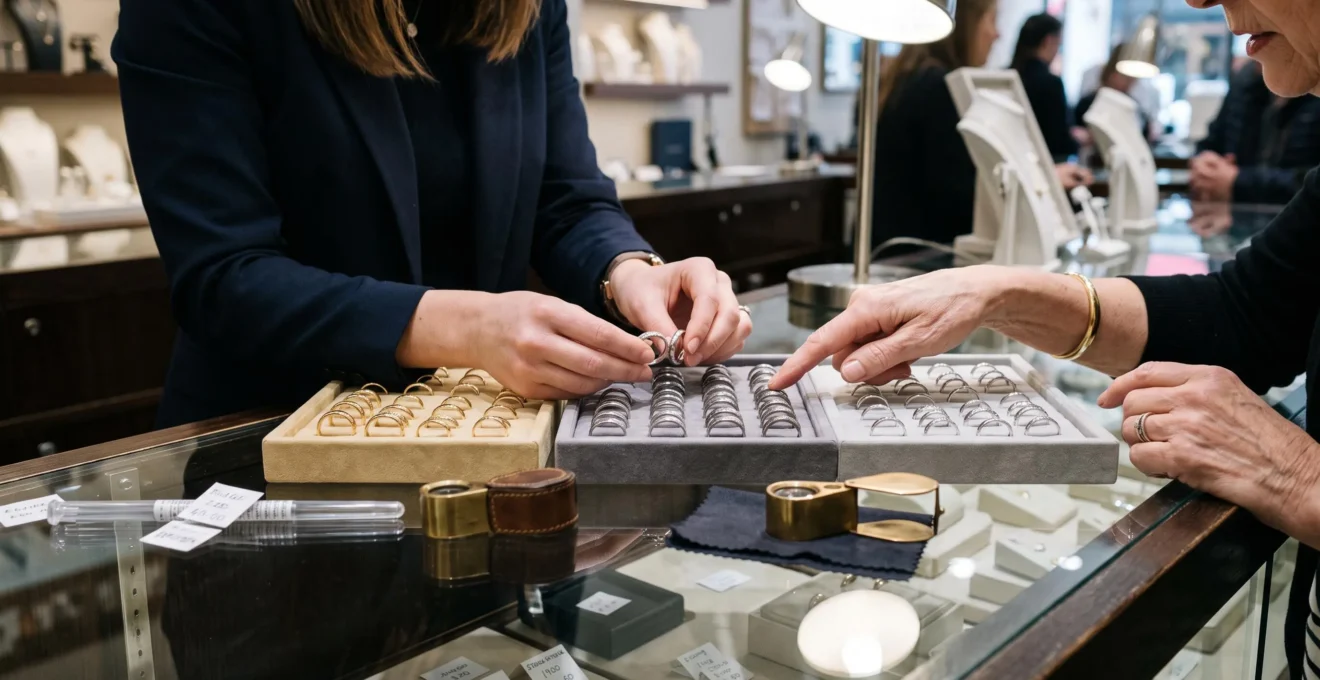
Three rings sit on the same jewellery counter. One is sterling silver with a modest price tag. Another is gold, considerably more expensive. The third is platinum, presented as a premium choice. All three are described as precious metals, yet that label tells you surprisingly little about how each ring will behave on your hand.
The confusion begins when metal value, purity, construction and durability are treated as interchangeable. They are not. A more expensive ring can scratch quickly. A high-purity gold band can bend more readily than a carefully designed lower-karat alternative. A gold-coloured necklace may contain only a thin surface layer of gold.
Across English-speaking jewellery markets, the terminology can also carry different regulatory meanings. Understanding the construction of a piece matters more than memorising sales descriptions.
The practical approach is to judge jewellery through three separate questions: what material you are paying for, how the finished piece will withstand your routine, and what maintenance or resale value you can reasonably expect.
Precious metals: the essential distinctions
- Purity is not durability. Hallmarks describe precious-metal content, not scratch resistance or expected lifespan.
- Construction changes value. Solid gold, gold-filled and gold-plated pieces may look similar but contain very different amounts of gold.
- Wear habits determine suitability. Handwashing, chemical exposure, daily friction and cleaning requirements should influence your choice as much as colour or price.
- Why Can a « Precious Metal » Ring Still Scratch in the First 30 Days of Daily Wear?
- How to Compare Gold, Platinum, and Silver in Under 10 Minutes Without Getting Upsold?
- Solid, Filled, or Plated: Which Should You Choose if You Want 5+ Years of Wear?
- The Costly Mistake of Choosing the Wrong Metal if You Wash Your Hands 20+ Times a Day
- The Simple Routine That Keeps Precious Metals Looking New After 6 Months of Hard Wear
- The Best Vibrant Gem Choices if You Mostly Wear Black, Navy, or Neutrals to Work
- Lab-Grown or Natural Diamond: Which Should You Choose if Resale Value Matters?
- Why Does Pure Gold Bend So Easily in Rings Worn Every Day?
Why Can a « Precious Metal » Ring Still Scratch in the First 30 Days of Daily Wear?
A precious-metal ring can develop visible scratches within its first month because precious describes the material’s composition and recognised value, not its resistance to abrasion. Gold, platinum and silver can all acquire surface marks through ordinary contact with harder objects. Alloy composition, finishing and protective coatings influence how quickly those marks become noticeable.
The distinction matters because hardness and toughness are different properties. Hardness concerns resistance to indentation and scratching. Toughness concerns resistance to fracture and the ability to absorb damage without breaking. A metal can resist cracking while still marking easily.
Precious metals are generally capable of plastic deformation: under sufficient pressure, material can move rather than fracture. Platinum, for example, can develop a distinctive worn surface as repeated contacts deform its finish. However, scratching is not always pure displacement; abrasive wear can also remove microscopic amounts of material. Repeated polishing removes additional material.
Daily life supplies enough contact to change a polished finish. Door handles, desk edges, keys and other jewellery create repeated opportunities for friction. A ring worn continuously encounters these surfaces far more frequently than a necklace protected beneath clothing.
The Mohs scale offers a rough introduction to scratch resistance, but it cannot reliably predict when marks will appear. Finished jewellery is made from alloys with different mechanical properties, and the pressure, surface finish and abrasive particles involved all affect wear. A controlled alloy-hardness measurement is more informative than a generic Mohs number for the pure metal.
White gold introduces another variable. Many white-gold rings are rhodium-plated to create a bright, cool-white finish. As that coating wears at contact points, the underlying alloy may become visible. A warmer-looking patch is not necessarily a structural defect: it may indicate a change in the surface coating. That is different from a scratch penetrating the ring itself.
Purity stamps answer another question entirely. According to UK government guidance on precious-metal hallmarking, fineness expresses precious-metal content in parts per thousand. A 375 gold mark denotes at least 375 parts gold per 1,000. A complete UK hallmark also identifies the sponsor and assay office; a standalone number is not proof of independent assay.
Other English-speaking countries follow their own marking and consumer-protection requirements. Neither the word precious nor a fineness number should be interpreted as a universal wear rating.
Once surface marks are separated from purity, the next decision becomes more useful: which metal offers the best balance of comfort, construction and maintenance for the price?
How to Compare Gold, Platinum, and Silver in Under 10 Minutes Without Getting Upsold?
Compare gold, platinum and silver by asking four questions before discussing appearance: What is your total budget? Do you react to particular alloys? What physical and chemical exposure will the jewellery face? Do you expect to resell it? These questions narrow the options without relying on a salesperson’s description of what is most luxurious.
A practical comparison starts with the intended use, not the display case. A low-contact silver pendant and a platinum engagement ring solve different problems. Treating them as interchangeable because both are precious metals creates a misleading price comparison.
| Decision question | What to check | How it narrows your choice |
|---|---|---|
| What can you spend? | Finished-piece price, construction, future servicing | Silver may be an affordable solid-metal option; gold and platinum require separate quotations. |
| Does your skin react? | Exact alloy composition, especially nickel content | Rule out known triggers rather than trusting a generic hypoallergenic label. |
| How will you wear it? | Ring versus pendant, friction, chemicals, manual work | Prioritise suitable construction, geometry and repairability over prestige. |
| Will you resell it? | Metal weight, fineness, dealer deductions and local buyback terms | Separate recoverable material value from the original retail price. |
Price comparisons need care because platinum is denser than gold, although actual jewellery alloys vary. Two rings with matching dimensions can have different weights. A heavier platinum ring is not necessarily more expensive per gram than a gold alternative, and retail prices also incorporate labour, design, finishing and margins.
Ask for each piece’s finished weight, metal fineness and total price. Only compare metal cost per unit of weight when the underlying composition and pricing basis are clear. A simple division of the retail price by the ring’s weight does not isolate raw-metal value.
Gold-coloured jewellery needs an additional check. In the United States, vermeil describes a particular gold-coated sterling-silver construction. The FTC explanation of the revised Jewelry Guides identifies a gold layer of at least 10-karat fineness and a thickness equivalent to 2.5 microns of fine gold for vermeil.
That is a US terminology standard, not a guarantee of service life or a rule that applies identically in every country. Before comparing a vermeil necklace with solid gold, ask what the base metal is, how thick the coating is and what each mark or hallmark represents.
Skin sensitivity deserves equal attention. Nickel in some jewellery alloys can cause reactions in susceptible wearers. Neither the colour white nor a low- or high-karat designation alone reveals whether nickel is present. Platinum alloys also differ by formulation, so request the composition rather than assuming an entire metal category is automatically suitable for sensitive skin.
A workable shortlist usually emerges when budget, skin compatibility, wear conditions and resale expectations are recorded separately. The next step is to determine whether the advertised metal runs through the entire piece or only covers its surface.
Solid, Filled, or Plated: Which Should You Choose if You Want 5+ Years of Wear?
For jewellery intended to last at least five years, solid precious metal generally offers the clearest long-term repair and refinishing options. Gold-filled construction may suit some lower-friction uses, while gold plating requires the most attention to coating wear. None guarantees a five-year appearance: wear frequency, layer specifications and maintenance determine the result.
The key distinction is where the precious metal sits within the construction. Solid gold is an alloy containing gold throughout the relevant metal component. It does not mean pure gold. Gold-filled jewellery generally uses a mechanically bonded gold-alloy layer over another metal, whereas gold-plated jewellery has a surface deposit of gold over a base material.
Gold-filled terminology and disclosure requirements vary between markets. The US has established guidance for qualifying descriptions, but a seller’s use of the word filled should not substitute for checking the gold content, bonding method and base metal. Plating thickness should also be specified where relevant.
Even the word solid needs examination when the item contains hollow sections, separate findings or different metal components. A hollow gold bangle may be genuine gold throughout its walls while remaining vulnerable to denting because of its geometry.
| Construction | Daily rings and bracelets | Occasional necklaces and earrings | Main ownership concern |
|---|---|---|---|
| Solid precious-metal alloy | Often the strongest long-term option when suitably designed | Offers flexibility for cleaning, servicing and refinishing | Scratches, deformation, polishing and repair costs |
| Gold-filled | Requires attention to abrasion points and construction | May offer a useful balance of appearance and cost | Layer wear-through and limitations on refinishing |
| Gold-plated | Coating may wear visibly under repeated friction | Can be practical for intermittent use | Re-plating, exposed base metal and coating-sensitive cleaning |
For a five-year decision, calculate ownership cost rather than comparing only purchase prices. Consider a purely hypothetical choice between a plated bracelet costing A and a solid bracelet costing B. The relevant question is whether A, plus any replacement or re-plating costs over five years, exceeds B plus its maintenance costs.
The calculation should use local written quotations and realistic wearing conditions. No universal replacement interval or cost multiplier applies to every coating, alloy or individual wearer.
Care requirements also alter the equation. Abrasive polishing can remove surface coatings, while certain chemical treatments and ultrasonic cleaning may be unsuitable for plated constructions or jewellery containing vulnerable gemstones. A manufacturer-approved cleaning procedure is more useful than a generic claim that an item is low-maintenance.
Construction is only half the decision. A person who rarely removes a ring before washing or handling cleaning products exposes it to very different conditions from someone who wears a necklace only for evening occasions.
The Costly Mistake of Choosing the Wrong Metal if You Wash Your Hands 20+ Times a Day
If you wash your hands more than 20 times daily, the costly mistake is choosing a ring solely by its metal name while ignoring coatings, alloys, settings and chemical exposure. Repeated wetting and handling can make maintenance more demanding, particularly for plated pieces. However, ordinary handwashing does not automatically damage every gold or platinum alloy.
High-frequency handwashing creates a different wear environment from occasional contact with water. Soap residue can accumulate around settings, trapped moisture may affect certain components, and the ring experiences repeated friction as hands are washed and dried.
It is important to separate these mechanical effects from chemical reactions. Water, mild soap, alcohol-based sanitiser and chlorine bleach are not interchangeable exposures. Their effects vary with the metal alloy, coating, gemstones and any adhesives or surface treatments.
For instance, gold and platinum are relatively corrosion-resistant precious metals, but the other components of their alloys and settings may behave differently. Silver can tarnish through reactions with environmental substances, while a plated ring may expose a base metal when its protective layer wears through.
The Gemological Institute of America advises protecting precious-metal jewellery from damaging chemical exposure. Its jewellery-care recommendations specifically warn about chlorine bleach, household cleaners and chlorinated pools, as well as cleaning methods that may harm gemstones.
That guidance does not establish a universal damage threshold at 20 handwashes per day, nor does it show that every alcohol-based sanitiser will strip a coating. The handwashing frequency is best understood as a reason to assess your routine, not as a scientifically demonstrated failure point.
A practical self-assessment is to record how often your ring encounters mild soap, sanitiser, cleaning agents and swimming-pool water. Identify which exposures happen while the jewellery remains on your hand and whether there are stones, coatings or vulnerable settings involved.
Repeated cosmetic servicing can carry its own costs. Re-plating restores a coating but does not make the underlying construction more substantial. Polishing removes some surface material, which deserves particular consideration with delicate eternity bands, thin shanks and hollow pieces.
Where workplace hygiene rules require frequent hand cleaning, jewellery should not interfere with those requirements. Removing a ring before suitable activities, when permitted and practical, is preferable to relying on an expensive metal designation as chemical protection.
The best ownership decision therefore includes a plan for care. A manageable maintenance routine can preserve a piece’s appearance without repeatedly exposing it to unnecessary polishing or aggressive cleaning.
The Simple Routine That Keeps Precious Metals Looking New After 6 Months of Hard Wear
A useful six-month jewellery-care routine combines gentle cleaning, separate storage and periodic inspection. Warm water, mild soap and a suitable soft brush can remove ordinary residue from many pieces, while padded storage reduces avoidable contact scratches. Professional inspection becomes important when settings loosen or surface wear exceeds what cleaning can correct.
The first rule is to distinguish dirt from damage. Soap film and skin oils often make gold look dull, but removing them cannot reverse an actual scratch. Silver tarnish is a chemical surface change requiring appropriate care, while platinum’s developing patina may be a finish the owner chooses to retain.
Before cleaning, identify the complete piece: metal, coating, stones and any special treatments. A simple soap-and-water method is not suitable for every gemstone, porous material, coating or construction. The least aggressive method compatible with all components should be preferred.
For suitable jewellery, a small amount of mild dish soap in warm water can loosen residue. A soft brush used gently around accessible surfaces is preferable to aggressive scrubbing. Rinse only when the entire construction tolerates water, protect the piece from drain loss and dry it using a soft, non-abrasive cloth.
Storage deserves comparable attention. Rings placed together in an uncovered dish can scratch one another as they move. Individual pouches or padded compartments reduce contact, while suitable anti-tarnish storage helps manage sterling silver’s tendency to discolour.
Toothpaste, abrasive cleaning pastes and inappropriate polishing cloths are poor substitutes for gentle care. They can abrade finishes or remove small quantities of metal. Ultrasonic equipment is not a universal solution either: vibrations can affect loose settings and certain treated, coated, organic or otherwise vulnerable stones.
Your five-step jewellery-care check
- Identify the construction. Record the metal, fineness, coating and stones; the deliverable is a short materials note for each frequently worn piece.
- Confirm a safe cleaning method. Check the jeweller’s or maker’s care instructions; the deliverable is one approved cleaning method, including any products to avoid.
- Clean without abrasion. Remove compatible surface residue gently and dry thoroughly; the deliverable is a clean piece with no remaining visible soap film.
- Separate every piece. Assign padded compartments or individual pouches; the deliverable is storage that prevents jewellery from rubbing against other jewellery.
- Inspect at six months. Look for loose settings, thinning coatings, deformation and scratches that catch on fabric; the deliverable is a written decision to continue routine care or obtain a professional inspection.
The six-month point is a convenient personal checkpoint, not a guaranteed professional servicing interval. A moving stone, damaged clasp or visibly distorted setting calls for attention sooner. Cosmetic dullness alone does not necessarily justify polishing.
Preserving jewellery is partly about accepting how its surface changes. Once maintenance is under control, the metal can be chosen for its visual effect as well as its practical behaviour, especially when paired with coloured gemstones.
The Best Vibrant Gem Choices if You Mostly Wear Black, Navy, or Neutrals to Work
For a wardrobe dominated by black, navy and neutral clothing, saturated blue, green and red gemstones are useful starting points because their colours can create a clear visual contrast. Sapphire, ruby and selected green stones offer different effects, but the best choice also depends on metal colour, jewellery type, lighting and resistance to everyday knocks.
Black clothing can make a brightly coloured stone feel like the centre of an outfit, while navy changes how a blue gem is perceived. Against dark blue fabric, a medium-to-vivid blue stone may look harmonious rather than sharply contrasting. Green or warm red can provide a more deliberate visual break.
The result is not determined by fabric colour alone. Gem tone, saturation, transparency, cut, size and the amount of visible metal all affect its appearance. A stone that looks vibrant under strong showroom lighting may appear darker under office lighting.
Consider the metal and gemstone together. Yellow gold introduces a warm frame around blue or green stones; platinum and white gold provide cooler surroundings. Neither pairing is inherently superior, but the contrast between the setting and stone can alter the overall impression.
| Wardrobe colour | Gemstone starting points | Styling and wear consideration |
|---|---|---|
| Black | Ruby, sapphire, vivid green gems | Strong colour contrast; inspect stone brightness under everyday light. |
| Navy | Ruby, green sapphire, contrasting blue sapphire | Warm or green accents create contrast; blue-on-blue creates a quieter effect. |
| Grey | Blue sapphire, ruby, coloured tourmaline | Cool and warm combinations are both possible, depending on the metal. |
| Beige or cream | Emerald, sapphire, ruby and other vivid stones | Fabric warmth and the metal setting influence perceived colour. |
Durability is the second filter. Sapphire and ruby, both varieties of corundum, offer strong scratch resistance, although any gemstone can suffer damage under sufficiently adverse conditions. Emeralds may require more caution because inclusions, fractures and treatments can affect their vulnerability.
Hardness does not guarantee resistance to chipping. A ring repeatedly knocked against desks or handles experiences greater mechanical exposure than a pendant or pair of earrings. For lower-contact jewellery, the range of practical gemstone choices becomes wider.
A useful wardrobe audit needs only three observations. Identify the three clothing colours worn most often, decide whether the desired result is contrast or harmony, and inspect the selected gemstone with its intended metal under lighting similar to the workplace.
Before choosing an everyday ring, also ask about treatments, setting protection and cleaning restrictions. A beautiful stone that requires cautious handling may still be ideal for earrings while being less suitable for a frequently worn ring.
The distinction between visual appeal and practical value becomes even more important with diamonds, where two stones can appear similar in jewellery while carrying very different purchase and resale expectations.
Lab-Grown or Natural Diamond: Which Should You Choose if Resale Value Matters?
If resale value matters, compare the actual purchase price and plausible resale proceeds of both natural and laboratory-grown diamonds. Natural diamonds have an established secondary market, while laboratory-grown diamonds face different supply and demand conditions. Neither category guarantees a profitable resale, and a grading report should never be mistaken for a valuation.
The starting point is recognising that resale value is not the same as retail price. The price paid at a jewellery counter includes more than the diamond: setting, craftsmanship, distribution costs and retailer margins may all contribute.
A buyer selling later usually enters a different market, with different participants and pricing. The original retail receipt does not establish what a second-hand buyer will offer.
Natural and laboratory-grown diamonds can have closely comparable gemological and optical characteristics. Their economic circumstances, however, are not identical. Laboratory production changes supply dynamics, while natural diamonds have an established trade and resale infrastructure.
Those differences should not be converted into unsupported universal resale percentages. Recovery depends on the specific stone, the price originally paid, market conditions, documentation, selling channel and buyer demand.
Consider two purchasing approaches. A buyer choosing a natural diamond may pay more initially while seeking access to an established resale market. A buyer choosing a laboratory-grown diamond may prioritise a lower initial expenditure and treat any eventual resale proceeds as uncertain.
The financially relevant comparison is not simply which diamond sells for more later. It is the difference between the initial expenditure and the realistic proceeds after selling costs.
For a purely hypothetical decision, let P represent the initial price, R the eventual resale proceeds and C the costs of selling. The owner’s net financial outlay is P − R + C. This framework works for either diamond category without assuming an unsupported future resale figure.
Documentation has a specific role. A recognised gemological laboratory report records identifying and quality characteristics, which can support an informed transaction. It does not promise a sale price.
GIA explicitly states in its institutional FAQ that its grading reports are not financial appraisals. A report can therefore help establish what a diamond is without determining what a particular buyer will pay for it.
To evaluate resale seriously, compare current quotations from actual potential buyers for stones with comparable documented characteristics. Retail asking prices and hypothetical trade-in allowances are not equivalent to completed secondary-market transactions.
Diamond resale illustrates the broader principle of preciousness: market value, material characteristics and practical wear are separate considerations. Gold purity presents the same tension in a more physical way.
What to remember before choosing a daily-wear ring
- Consider geometry alongside purity: band thickness, profile and setting design influence structural performance.
- Ask which metals make up the alloy: karat alone does not reveal hardness, nickel content or skin compatibility.
- Choose the compromise deliberately: richer gold colour and higher gold content may be desirable even when a different alloy would better tolerate daily mechanical demands.
Why Does Pure Gold Bend So Easily in Rings Worn Every Day?
Pure gold bends relatively easily because its naturally high ductility and comparatively low hardness allow it to deform under mechanical force. Alloying gold with other metals can improve its resistance to deformation, although the result depends on the exact formulation and processing. Thin rings are particularly exposed because everyday pressure acts on a small cross-section.
Gold purity is expressed in karats. A 24-karat designation represents gold at or near full purity, while lower-karat gold contains larger proportions of other metals. These added metals can modify colour, hardness, workability and other physical properties.
It would be misleading, however, to say every lower-karat gold alloy is automatically harder or more durable than every higher-karat alloy. Copper, silver, palladium, nickel and other alloying elements influence properties differently. Manufacturing and heat treatment can also affect the final behaviour of the metal.
Purity describes composition; durability describes performance. A simple gold-content number cannot replace an assessment of the finished ring’s alloy and design.
Ring geometry makes the difference especially visible. A thin band must withstand pressure when its wearer grips objects, carries bags or strikes a hard surface. The same metal alloy in a thicker, appropriately supported design may respond differently to those forces.
A pendant generally encounters less repeated bending pressure than a ring worn throughout the working day. That is why an alloy suitable for one jewellery type is not necessarily the best practical choice for another.
| Gold category | Main attraction | Practical consideration |
|---|---|---|
| 24-karat gold | Very high gold content and characteristic rich colour | Its relatively soft, ductile nature requires careful consideration of ring design and exposure. |
| 18-karat gold | High gold content with room for alloy-driven property changes | Mechanical performance and skin compatibility depend on the alloy. |
| 14-karat gold | Lower gold content and potentially useful mechanical properties | Hardness, colour and allergy risks vary with formulation. |
| 9-karat or 10-karat gold | Lower gold content, with market availability varying by country | Greater alloy content does not independently guarantee superior durability or skin tolerance. |
A gold ring should therefore be selected through three linked decisions: the gold content you want, the alloy properties you need and the physical design that suits your routine.
If skin sensitivity is relevant, request the alloy composition instead of assuming higher purity always prevents reactions. If the ring will be worn during demanding physical activity, discuss band thickness, setting protection and deformation risks with a qualified jeweller.
There is no universal karat number that optimises all these factors. A buyer prioritising gold content, distinctive colour and occasional wear may reasonably accept different compromises from someone seeking a ring for uninterrupted daily use.
The next useful action at a jewellery counter is to request the exact alloy, construction, finished weight and care requirements in writing. Compare those details against your routine and budget. The most appropriate precious-metal jewellery is not necessarily the purest or most expensive piece, but the one whose properties and limitations you understand before buying.
Does a 925 stamp mean a silver ring will never tarnish?
No. A 925 fineness mark indicates 925 parts silver per thousand in the relevant alloy, but it does not promise tarnish resistance. Sterling silver can react with environmental substances and develop surface discolouration. Suitable cleaning and anti-tarnish storage help manage its appearance. The legal significance and verification of a particular mark depend on the market.
Can white gold be worn without rhodium plating?
Yes. White gold can be sold or worn with its natural alloy colour, although the shade depends on the formulation. Rhodium plating is often used to give white gold a brighter, cooler appearance. Ask whether the selected finish is plated and what maintenance may be needed to preserve that appearance.
Is a heavier ring always better quality?
No. Weight reflects volume, density and construction, not overall quality on its own. Platinum and gold rings of similar dimensions may weigh differently, while a heavy design can still have weak settings or inconvenient proportions. Assess metal fineness, geometry, craftsmanship and comfort together.
Can a gold-plated necklace be replated indefinitely?
Re-plating may be possible, but repeated treatment is not guaranteed to remain practical or economical. The base metal, surface condition, attached stones and design influence the options. A jeweller should inspect the piece and confirm whether refinishing is appropriate before any service is arranged.
Does a diamond grading report prove what a ring is worth?
No. A grading report documents gemological characteristics rather than a guaranteed market price. The GIA distinguishes its technical grading reports from financial appraisals. Anyone considering resale should obtain current offers or appropriate valuations and account for the setting, selling costs and market conditions.