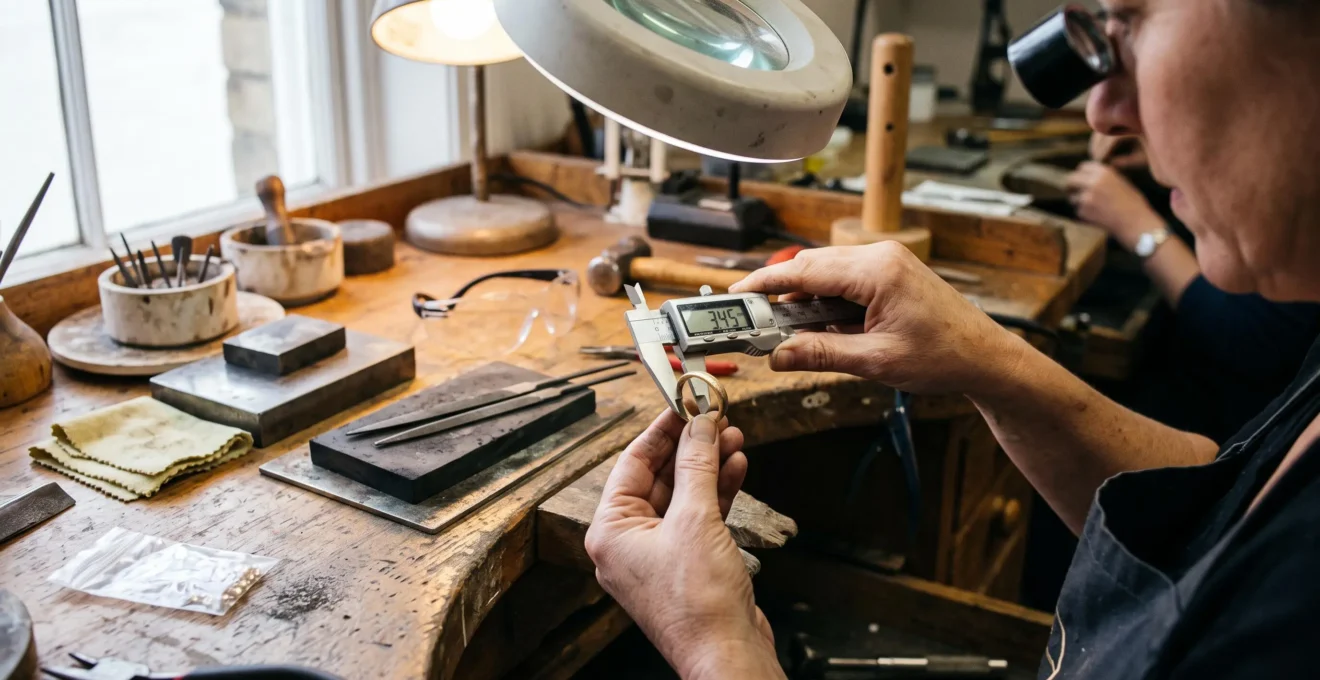
A ring does not need to look heavy to withstand daily wear. What matters is whether enough metal remains in the places that carry bending forces, whether the gemstone setting protects vulnerable edges, and whether the construction can be maintained as it wears.
Two rings can look equally delicate from above yet behave very differently after years of gripping handles, carrying bags and brushing against hard surfaces. One may have a comfortably rounded shank with substantial hidden thickness. The other may conceal a thin underside, poorly supported prongs or stone-set shoulders that are difficult to repair.
Metal choice matters, but platinum, 14k gold and 18k gold are not interchangeable engineering specifications. Their performance also depends on alloy composition, dimensions, manufacturing and the forces applied during wear.
The practical objective is to distinguish structural durability, gemstone security and surface appearance. Those three qualities interact, but they are not the same thing. Understanding that difference makes it easier to buy jewellery that stays elegant without requiring fragile construction.
Everyday jewellery durability: the essentials
- Choose adequate shank thickness and supported settings rather than judging strength by metal price or visible band width.
- Match setting height and gemstone protection to actual activities, especially gripping, gloves and repetitive hand contact.
- Inspect stone security and structural wear regularly; routine cleaning maintains appearance but cannot repair weakened metal.
- Why Do “Delicate” Rings Warp So Fast Even if the Metal Is Expensive?
- How to Spot a Durable Ring Design in 5 Checks Before You Leave the Shop?
- Low-Profile or High-Profile Setting: Which Should You Choose if You’re Clumsy With Hands?
- The Durability Feature That Backfires and Creates a Weak Spot at the Worst Place
- When Should You Book a Prong and Shank Check if You Wear Your Ring Every Day?
- The Simple Routine That Keeps Precious Metals Looking New After 6 Months of Hard Wear
- Why Does Platinum Develop a Patina Instead of “Wearing Away” Like Some Gold Alloys?
- Why Do Platinum Frameworks Hold Stones Securely Even When the Prongs Look Thin?
Why Do “Delicate” Rings Warp So Fast Even if the Metal Is Expensive?
Delicate rings warp when their metal cross-sections cannot adequately resist the bending forces of everyday use. Expensive metal does not compensate for insufficient shank thickness, narrow shoulders or weak connections. A well-proportioned ring made from an appropriate alloy can therefore outperform a more expensive ring whose design removes too much material from critical areas.
The shank is the circular part surrounding the finger. Its visible width affects appearance, but its thickness from the inner surface to the outer surface is equally important for strength. With otherwise comparable geometry, increasing the thickness in the bending direction can substantially increase resistance to deformation.
This is why a relatively narrow ring with a deeper, rounded cross-section may resist bending better than a broad, flat-looking ring that has very little depth.
Hardness is not the same as toughness. Hardness describes resistance to indentation and, to a degree, certain forms of surface scratching. Toughness describes the ability to absorb energy before fracturing. Ductility describes how much a material can deform plastically without breaking.
A harder alloy may retain its polished appearance better under some conditions, yet be less forgiving of certain impacts. A more ductile material may bend instead of cracking. Neither behaviour automatically makes a ring safe: a bent setting can still release a gemstone.
Inspect three areas before assuming a delicate ring is fragile:
- Lower shank: the underside often experiences contact and gradual wear, particularly when gripping objects.
- Shoulders and gallery: reduced material near the setting can leave concentrated loads at connections.
- Decorative edges: very fine halo rims or unsupported details may distort independently of the main band.
Resizing deserves attention too. Resizing does not inherently weaken a properly constructed ring, but repeated cutting, stretching, thinning or inadequate joining can create problems. Ask whether previous work altered the lower shank or introduced a joint requiring inspection.
A useful home observation is to examine the ring from its underside and side profile under good light. Look for flattening, asymmetry and visibly thin sections. Do not try to bend it to test its strength.
The next step is turning these observations into a repeatable inspection method that works at a jewellery counter.
How to Spot a Durable Ring Design in 5 Checks Before You Leave the Shop?
A durable ring should pass five practical checks: adequate lower-shank thickness, suitable setting height, properly proportioned prongs, reliable support beneath the main gemstone, and shoulders that do not taper into vulnerable joints. Examine the ring from several angles and request actual dimensions. Visual weight and sales descriptions alone cannot establish structural quality.
The GIA‘s guide to engagement ring settings explains how the head, shoulders, shank, prongs and supporting structures work together. Their construction matters at least as much as the style name.
Start by looking underneath the band. A substantial top view can hide a thin lower shank. Next, turn the ring sideways to inspect the head and its attachment to the shoulders.
Check whether the centre stone has appropriate support. A basket or gallery rail may help stabilise the setting, depending on its construction. Conversely, a decorative element that looks substantial may contribute little if it is poorly connected to the load-bearing components.
Count the prongs and examine their placement. Four-prong and six-prong arrangements are both common, but the appropriate configuration depends on the gemstone’s size, shape, vulnerability and setting design. More prongs can provide redundancy, but poor prongs are not made safe simply by increasing their number.
Finally, study the transition between the shoulders and the main setting. A dramatic taper may be visually attractive, but an abrupt reduction in section can concentrate stress.
Put the ring on and gently close your fist. Observe whether the head protrudes into neighbouring fingers, catches on clothing or becomes uncomfortable when gripping. A display tray rarely reveals these problems.
Ask the jeweller for the actual shank width and thickness in millimetres, particularly at the bottom and near the shoulders. No universal safe measurement applies to every ring; gemstone size, alloy, ring size and geometry change the requirement.
Five checks to complete before purchasing
- Measure the shank. Ask for its minimum width and thickness in millimetres, and record both measurements.
- Test the profile. Wear the ring, close your fist gently and record whether the setting catches or restricts movement.
- Inspect the prongs. Count them and request confirmation that their placement adequately protects the gemstone; note the answer.
- Examine the gallery. Request a side-view image showing the basket, supports and setting connections.
- Confirm repairability. Ask whether the shoulders, shank and prongs can be reinforced or repaired; retain the jeweller’s written response.
A ring that looks delicate may pass all five checks because its hidden structure is appropriately proportioned. A chunky-looking ring may fail because of a weak joint or hollow construction.
Once the underlying structure is satisfactory, setting height becomes the next decision because it determines how readily the gemstone meets the surrounding world.
Low-Profile or High-Profile Setting: Which Should You Choose if You’re Clumsy With Hands?
A low-profile setting is generally the more practical choice when your hands regularly contact clothing, gloves, furniture or other objects. Keeping the gemstone close to the finger reduces opportunities for snagging and certain impacts. However, a low setting is not automatically stronger: edge protection, cleaning access and the construction underneath the stone still matter.
A high-profile setting raises the gemstone above the band. This may provide a more prominent appearance and facilitate access around the stone, but also puts the setting in the path of accidental contact.
Low settings often reduce interference with gloves, sleeves and handrails. Their drawback is that tightly enclosed areas can collect dirt and be harder to reach during cleaning.
Setting height also differs from gemstone protection. A low-mounted stone with exposed edges may remain vulnerable to lateral impacts, while a slightly raised bezel can protect the perimeter effectively.
For a practical comparison, match the design to what your hands actually do.
| Daily situation | Practical preference | What to verify |
|---|---|---|
| Typing and office work | Low or moderate profile | Comfort when the hand rests on a desk |
| Frequently wearing gloves | Low-profile bezel | Fabric clearance and absence of protruding claws |
| Caring for young children | Smooth, protected setting | No sharp edges or prongs catching fabric |
| Gym and weight training | Remove the ring | Risk of compression, deformation and finger injury |
| Manual work with tools | Remove the ring where hazardous | Snagging, crushing and equipment-related risks |
| Occasional formal wear | High profile may be reasonable | Prong protection and maintenance requirements |
The frequently overlooked compromise is a moderately raised bezel or hybrid setting. A protective metal rim can surround much of the gemstone while preserving enough height for comfortable cleaning and an airy appearance.
A partial bezel may leave portions of the gemstone exposed, so its protection depends on precisely where the opening sits. Similarly, a low basket with fragile connections is not made durable by its small height alone.
For bracelets, apply the same principle to protruding gemstone mounts and clasp components. Smooth edges and protected connections matter more than simply choosing a narrow chain.
The best everyday setting is one that avoids unnecessary contact while retaining adequate metal around the stone and its supporting connections.
The Durability Feature That Backfires and Creates a Weak Spot at the Worst Place
Channel and pavé settings can protect or decorate gemstones, yet they may also introduce structural vulnerabilities when too much metal is removed from the band. The danger is not the setting name itself but the remaining metal around stone seats, especially at narrow shoulders and other loaded sections. Properly engineered versions can still be durable.
In a channel setting, stones sit between metal walls. Pavé uses closely spaced small stones secured by beads or tiny prongs. Both can create a continuous sparkling surface without the visual bulk of a large central setting.
However, creating individual stone seats requires working metal away from parts of the ring. If the original shank is already thin, the remaining material may be insufficient to resist repeated bending.
This matters particularly where the shoulders meet the head. A reduction in load-bearing cross-section can increase local stress, even when the band appears broad from above.
Full pavé eternity bands present a further complication: stones extend around the circumference, leaving fewer straightforward locations for resizing. Changing the ring’s curvature can disturb stone seats and alter gemstone security.
It would be inaccurate to claim that every channel-set or pavé ring is weaker than every plain band. A sufficiently substantial and well-manufactured channel can remain mechanically sound. The correct comparison considers remaining wall thickness, stone-seat geometry, workmanship and future repairability.
If the band is bent, several adjacent stone settings may be affected. Multiple loose stones are possible, but a sequential failure is not inevitable and should not be treated as a universal characteristic.
There are practical alternatives for buyers who like a delicate sparkle:
- Place smaller accent stones in a structurally supported basket or gallery rather than cutting stone seats into every section of the shank.
- Choose a partial pavé arrangement that leaves a plain lower shank for wear management and potential resizing.
- Maintain appropriate metal sections beneath decorative stone seats, even if those supports are largely invisible from above.
Before buying a pavé or channel-set ring, ask the jeweller whether resizing would require resetting stones, replacing part of the shank or rebuilding the setting. The answer can reveal the real long-term cost of the design.
A carefully designed accent-stone arrangement can look just as refined while leaving more options for maintenance as the ring ages.
When Should You Book a Prong and Shank Check if You Wear Your Ring Every Day?
Book a professional check whenever a gemstone appears loose, a prong catches fabric, the band changes shape or the setting receives a significant impact. For rings worn daily, establish a recurring inspection schedule with the jeweller based on the activities involved, the setting’s condition and the ring’s construction rather than assuming one interval suits every piece.
Daily wear creates different maintenance demands from occasional use. A ring worn during frequent lifting, gripping, cleaning or physical work experiences more mechanical contact than one removed for such activities.
A useful initial approach is to ask about inspections approximately every six to twelve months, adjusting the schedule with a qualified jeweller when wear or impact exposure warrants it. This is a practical starting point, not a scientifically established universal interval.
Watch for four warning signs:
- A prong catches on clothing or hair when it did not previously.
- A gemstone visibly shifts, appears crooked or produces a rattle during ordinary movement.
- A prong tip looks flattened, shortened or displaced.
- The band appears oval, develops a flat area or shows a visible change in thickness.
Do not deliberately tap or shake a ring to test a suspected loose gemstone. If movement is already apparent, stop wearing it until a jeweller has inspected the setting.
The lower shank deserves the same attention as the prongs. Metal loss caused by prolonged abrasion or previous repairs may be difficult to recognise without comparing measurements. A professional can inspect remaining thickness, junctions and possible cracks.
Ask the jeweller to check stone movement, prong condition, gallery attachments and band geometry. If weakness is found, the appropriate intervention might include tightening, re-tipping, rebuilding or replacing worn components.
Combining an inspection with professional cleaning is convenient because the jewellery is already being handled and examined. Ask whether the inspection is included in the service rather than assuming it is free.
Maintenance is most effective before a worn component fails. Keeping the ring clean helps with inspection, but preserving its shine requires a separate routine.
The Simple Routine That Keeps Precious Metals Looking New After 6 Months of Hard Wear
A gentle cleaning routine can keep suitable jewellery brighter by removing accumulated oils, soap residue and dirt, but it cannot prevent every scratch or preserve a factory-new polish indefinitely. For uncomplicated diamond jewellery in sound settings, mild soapy water and careful brushing may be appropriate. Other gemstones, coatings and weakened settings require different treatment.
The distinction is between visual durability and mechanical durability. Dirt can make jewellery look dull without damaging its structure. Scratches, worn plating, thinning metal and loose prongs require different responses.
For a sound, uncomplicated diamond ring that its jeweller confirms is suitable for home cleaning, a low-effort routine may involve:
- Preparing a small bowl of lukewarm water with a little mild dish soap.
- Gently removing surface deposits with a suitable soft brush, avoiding unnecessary pressure on the setting.
- Rinsing safely in a separate container and drying with a clean, soft, lint-free cloth.
- Inspecting the ring visually before returning it to storage or regular wear.
Weekly cleaning may be convenient for frequently worn diamond jewellery, but it is not a universal instruction for every gemstone. Frequency should follow actual dirt accumulation, material compatibility and jeweller guidance.
According to GIA’s diamond jewellery cleaning recommendations, gemstones and settings require different precautions. Some gemstones can be scratched by brushing, and fragile settings need particular care. Bleach and abrasive household products should not be used for cleaning diamond jewellery.
Ultrasonic or steam cleaning is not automatically safe either. Existing stone looseness, certain treatments and gemstone sensitivity may rule out those methods.
The most useful preventive habits are selective rather than restrictive. Remove rings before weight training, activities involving substantial gripping, and exposure to harsh cleaners or chlorine-containing chemicals.
Repeated contact with harder surfaces can create micro-scratches and gradually soften a polished finish. Rings that rub against each other may also wear where they meet. Separating them during storage and reducing unnecessary contact can help limit abrasion.
Some people choose to rotate rings or wear a piece on a less-used hand. This can reduce exposure in particular routines, although it should not be presented as a measured guarantee of lower scratching.
After six months of frequent wear, fine marks or a softer polish are entirely possible even with careful cleaning. They are not necessarily manufacturing defects.
Realistic expectations matter most when comparing precious metals whose surfaces age differently, especially gold and platinum.
Why Does Platinum Develop a Patina Instead of “Wearing Away” Like Some Gold Alloys?
Platinum develops a greyish patina because repeated surface contact produces fine scratches and microscopic deformation that change how the metal reflects light. Some scratching displaces metal rather than removing it, although platinum can still lose material through wear. Gold alloys also scratch, deform and abrade; their behaviour depends on composition, treatment and use.
Platinum’s familiar patina is therefore a change in surface texture, not proof of structural failure. A polished platinum ring may gradually become more matte where it repeatedly contacts other objects.
When a surface scratch forms through plastic deformation, some material is pushed aside into small ridges. That differs from abrasive wear, where particles can actually be removed. Both mechanisms may occur over the lifetime of the same piece.
Consequently, the statement that platinum never wears away is too strong. It can lose metal, suffer damage and need repairs, particularly in exposed or poorly constructed areas.
The GIA’s comparison of ring metals for everyday wear identifies both 14k and 18k gold as practical choices and describes platinum’s good long-term wear resistance and characteristic patina.
Gold purity alone does not determine durability. A 14k alloy contains more non-gold alloying material than an 18k alloy, but hardness and toughness depend on the specific metals added and on manufacturing or heat treatment. It is not accurate to assume every 14k ring resists scratches better than every 18k ring.
The long-term question for a delicate ring is whether enough metal remains in the shank and setting to maintain their function. Surface hardness alone cannot answer that question.
Maintenance also differs between platinum and white gold. Platinum can generally be professionally refinished when its patina is not desired, although polishing can remove some surface material. White gold with rhodium plating may require periodic replating to restore its original bright white appearance.
That creates two distinct choices: allow an unplated platinum finish to evolve naturally, or maintain a particular plated appearance through periodic professional treatment.
Neither is universally better. Some wearers like platinum’s subdued patina, while others prefer the brighter appearance of newly finished white gold.
Platinum’s surface behaviour is only part of the story. The more demanding engineering question is whether its prongs and framework retain gemstones safely.
Key takeaways before choosing a platinum setting
- Density and price do not establish prong strength; alloy properties and structural dimensions must be assessed separately.
- Prong alignment, connection quality and support beneath the gemstone matter even when the metal has excellent long-term wear characteristics.
- Choose a setting that can be inspected and repaired, rather than relying on claims that platinum is permanently secure.
Why Do Platinum Frameworks Hold Stones Securely Even When the Prongs Look Thin?
Well-designed platinum frameworks can secure gemstones with relatively discreet prongs because suitable platinum alloys combine useful mechanical properties with carefully engineered support and attachment geometry. Their strength does not come from density alone. A thin platinum prong is not automatically stronger than an identical gold prong, and inadequate dimensions can compromise security regardless of material.
Platinum is considerably denser than common jewellery gold alloys, so an identical volume may weigh more. However, greater mass is not the same as greater resistance to bending or permanent deformation. Those properties depend on yield strength, stiffness, alloy composition, processing and geometry.
For prongs, geometry is particularly important. A small reduction in section can substantially affect bending resistance. The shape of the prong, the quality of its attachment and the position of the gemstone contact points all influence performance.
Platinum alloys can offer valuable ductility and toughness, allowing certain prongs to be adjusted during setting and repair. But the behaviour of a prong under impact varies. A displaced prong may provide a visible warning, while other forms of damage may be less obvious. Gradual deformation before failure cannot be guaranteed.
A real platinum mounting that needed structural improvement
GIA’s quality-assurance material describes a custom platinum setting produced for a 22.50-carat round brilliant diamond. The mounting used an alloy containing 90% platinum and 10% iridium, identified in the reference as a particularly soft and malleable platinum composition.
The documented example illustrates a setting whose construction was inadequate despite its precious-metal composition. GIA contrasts that mounting with an improved design, demonstrating the importance of prong engineering and support. Because the gemstone was unusually large, the case does not establish failure rates or minimum dimensions for ordinary everyday rings.
The example is documented in GIA’s platinum prong-setting quality benchmarks. Its central lesson is that precious-metal choice cannot compensate for inadequate structural engineering.
For a buyer seeking the appearance of fine prongs and maximum gemstone visibility, ask the jeweller to explain how the setting achieves security:
- Are the prongs sufficiently proportioned for the particular gemstone and alloy?
- Do their contact points protect the stone against realistic movement?
- Does the gallery or basket provide appropriate support?
- Can individual prongs be tightened, re-tipped or rebuilt if they wear?
Thin platinum prongs may be entirely appropriate in a sound design, but stone shape and exposed edges still matter. A configuration that leaves a vulnerable gemstone corner unsupported cannot be made safe merely by specifying platinum.
Repairability is another benefit worth investigating. Depending on the alloy, setting condition and workmanship, displaced or worn platinum prongs may be adjustable or rebuildable. Some gold settings can also be repaired effectively, so there is no universal platinum-versus-gold repair advantage.
For an everyday bracelet, the equivalent engineering questions concern links, clasp mechanisms, connecting rings and stone mounts. A durable clasp must be correctly made and secured; the metal’s prestige is not sufficient evidence.
Take the ring’s dimensions, setting details and intended wearing routine to a qualified bench jeweller. Ask for a specific assessment of the lower shank, prong support, exposed gemstone edges and future repair options. That is a stronger basis for buying elegant everyday jewellery than either a bulky silhouette or an expensive metal label.
Can a thin ring be durable enough for everyday wear?
Yes. A visually thin ring can be suitable for everyday wear when its thickness, cross-sectional shape, alloy and setting construction are properly matched. The jeweller should assess the minimum metal section and stress points rather than relying on appearance alone.
Is 14k gold always more durable than 18k gold?
No. Although 14k gold contains a higher proportion of alloying metals, its performance depends on the specific composition and manufacturing process. Both 14k and 18k gold can be appropriate for everyday rings, and ring geometry often matters more than purity alone.
Should an everyday ring be removed before sleeping?
Removing a ring during sleep may reduce incidental snagging, pressure or contact with bedding, particularly if the setting has protruding prongs. Whether removal is necessary depends on the ring’s design, fit, condition and the wearer’s circumstances. A damaged or loose setting should be inspected rather than worn continuously.
Can a worn ring shank be reinforced without changing its appearance?
Sometimes. A jeweller may be able to rebuild or replace a worn lower shank, adjust its profile or reinforce a connection while preserving much of the visible design. Feasibility depends on the remaining metal, alloy, gemstones, existing joints and previous repairs.
Does a higher jewellery price guarantee fewer repairs?
No. Price can reflect metal content, gemstones, craftsmanship, branding and design complexity without establishing lower mechanical failure risk. Construction quality, suitable dimensions, everyday exposure and maintenance determine whether a particular piece is likely to remain serviceable.