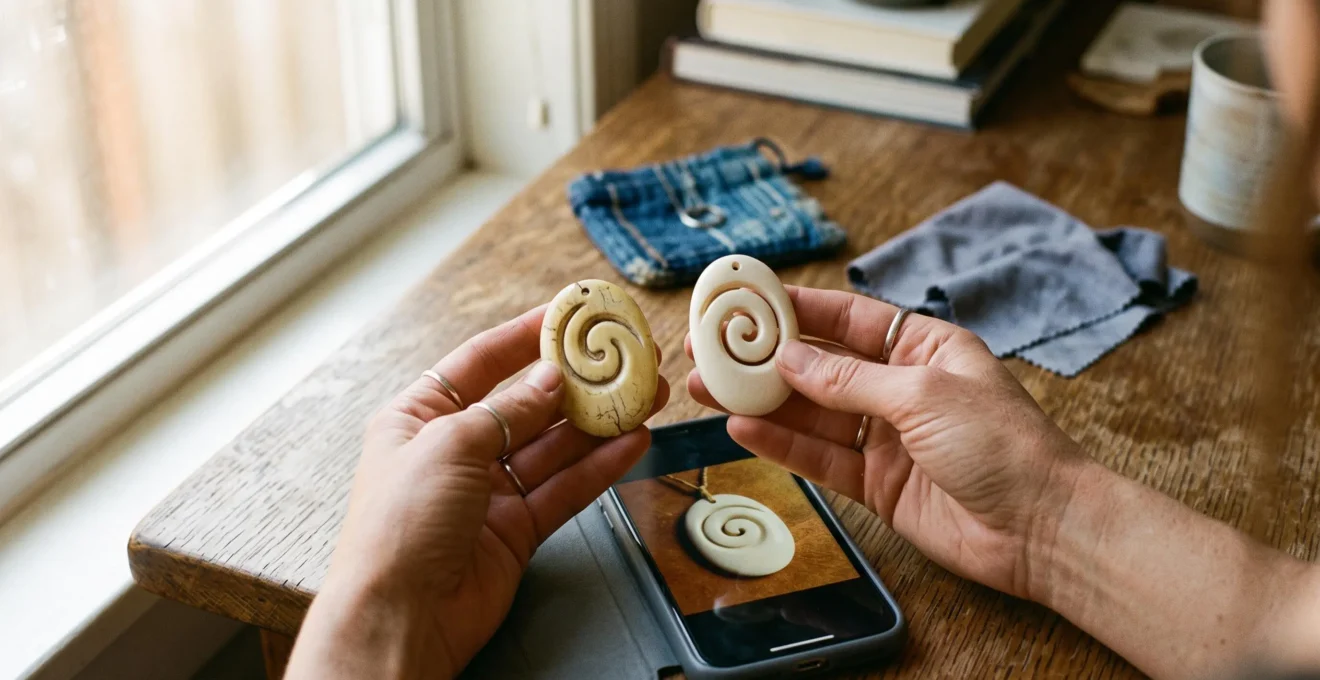
A pearl necklace that loses its lustre, a horn pendant that changes colour, or a carved bone ornament developing fine cracks can be alarming, especially when the jewellery is relatively new. Yet natural materials do not respond to everyday conditions in the same way as precious metals or conventional gemstones.
Organic jewellery can deteriorate through exposure to light, heat, moisture fluctuations, cosmetics and inappropriate cleaning. Some changes are superficial; others affect the material itself and cannot be reversed. Damage may become noticeable within 90 days under unfavourable conditions, but there is no universal deterioration schedule.
The most useful protection begins with identifying the material. Pearls, amber, shell, coral, horn, bone and wood have different structures and sensitivities. Even visually similar pieces may need different cleaning and storage routines. Meanwhile, decorative glass enamel introduces a separate kind of fragility that matters when choosing jewellery for everyday wear.
Understanding these differences makes it easier to choose pieces suited to your lifestyle, recognise warning signs and prevent avoidable damage before it becomes permanent.
Organic jewellery care: the essentials
- Sunlight, temperature and humidity can cause cumulative colour changes, distortion or cracking, but deterioration rates differ substantially between materials.
- Cleaning must be material-specific: gentle wiping is often safer than soaking, abrasion, steam or ultrasonic equipment.
- Stable storage, protection from cosmetics and regular inspection matter more than intensive cleaning or attempted restoration.
- Why Can an Organic Material Pendant Start Yellowing After Just 8 Weeks of Sunlight?
- How to Clean Organic-Material Jewellery at Home Without Causing Micro-Cracks?
- Pearl Look or Moonstone Glow: Which Is Better if You Want Low Maintenance?
- The Ultrasonic-Cleaner Mistake That Can Ruin Organic Jewellery in 3 Minutes
- The Simple Storage Setup That Extends Organic Jewellery Life by Years in Humid Homes
- Why Can Plique-à-Jour Enamel Crack From a Single Drop Even if the Metal Frame Survives?
- Why Are Powdered-Glass Inlays Most Likely to Chip at the Border, Not the Centre?
- Why Does Plique-à-Jour Enamel Cost So Much, and Why Can It Still Crack Easily?
Why Can an Organic Material Pendant Start Yellowing After Just 8 Weeks of Sunlight?
An organic-material pendant can begin changing colour after sustained sunlight exposure because light, heat and oxygen may alter susceptible pigments or components of the material. Eight weeks is a possible observation, not a scientifically established deadline. The outcome depends on the pendant’s composition, finish, exposure conditions and previous ageing.
Materials such as amber, horn, bone and certain natural or synthetic resins can develop different forms of discolouration. In susceptible materials, light-driven chemical reactions may contribute to oxidation or changes in colour-producing compounds. Heat can accelerate some ageing processes, while accumulated dirt and surface coatings can produce a similar appearance without the same underlying damage.
Not every organic material behaves identically. Pearls, for example, are generally stable to ordinary light exposure, although excessive heat can damage them. Bone may develop a natural yellow-brown patina with age. These differences make it misleading to treat yellowing as a universal sign of sunlight damage.
The Canadian Conservation Institute guidance on caring for bone and horn recommends avoiding direct sunlight, strong lighting and nearby heat sources. Its conservation advice also explains why environmental stability matters for natural materials.
Colour change may appear before obvious structural damage, but it is not necessarily the first symptom. Some pieces develop distortion, a dull surface or fine cracking without noticeable yellowing.
A practical inspection starts with a photograph taken when the piece was new. Compare the colour under similar lighting, looking particularly at exposed surfaces, edges and areas previously hidden beneath fittings. A contrast between protected and exposed surfaces can provide a useful clue, although it cannot establish the precise cause.
Before attempting treatment, distinguish contamination from material change:
| Observation | Possible explanation | Appropriate response |
|---|---|---|
| Removable dull film | Surface deposits or accumulated cosmetics | Use a material-compatible cleaning method. |
| Colour change within the surface or material | Ageing, pigment alteration or oxidation | Reduce exposure; request professional assessment before polishing. |
| Yellowing with cracks or distortion | Potential combined chemical and physical deterioration | Stop aggressive cleaning and seek specialist advice. |
Surface deposits may be removable, but molecular deterioration cannot simply be washed away. Polishing may remove original material or a protective coating, so apparent colour improvement is not necessarily harmless restoration.
For everyday wear, the safest preventive choices are straightforward: avoid leaving jewellery on sunny windowsills, rotate frequently worn pieces and ask sellers to identify the actual material rather than relying on a broad description such as “organic pendant”.
How to Clean Organic-Material Jewellery at Home Without Causing Micro-Cracks?
Clean organic-material jewellery with the gentlest method appropriate to its exact composition, usually beginning with a soft, dry cloth or brush. Avoid soaking porous or cracked materials, using household solvents or rubbing aggressively. Moisture absorption followed by drying can create dimensional changes that worsen existing weaknesses, particularly around holes, edges and fittings.
The problem is not that every contact with water causes damage. Different materials absorb moisture differently, and some tolerate occasional gentle washing. The greater concern is uncontrolled wetting, prolonged exposure or repeated moisture changes in materials that swell and contract.
Bone, horn, wood, pearls and amber should therefore not receive identical cleaning treatment. A product safe for a smooth, intact surface may be unsuitable for porous material, an aged coating or a repaired piece.
The following methods provide conservative starting points, not permission to wet every piece of jewellery.
| Material | Suggested approach | Main precaution |
|---|---|---|
| Bone | Soft dry brush; minimal mild soapy water only on suitable intact, smooth surfaces | Do not soak or wet cracked or porous areas. |
| Horn | Soft dry cloth or brush | Avoid soaking and unverified chemical treatments. |
| Wood | Gentle dry dusting unless its finish has specific care instructions | Avoid prolonged wetting and harsh cleaners. |
| Pearls | Very soft cloth after wear; occasional careful washing when appropriate | Avoid acids, abrasives and ultrasonic cleaning. |
| Amber | Soft cloth; limited gentle cleaning according to the piece’s condition | Avoid solvents, abrasive polishing and prolonged heat. |
| Shell and coral | Soft cloth with minimal moisture where suitable | Avoid acids, abrasive tools and soaking. |
Over-polishing creates an additional risk. Repeated vigorous rubbing can remove original surface material, coatings or patina. Wood polish, leather conditioners, abrasive pastes and bleaching products should not be applied simply because the jewellery contains a natural material.
After cleaning, examine the piece beneath a bright lamp. Angle it gently to reveal fine lines, particularly around drilled holes, clasp connections and thin edges. If a line catches the light differently, opens under slight movement or appears to deepen, stop handling the vulnerable area and arrange a professional assessment.
Five-step home jewellery cleaning check
- Identify the main material and any secondary materials; write down the composition or record that it remains unknown.
- Photograph the piece before cleaning; keep a clear reference image of its current condition.
- Choose the mildest verified cleaning method; make a short note of what will touch the surface.
- Remove loose dust gently and inspect the result; check that no residue or unexpected surface change remains.
- Inspect edges, holes and settings under angled light; record any cracks or changes that require specialist attention.
Gentle cleaning can remove surface contamination, but it cannot repair cracks already formed. Once a piece is clean and completely ready for storage, protecting it from repeated environmental changes becomes the next priority.
Pearl Look or Moonstone Glow: Which Is Better if You Want Low Maintenance?
Moonstone may be the more convenient choice for someone who regularly wears cosmetics or experiences frequent skin contact, because it is generally stable to light and is less vulnerable to ordinary cosmetic exposure than pearls. However, moonstone can fracture along natural cleavage planes after an impact. Pearls need greater chemical care but can remain suitable for occasional, carefully managed wear.
Pearls are organic gemstones with nacre made principally from layered calcium carbonate and an organic matrix. Their lustre is attractive, but the surface is vulnerable to abrasion, acids, perspiration, perfume and certain cosmetic products.
The GIA’s pearl care and cleaning recommendations explain that pearls should be wiped after wearing and must not undergo ultrasonic or steam cleaning. Excessive heat can also cause discolouration or cracking.
Moonstone is different. It belongs to the feldspar mineral family, making it a natural gemstone rather than an organic material. Its distinctive glow, known as adularescence, comes from the interaction of light with its internal structure.
Although moonstone is harder than pearl, hardness alone does not measure durability. Its cleavage planes make it vulnerable to forceful impacts. A moonstone ring worn during physical work may therefore be at greater risk of fracture than a pearl pendant reserved for special occasions.
The following comparison focuses on actual wearing conditions rather than treating one gemstone as universally superior.
| Consideration | Pearls | Moonstone |
|---|---|---|
| Cosmetics and perspiration | Require careful protection and wiping | Generally less vulnerable, but still needs gentle cleaning |
| Scratching | Soft surface; easily abraded | Harder surface; better scratch resistance |
| Sudden impacts | Can be scratched, chipped or otherwise damaged | Cleavage creates a significant fracture risk |
| Light and heat | Generally light-stable; excessive heat is harmful | Light-stable; avoid sudden temperature changes and high heat |
| Preferred wear pattern | Occasional or careful regular wear | Regular wear in protected settings, avoiding knocks |
| Cleaning | Soft cloth; gentle washing when appropriate | Warm soapy water; no ultrasonic or steam cleaning |
The GIA’s moonstone durability and cleaning guidance identifies moonstone’s two cleavage directions and recommends warm soapy water rather than ultrasonic or steam cleaning.
Hot or humid environments can increase perspiration exposure for pearls. Dry environments may also call for care in storage, particularly where heat and dehydration are possible. Neither climate alone determines how long a piece will last.
Pearls do not need skin oils applied to them to stay lustrous, and the idea that they must “breathe” should not be interpreted as a reason to expose them to perfume or perspiration. Gentle wiping and sensible storage are more useful.
Ownership cost also depends on cleaning, restringing, repairs and replacement risk. A carefully worn pearl necklace can be a better long-term choice than a moonstone ring repeatedly exposed to knocks. Frequency of wear and setting design matter as much as material characteristics.
The Ultrasonic-Cleaner Mistake That Can Ruin Organic Jewellery in 3 Minutes
Placing organic jewellery in an ultrasonic cleaner can cause irreversible damage during a single cleaning cycle. Ultrasonic machines use high-frequency vibrations and cavitation in liquid to dislodge contamination. Vulnerable materials, existing cracks, delicate settings and adhesives may not tolerate that process. Three minutes is an illustrative cycle duration, not an established damage threshold.
Ultrasonic cleaning is popular because it removes dirt from areas that are difficult to reach manually. However, a cleaning method that works for some durable metal jewellery is not automatically safe for assembled pieces containing natural or fragile components.
Energy transmitted through cleaning liquid can aggravate weaknesses, loosen attachments or compromise vulnerable surfaces. The exact failure mechanism varies with the material, its construction and its previous condition. It would be inaccurate to assume that ultrasonic cleaning always destroys every porous cell or nacre layer in the same way.
Exclude the following materials from routine ultrasonic cleaning:
- Pearls and mother-of-pearl
- Amber and many organic resins
- Coral and delicate shell components
- Bone, horn and wood
- Enamel, particularly delicate or damaged enamel work
- Moonstone and other gemstones for which ultrasonic cleaning is unsuitable
A piece does not become safe merely because most of it is metal. A small pearl accent, glued element or enamel panel can still determine whether the entire piece tolerates cleaning.
Before cleaning an unfamiliar item, inspect every component. Check for attached ornaments, delicate inlays, loose settings, old repairs and materials that cannot be identified confidently.
Use a soft dry brush or cloth as the default approach. Where a suitable material-specific method permits moisture, use it sparingly and keep vulnerable components protected. Cleaning metal areas separately is appropriate only where the construction allows this without risking adjacent materials.
Vintage and inherited jewellery require particular caution. Earlier repairs, adhesives and concealed damage may not be obvious, making conventional workshop cleaning unsuitable without prior assessment.
When leaving jewellery with a professional, explain which materials it contains and explicitly request that no ultrasonic or steam cleaning be performed unless its safety has been confirmed for every component.
A short conversation before cleaning is easier than repairing a fractured ornament or replacing a lost inlay. Once cleaning risks have been controlled, the jewellery’s daily storage environment becomes the next important consideration.
The Simple Storage Setup That Extends Organic Jewellery Life by Years in Humid Homes
Organic jewellery generally benefits from storage that minimises abrupt changes in humidity, temperature and light exposure. Individual soft compartments, a stable indoor location and periodic condition checks can reduce avoidable deterioration. In particularly damp homes, controlled moisture protection may help some materials, but pearls require special consideration because excessively dry conditions can also damage them.
Humidity can affect natural materials through moisture absorption and release. In susceptible components, this causes expansion and contraction that may contribute to warping, separation or cracking.
Persistent dampness can also encourage mould on vulnerable organic surfaces and nearby storage fabrics. Bathrooms and windowsills are therefore poor long-term storage locations: bathrooms experience frequent humidity fluctuations, while windowsills introduce sunlight and temperature changes.
A practical setup begins with soft pouches or lined compartments so jewellery does not rub against metal fittings or harder gemstones. The storage location should be away from radiators, direct sunlight and frequently opened windows.
A passive humidity indicator can help identify a persistently damp storage area. For suitable non-pearl pieces, a carefully managed sealed container and desiccant may be useful where ambient humidity is excessive. Desiccants should not be used indiscriminately: over-drying can create a different conservation problem.
The Canadian Conservation Institute identifies 45–55% relative humidity and temperatures not exceeding 25°C as ideal conservation conditions for the bone, ivory, horn and antler objects covered by its guidance. These are museum-oriented recommendations, not universal specifications for every type of jewellery.
Pearls need a different storage strategy. Avoid leaving them in an excessively dry sealed environment, particularly alongside strong desiccants. A soft-lined jewellery compartment in a reasonably stable room is generally more appropriate than an improvised moisture-removal system.
Storage frequency also matters. Jewellery worn daily should be wiped as appropriate and allowed to become dry before being put away. Seasonal or occasional pieces should be checked periodically for mould, unusual odours, loosened fittings, cracking or visible colour changes.
For a home collection, a manageable routine is to inspect stored pieces whenever they are taken out for wear, and periodically review items that remain unused for extended periods.
No storage arrangement repairs existing damage, and there is no evidence-backed universal number of additional years it will provide. Nevertheless, controlling environmental exposure is a valuable preventive measure because it protects the jewellery even when it is not being worn.
Good storage also protects delicate non-organic decorative techniques. Glass enamel, in particular, may tolerate ordinary environmental conditions yet remain highly vulnerable to impact and movement in its supporting frame.
Why Can Plique-à-Jour Enamel Crack From a Single Drop Even if the Metal Frame Survives?
Plique-à-jour enamel can crack after a single impact because its finished glass-filled cells have no continuous backing beneath them. Although the surrounding metal framework may remain intact, it can flex or transfer impact forces into the brittle enamel. A surviving frame therefore does not guarantee that the translucent glass cells have escaped damage.
Plique-à-jour creates a stained-glass effect by allowing light to pass through coloured enamel held within metal outlines. Unlike champlevé enamel, which sits in recessed metal cavities, the finished plique-à-jour structure exposes the enamel windows without a solid supporting background.
The Victoria and Albert Museum’s explanation of metalworking techniques describes this construction and the demanding process used to produce it. Some methods employ temporary backing during firing, which is subsequently removed.
Glass enamel is hard but brittle. A forceful knock can produce local stress within a cell, particularly where the glass meets its frame. Metal and enamel respond differently to deformation, allowing damage to develop even when the metal has not visibly bent or broken.
The likelihood of cracking depends on the impact, cell geometry, frame rigidity, enamel condition and construction quality. One drop can be sufficient, but not every drop causes a fracture.
After an impact, inspect the piece without flexing or tapping it:
- Place it on a stable, soft surface under bright, indirect light.
- Examine each translucent cell from several angles.
- Look for thin lines, cloudy areas, missing fragments or changes in reflected light.
- Pay close attention to the borders where glass meets metal.
- Stop wearing the piece if a crack, loose fragment or unexpected movement is visible.
Very fine fractures can be difficult to detect without magnification. Avoid testing the enamel by pressing it, bending the frame or tapping the cells to judge their sound, because these actions could worsen an existing weakness.
Professional repair may involve stabilisation, reconstruction or replacement of damaged enamel, depending on the technique and condition. An invisible repair cannot be guaranteed, and heating a damaged antique piece can introduce additional risks.
For buyers attracted to translucent enamel, the practical lesson is that impact protection matters more than the apparent strength of the metal frame. Similar attention is needed at the edges of decorative glass inlays, where settings and brittle materials meet.
Why Are Powdered-Glass Inlays Most Likely to Chip at the Border, Not the Centre?
Powdered-glass inlays can be vulnerable at their borders because the junction between glass and its surrounding setting may concentrate mechanical stress. Impacts, differences in thermal expansion and imperfect support can encourage damage near that interface. However, border chipping is not universally more common than central damage; the actual failure pattern depends on construction and impact conditions.
Powdered-glass decoration can involve different manufacturing methods, including fired enamel and glass-based inlay techniques. Their support structures are not interchangeable, so an assessment should begin by establishing how the individual piece was made.
Where a glass inlay is held within a metal channel or bezel, the boundary between materials is particularly important. Differences in stiffness and thermal response can create stress where the glass meets the metal.
A narrow unsupported area, sharp internal corner or poorly fitted component may increase local vulnerability. Conversely, a well-supported border can protect the inlay against some impacts. A direct strike to the centre can still cause central cracking or breakage.
Before buying or wearing a glass-inlaid piece, examine the setting under good lighting. Look for visible gaps, uneven borders, raised edges, chipped corners or surfaces that appear to have shifted relative to the surrounding metal.
Edge condition is a useful inspection clue, not a definitive quality test. Some irregularities reflect the original manufacturing technique rather than damage, especially in handmade pieces.
Practical prevention includes avoiding catches on sleeves and pockets, keeping inlaid jewellery away from hard objects during storage and removing it before activities likely to produce knocks.
Repair options depend on whether the problem is superficial, structural or related to the setting:
| Condition | What it may indicate | Practical next step |
|---|---|---|
| Minor surface mark | Possible cosmetic wear | Document and monitor; avoid abrasive treatment. |
| Small border chip | Localised material loss | Seek advice about suitable stabilisation or repair. |
| Crack crossing the inlay | Structural damage | Stop wearing until professionally assessed. |
| Loose or displaced inlay | Possible setting failure | Request professional re-setting or reconstruction advice. |
Some minor chips can be repaired, while extensive damage may require reconstruction or replacement. The choice depends on material compatibility, visual expectations and whether the jewellery has historical or collectible significance.
Recognising the limits of glass decoration helps explain a broader jewellery-buying paradox: a technically demanding and expensive enamel piece may still be more fragile than a simpler, less costly alternative.
Key takeaways before choosing delicate enamel jewellery
- Evaluate how an enamel piece is constructed, especially whether glass cells have a continuous backing.
- Ask about intended wear, impact exposure and repair options before committing to a delicate design.
- Treat price as an indication of craftsmanship and market factors, not as proof of physical durability.
Why Does Plique-à-Jour Enamel Cost So Much, and Why Can It Still Crack Easily?
Plique-à-jour enamel can be expensive because producing transparent glass-filled metal cells requires specialised craftsmanship, careful firing and considerable labour. Its finished enamel windows remain fragile precisely because they lack a solid backing. The price may reflect skill, time and manufacturing difficulty, but it does not establish resistance to impact or guarantee everyday durability.
The visual appeal of plique-à-jour is closely connected to its construction. Light passes through coloured enamel, creating a miniature stained-glass appearance that differs from opaque or metal-backed enamel techniques.
Producing this effect requires control over the enamel, metal framework, firing process and final finish. Mistakes or material failures may require additional work or replacement of affected sections.
The Victoria and Albert Museum characterises plique-à-jour as technically demanding. However, its educational explanation does not establish a standard number of working hours, a universal firing failure rate or a fixed price premium.
Those values vary between makers and individual designs. Price can also reflect the scale of the piece, the metal used, artistic complexity, provenance and commercial factors.
The essential distinction is that craftsmanship difficulty and physical toughness measure different qualities. A finely executed transparent enamel pendant may require greater care than a simpler metal ornament.
For someone choosing jewellery for frequent use, suitability is more important than the price tag:
| Jewellery type | Typical exposure | Practical consideration |
|---|---|---|
| Earrings | Generally fewer direct hand-contact impacts | Often suitable for careful occasional wear. |
| Pendants | Possible contact with clothing, bags and surfaces | Protect from snagging and knocks. |
| Brooches | Fabric contact and handling during fastening | Check the fastening and avoid pressure on enamel cells. |
| Rings | Frequent knocks and contact with hard surfaces | Require particularly careful design and use. |
| Bracelets | Contact with desks, furniture and other objects | May be poorly suited to frequent physical activity. |
Before purchase, ask the maker about the rigidity of the metal framework, cell dimensions, intended wearing conditions and available repair services. Larger unsupported areas can present additional structural challenges, although dimensions alone cannot predict whether an individual piece will crack.
Care should remain conservative: avoid ultrasonic cleaning, sudden impacts, unnecessary flexing and abrasive contact. Store the piece in its own lined compartment, with nothing pressing against the enamel.
If damage occurs, seek assessment from a professional experienced in enamel restoration rather than attempting adhesive repairs or heating at home.
Before choosing an organic-material or enamelled piece, identify its construction, consider your usual wearing conditions and confirm its care requirements with the seller. A beautiful material becomes a better long-term purchase when its vulnerabilities fit the way you intend to wear it.
Can organic jewellery really deteriorate within three months?
Yes, visible changes are possible within three months under unfavourable conditions, especially if a vulnerable material is exposed to excessive heat, moisture fluctuations, chemicals or inappropriate cleaning. However, there is no universal 90-day failure period. The material, original condition, finish and actual exposure determine how quickly deterioration appears.
Does yellowing mean an organic pendant is permanently damaged?
Not necessarily. Surface deposits or contamination may be removable through suitable gentle cleaning. Yellowing caused by changes within the material may be irreversible, while some natural patinas should be preserved. If the cause is uncertain, avoid bleaching, sanding or aggressive polishing and seek material-specific advice.
Should pearls be stored with silica gel?
Strong desiccants are generally not an appropriate default for pearl storage because excessively dry conditions can contribute to dehydration-related problems. A soft, protective compartment in a reasonably stable indoor environment is preferable. Avoid direct heat, cosmetics and prolonged exposure to unsuitable cleaning chemicals.
Is organic jewellery suitable for everyday wear?
Some organic jewellery is suitable for regular careful wear, but the answer depends on the material, setting and lifestyle. Pearls require protection from cosmetics and abrasion, while horn, bone and wood may be sensitive to moisture changes. Delicate enamel requires additional impact protection. Remove vulnerable pieces before swimming, strenuous activity or exposure to cleaning products.
Can a jeweller repair cracked organic materials or enamel?
Some damage can be stabilised or repaired, depending on the material, construction and extent of deterioration. Loose settings and minor chips may have different repair options from structural cracks or chemically altered surfaces. Repairs may remain visible, and replacing damaged components is sometimes necessary. A specialist assessment is safer than attempting household adhesives, solvents or heat treatments.