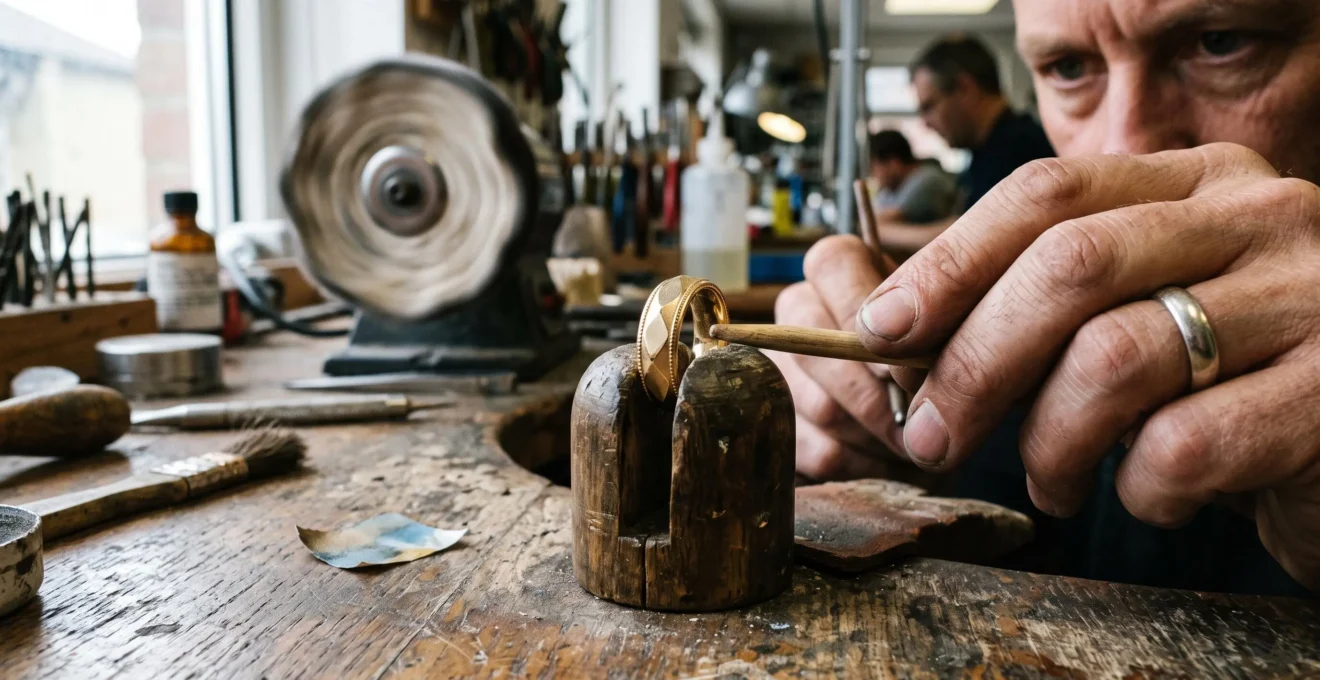
A ring can emerge from professional polishing brighter than ever yet somehow less beautiful. Its engraved shoulders may look shallow, its milgrain border less distinct, or the straight edges of its setting noticeably softer. The finish is technically shinier, but the design has lost some of its definition.
This happens because conventional abrasive polishing does more than remove scratches. It also removes a small amount of the surrounding metal. When polishing pressure, tools or compounds are poorly matched to a ring’s geometry, decorative details can wear down alongside the surface damage.
Not every polish produces visible distortion, and careful finishing remains an essential part of jewellery craftsmanship. The difference lies in choosing the right treatment for the specific metal, design and condition.
For owners of antique rings, engraved wedding bands, geometric signets and delicate platinum settings, preserving the original shape often matters more than achieving a flawless mirror finish. Understanding what polishing can change makes it easier to request a refresh without sacrificing the features that make a piece distinctive.
What to know before having a ring polished
- Traditional abrasive polishing removes some metal, so repeated or aggressive treatment can gradually soften edges, engraving and decorative textures.
- Ask for limited cleaning or targeted finishing, and identify the details that must remain untouched before the jeweller begins.
- Antique rings and delicate stone settings deserve particular caution; a structural inspection should come before cosmetic refinishing.
- Why Does Over-Polishing Slowly Change a Ring’s Shape Even if You Can’t See It Day to Day?
- How to Ask for a Polish That Preserves Edges and Engraving Without Sounding Technical?
- High Polish or Satin Finish: Which Should You Choose if Scratches Drive You Mad?
- The Polishing Request That Can Destroy Antique Character in One Afternoon
- When Should You Polish Jewellery Before an Event Without Risking a ‘Too New’ Look?
- Why Do Hand-Finished Edges Feel Smoother on Skin After 8 Hours of Wear?
- When Should You Polish Platinum if You Want Shine Without Thinning Details?
- Why Do Platinum Frameworks Hold Stones Securely Even When the Prongs Look Thin?
Why Does Over-Polishing Slowly Change a Ring’s Shape Even if You Can’t See It Day to Day?
Over-polishing changes a ring’s shape because abrasive finishing removes metal from its surface. A single careful polish may produce no obvious alteration, but repeated treatments can gradually round corners, flatten decorative borders and reduce engraving depth. The change is difficult to notice during everyday wear because each individual adjustment is small.
A polishing wheel works by moving an abrasive compound across the metal. Fine scratches are reduced as the surrounding high points are smoothed. On a broad, plain surface, this can restore an attractive reflection. On a sharply defined edge, however, the same action can gradually remove the boundary that gives the design its character.
The GIA‘s technical reference on platinum polishing and buffing distinguishes different finishing stages and explains how professional workshops use abrasive compounds and polishing tools. These stages are not interchangeable, and their suitability depends on the jewellery being treated.
Consider a hypothetical rectangular signet ring. Its flat upper face may benefit from removing fine scratches, while its surrounding bevels need to retain crisp transitions. Polishing the entire ring uniformly can improve the face but soften those bevels. One operation produces both a cosmetic improvement and an unwanted change in geometry.
Photographic comparison is more reliable than memory. Keep dated close-up photographs of a ring’s original appearance, including its profile, engraving, corners and stone settings. Reproduce similar angles and lighting after future maintenance. These images help identify changes, although they cannot establish precisely how much metal has been removed.
The risk also depends on the design:
- Higher sensitivity: geometric signets, knife-edge bands, engraved shoulders, milgrain, fine bezels and sharply defined decorative features.
- Generally more tolerant: plain rounded bands with ample metal and few vulnerable details.
- Additional structural concern: settings with already-worn prongs, thin galleries or damaged joints.
The goal is not to avoid every finishing treatment. It is to ensure that the metal removed is justified by a visible problem rather than by an automatic maintenance routine.
How to Ask for a Polish That Preserves Edges and Engraving Without Sounding Technical?
You can protect a ring’s details by explaining what should remain unchanged rather than trying to prescribe a polishing technique. Ask for a light clean-up, identify the edges and engraving you want preserved, and request approval before any substantial refinishing. A clear visual instruction is often more useful than technical terminology.
A suitable request might be: « I’d like the surface cleaned up, but please keep the edges sharp and leave the engraving exactly as it is. »
For a ring with contrasting finishes, another useful instruction is: « Please work on the marked flat surfaces only. I don’t want the textured areas or corners refinished. »
It helps to understand three terms commonly encountered at a jewellery workshop:
- Cleaning: removing dirt, oils and residues without intentionally reshaping the metal.
- Light buffing: a limited finishing treatment intended to improve surface appearance; it may still involve some abrasion.
- Refinishing: a broader process of restoring or changing the surface finish, potentially involving more extensive smoothing and polishing.
These descriptions are not universally standardised service grades. A workshop may use the same word for a different sequence of operations, so ask what the proposed work actually involves.
Point to the specific areas that matter: the top edge of a signet, the lines inside an engraving, a milgrain border or the shoulders around a stone. Ask whether the jeweller plans to use a polishing wheel, localised hand finishing or another approach.
If the ring is white gold, also clarify whether rhodium re-plating is included. Rhodium plating itself is a surface coating, not an abrasive removal process, but the cleaning and preparation performed before plating may involve polishing. The distinction matters when conserving fine detail.
Five actions to agree on before handing over your ring
- Take clear photographs of the ring’s face, profile and engraving, and retain a dated visual record.
- Identify vulnerable features directly on the ring or annotated photographs, producing a marked reference for the workshop.
- State the desired result in plain language and have the agreed limits recorded on the job sheet.
- Ask which surfaces will be treated, by what method, and whether any plating or additional finishing is planned; obtain a written description.
- Request confirmation before extra polishing, stone-setting work or changes to the original finish, creating an agreed approval condition.
A competent jeweller may recommend an alternative to your initial request. That is valuable professional judgement, provided the proposed treatment and its consequences are explained before irreversible work begins.
High Polish or Satin Finish: Which Should You Choose if Scratches Drive You Mad?
High polish gives a ring strong, mirror-like reflections but makes small surface scratches conspicuous. Satin and brushed finishes diffuse light, often making fine wear less visually distracting. Neither finish prevents scratching, and both can require specialist restoration. The better choice depends on the design, your tolerance for visible marks and how often you want the surface refreshed.
With a mirror finish, even modest daily contact can produce marks that interrupt the reflection. Owners sometimes respond by requesting frequent re-polishing, creating a cycle in which relatively minor cosmetic wear leads to repeated metal removal.
A satin surface behaves differently. Its directional texture can visually disguise small scratches that follow the existing pattern, although marks crossing the grain or deeper dents may remain noticeable. Restoring a consistent texture can also require careful work around engraving, borders and adjoining polished areas.
The practical trade-offs are clearer when compared directly.
| Consideration | High polish | Satin or brushed finish |
|---|---|---|
| Appearance | Bright, reflective surface | Soft, diffuse reflection |
| Fine scratches | Often highly visible | Can be less visually prominent |
| Restoration | May require abrasive polishing | May require directional re-texturing |
| Detailed designs | Edges need careful protection | Original texture boundaries need protection |
| Long-term care | Accept some natural scratching between treatments | Avoid unnecessary full-surface re-texturing |
Changing finishes is not always a neutral cosmetic choice. Converting a textured ring to mirror polish can require substantial smoothing of the existing surface. The amount of work depends on the depth of the texture and the condition of the metal.
Mixed finishes provide another option. A jeweller might create a polished central band with satin shoulders, or preserve polished bevels around a brushed face. Such designs can concentrate future maintenance on simpler surfaces while keeping intricate borders untouched.
That approach requires particular care at the boundary between finishes. An uncontrolled polishing wheel can blur the transition that originally made the contrast attractive.
For owners who dislike scratches, the most useful change may be learning to accept ordinary wear rather than repeatedly restoring the entire ring to a showroom appearance.
The Polishing Request That Can Destroy Antique Character in One Afternoon
Asking a jeweller to make an antique ring « look like new » can unintentionally authorise extensive refinishing. That treatment may remove original tool marks, flatten engraving and erase surface characteristics associated with the ring’s age. Once original metal and detailing have been polished away, ordinary cleaning cannot restore them.
Antique jewellery often contains evidence of its manufacturing methods. Hand-cut engraving, subtle asymmetry, original finishing marks and naturally developed surface wear can contribute to a piece’s historical character.
The Society for Historical Archaeology‘s conservation advice explains that repeated polishing of historical metal objects can wear away original surface details, including engravings and tool marks. Its guidance concerns historical artefacts rather than jewellery valuation specifically, but the underlying conservation principle is relevant to antique rings.
Patina and damage should not automatically receive the same treatment. A gently aged finish may be desirable to preserve, while a bent prong, unstable setting or hazardous burr may require intervention.
Neither age nor patina automatically establishes authenticity or monetary value. A poorly preserved coating may also need specialist treatment. The owner and an appropriately experienced professional should distinguish significant original surfaces from deterioration that threatens the object.
The Canadian Conservation Institute‘s metal conservation guidance emphasises the importance of recognising and preserving original finishes. This preservation perspective helps explain why an older ring should not automatically be treated like a newly manufactured band.
Antique stone settings require a separate inspection. Existing wear can leave prongs, bezels and gallery components with limited material. Aggressive finishing near these areas may remove metal that still contributes to stone security.
For an inherited or collectible piece, request « clean only, no refinishing » or « conservation-focused cleaning, with original surfaces preserved. » Ask whether the workshop regularly works on antique jewellery and whether it can refer significant pieces to a qualified conservator.
Conservation-focused treatment may improve cleanliness without eliminating age-related visual characteristics. It may also help retain features relevant to future authentication or appraisal, although no universal resale-value benefit can be guaranteed.
When a ring has historical importance, the safest starting point is a condition assessment and a clearly limited treatment proposal, not a request for maximum shine.
When Should You Polish Jewellery Before an Event Without Risking a ‘Too New’ Look?
Arrange any necessary polishing early enough to inspect the finished jewellery before the event, rather than treating it at the last possible moment. A light, targeted refresh is often preferable when you want brighter surfaces without losing established texture. The appropriate timing depends on the ring’s condition, the proposed treatment and the workshop’s availability.
A newly polished ring may look noticeably different from jewellery that has developed a natural surface finish through years of use. Its mirror reflection can appear visually disconnected from accompanying pieces, especially when one item has retained its original soft sheen.
For a wedding, engagement celebration or formal portrait, consider what the photographs will actually show.
Close-up photography can reveal rounded edges, flattened engraving and uneven polishing marks more readily than ordinary viewing. If detailed photographs are planned, preservation of the ring’s contours may matter more than removing every small scratch.
At conversational distance, broad reflections are more noticeable than subtle surface texture. A ring with simple geometry may benefit from a more complete cosmetic refresh if its condition justifies one.
There is still no reason to assume that a fuller polish is always appropriate. Decorative complexity, existing metal wear and stone security should determine the treatment.
A practical approach is to clean the ring first, inspect it under the kind of lighting expected at the event, and decide whether any remaining scratches genuinely need intervention. A jeweller may find that removing accumulated oils and residues already delivers the desired improvement.
Allow a sensible buffer for inspecting the completed work and addressing any concerns. The available sources do not establish a universally safe number of days, so a fixed deadline would be misleading.
Finally, consider what happens after the event. Ordinary contact with hard surfaces can introduce fresh marks soon after polishing. If the shine matters for only a brief occasion, extensive metal removal may offer little lasting benefit.
The best preparation is a ring that is clean, structurally sound and recognisably itself, whether it has a brilliant mirror finish or a few honest signs of wear.
Why Do Hand-Finished Edges Feel Smoother on Skin After 8 Hours of Wear?
Hand-finished edges can feel more comfortable during prolonged wear because targeted finishing removes tiny burrs, catches and rough transitions where a ring contacts the skin. This is different from polishing the entire ring for shine. A skilled jeweller can soften interior contact points while leaving the visible exterior edges sharply defined.
The distinction becomes important during a full day of wearing a ring. A small imperfection that goes unnoticed during a brief fitting may create friction or pressure after prolonged movement.
Mechanical buffing tools can produce consistent reflections across accessible surfaces. However, their size, flexibility and direction of contact may make them less suitable for some narrow transitions, internal curves or complicated setting areas.
Controlled hand finishing allows a jeweller to work on specific contact zones without treating every nearby decorative feature.
Smoothness is not the same as shininess. A highly reflective ring can still contain an uncomfortable internal edge. Conversely, a satin-finished ring can be exceptionally comfortable when its contact surfaces are properly shaped and free of burrs.
There is also a useful difference between intentional comfort shaping and unwanted rounding. A slight radius on the inside edge of a band can reduce pressure against the finger. Rounding the upper outside edge of a geometric signet, by contrast, may undermine the visual design.
If a ring becomes uncomfortable over several hours, record where the sensation occurs:
- At the inside edge of the band, particularly during finger movement.
- Under the gallery, where a setting meets the finger.
- Near a prong or decorative element that catches on skin or fabric.
- At a joint or previous repair that may have left an uneven transition.
Ask the jeweller to examine those precise locations. Discomfort can also arise from ring size, swelling or setting shape, so polishing is not always the solution.
Comfort and detail preservation are compatible goals when the workshop treats the actual contact problem rather than automatically polishing every visible surface.
When Should You Polish Platinum if You Want Shine Without Thinning Details?
Polish platinum when its visible condition justifies restoration, not simply because a fixed amount of time has passed. Platinum can develop a distinctive soft patina through wear, which many owners prefer. For certain scratches and surface marks, professional burnishing followed by limited buffing may restore appearance while avoiding unnecessary abrasive metal removal.
Platinum behaves differently from many other jewellery metals under mechanical deformation. Scratches can displace some surface metal into adjacent ridges rather than removing all of it. This makes it possible, in suitable circumstances, to work displaced metal back towards the surface.
The distinction is important but should not be overstated. Platinum can still lose material through wear, abrasion, polishing and other processes. It is not immune to metal loss.
GIA’s platinum burnishing quality-assurance guidance describes a restoration approach involving burnishing and light buffing for a scratched platinum ring. The technique can be preferable to unnecessary filing or abrasive treatment when the condition of the piece permits it.
A documented platinum restoration approach
The Gemological Institute of America describes assessment of a platinum ring with scratches and nicks, including decorative milgrain and side stones.
Its technical example identifies burnishing followed by light buffing as a suitable restoration method in that context. The guidance illustrates a less abrasive option but does not establish measured metal savings or guarantee suitability for every platinum ring.
Platinum’s natural grey-white surface patina should also be treated as an aesthetic choice. Some owners appreciate its softer appearance, particularly on older pieces. Restoring a mirror finish removes that visual character, even when the work is performed competently.
Risk increases around narrow knife-edge bands, fine engraving, small bezels and slender prongs. The amount of material that can safely be removed depends on the remaining geometry and condition, not merely on platinum’s reputation for durability.
For long-term ownership, periodic professional inspections and restrained cosmetic maintenance are generally more useful than an automatic polishing calendar. A ring can be structurally healthy while showing entirely normal surface wear.
Before authorising abrasive refinishing, ask whether cleaning, burnishing or localised treatment could address the specific marks that concern you.
Key takeaways before assessing a platinum setting
- Platinum’s apparent strength does not eliminate the need to inspect delicate stone-holding components.
- Prong condition should be assessed individually, rather than judged from appearance or metal type alone.
- Preserving original setting geometry may be more important than restoring mirror shine to every accessible surface.
Why Do Platinum Frameworks Hold Stones Securely Even When the Prongs Look Thin?
Platinum settings can use relatively slender prongs because appropriately selected platinum alloys offer mechanical properties suited to fine stone-setting work. A slim-looking prong is not necessarily weak. However, security depends on its actual dimensions, condition, construction and contact with the gemstone. Appearance alone cannot establish whether a setting is safe.
The apparent contradiction is familiar in older platinum jewellery. A delicate framework may hold a stone securely despite looking much finer than a modern, heavier setting.
Platinum’s density contributes to its substantial feel, but density is not the property that determines prong security. Alloy composition, strength, ductility, work hardening, setting design and workmanship all matter.
Thin appearance and insufficient metal are different conditions. A correctly constructed slender prong may perform its function well. A similarly sized prong that has been worn, cracked, bent or repeatedly refinished may require professional repair.
Polishing introduces a particular concern because prongs are small components with limited material. Removing metal from an already delicate tip or its junction with the setting can compromise the intended geometry. The proportion of material lost matters more than how insignificant the polished area appears to the naked eye.
A professional inspection can assess the prong tips, contact points, junctions and gemstone seating under magnification. Where appropriate, the jeweller can also evaluate whether components have sufficient remaining metal or require reinforcement.
Owners should not test gemstone security by pulling or tugging on prongs themselves. Such actions can distort worn settings or loosen a stone. Instead, request professional examination if a gemstone moves, catches unexpectedly or appears to have shifted.
For inherited platinum rings, preserving the original setting can be important both structurally and aesthetically. Rebuilding damaged prongs may be necessary, but it can also alter original workmanship. A qualified jeweller should explain the available repair choices and their implications before work proceeds.
A ring that retains its original proportions and secure stone setting may require less intervention over time than one repeatedly subjected to aggressive cosmetic refinishing. However, even carefully maintained jewellery can eventually need structural repairs through ordinary wear.
Before your next professional polish, request an inspection of the setting, identify the details that must be preserved and agree on the least invasive treatment capable of achieving your desired result. A beautifully finished ring should retain not only its shine, but also the workmanship that defines it.
Can a jeweller restore edges that have already been rounded by polishing?
Sometimes, but not through polishing alone. Re-establishing a crisp edge may require careful reshaping, adding compatible metal or reconstructing missing features. Each option has consequences for the original material and workmanship. On antique jewellery, reconstruction may be inappropriate when preserving the surviving original surface is more important than reproducing a new appearance.
Can ultrasonic cleaning replace polishing without removing metal?
Ultrasonic cleaning can remove certain deposits and residues without intentionally abrading the metal surface, but it does not eliminate scratches. It is unsuitable for some gemstones, treatments and vulnerable settings. A jeweller should assess the entire piece before choosing ultrasonic cleaning, particularly when stones may be loose or the jewellery contains delicate materials.
Does polishing permanently remove engraved lettering inside a ring?
Abrasive polishing can reduce the depth and sharpness of an engraving, especially when the area is treated repeatedly. Deep lettering may survive several light treatments, but shallow inscriptions can become less legible. Re-engraving may reproduce the wording, although it cannot recover the exact original metal or necessarily replicate historical hand-cut workmanship.
Should a ring be polished before a professional jewellery valuation?
Not automatically. An appraiser may need to examine original finishes, wear, marks and manufacturing characteristics. Unnecessary polishing could obscure some of that evidence, particularly on antique or collectible rings. Cleaning may be appropriate when dirt prevents examination, but ask the appraiser what preparation is suitable before authorising abrasive work.
How can you tell whether a jeweller has removed too much metal?
Possible warning signs include visibly softened corners, uneven bevels, flattened decorative beads, reduced engraving definition and noticeably altered setting contours. Compare detailed photographs taken before and after the work. Appearance alone cannot quantify metal loss, so a qualified jeweller may need to inspect or measure critical dimensions, particularly around prongs and other structural components.