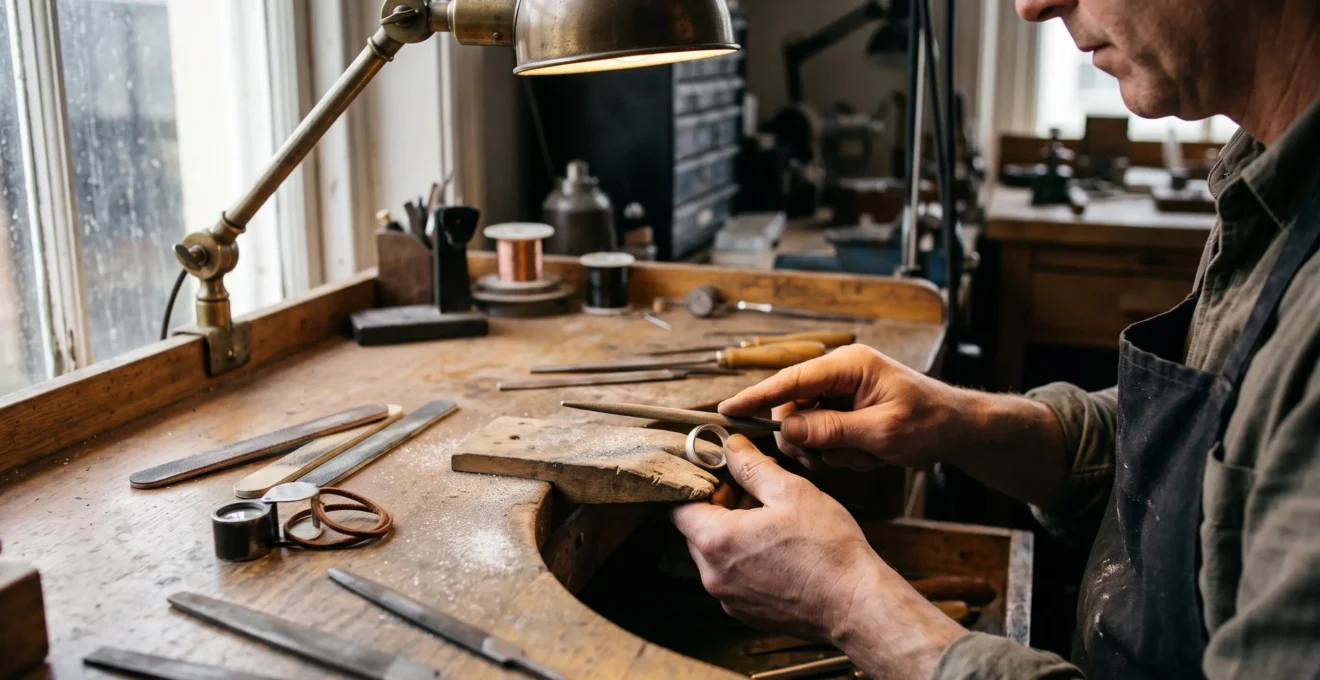
A “master artisan” label can suggest exceptional skill, but it does not tell you which parts of a piece were made by hand, how carefully the finishing was controlled, or whether the result justifies its price. A convincing shine is not enough. The more revealing evidence often sits inside a ring, beneath a stone setting, around a solder joint or along an edge that receives little attention in product photography.
A useful inspection takes less than five minutes. Examine the accessible surfaces under good light, use a 10× jeweller’s loupe or a phone’s macro camera, and pay attention to the transitions between components. Look for clean joints, carefully finished internal surfaces and edges that feel appropriate for their intended use. Treat small irregularities as clues to investigate, not automatic proof of handmade work.
There is an important distinction between craftsmanship and manufacturing method. A machine can produce an excellent surface, and skilled hand-finishing can improve a piece made using casting or other industrial processes. The strongest buying decision therefore combines physical inspection with precise questions about who made, assembled, set and finished the jewellery—and what service the maker will provide afterwards.
The five-minute jewellery inspection
- Inspect the inside of the band, underside of the setting, solder joints and clasp rather than judging the piece by its shine.
- Look for consistent workmanship and well-resolved details, but do not mistake minor asymmetry or tool marks for conclusive proof of hand-finishing.
- Ask which operations were performed by hand, who approved the final finish, and how repairs, resizing and maintenance are handled.
- Why Do Hand-Finished Edges Feel Smoother on Skin After 8 Hours of Wear?
- How to Spot True Hand-Finishing Using 4 Details Most Shoppers Never Check
- Boutique Atelier or High-End Factory: Which Makes More Sense for a Daily Ring?
- The Commissioning Mistake That Turns a 6-Week Handmade Project Into a 6-Month Wait
- When Should You Take Fine Jewellery Back to the Bench for a Check-Up After Heavy Wear?
- Why Does Specialisation Improve Quality but Sometimes Increase Lead Times?
- How to Spot a High-Master Model by Looking at 4 ‘Hidden’ Areas
- Why Do Specialised Jewellery Workshops Split One Piece Between 4 Different Experts?
Why Do Hand-Finished Edges Feel Smoother on Skin After 8 Hours of Wear?
Hand-finished edges can feel comfortable when the maker has carefully controlled their shape, transitions and surface texture, but the sensation is not exclusive to handmade jewellery. A properly executed machine finish can also produce smooth, comfortable surfaces. After several hours of wear, fit, edge geometry, contact pressure and the wearer’s skin all influence comfort, so the experience alone cannot authenticate a manufacturing method.
The useful distinction is between **surface appearance and functional finishing**. A bright mirror polish describes how a surface reflects light; it does not guarantee that every internal edge has been rounded appropriately. Conversely, a matte finish can be deliberate and professionally executed without being less comfortable.
For a ring, inspect the inside of the band, particularly the edges that contact neighbouring fingers. For earrings, look at the posts and the areas that sit against the ear. For bracelets, examine the inside of the clasp and the links that move against the wrist. Each area has different comfort requirements, and a single overall judgement of smoothness is insufficient.
A full working day can provide useful feedback when trying a piece you own or are permitted to wear on approval. Notice whether it creates pressure, catches on clothing or develops a persistent irritation point. These observations identify a potential fit or finishing issue; they do not establish whether a polishing wheel or a hand tool was used.
GIA‘s technical benchmarks distinguish prefinishing, polishing and buffing as separate operations. Their treatment of platinum jewellery also illustrates why internal settings and less-visible surfaces deserve attention. The relevant lesson is not that machines necessarily leave uncomfortable ridges, but that **finishing quality must be assessed across the whole piece**, not just its most reflective face.
Once comfort has been considered, the next step is to examine the workmanship itself. Several details can reveal how carefully a piece was finished, even though none independently proves that it was made entirely by hand.
How to Spot True Hand-Finishing Using 4 Details Most Shoppers Never Check
The most useful inspection combines four areas: matching components, internal surfaces, solder joints and surface marks. These reveal whether the maker has controlled the visible and hidden details consistently. They cannot conclusively establish the manufacturing method, but they help distinguish a carefully finished piece from one whose quality is supported mainly by branding and presentation.
Examine the jewellery under diffuse light first, then use a 10× loupe or a phone macro photograph to investigate specific details. Avoid drawing conclusions from one scratch, one irregular edge or one apparently perfect component.
**1. Matching components and alignment.** Compare paired prongs, repeated links, mirrored motifs or corresponding engraved details. They should be appropriately aligned and consistent with the design. Slight variation may arise from hand work, but it can also result from wear, repair or production tolerances. Perfect duplication is not proof of factory manufacture, just as asymmetry is not proof of artisan skill.
**2. The inside of the band and gallery.** Inspect areas that receive less attention in ordinary product photography. Look for obvious pits, unfinished edges, deep filing scratches and abrupt transitions that do not suit the design. Some textures are intentional, so a rough-looking surface is not automatically defective.
**3. Solder joints and component transitions.** Where two metal components meet, look for a clean, integrated transition appropriate to the construction. A conspicuous lump, poorly aligned joint or abrupt change in surface quality deserves an explanation. However, not every visible line is a defective solder joint: some are intentional design features, construction boundaries or evidence of previous repair.
**4. Tool marks and surface texture.** Observe whether scratches or finishing lines appear consistent with the intended texture. Directional marks can arise from filing or abrasive work, while circular patterns can occur during mechanical polishing. Neither pattern is exclusive to one process. The relevant question is whether the marks are controlled, appropriate and consistent with the maker’s description.
The US federal guidance on handmade and hand-finished jewellery claims distinguishes a representation that an entire piece is handmade from a claim that a particular finishing operation was performed by hand. Its scope is the United States; terminology and legal requirements should not be assumed to be identical across all English-speaking markets.
Marketing expressions such as “artisan”, “atelier” and “handcrafted” should therefore prompt specific questions rather than automatic acceptance. Ask which operations were performed manually and which used machines. Comparing macro photographs of two pieces from the same collection may reveal differences worth discussing, but identical or different marks do not reliably authenticate the process.
Your five-minute inspection checklist
- Photograph the front, side and inside of the piece. Deliverable: three reference images showing its overall construction.
- Inspect the band interior or another body-contact surface under good light. Deliverable: one close-up of any roughness, pits or sharp-looking transitions.
- Compare matching prongs, links or repeated motifs. Deliverable: a note recording any alignment issue that needs explaining.
- Examine one joint and one textured surface with a loupe or macro camera. Deliverable: two close-up images of the workmanship.
- Ask the seller which stages were completed by hand and who approved the final finish. Deliverable: a written answer that can be compared with the physical evidence.
Inspection becomes more valuable when the expected price and intended use are considered together. A beautifully finished bespoke ring and a well-engineered production ring can both be excellent purchases, but they may offer different advantages over years of daily wear.
Boutique Atelier or High-End Factory: Which Makes More Sense for a Daily Ring?
For a daily ring, the better choice depends on fit, construction, setting security, repairability and the type of customisation required. A well-controlled factory process can deliver consistency and predictable specifications, while a specialist atelier may offer greater flexibility in design, individual fitting and repairs. Neither production model automatically guarantees better durability or superior craftsmanship.
A ring worn every day encounters repeated contact, knocks, handwashing, lotions and other ordinary stresses. Its alloy, dimensions, setting design and construction matter at least as much as whether its final surfaces were finished by hand.
| Buying criterion | Boutique atelier | High-end factory |
|—|—|—|
| Custom fit and design | Often offers more direct individual adjustments and bespoke options | Usually works within established models and tolerances |
| Production consistency | Depends on the maker, workshop processes and quality control | Repeatable processes can support consistent dimensions and finishing |
| Lead time | May depend on individual availability, stone sourcing and bench workload | Established production systems may offer more predictable availability |
| Repairs and resizing | Direct access to the maker can simplify assessment and specialist work | Standardised designs may have established service procedures and replacement options |
| Cost of ownership | Custom construction can make some repairs more specialised or expensive | Replacement or servicing may be simpler for standardised designs, depending on the product |
These are tendencies, not guarantees. Some ateliers use computer-aided modelling, casting and specialised machinery before hand-assembling and finishing a piece. Some high-end factories employ skilled setters and finishers whose work is carefully inspected.
The important trade-off is between the specific benefits you need and the service you can reasonably expect. A bespoke design with a very thin shank or an unusual tension setting may require specialised repairs. A standard ring may be easier to service, but its setting still needs inspection and its construction must suit the intended use.
Before purchasing, ask about resizing limits, stone-setting repairs, replacement parts and the availability of the original maker. Request an explanation of any structural feature that could restrict future maintenance. Also establish whether routine servicing is performed in-house or sent elsewhere.
A premium price is easier to justify when it buys a measurable advantage: a better fit, a carefully executed design, a durable setting, documented materials or dependable after-sales support. Hand-finishing can contribute to that value, but the label alone cannot establish it.
For buyers commissioning a bespoke piece, this comparison leads to another practical issue: the quality of the finished ring depends not only on the workshop’s skills, but also on how clearly the design is agreed before production begins.
The Commissioning Mistake That Turns a 6-Week Handmade Project Into a 6-Month Wait
A major source of avoidable commissioning risk is approving a design without settling important structural and visual decisions, then requesting substantial changes after production has begun. Such changes can require earlier work to be repeated, components to be remade or stones to be sourced again. The extent of any delay depends on the project; the six-week-to-six-month scenario is not a documented industry-wide outcome.
A sketch or digital rendering is useful for discussing proportions, but it may not communicate every practical detail. The thickness of a shank, the height of a setting, the clearance around a stone and the way a clasp operates can affect both appearance and construction. If those decisions remain unresolved, the finished piece may differ from the customer’s expectations even when the original drawing was followed.
Before committing, agree on the design elements that must not change and those that can still be adjusted. For a ring, this might include the dimensions, profile, metal, stone specifications and setting arrangement. For other jewellery, the equivalent details could be clasp design, chain length, link construction or the position of decorative elements.
GIA’s guidance on commissioning a custom engagement ring recommends discussing production timing with the jeweller before placing the commission. Its 2016 article gives illustrative estimates of at least two weeks for a straightforward custom ring and five to six weeks or longer for complex designs or gemstone matching. These historical estimates are not current guarantees or universal timelines.
A credible schedule separates design approval, material and stone sourcing, fabrication, setting and final finishing. Not every workshop uses exactly these stages, and some operations may overlap. What matters is that the maker can explain the dependencies, identify external suppliers and communicate what could delay delivery.
A written amendment policy is equally important. Ask what happens if the design changes after approval, whether additional work attracts extra charges, and how revised delivery dates are agreed. A maker who explains these conditions before taking the commission gives the buyer a clearer basis for planning.
Even a well-planned commission requires ongoing care once it reaches the wearer. The next decision is knowing when normal wear calls for routine maintenance and when a possible defect warrants a prompt professional inspection.
When Should You Take Fine Jewellery Back to the Bench for a Check-Up After Heavy Wear?
Take jewellery for a professional assessment after a significant impact, when a stone appears to move, when a setting develops a visible gap, or when a prong, clasp or link looks damaged. A scheduled inspection is also sensible for frequently worn pieces with exposed settings. The appropriate interval depends on the construction, wear pattern and maker’s advice; there is no single schedule for every item of fine jewellery.
A ring can look intact from above while a prong has shifted or a stone has developed movement within its setting. Repeated contact with hard surfaces, snagging on clothing, exercise and accidental impacts can contribute to damage. Continuing to wear a piece when its setting appears loose risks losing the stone.
A simple home inspection can identify reasons to seek help without attempting a repair:
- Examine the piece under good light, looking for bent prongs, visible gaps, damaged links or a clasp that no longer closes properly.
- Use a 10× loupe, if available, to inspect the setting and compare the prongs for obvious damage or unevenness.
- Check whether a chain or bracelet has developed a visibly weakened or distorted link.
- Look for new snagging, sharp edges or changes in how the jewellery sits against the body.
Do not deliberately pull at a stone, force a setting or rely on shaking the jewellery near your ear to establish whether it is secure. These are not dependable substitutes for a professional assessment. If a stone seems loose, stop wearing the piece until a jeweller has examined it.
The Gemological Institute of America recommends that diamond engagement-ring prongs be checked approximately every six months, with annual checks presented as an alternative for people who find more frequent inspections difficult. Its diamond engagement ring maintenance advice also identifies visible gaps and stone movement as warning signs. This guidance concerns diamond engagement rings, particularly prong-set designs; it is not a universal rule for all jewellery.
Hand-applied finishes, including matte textures, hammering and milgrain, may change visibly with wear. That change is not necessarily structural damage, and it does not mean hand-finished jewellery inherently requires more frequent servicing. A maker familiar with the original construction can help distinguish expected surface wear from a problem needing repair.
Good maintenance protects the piece, but the quality of the original work also depends on how the workshop organises the people and processes responsible for making it.
Why Does Specialisation Improve Quality but Sometimes Increase Lead Times?
Specialisation can improve workmanship because different stages of jewellery production demand different skills, tools and forms of quality control. However, when a piece moves between separate specialists, each handover can introduce scheduling dependencies. A delay in modelling, casting, stone-setting or finishing may hold up subsequent work, even when every individual craftsman performs well.
A specialist can devote attention to a narrower task. A setter, for example, concentrates on securing stones while protecting their integrity and achieving the intended alignment. A finisher focuses on surface quality, edges and transitions. Their expertise may be valuable precisely because those tasks are not interchangeable.
The trade-off is coordination. A workshop must decide when each component is ready, reserve time with the next specialist and check that the previous stage has met the required standard. If casting is outsourced, the workshop may also depend on another company’s production schedule. The same applies to stone-setting or other specialist operations performed externally.
This does not mean that a generalist workshop is less capable or that a specialist atelier will necessarily take longer. A well-organised specialist team can work efficiently, while an overloaded generalist may experience significant delays. The relevant factors are capacity, workflow, complexity and communication—not the number of people involved by itself.
A buyer can establish how the arrangement works with three questions:
- Which stages are completed in-house, and which are outsourced?
- Who checks the work when the piece passes from one specialist to another?
- Who is responsible for communicating delays and approving the finished jewellery?
A workshop that can explain its process gives a more useful picture than one that simply promises expert craftsmanship. Clear milestones also make it easier to distinguish a legitimate technical delay from a project that has not been managed carefully.
Specialisation is most valuable when expertise is matched with accountability. A skilled setter and a skilled finisher can each produce excellent work, but the final piece still needs someone to verify that the setting, surfaces, edges and overall construction meet the agreed specification.
That process-based view also helps explain why a piece can be genuinely handcrafted in some respects without being the work of a single person. To assess a claim of mastery, it helps to look at details that ordinary product images often conceal.
How to Spot a High-Master Model by Looking at 4 ‘Hidden’ Areas
The most revealing hidden areas are the underside of the gallery, the interior of the band, the backs of prongs and collets, and the joints in chains and clasps. Inspecting these locations can expose unfinished transitions, visible casting pits, filing scratches or poorly aligned components that are less apparent from the front. Their condition provides evidence of workmanship, but no single detail proves that a piece was made by a master artisan.
**1. The underside of the gallery.** The gallery is the structure beneath a ring’s stone or setting. Inspect its accessible surfaces and transitions for rough edges, obvious pits or marks inconsistent with the intended finish. Some openings and structural features are deliberately left visible; assess them in the context of the design rather than expecting every surface to be mirror-polished.
**2. The interior of the band.** Look for deep scratches, casting irregularities and edges that appear unnecessarily sharp. A carefully executed interior should be appropriate to the design and comfortable for its intended use. Different finishes are legitimate, so a matte or textured surface is not automatically evidence of poor workmanship.
**3. The backs of prongs and collets.** Check whether the accessible surfaces appear deliberately finished and whether the setting has obvious gaps or irregularities that warrant explanation. The important issue is not whether every part looks decorative, but whether the construction appears sound and the finish is consistent with the maker’s stated quality.
**4. Chain links and clasp joints.** Examine the alignment of adjoining links, the visible transitions around joints and the operation of the clasp. Look for bent components, conspicuous excess material or rough edges that could catch on clothing. Because clasps and links experience repeated movement, their functional condition matters as much as their appearance.
GIA’s technical finishing benchmarks for platinum distinguish several finishing operations and explicitly address work inside stone settings. This supports examining less-visible areas as part of quality assessment, rather than treating exterior shine as the only criterion.
A useful comparison is to request macro photographs of the same hidden areas on two examples of a maker’s work. Similarities and differences may prompt questions about process consistency, but they cannot establish whether either item was finished by hand. A confident maker should be able to explain the construction and, where practical, show how the piece is finished beyond the surfaces used in marketing photographs.
These observations establish what can be seen, but a final question remains: who actually performed the work? Understanding how specialists divide responsibilities helps connect the physical evidence to the maker’s claims and the support available after purchase.
Key takeaways
- Assess the complete piece, including hidden surfaces and functional components, rather than relying on a polished exterior or a premium label.
- Separate evidence of good workmanship from evidence of manufacturing method; neither a tool mark nor a perfectly regular component proves who made it.
- Before commissioning, establish who is responsible for setting, finishing, final inspection and after-sales service.
Why Do Specialised Jewellery Workshops Split One Piece Between 4 Different Experts?
A specialised jewellery workshop may divide production among four principal areas of expertise: design and modelling, casting or fabrication, stone-setting, and final finishing. Each stage addresses a different technical problem, and the same person does not necessarily have the tools or specialist experience to perform every operation to the same standard. The division can support quality, provided that responsibility for the completed piece remains clear.
**Design and modelling** establish the proportions, geometry and structural arrangement of the jewellery. This stage determines how components fit together and how the finished design will accommodate its intended stones, dimensions and use.
**Casting or fabrication** turns the approved design into a metal object. The chosen method depends on the piece’s construction and the workshop’s process. At this stage, the priority is to create the intended form and establish a sound basis for subsequent work.
**Stone-setting** secures the gemstone within its setting. The setter must consider the stone, the setting design and the metal surrounding it. Good setting work must also leave the piece suitable for the remaining finishing operations.
**Finishing** addresses the final surfaces, edges, transitions and overall presentation. It may include filing, abrasive work, polishing or other treatments appropriate to the design. The objective is to achieve the agreed finish without compromising the construction or damaging the setting.
These responsibilities can overlap, and a small workshop may combine several of them under one craftsperson. Larger or more specialised workshops may distribute the work across several people or external suppliers. Neither arrangement automatically establishes a higher level of quality.
The distinction matters when a seller describes a piece as the work of a “master artisan”. The phrase could refer to the designer, the principal maker, a specialist responsible for one operation or a coordinated team. Those arrangements can all produce legitimate craftsmanship, but the buyer should understand what the claim actually means.
Ask who performs the setting and finishing, who inspects the complete piece, and who is responsible if a defect appears after purchase. A well-set stone does not compensate for a sharp finishing burr, just as an excellent polish cannot correct an unsuitable design or a structurally compromised setting.
A clear answer should identify the workshop’s responsibilities without requiring the buyer to assume that one celebrated craftsperson personally performed every stage. The final quality depends on both individual skill and the way those skills are coordinated.
Before committing to a premium purchase, ask the maker for a clear account of the work performed by hand, the checks applied to the completed piece, and the arrangements for future servicing. A defensible premium rests on workmanship, suitability and accountability—not on the title “master artisan” alone.
Can you prove that a piece is hand-finished by looking at it?
No single visual feature conclusively proves that a piece was hand-finished. Internal surfaces, joints, edge quality and tool marks can help assess workmanship, but similar results may be achieved using different methods. Ask the maker which operations were performed manually and compare that explanation with the physical evidence.
Does hand-finished jewellery last longer than machine-finished jewellery?
Not necessarily. Longevity depends on the metal or alloy, construction, dimensions, setting security, intended use and quality control. Hand-finishing may improve particular details, but it does not automatically make a ring more durable. Ask about structural design, repairability and appropriate maintenance.
Is a perfectly polished ring evidence of master craftsmanship?
A bright, even polish can indicate careful work, but it is not proof of exceptional craftsmanship or hand-finishing. Inspect the interior, the underside of the setting, joints and comfort-critical edges. A good finish should suit the design and extend to the relevant surfaces, not merely those visible in product photographs.
What should you ask before paying a premium for an artisan ring?
Ask which stages are performed by hand, who completes the stone-setting and final finishing, how the finished piece is inspected, and whether the ring can be resized or repaired. Request a clear description of the materials and construction, an agreed production schedule for bespoke work, and written information about after-sales service.
How often should a hand-finished ring be inspected?
There is no universal interval for every ring. Inspection needs depend on the setting, frequency of wear, exposure to impacts and the maker’s guidance. For diamond engagement rings, GIA recommends checking prongs approximately every six months, with annual checks as an alternative. Seek professional assessment promptly after a significant impact or if a stone appears loose.