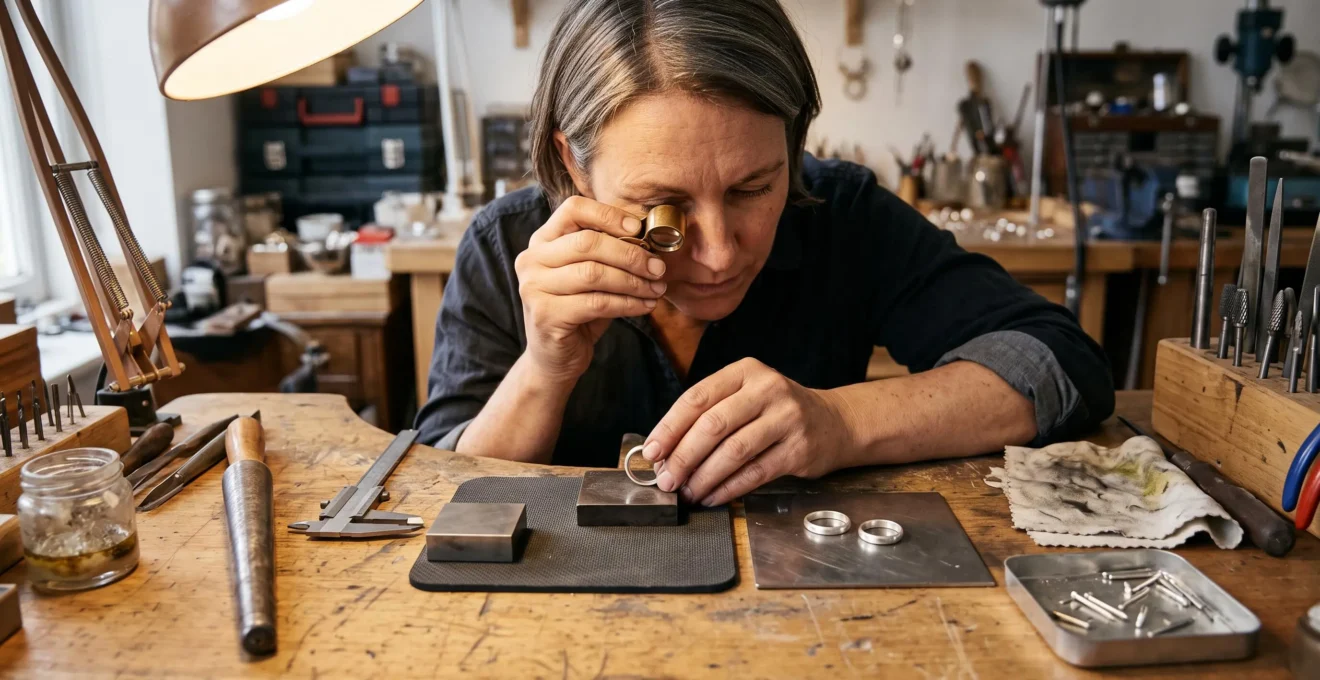
Place two newly polished sterling silver rings side by side. Both carry the same metal description, have similar dimensions and look equally well finished. After 12 months of ordinary wear, however, one may remain structurally sound while the other develops pits, a distorted band or a loose gemstone.
The difference is not necessarily visible at purchase. Metal composition describes only part of jewellery quality. The cleanliness of the starting alloy, melting conditions, casting technique, mechanical working, joining, gemstone setting and structural proportions can all influence how a finished piece behaves.
Even genuine 925 sterling silver can perform differently depending on how it has been processed. Likewise, a beautifully polished gold ring can contain hidden weaknesses that its hallmark does not reveal.
Understanding the journey from raw metal to wearable jewellery helps buyers distinguish ordinary surface ageing from potentially significant manufacturing problems. It also reveals which questions are worth asking before investing in an everyday piece or a future heirloom.
Why similar jewellery can age differently
- Starting metal matters: contamination, inclusions and unsuitable processing can introduce weaknesses before a piece reaches the workbench.
- Manufacturing changes durability: casting temperature, deformation, annealing, joining and setting can influence the finished structure.
- Appearance is not proof: inspect construction details, ask about production methods and consider future repairs rather than relying on shine alone.
- Why Can Jewellery Made From Poor Metal Stock Develop Porosity Even With Good Craftsmanship?
- Why Does Contaminated Metal Stock Create Pitting That Polishing Can’t Fix?
- Why Can Overheating During Pouring Create Hidden Weakness Even if the Cast Looks Fine?
- How to Follow the Metal’s Journey From Raw Stock to Finished Jewellery Without Getting Lost?
- Hand-Fabricated or Cast: Which Should You Choose if You Want Easy Repairs Later?
- The Shiny-Finish Trap That Hides Weak Structure in “New” Jewellery
- The One Design Adjustment That Makes Raw-Derived Jewellery Hold Its Shape After 50 Wears
- Why Can Poor Raw Handling Cause a Prong to Fail Even if the Design Looks Strong?
Why Can Jewellery Made From Poor Metal Stock Develop Porosity Even With Good Craftsmanship?
Jewellery made from poorly prepared metal can develop porosity because impurities, trapped gases and unsuitable melting conditions may leave cavities inside the solidified alloy. A skilled craftsperson can produce excellent workmanship around such defects without necessarily detecting them. The result is a piece that looks professionally finished but may contain weaknesses that become significant during wear or repair.
Porosity means that the metal contains small voids rather than being completely solid. These voids can arise at different stages of production, and identifying their origin requires more than observing a finished surface.
For example, recycled material containing solder residues, oxides or foreign particles may introduce inclusions or influence the behaviour of a melt. Poor melting practices can also contribute to gas-related cavities. Separately, metal contraction during solidification can create shrinkage porosity even when the starting alloy is clean.
This distinction matters: not every pore is evidence of contaminated raw metal. As explained in Ganoksin‘s technical article on cracking in jewellery manufacturing, weaknesses can originate in starting materials, melting, casting and subsequent metalworking operations.
Two broad categories are particularly useful to understand:
- Surface porosity: cavities reaching the exterior can appear as pinholes, rough patches or small depressions, sometimes becoming more noticeable after finishing.
- Internal porosity: cavities inside a ring shank, prong base or other section may remain invisible without specialist inspection.
Internal defects deserve attention because a cavity located at a highly stressed point can reduce the effective load-bearing section. However, a small internal pore is not automatically more dangerous than a visible surface defect. Risk depends on its dimensions, shape, position and the loads applied to the jewellery.
A gemstone setter may secure a stone correctly while working on a prong containing an unseen casting void. Months later, an impact or repeated deformation could expose that vulnerability. This is one possible explanation for different ageing outcomes, not a predictable 12-month failure schedule.
Buyers can ask whether the piece was fabricated from commercially produced mill stock or cast from a controlled alloy, and whether its metal fineness can be verified. A supplier’s alloy specification or certificate may offer useful traceability, particularly for higher-value commissions, although such documents are not always supplied to retail customers.
Inspect the underside of a band and the areas around settings for visible pinholes or unusually grainy surfaces. A clean exterior is reassuring but cannot establish that no internal defects exist.
The important difference between two visually identical pieces is not simply whether defects exist, but whether their locations and severity affect the structure during actual wear. Surface pitting is the next clue worth investigating.
Why Does Contaminated Metal Stock Create Pitting That Polishing Can’t Fix?
Contaminated metal can develop persistent pitting when foreign particles, inclusions or defects introduced during melting become exposed at the surface. Polishing may smooth the surrounding metal, but it does not remove a subsurface cavity or restore missing material. Repeated polishing can therefore make a piece look brighter while gradually reducing the thickness of vulnerable sections.
In jewellery production, contamination can involve several different materials and pathways.
- Solder-contaminated scrap: inappropriate solder constituents can change local alloy behaviour and contribute to brittle phases or manufacturing defects.
- Mixed recycled alloys: scrap of uncertain composition may introduce unwanted elements or produce inconsistent processing behaviour.
- Oxides and foreign particles: residues from previous operations, tools or mould materials can become inclusions.
- Moisture or unsuitable melting conditions: these may contribute to gas-related defects through mechanisms dependent on the particular process and alloy.
These problems do not all create the same surface appearance. A gas cavity can resemble a rounded pinhole, an inclusion may produce a localised defect, and shrinkage cavities have a different origin. Surface blistering and discolouration also require their own diagnosis rather than being treated as interchangeable evidence of contaminated stock.
The technical analysis of platinum casting defects published by Ganoksin distinguishes gas cavities, shrinkage defects, inclusions and other casting abnormalities. Its platinum-specific observations are useful for understanding diagnostic principles, but should not be applied indiscriminately to every gold or silver alloy.
Consider a hypothetical sterling silver ring with a tiny cavity near the base of a prong. The ring may initially appear smooth because the finishing operation reduces the visibility of the opening. After regular cleaning and wear, the cavity could become easier to see.
If a jeweller attempts to eliminate the mark solely through further polishing, the surrounding metal must be removed until the depression is reduced. In a structural area, this can be undesirable.
Over 12 months, exposed imperfections may also retain dirt or moisture and make localised surface changes more noticeable. Whether actual corrosion occurs depends on the alloy, environment and nature of the defect. Ordinary silver tarnish, for instance, is not sufficient evidence of contaminated stock.
A buyer can perform a simple visual screening:
- Examine the ring beneath a bright light directed across, rather than straight onto, the surface.
- Use a jeweller’s loupe to inspect the inside of the shank and the undersides of accessible settings.
- Look for clusters of pinholes, irregular depressions or areas that appear unusually porous.
- Ask a qualified jeweller to assess any suspicious features before purchase or repair.
This examination can reveal surface defects, but it cannot reliably identify their metallurgical cause or establish whether internal porosity exists.
A finish may be restored several times, but replacing metal lost to a serious defect requires a different intervention. The conditions under which that metal was cast are therefore just as important as its initial cleanliness.
Why Can Overheating During Pouring Create Hidden Weakness Even if the Cast Looks Fine?
Excessive casting temperature can weaken jewellery because it may encourage coarse grain structures and other processing defects, even when the finished casting has the correct shape. Depending on the alloy and casting method, unsuitable temperatures can also affect gas-related defects and solidification behaviour. A smooth exterior cannot reveal all these internal changes.
Casting requires the metal to reach a temperature suitable for filling the mould while remaining within an appropriate processing window.
If the metal is insufficiently fluid, intricate sections may fail to fill completely. Excessive temperature, on the other hand, may encourage undesirable grain growth or introduce additional casting problems. The suitable range depends on the alloy, mould system and equipment; there is no single correct pouring temperature for all jewellery.
During solidification, the metal develops a crystalline grain structure. Its grain size and other microstructural features influence mechanical properties such as ductility and resistance to deformation.
Overheating can encourage coarse grains in susceptible alloys and processing conditions. Those regions may respond less favourably to subsequent forming or stress than appropriately processed metal.
For a ring, the most relevant areas include the shoulders where the shank meets the setting, narrow decorative connections and prong junctions. These locations often concentrate mechanical loads.
Repeated bending or impact can initiate or extend cracks when significant defects or unfavourable microstructures are present. However, grain size alone does not establish that a specific ring will fail after a year.
Hand-fabrication from rolled sheet or drawn wire offers a different manufacturing route. Rolling and drawing deform metal and can influence its mechanical properties. Appropriate annealing can restore ductility and alter the grain structure during fabrication.
That does not mean fabricated jewellery is automatically stronger. Incorrect annealing, excessive deformation or poor joining can also create weaknesses. Equally, a well-controlled casting can produce a reliable piece suitable for long-term wear.
Questions worth asking a casting workshop include whether pouring temperatures are monitored, which casting method is used and how defective pieces are identified before setting.
Vacuum-assisted and centrifugal casting are established production approaches, but neither guarantees freedom from porosity. The value lies in a controlled process and appropriate inspection, not simply in the equipment name.
A workshop that can explain how it selects casting conditions and rejects visibly defective components provides more useful information than one that relies solely on the appearance of its finished products. Reject rates, where available, need context because design complexity and inspection standards affect them.
Temperature control is only one stage in the production chain. Following the complete journey of the metal makes it easier to identify where a weakness could have originated.
How to Follow the Metal’s Journey From Raw Stock to Finished Jewellery Without Getting Lost?
The easiest way to follow jewellery production is to divide it into material sourcing, stock preparation, shaping, joining, setting and finishing. Each stage changes either the metal itself or the way it carries mechanical loads. Understanding these transitions helps buyers ask targeted questions without needing a metallurgical qualification.
A simple production map shows where quality controls become relevant.
| Production stage | What happens | What buyers can ask |
|---|---|---|
| Alloy sourcing | Metals are selected, refined or combined to achieve the required composition. | What alloy and fineness are being supplied? |
| Stock preparation | Material is converted into casting grain, ingots, sheet, rod or wire. | Is the stock from a known supplier? |
| Rolling and drawing | Metal may be mechanically worked to obtain dimensions and useful properties. | Is the piece made from mill-produced sheet or wire? |
| Forming or casting | Components are shaped through fabrication or molten-metal casting. | Who manufactured or cast the components? |
| Joining | Separate sections may be soldered, welded or otherwise connected. | Are the joints accessible and suitable for future repairs? |
| Gemstone setting | Prongs, bezels or other settings secure gemstones. | Have stone contact and setting dimensions been checked? |
| Finishing and inspection | Surfaces are polished or textured and the piece is inspected. | What structural checks are performed before delivery? |
The material’s traceability can become less clear when it changes hands. A designer may buy commercial sheet from a metal supplier, commission a casting from a specialist workshop and then send the piece to another professional for setting.
There is nothing inherently wrong with outsourcing. The important question is whether responsibility for material choice and quality inspection remains clear.
For a cast piece, a useful starting question is: Who cast this component, and what information is available about the alloy and production process?
A responsible retailer may not be able to disclose proprietary workshop documents, but should still be able to explain the stated metal composition and the basic construction method. For a substantial bespoke commission, additional manufacturing or supplier information may reasonably form part of the discussion.
Buyers should distinguish three kinds of documentation:
- Fineness identification: a hallmark or other appropriate metal declaration indicates precious-metal content under the relevant system.
- Supplier documentation: an alloy specification or certificate can describe the composition of a particular material supply.
- Manufacturing records: workshop inspection and process information can help explain how components were made and evaluated.
These documents answer different questions. None automatically proves that a finished ring has no weak joints, internal pores or unsuitable structural dimensions.
In the United Kingdom, Sheffield Assay Office‘s information on UK hallmarks explains the marks used to establish precious-metal fineness and assay-office identification. UK rules should not be assumed to apply unchanged in the United States, Canada, Australia or other English-speaking markets.
Five checks to document before buying everyday jewellery
- Confirm the metal designation. Record the stated alloy and fineness, and photograph any relevant hallmark or metal marking.
- Identify the manufacturing method. Ask whether the main structure is cast, fabricated or assembled from both types of components; retain the seller’s answer.
- Request available material information. Obtain the alloy specification, certificate or written metal disclosure the seller can reasonably provide.
- Document structural condition. Take clear photographs of the inside of the band, accessible joints and gemstone settings, with a professional inspection if concerns arise.
- Clarify repair options. Ask whether resizing, re-tipping or other likely repairs are feasible and keep the answer with the purchase documentation.
These records provide a practical reference if a problem develops later. They do not eliminate manufacturing risk, but they make conversations about repairs, quality concerns and future maintenance more precise.
Once the production route is understood, buyers can make a more informed choice between cast and hand-fabricated construction, particularly when long-term repairability matters.
Hand-Fabricated or Cast: Which Should You Choose if You Want Easy Repairs Later?
Hand-fabricated jewellery can offer repair advantages when its metal has been appropriately worked and its joints remain accessible. Well-made cast jewellery can also be resized, soldered and repaired successfully. The deciding factors are the alloy’s condition, defect levels, construction and accessibility—not whether casting was involved at all.
In hand-fabrication, a jeweller typically shapes prepared sheet, wire or other stock and connects components to create the finished piece. These materials may have undergone controlled rolling, drawing and annealing before assembly.
When those operations are carried out correctly, the result can be consistent and predictable during subsequent workshop operations.
Cast jewellery follows a different route: molten alloy solidifies into a moulded shape. This method makes complex geometry and repeated production practical, including designs that would require substantial labour to fabricate entirely by hand.
The repair concern arises when a casting contains significant porosity or other structural defects, especially near an area that must be heated, cut or reshaped.
Imagine two otherwise comparable rings needing enlargement. One has been fabricated from sound rolled stock; the other is a casting with substantial hidden porosity near the shank.
When preparing the repair, the jeweller may find that the porous section behaves poorly or exposes cavities as material is removed. A sound fabricated ring might allow a more straightforward alteration. This is a hypothetical comparison: the actual outcome depends on each ring’s condition, design and alloy.
Some repairs can be addressed through local rebuilding, component replacement or suitable welding techniques. Others may be impractical or economically unjustified. A responsible jeweller may recommend remaking a compromised setting rather than attempting repeated local repairs.
For buyers, the most useful comparison is how the piece fits the expected ownership pattern.
| Decision factor | Hand-fabricated jewellery | Cast jewellery |
|---|---|---|
| Resizing | Can be straightforward when the shank and joints are suitable. | Can also be straightforward; significant porosity or complex shapes may complicate work. |
| Prong repair | Individual fabricated elements may sometimes be rebuilt or replaced. | Cast prongs may be repaired or replaced, depending on integrity and access. |
| Complex designs | Often requires additional labour and assembly. | Can reproduce intricate forms efficiently. |
| Production cost and time | Often more labour-intensive. | Can be economical for repeated or complex forms. |
| Long-term durability | Depends on material quality, workmanship and dimensions. | Depends on casting quality, workmanship and dimensions. |
Hand-fabrication may deserve particular consideration for an heirloom intended to undergo multiple alterations, especially when the design allows individual structural components to be serviced. Yet a well-engineered casting can also remain serviceable for decades.
The strongest purchasing question is therefore not simply “Was this cast?” but “Can this design be maintained and repaired as my needs change?”
For everyday rings, ask specifically about resizing restrictions, setting repairs and whether critical components can be replaced independently.
The distinction becomes even more important when a beautiful surface finish makes construction details difficult to assess at the point of sale.
The Shiny-Finish Trap That Hides Weak Structure in “New” Jewellery
A mirror polish can make jewellery appear exceptionally smooth while leaving important structural questions unanswered. Bright reflections may make fine surface irregularities difficult to notice under ordinary lighting, but polishing cannot verify internal integrity, setting strength or joint quality. A flawless-looking new piece may therefore still contain construction weaknesses.
Polishing is primarily a finishing process. It removes or modifies a thin surface layer to improve appearance. Depending on the method and previous preparation, it can reduce visible tool marks and minor imperfections.
That improvement is valuable, but it should not be mistaken for evidence that the underlying metal is defect-free.
Under strong directional reflections, a buyer may overlook a small depression beside a prong or a poorly finished seam. Repeated polishing can also gradually remove metal, making unnecessary aggressive finishing undesirable for delicate settings.
The GIA‘s article on jewellery workmanship and longevity describes a professional approach that examines manufacturing quality, structural dimensions and gemstone settings rather than judging appearance alone.
A real example: porosity discovered during jewellery assessment
In the GIA educational feature, a jewellery appraiser identified extensive surface porosity in an engagement ring. The account also described an attempted repair in which solder was used to fill existing porosity.
The appraiser recommended remaking the piece. This illustrates why apparent cosmetic correction may not resolve underlying manufacturing concerns, although the case does not establish how frequently similar defects occur.
Changes during the first year can offer useful clues. A previously smooth area may reveal pits, a solder junction may become more noticeable or a setting may develop movement.
However, uneven dulling and superficial scratches are not reliable standalone indicators of structural weakness. Normal wear, contact patterns, surface treatments and cleaning practices can explain many cosmetic changes.
For this reason, inspection should combine appearance with construction.
Look at the inside of the ring, the underside of the setting and accessible junctions. Use directional light to reveal irregularities and ask a jeweller to examine any area that appears cracked, porous or unusually thin.
Matte and brushed finishes deserve the same scrutiny. A textured surface is not automatically stronger than a polished one, and both finishing approaches can conceal certain imperfections.
The more useful distinction is between surface presentation and structural condition. Only the latter can establish whether a component has suitable dimensions, sound joints and adequate integrity for its intended purpose.
Even jewellery made from sound metal with competent finishing needs appropriate structural proportions. Those proportions become especially important under repeated everyday loads.
The One Design Adjustment That Makes Raw-Derived Jewellery Hold Its Shape After 50 Wears
The most useful design adjustment is to provide adequate structural thickness at the points experiencing the greatest mechanical stress. Prong bases, ring shoulders and narrow shank sections must be proportioned for actual wear rather than appearance alone. Sufficient material can reduce excessive bending and local stress, although no design change guarantees durability after a fixed number of wears.
Jewellery experiences mechanical loads whenever it contacts other objects, is squeezed, catches on clothing or is subjected to ordinary hand movement.
Some deformation is elastic: the metal returns to its original shape when the load disappears. If a load exceeds the material’s elastic range, permanent deformation may occur. Repeated cyclic loading can also contribute to fatigue damage under suitable conditions.
This distinction is central to everyday jewellery design. A visually balanced shape is not necessarily mechanically balanced.
A very slender ring shank may look elegant but resist bending less effectively than a suitably proportioned section of comparable material. Similarly, a prong that appears long enough to hold a gemstone may lack adequate thickness near its base.
Thickness is not the only relevant variable. Geometry, alloy properties, heat treatment, manufacturing defects and the position of applied forces all influence performance.
Adding metal indiscriminately is not the answer. The goal is to position sufficient material where it supports the design without creating unnecessary weight or interfering with gemstone setting and comfort.
Before purchasing a ring, examine the underside of the shank, where repeated contact and wear may progressively reduce material. Compare its proportions with a similar, well-maintained ring that has performed reliably over time.
A jeweller can use a caliper to document dimensions and explain whether the cross-section is appropriate for the specific alloy, finger size, setting and intended usage. There is no universally suitable measurement for every ring design.
For prongs, inspect the side profile rather than only the front view. The base should provide adequate support for the gemstone and the setting style, while the tip should make appropriate contact without excessive material removal.
The expression “50 wears” is illustrative, not a validated engineering threshold. A lightweight earring, a bracelet and an everyday ring encounter markedly different loads. Dominant-hand use, contact with hard surfaces, jewellery fit and alloy condition further change exposure.
A person who removes a ring before manual work may experience a different wear pattern from someone who keeps it on during every activity. Neither pattern allows an exact fatigue-life prediction from wear count alone.
A practical comparison should therefore consider the intended wearer and activity level alongside the ring’s actual structure.
Even suitable proportions cannot fully compensate for material defects concentrated in a critical component. Prongs demonstrate why the history of the metal remains important right up to the finished setting.
Key takeaways before evaluating prong strength
- Check whether the metal in critical structural areas is sound, not merely whether the overall design appears substantial.
- Ask how prongs were manufactured and whether their bases and gemstone contact have been professionally inspected.
- Consider whether damaged prongs can be repaired or replaced before choosing a piece intended for long-term daily use.
Why Can Poor Raw Handling Cause a Prong to Fail Even if the Design Looks Strong?
A prong can fail despite looking substantial when its metal contains defects introduced during sourcing, casting or subsequent processing. Inclusions, porosity, inappropriate annealing and damage from metalworking can reduce structural reliability. Because prongs are relatively small components that carry concentrated loads, defects in critical locations may contribute to bending, cracking or gemstone loss.
A gemstone setting is only as reliable as the interaction between its material, geometry and workmanship.
Consider a prong cut from a casting that contains a void near its base. Its external dimensions might appear appropriate, yet the cavity reduces the amount of sound metal available to carry stress at that location.
Alternatively, a prong fabricated from wire can be weakened by inappropriate processing, excessive bending or poor joining. Fabricated wire is not immune to manufacturing defects simply because it was not cast as part of the setting.
Improper annealing may leave unsuitable mechanical properties or encourage microstructural problems, depending on the alloy and processing history. Uneven working or severe surface damage can also produce stress concentrations.
Storage-related surface contamination should be distinguished from serious metallurgical defects: ordinary tarnish on stored metal does not by itself mean that a finished prong will fail.
The way a gemstone is set adds another layer of risk. Incorrectly cut seats, insufficient stone contact, excessive reduction of the prong section or inadequate tip placement can compromise security even when the metal itself is sound.
These are different failure mechanisms. A loose stone does not automatically prove that the starting alloy was contaminated, just as a fractured prong does not identify a casting problem without examination.
Buyers can reduce uncertainty by asking whether the prongs were formed from separate wire, fabricated as individual components or cast together with the main setting.
Cast prongs share the processing history of their casting, while separately fabricated prongs have their own stock and manufacturing history. Either construction may be reliable when correctly engineered and produced.
Under magnification, look for visible cracks, pinholes, asymmetry or evidence that a prong has been excessively thinned. Also check whether the tips contact the gemstone properly, without attempting to bend or test them yourself.
For a valuable or frequently worn gemstone ring, periodic professional inspections can identify looseness and visible damage before a stone is lost. A jeweller can also advise whether re-tipping, re-pronging or rebuilding the setting is feasible.
Across the first 12 months, two apparently identical rings may therefore develop different outcomes because of a combination of material quality, fabrication, setting workmanship and everyday use. Prong failure is one possible symptom, but it is not evidence of a particular cause on its own.
Before purchasing a ring intended for regular wear, ask the seller or an independent qualified jeweller to examine the prongs, shank and relevant joints. A clear explanation of how the piece was made, together with an assessment of its repair options, is more useful than relying on a material label or flawless polish alone.
Does a 925 hallmark guarantee that a silver ring will last?
No. The designation 925 refers to silver fineness, meaning 925 parts per thousand silver. It does not establish that a ring was cast without defects, correctly annealed or designed with sufficient structural thickness. Where applicable, official hallmarking can help confirm precious-metal content, but manufacturing integrity and setting quality require separate assessment.
Can a jeweller detect hidden porosity before purchase?
A professional can examine visible pores, cracks and suspicious construction details, but ordinary magnification cannot reliably reveal every internal cavity. More specialised examination may be needed to investigate hidden defects. The appropriate method depends on the piece and the seriousness of the concern, and routine retail inspection is not equivalent to comprehensive internal testing.
Why does sterling silver tarnish even when the metal is good quality?
Sterling silver can tarnish through normal chemical reactions involving substances in its environment, including sulphur-containing compounds. Exposure conditions, surface treatment and cleaning habits influence how quickly the appearance changes. Tarnish alone does not demonstrate contaminated stock, casting porosity or poor craftsmanship. It should be distinguished from structural cracks, persistent pits and loose settings.
Is recycled precious metal less durable than newly refined metal?
Not necessarily. Properly refined and composition-controlled recycled metal can be suitable for quality jewellery. Problems arise when scrap of uncertain composition contains unwanted residues or is melted and processed without adequate controls. The important distinction is between controlled recycling and uncontrolled reuse, rather than between recycled and newly sourced metal alone.
Should jewellery with visible pitting always be replaced?
No. The significance of pitting depends on its extent, location, cause and proximity to structural features. Minor superficial imperfections may have limited practical consequences, while extensive porosity near prongs or stressed sections may justify rebuilding or replacement. A qualified jeweller should assess the piece before aggressive polishing or structural repairs are attempted.