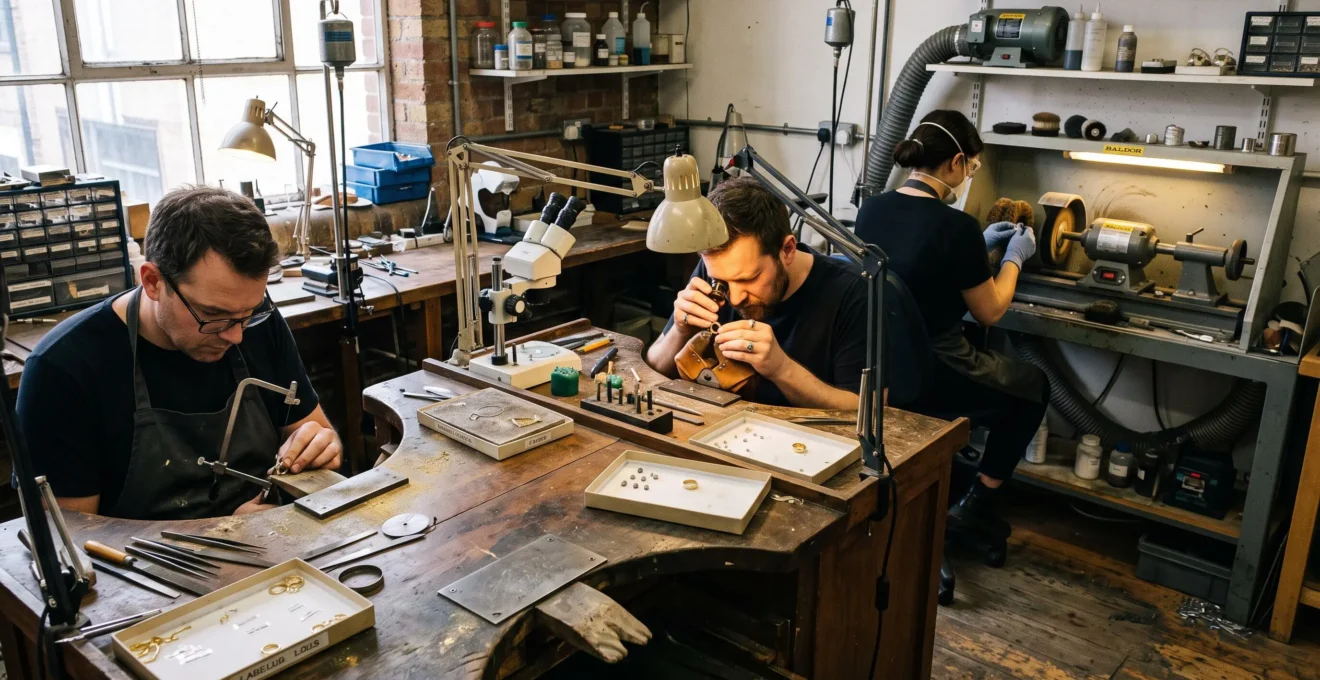
A bespoke ring can pass through four different pairs of hands before its owner sees the finished piece. That is not necessarily evidence of an inefficient workshop. It often reflects a deliberate division between model making, metal fabrication, gemstone setting and final finishing.
Each specialist brings different tools, technical judgement and quality checks. A model maker resolves the physical form, a bench jeweller prepares the metal structure, a setter secures the stones, and a polisher refines the surfaces. Some workshops combine these responsibilities; others involve additional craftspeople, such as engravers or independent gemstone specialists.
The difficulty for a client is that four experts also create multiple hand-offs. Every transfer introduces a scheduling dependency, a potential misunderstanding and a point where an unnoticed defect can become more expensive to correct.
Understanding those dependencies makes it easier to assess a workshop before paying a deposit, approve the correct design and establish a realistic delivery schedule.
What matters when commissioning specialist-made jewellery
- Specialisation distributes technical work, but quality depends on clear responsibility and inspections between stages.
- Confirm actual stone measurements, physical proportions and written approval boundaries before irreversible production begins.
- Judge a workshop by its complete production and correction process, not simply its promised completion date or finished photographs.
- Why Does Specialisation Improve Quality but Sometimes Increase Lead Times?
- How to Vet a Jewellery Workshop’s Quality Process in 6 Questions Before You Pay a Deposit
- Solo Maker or Specialised Workshop: Which Should You Choose for a Multi-Stone Design?
- The Approval Mistake That Triggers Rework Fees and ‘That’s Not What I Meant’ Conflicts
- In What Order Should a Workshop Finalise Stones, CAD, and Bench Work to Avoid Delays?
- Boutique Atelier or High-End Factory: Which Makes More Sense for a Daily Ring?
- Hand-Carved Model or CAD-Only: Which Should You Choose for Organic Shapes?
- Why Does the Model Maker Matter More Than the CAD File for How a Ring Feels on Hand?
Why Does Specialisation Improve Quality but Sometimes Increase Lead Times?
Specialisation can improve jewellery quality by assigning technically demanding operations to craftspeople who practise them regularly. It may also extend delivery because a piece must wait for each specialist to become available. The outcome depends on how the workshop schedules work, checks completed stages and handles corrections, rather than on the number of experts alone.
Consider a ring requiring a sculpted setting, precise metal assembly, pavé diamonds and a high-polish finish. The model maker establishes the form, the bench jeweller prepares and refines the metal, the setter secures the stones, and the finishing specialist completes the surface treatment.
Each operation has different tolerances. A setter needs suitable stone seats; a polisher must avoid damaging delicate setting details. Passing the ring onward before those conditions are met risks carrying an error into the next operation.
GIA‘s report on Shenzhen jewellery manufacturing documents industrial operations involving model preparation, casting, setting preparation, gemstone setting, polishing and final quality control. This illustrates a structured production chain, although it does not establish that every independent atelier uses the same arrangement.
Two forms of specialisation have different scheduling implications:
- Craft specialisation: different workers repeatedly perform particular operations. Several pieces can move through separate stations simultaneously, potentially improving overall workshop throughput.
- Stage specialisation: one commission moves between design, modelling, bench work and finishing appointments. Its completion depends on the availability and successful hand-off of each stage.
These models can coexist. Parallel production increases capacity, but a particular ring may still spend time waiting between stages.
A solo jeweller may be able to adjust a design immediately without transferring it to another person. A specialised workshop may instead need to return the piece to a previously booked station.
Specialisation introduces another risk when techniques are distributed between studios that rarely collaborate. For example, hand engraving and intricate pavé setting may require agreement about which surfaces are finished first and which areas must remain accessible.
Neither arrangement automatically produces better quality or shorter lead times. The relevant measure is the total time to an accepted finished piece, including inspections, possible adjustments and final approval.
Before accepting a production estimate, ask for the planned stages, the person responsible for each transfer and the conditions that could change the promised delivery date. Those answers lead directly to the question of how the workshop controls quality.
How to Vet a Jewellery Workshop’s Quality Process in 6 Questions Before You Pay a Deposit
Before paying a deposit, ask who inspects the piece between stages, how setting problems are corrected, whether progress evidence is available, what rework costs are covered, who approves the final finish and how design approval is recorded. Specific, documented answers demonstrate a clearer process than broad promises that every piece receives attention.
A beautiful portfolio demonstrates that a workshop can produce attractive finished jewellery. It does not reveal whether errors were discovered early, whether substantial corrections were necessary or how responsibility was assigned.
Use these six questions during the initial consultation:
- Who checks the piece before it moves to the next specialist? Establishes whether inspection responsibility belongs to a named craftsperson, production manager or quality-control role.
- What happens if a gemstone does not fit its prepared seat? Reveals whether the workshop reassesses the stone, corrects the setting or returns the piece to an earlier stage.
- Can progress photographs be supplied at agreed milestones? Clarifies whether the client can see the actual commission during model making, metal preparation or setting.
- Which corrections are included, and which changes generate extra charges? Distinguishes workmanship problems from client-requested alterations after approval.
- Who signs off the finished setting and polish? Identifies the final inspection responsibility and the criteria applied before delivery.
- How are measurements, materials and design approvals documented? Establishes the written reference against which the finished commission will be assessed.
The distinction between an effective answer and an unhelpful one is specificity. “Everything is checked” gives little information. “The setter checks seat security before the final finisher receives the ring” identifies both the operation and the responsibility.
GIA’s Quality Assurance Benchmarks provide technical criteria for evaluating jewellery workmanship, including sizing, finishing, assembly and setting. Their particular coverage includes platinum jewellery, and they should not be treated as a universal workshop certification.
Request an example of an intermediate production stage, ideally photographs of a previous commission with the workshop’s permission. A model, unfinished casting or pre-setting inspection can reveal aspects of the process that finished photographs conceal.
Payment terms also deserve scrutiny. A proposal with agreed milestones for model approval, stone setting and completion can make review points clearer. However, staged payments are not inherently safer in every contract, and a single upfront deposit does not automatically indicate poor workmanship.
What matters is the written agreement: payment amounts, refund conditions, ownership of materials, revision allowances, responsibility for defects and the consequences of cancellation or delay.
Five checks to complete before paying your deposit
- Request a production-stage outline and obtain a document naming the expected inspections.
- Ask for an intermediate-stage example and retain photographs or a written explanation of the process.
- Confirm the stone-setting correction policy and obtain its terms in writing.
- Agree on approval milestones and keep a dated record of the dimensions and specifications accepted.
- Review the payment and revision schedule and obtain an itemised quotation or written agreement.
A workshop that can explain its checks is easier to evaluate than one that relies on reputation alone. The next decision is whether the design requires that workshop structure in the first place.
Solo Maker or Specialised Workshop: Which Should You Choose for a Multi-Stone Design?
Choose between a solo jeweller and a specialised workshop according to the design’s technical demands, the maker’s demonstrated experience and how errors are detected. Multiple stones do not automatically require a team. However, precise matching, complex settings and repeated symmetry checks can make a documented specialist workflow particularly valuable.
Start with the stones rather than the maker’s business size. A ring containing several matched stones requires attention to dimensions, relative appearance, spacing and the way each setting interacts with its neighbours.
Small differences can become more noticeable when the design relies on repetition. If one stone is positioned incorrectly, correcting its seat after adjacent work has progressed may require changes beyond the individual setting.
The most useful comparison therefore concerns accountability.
| Design requirement | Solo jeweller | Specialised workshop |
|---|---|---|
| Simple arrangement with a few stones | Suitable where the maker demonstrates relevant setting experience | Also suitable, although multiple hand-offs may be unnecessary |
| Matched stones and repeated symmetry | Requires demonstrated matching and inspection capability | Can allocate matching, modelling and setting to different specialists |
| Pavé or complex channel setting | Depends on the maker’s specialist skills or subcontractors | Can use a dedicated setter and separate inspections |
| Structural or tension setting | Requires appropriate design and engineering expertise | Requires the same expertise, irrespective of team size |
| Changes during production | Potentially simpler direct communication | Needs coordinated instructions across production stages |
| Responsibility for corrections | Usually discussed directly with the maker | Should remain clearly assigned despite multiple contributors |
The comparison also has a less obvious complication: an apparently independent maker may commission specialist setting, casting or engraving externally. That is not necessarily problematic. It simply means the client should understand who coordinates the subcontractors and who remains responsible for the completed piece.
A small atelier with two to four bench specialists can offer an appealing middle ground. The client may retain direct communication with a single workshop while benefiting from different technical skills. This is an organisational possibility, not a guarantee of superior workmanship.
For a design involving several matched gemstones, ask one revealing question:
“If the third stone does not match after setting, what happens next, and who pays for the correction?”
A convincing response should distinguish between a supplied stone outside the approved specification, an error in setting or matching, and a client preference that changed after approval.
Once the responsible maker or workshop is selected, the client’s most consequential contribution is often the design approval. That approval can determine which subsequent changes are included in the original commission.
The Approval Mistake That Triggers Rework Fees and ‘That’s Not What I Meant’ Conflicts
The most consequential approval mistake is accepting a convincing CAD rendering without confirming the ring’s real dimensions, proportions and physical appearance. Digital images can make stones appear larger, metal edges finer and curves more comfortable than they will feel. Written approval should therefore identify exactly what has been accepted and which aspects remain provisional.
A rendering communicates shape and visual intention, but its screen size is not a reliable physical reference. Zoom, lighting, perspective and material effects can all change how the proposed jewellery appears.
For example, a ring viewed as a large three-dimensional image may look delicately proportioned. The same geometry, reduced to actual finger scale, may feel bulky across the shoulders or sit higher than expected.
Before approving the design, confirm:
- Ring size: verify the intended fit, ideally with a suitable physical sizing test where practical.
- Stone dimensions: compare millimetre measurements with a scale reference rather than relying solely on carat weight or visual representations.
- Height and projection: examine how far the setting extends above the finger and whether it may catch on clothing.
- Finish and appearance: view representations under neutral lighting and agree on polished, satin, textured or other surface treatments.
- Physical form: request a resin, wax or 3D-printed model when shape, comfort or unusual proportions are difficult to assess digitally.
For complex designs, a physical model may be especially useful even when it does not reproduce the final metal’s weight, surface finish or setting behaviour.
The commercial problem begins when a client assumes approval means agreement with the general aesthetic, while the workshop treats it as acceptance of the detailed specifications.
Approval boundaries should therefore be explicit. An agreement might distinguish accepted dimensions and stone positions from minor surface details still subject to refinement.
Whether a subsequent alteration attracts a fee depends on the written terms, the cause of the change and applicable consumer law. A workshop error should not automatically be treated as a chargeable client revision.
Telephone conversations create particular uncertainty. A verbal request to move a stone or change a shoulder profile can become difficult to reconstruct once a new CAD version has replaced the previous one.
Keep dated images, measurements and written confirmations. When a change is made, request a revised specification identifying what changed and whether it affects the price or schedule.
Hypothetical approval dispute: the unexpectedly high setting
A client approves a ring rendering because the gemstone arrangement looks balanced. After casting, the client discovers that the setting stands higher above the finger than expected. The CAD file accurately represents the approved dimensions, but those dimensions were never explained alongside a physical-scale reference.
The dispute is not necessarily about defective manufacture. It concerns whether the approval process adequately established the intended height. A dimensioned drawing or physical model before production could have exposed the disagreement while adjustment remained simpler.
Once the intended geometry is properly agreed, the workshop can organise gemstone sourcing, modelling and bench work without repeatedly reopening decisions that should already have been resolved.
In What Order Should a Workshop Finalise Stones, CAD, and Bench Work to Avoid Delays?
For bespoke jewellery built around specific gemstones, the safest sequence is usually to confirm stone availability and actual measurements before finalising the setting geometry. The workshop can then complete its CAD or physical model, prepare the metal structure, fit the stones and finish the piece. Variations are possible, but changes to critical dimensions must be controlled.
Designers may begin with a preliminary CAD concept before sourcing stones. That is often useful for exploring form and budget. The risk arises when provisional stone sizes are treated as final measurements and irreversible production begins before the actual stones are verified.
A practical dependency sequence is:
- Define the design brief, preferred gemstones, setting approach and intended proportions.
- Source or identify appropriate stones and confirm their actual dimensions and relevant characteristics.
- Complete stone matching where the design requires consistent proportions or appearance.
- Finalise CAD geometry or a physical model using the confirmed stone requirements.
- Approve dimensions, structure and finish specifications before production proceeds.
- Produce or prepare the metal structure through the appropriate fabrication or casting process.
- Complete necessary prefinishing and setting preparation, then set the stones using the appropriate technique.
- Inspect the setting, perform final finishing and complete final quality control.
This sequence is a practical planning framework, not a universal manufacturing standard. Some stones can be cast in place using suitable processes, and certain constructions require a different order of assembly and finishing.
Dependencies become particularly important when stones have unusual outlines, shallow or deep proportions, or small differences from nominal calibrated sizes.
Consider a purely hypothetical example: a workshop models a ring around stones assumed to measure 4.0 mm, but the sourced stones measure 4.5 mm across a critical dimension. That difference may affect stone seats, metal clearances and neighbouring settings. The workshop must determine whether the design can accommodate the actual stones or whether the model requires revision.
The right response depends on the design’s geometry, not simply on the numerical difference.
For organic pieces, the workflow may involve hand-carving the principal form and checking it against the physical stones before committing to final structural details. Insisting on a complete and rigid digital model at the beginning can introduce unnecessary redesign when the intended form is inherently tactile.
Ask the workshop: “What happens if the sourced stones arrive half a millimetre outside your CAD assumptions?”
An experienced production coordinator should be able to explain who measures the stones, who assesses the setting, which approvals must be reopened and when fabrication can proceed.
A useful schedule also separates milestones under workshop control from external dependencies such as stone availability, outsourced operations and client approval time.
Once those dependencies are established, the next consideration is how the production model affects the ring’s intended use. A technically ambitious commission and a ring worn every day do not always require the same priorities.
Boutique Atelier or High-End Factory: Which Makes More Sense for a Daily Ring?
For a ring intended for everyday wear, choose a boutique atelier or high-end factory according to construction quality, comfort, repairability and long-term service. A factory may offer repeatable specifications and established service processes, while a boutique may offer closer design collaboration and greater flexibility. Neither production model guarantees greater durability.
Daily jewellery experiences repeated contact with hard surfaces, clothing and ordinary activities. The setting’s profile, stone security, band construction and ability to undergo future maintenance matter more than the prestige attached to its maker.
Factory production can support standardised dimensions, repeatable assembly procedures and organised after-sales servicing. However, those capabilities vary by manufacturer, and the existence or terms of a lifetime service programme must be verified rather than assumed.
A boutique atelier may offer easier discussions about altered shoulder proportions, a lowered setting or a customised fit. That flexibility depends on the particular workshop’s skills, equipment and policies.
The engineering details matter in either environment.
GIA’s guide to engagement ring settings explains practical trade-offs: prong settings can snag and require inspection, channel settings can complicate resizing, and tension settings may be difficult or impossible to resize. Pavé designs may also require periodic maintenance.
That means a highly elaborate ring can be less convenient for constant wear even when its construction is excellent.
| Consideration | Boutique atelier | High-end factory |
|---|---|---|
| Personal fit adjustments | May provide direct design modifications | Often follows established size and design options |
| Consistency | Depends on documented craft and inspection practices | May benefit from repeatable production controls |
| Repairability | Depends on construction and workshop capabilities | Depends on construction and service arrangements |
| After-sales communication | May involve direct contact with the maker | May involve a retailer or dedicated service team |
| Future design alterations | Can offer case-specific flexibility | May be restricted by standardised construction |
Ask both suppliers about alloy specifications, casting or fabrication methods, finishing tolerances and stone-security inspections. A description of the production process is more informative than a general claim that jewellery is handmade or precision manufactured.
The practical test is to imagine the ring after several years of wear. Can it be resized? Who checks loose stones? Can worn prongs be repaired? Is re-polishing or re-plating available where appropriate? What limitations or charges apply?
Some construction choices make later alteration difficult regardless of who produced the ring. These limitations should be discussed before the client commits.
Long-term suitability depends on both design and execution. For softer, more sculptural designs, that brings another important choice into focus: how the physical model is created.
Hand-Carved Model or CAD-Only: Which Should You Choose for Organic Shapes?
Choose hand-carving when direct sculptural judgement and tactile refinement are central to the design, and CAD when precise geometry, repeatability or controlled stone placement dominates. For organic jewellery, a hybrid process can combine a physically sculpted form with digitally defined structural components. The better method depends on the desired shape, available skills and revision requirements.
CAD is particularly useful for controlled symmetry, repeated features and exact geometric relationships. It can also produce complex organic forms when the designer has suitable digital sculpting expertise.
Hand-carving works differently. The maker removes and refines material directly, assessing transitions, mass and visual balance on a physical object as the design develops.
Neither technique is intrinsically more artistic or more accurate. The difference concerns the tools through which the craftsperson makes decisions.
For a ring with flowing shoulders and irregular sculptural surfaces, a hand-carved wax model may allow the maker to judge relationships that are difficult to evaluate from a conventional technical rendering.
However, hand-carving is not the only way to produce natural-looking forms. Digital sculpting, detailed modelling and carefully finished printed or milled models can also support organic design.
A hybrid workflow may involve:
- Carving the principal sculptural form by hand.
- Digitally scanning the model.
- Refining structural geometry, including stone seats and the ring shank, using CAD.
- Producing a revised physical prototype for approval.
- Preparing the approved model for the selected manufacturing process.
This approach can preserve hand-developed character while allowing dimensional control where the design requires it. It also adds steps, so the workshop should explain why the combination is necessary.
Hand-carving can involve additional labour and depend on an individual model maker’s availability. CAD-based production may make authorised revisions and reproductions easier when digital records are retained, although repeatability still depends on the production process.
To establish what is being purchased, ask whether the physical model is hand-carved, 3D-printed, milled or produced through a combination of methods.
Request photographs or an opportunity to inspect the model before casting. A physical preview is particularly valuable when asymmetry, texture or changing thickness contributes to the intended character.
Even after a modelling method has been selected, comfort cannot be reduced to whether the design is digital or handmade. The last critical distinction is between a ring’s specified geometry and the judgement used to realise it physically.
Key takeaways before finalising your ring design
- A technically correct model still needs careful evaluation of the surfaces that contact the hand.
- Physical prototypes help reveal proportion and comfort questions that may remain unclear in renderings.
- The person responsible for modelling and finishing should understand the intended wearing experience, not only the approved dimensions.
Why Does the Model Maker Matter More Than the CAD File for How a Ring Feels on Hand?
The model maker can have a decisive influence on comfort because the wearer experiences physical edges, transitions and surfaces rather than a digital drawing. CAD establishes geometry, but modelling, bench execution and finishing determine whether the intended form is faithfully realised. The relative importance of each role varies with the design and production method.
Consider the junction between the ring’s shank and setting head. On a rendering, the transition may appear smooth. On the hand, however, a bulky shoulder or poorly refined underside may create an uncomfortable contact point.
Other areas deserve similar attention: the inner edge of the band, the gallery beneath the stones, the width of the shoulders and the way the ring sits beside adjacent fingers.
A technically detailed CAD design can account for these features. Nevertheless, the actual manufacturing process must reproduce and preserve them.
In platinum jewellery, GIA’s technical prefinishing guidance emphasises preserving intended dimensions and design details while preparing surfaces. It also cautions against removing unnecessary metal. The broader lesson is that surface finishing must be controlled rather than treated as an entirely cosmetic operation.
Two contrasting failure scenarios illustrate the issue.
In the first, a carefully developed CAD file reaches production, but inaccurate model preparation or excessive finishing leaves the physical ring with uncomfortable edges or altered proportions. The file may have been appropriate even though execution fell short.
In the second, an experienced model maker identifies awkward transitions in an early concept and recommends adjustments before the piece reaches metal fabrication. The resulting design benefits from physical judgement, although significant structural defects may still require formal redesign.
The most useful assessment is sensory. When possible, try a physical prototype or a finished ring with comparable dimensions. Rotate the hand, bring the fingers together and notice whether the underside of the setting presses against neighbouring skin.
Inspect the inside shank edges, shoulder width and underside of the gallery. A lightweight prototype can help establish geometry, although it will not reproduce the final ring’s weight or every characteristic of its finished surfaces.
Ask who evaluates those contact points and whether adjustments can be requested before casting or other irreversible operations.
The answer should reveal collaboration between the designer, model maker and bench jeweller. Responsibility for comfort should not disappear simply because the commission moves to another specialist.
That is the value of a properly coordinated workshop: individual craftspeople contribute different forms of judgement while the overall process maintains a coherent specification.
Before making a final commitment, ask the workshop to identify who owns the physical model, how comfort will be evaluated and which changes can still be made at the model-approval stage. These concrete answers are more useful than an assurance that the finished ring will simply feel perfect.
Does a bespoke ring really need four different specialists?
No. Four specialists illustrate one possible division of model making, metalwork, gemstone setting and finishing. A skilled jeweller may undertake several operations, while a highly complex piece may involve additional craftspeople. The necessary team depends on the design, processes and capabilities of the people producing it.
Should the workshop provide photographs during production?
Progress photographs can make approvals and hand-offs more transparent, particularly before casting or setting. However, they are not a universal industry requirement. Agree in advance which photographs will be supplied, at what stages and whether they form part of an approval process.
Can a commissioned ring be altered after casting?
Some alterations are feasible, but the options depend on the metal, construction, stone setting and nature of the requested change. Adjusting the finish may be relatively straightforward, while changing major proportions or stone positions can require substantial reconstruction. Ask for a technical assessment and written cost implications before authorising alterations.
Who is responsible if an external specialist makes a mistake?
The client should establish which business is contractually responsible for the completed commission, including outsourced operations. Internal allocation of work does not itself determine the client’s rights. The written agreement and applicable consumer law govern remedies and liability, so clarify the correction and dispute procedures before production.
Is a longer production estimate a sign of better craftsmanship?
Not necessarily. A longer estimate may reflect specialist scheduling, material availability or additional inspection stages, but it may also reflect a production backlog. Ask the workshop to explain the sequence, dependencies and contingency arrangements. A credible schedule is one whose assumptions and approval milestones can be understood.