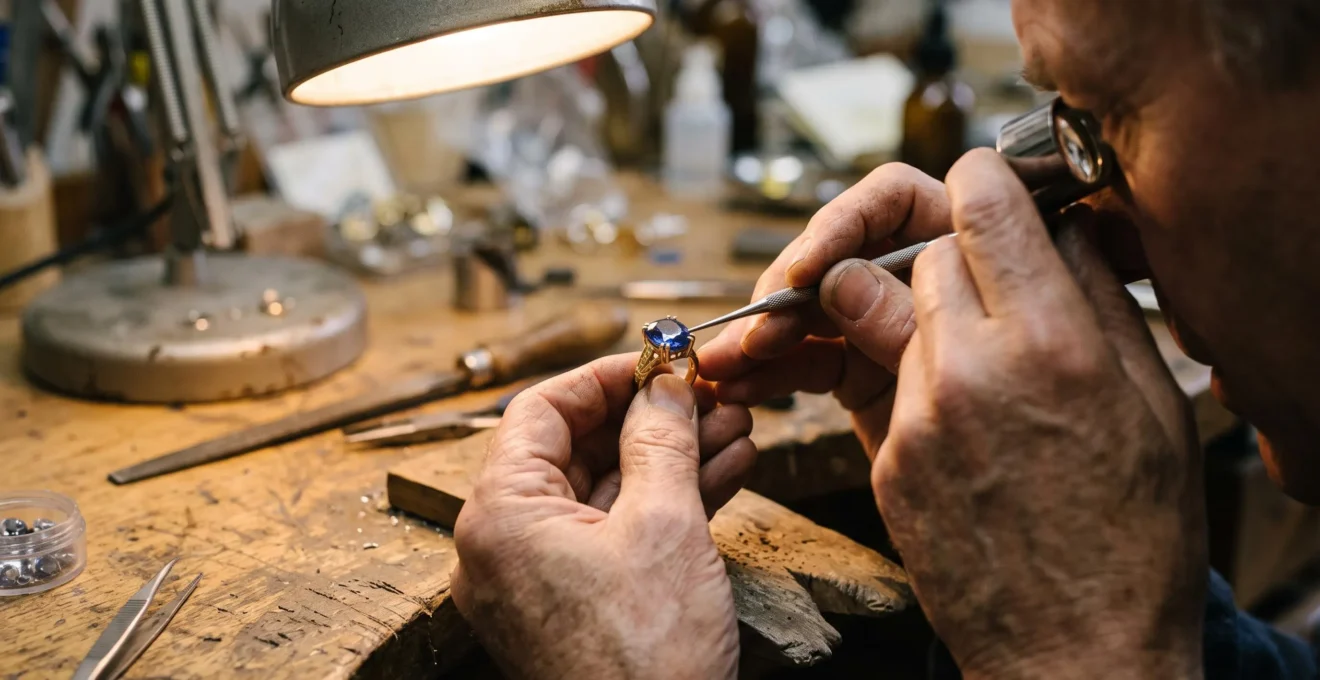
A faint clicking sound from a ring can be unsettling, particularly when the gemstone was securely mounted only six months ago. You may notice a slight rattle while moving your hand, a prong that catches a jumper, or a stone that appears to sit differently from when you bought it.
A mounted stone should not move freely within its setting. If movement is suspected, stop wearing the ring until a jeweller can examine it. Six months is not a normal replacement interval or an established deadline for gemstone settings to fail. A well-constructed setting can remain secure much longer, although damage or a construction defect may produce problems sooner.
Everyday activities create opportunities for wear: knocks against hard surfaces, repeated fabric snags, abrasion and pressure on exposed metal. The consequences depend on the gemstone, the setting design, the quality of the original workmanship and the wearer’s habits.
Understanding which changes indicate a genuine security problem can help protect the stone, avoid unnecessary handling and identify a manageable repair before gemstone replacement becomes necessary.
Loose mounted stones: what matters most
- Six months is not a failure threshold. Early looseness can result from impact, inadequate initial stone contact, deformation or accumulated wear.
- Clicking, rattling, visible movement or a newly raised prong require attention. Stop wearing the ring and arrange an inspection rather than testing its movement repeatedly.
- Setting design and maintenance matter. Smooth bezels and recessed settings generally reduce snagging, while professional checks can identify vulnerable metal before a stone is lost.
- Why Can Mounted Stones Loosen Faster in Winter-to-Heated-Office Routines?
- How to Check if a Mounted Stone Is Secure at Home Without Touching the Prongs
- Prongs, Bezel, or Channel: Which Setting Should You Choose if You Wear Gloves Daily?
- The Cleaning Habit That Bends Prongs and Makes Stones Drop Out Without Warning
- When Should You Re-Tip Prongs if You Want to Avoid a Stone-Loss Emergency?
- Why Can a Stone Start Moving Long Before You Notice Anything Is Wrong?
- Why Do Some Settings Snag Knitwear Every Week While Others Don’t?
- Which Stone Setting Technique Is Best if You Catch Your Ring on Everything You Wear?
Why Can Mounted Stones Loosen Faster in Winter-to-Heated-Office Routines?
Winter routines can expose rings to repeated handling, glove friction, fabric snags and changes in fit, all of which may increase mechanical stress on a setting. Metals and gemstones also respond differently to temperature, but ordinary movement between cold streets and heated offices has not been shown to loosen a properly constructed setting within six months.
Gold, platinum and gemstones have different coefficients of thermal expansion. As temperature changes, their dimensions change by different amounts. However, the small temperature variations encountered during ordinary commuting should not be treated as proof of progressive damage to a gemstone’s seat.
Thermal expansion matters when evaluating material behaviour, but its practical significance depends on temperature range, setting geometry, gemstone properties and existing defects. Repeated thermal cycling is therefore a possible engineering consideration, not an established explanation for ordinary six-month ring loosening.
The more immediate winter-related concern is physical interference with the setting. A tight glove sliding over a raised gemstone can catch a prong. Pulling the glove away may apply lateral force to the metal supporting the stone.
When the same prong catches repeatedly, the risk becomes more credible, particularly if the tip was already slightly raised or poorly finished. The number of snags, their force and the condition of the metal matter more than the calendar.
Winter also introduces circumstances that can change how a ring behaves:
- Repeated glove removal: tight cuffs and glove linings can pull against exposed prongs or decorative edges.
- Changes in finger size: temperature and skin conditions can affect ring fit, allowing a loose-fitting ring to rotate more frequently.
- Frequent handwashing: removing, replacing and handling a ring creates opportunities for accidental knocks or drops.
- Layered clothing: loose knits, scarves and coat linings may catch raised metal components.
Gemstone sensitivity introduces a separate issue. Diamonds and emeralds do not react identically to heat or sudden temperature changes. The GIA Emerald Care and Cleaning Guide explains that heat can extend existing emerald fractures and that fracture-filling substances require particular care. This is evidence of gemstone vulnerability, not evidence that office heating routinely loosens emerald settings.
A ring that begins clicking after winter commuting should therefore be examined for displaced prongs, wear and impact damage rather than automatically attributed to temperature fluctuations.
The useful question is not whether the ring has experienced hundreds of temperature changes, but whether its supporting metal has been snagged, struck, distorted or inadequately secured. The next step is to recognise warning signs without creating additional damage during inspection.
How to Check if a Mounted Stone Is Secure at Home Without Touching the Prongs
You can look for possible looseness without touching the prongs by examining the ring under good lighting, comparing close-up photographs and observing whether the stone sits differently. A faint rattle may be a warning sign, but it does not identify the defect. If movement is already suspected, avoid shaking or tapping the ring to confirm it.
Start with an inspection rather than a mechanical test. Place the ring on a clean, soft, stable surface with the gemstone facing upwards. Use a phone flashlight or indirect daylight to illuminate the stone and surrounding metal.
Look for changes in the relationship between the gemstone and its setting. A stone that appears tilted, an unusually large gap beside a prong, or a raised metal tip may suggest that professional attention is needed.
Monthly photographs can provide a useful visual reference, provided the angle and lighting remain consistent. For a faceted gemstone, differences in reflections alone are not evidence of looseness: illumination, camera position and focus can change its appearance dramatically.
A clicking noise detected during normal handling deserves attention. Although gently tapping a ring close to the ear is sometimes suggested as a home test, deliberately repeating this procedure on a potentially loose gemstone risks worsening an existing problem. A rattle may also come from another moving component, such as a hinged element.
Similarly, dragging dental floss, fine thread or fabric across a questionable setting can reveal a protruding tip, but the material may pull on that tip. These are not reliable ways to certify gemstone security.
Even apparently firm settings can conceal thinning prongs, cracked metal or weakened channel walls. A visual inspection cannot reliably measure remaining metal thickness or the adequacy of the gemstone’s contact with the mount.
Five steps for a safe, documented ring check
- Stop wearing a suspicious ring. Record whether the first warning was a click, snag, visible tilt or noticeable movement.
- Inspect without applying pressure. Examine the ring on a soft surface under good lighting and note any visibly raised or damaged metal.
- Take two reference photographs. Capture a clear overhead image and a side view, keeping both for comparison.
- Record the circumstances. Note recent knocks, glove snags, cleaning methods or changes in how the ring fits.
- Request a professional setting inspection. Ask the jeweller to assess stone security, prong contact, metal wear and whether cleaning or repair is safe; keep the findings.
If the stone is visibly displaced or the setting is cracked, store the ring securely and arrange an inspection promptly. Do not attempt to tighten metal with pliers, push a gemstone back into place or wear the ring until a convenient cleaning appointment.
Home observation is a useful early-warning system, not a substitute for professional examination. Once the immediate risk is understood, the setting’s design becomes an important consideration, especially for anyone who wears gloves every day.
Prongs, Bezel, or Channel: Which Setting Should You Choose if You Wear Gloves Daily?
For frequent glove wearers, a well-finished, low-profile bezel is often a practical choice because its continuous rim offers fewer exposed points for fabric to catch. Low-profile prongs can still work well, while channel settings protect many smaller stones along a band. The best option depends on gemstone size, placement and construction quality.
Gloves create friction around the ring. When a cuff passes over a raised setting, the fabric can push against the mounting. Removing a tight glove may then pull in the opposite direction, particularly if an exposed prong catches the lining.
These forces do not guarantee damage. Their significance depends on whether the setting has vulnerable edges, how tightly the glove fits and whether existing metal wear is present.
The following comparison shows how the three setting families handle everyday contact.
| Feature | Prong | Bezel | Channel |
|---|---|---|---|
| Stone retention | Individual metal tips grip the gemstone. | A metal rim surrounds all or part of the gemstone. | Opposing metal walls retain stones within a channel. |
| Glove snagging | Greater potential where tips project or are poorly finished. | Generally lower with a smooth, continuous rim. | Often low when walls and edges are smooth. |
| Stone-edge protection | Varies with prong arrangement and exposed edges. | Provides substantial protection around covered edges. | Provides protection along the channel’s sides. |
| Cleaning access | Often relatively accessible around exposed surfaces. | Covered edges and enclosed areas may be harder to reach. | Debris may collect within the channel. |
| Maintenance focus | Prong contact, thickness and tip shape. | Rim integrity and gemstone contact. | Wall integrity, edge wear and individual stone security. |
| Typical suitability | Wearers prioritising an open gemstone appearance. | Wearers seeking smoother profiles and edge protection. | Bands incorporating several stones. |
The GIA guide to engagement ring settings describes the structural differences between these mounting styles and explains their practical advantages and limitations.
A bezel does not make a gemstone immune to loss, and a prong setting is not inherently defective. Gemstone security still depends on correct construction, sufficient metal and appropriate finishing.
There are also useful intermediate choices. A partial bezel protects selected edges while leaving other parts exposed. A low-profile prong head can reduce snagging without fully surrounding the gemstone.
These alternatives can suit a wearer who likes an open setting but regularly catches a higher mount on winter gloves. A jeweller should assess whether the existing ring can be modified safely or would require replacement of the setting.
Cleaning access is another compromise. A bezel can limit access to concealed areas, while open prongs expose more of the stone. Neither design alone determines whether ultrasonic cleaning is safe; gemstone treatments, condition and setting integrity remain essential.
The most suitable design balances appearance, stone protection, cleaning access and maintenance needs. Whatever the mounting style, inappropriate cleaning can introduce a different category of risk.
The Cleaning Habit That Bends Prongs and Makes Stones Drop Out Without Warning
Forceful scrubbing against prong tips is an avoidable cleaning risk, particularly when a setting is already thin, damaged or poorly secured. However, ordinary gentle brushing has not been shown to progressively bend sound prongs in a predictable six-month period. The more clearly documented concern is using inappropriate equipment or cleaning a compromised setting without checking its security first.
A stiff brush pressed repeatedly against protruding metal may catch an exposed prong. An old toothbrush with hardened or damaged bristles is therefore a poor choice for delicate settings, especially when its condition is uncertain.
The problem is not simply how frequently a ring is cleaned. Pressure, brush stiffness, stone treatment and the original condition of the mounting all influence whether a particular method is appropriate.
Debris trapped beneath a gemstone can make the setting difficult to inspect. Soap residue, skin oils and other deposits may conceal gaps or obscure damaged metal. Removing this material can reveal a pre-existing problem, but there is insufficient evidence to claim that dirt routinely lifts securely mounted stones from their seats.
There is a more substantial concern with ultrasonic cleaning. High-frequency vibrations can affect loose gemstones and are unsuitable for various treated or delicate materials. A stone already held inadequately may be dislodged during cleaning.
The GIA jewellery care and cleaning recommendations explain the risks associated with ultrasonic equipment and the importance of choosing methods appropriate to the gemstone.
For suitable jewellery with a confirmed secure setting, gentle cleaning may involve:
- Preparing a small container of lukewarm water with a little mild dish soap.
- Allowing appropriate jewellery to soak briefly, if its gemstone and construction permit soaking.
- Using a soft brush only where needed, without forcing its bristles against vulnerable prongs.
- Rinsing in a separate container rather than over an open drain.
- Drying carefully with a clean, soft, lint-free cloth.
Do not immerse a ring with an already loose stone simply to clean it. Obtain an inspection first so that washing does not dislodge the gemstone.
Emeralds with fracture-filling treatments require particular caution, and opals and pearls also have material-specific cleaning restrictions. Ultrasonic or steam cleaning should not be treated as universally safe for these stones.
Some sensitive gemstones and jewellery constructions may be unsuitable even for ordinary soaking. Pearls, delicate assemblies and older pieces should be assessed individually rather than cleaned according to a generic diamond-ring routine.
Cleaning cannot restore worn prongs or repair a damaged gemstone seat. A ring may become visibly cleaner while its underlying security problem remains unchanged.
When the metal itself has become thin or displaced, cleaning should give way to repair. Recognising when a prong needs rebuilding helps prevent an avoidable stone-loss emergency.
When Should You Re-Tip Prongs if You Want to Avoid a Stone-Loss Emergency?
Prongs should be considered for re-tipping when a jeweller identifies insufficient metal, inadequate contact with the gemstone or wear that threatens retention. Visible thinning, flattened tips, gaps and persistent fabric snags justify an assessment. Re-tipping should occur before the prong loses its ability to hold the stone, rather than after the gemstone has moved or fallen out.
A prong is a small structural component. Its tip must contact the stone appropriately, while the supporting metal must remain strong enough to resist ordinary handling.
Over time, abrasion may remove metal. Accidental impacts can distort prongs, and a poorly positioned tip can be vulnerable even on a relatively new ring.
Signs that warrant professional inspection include:
- Rounded or flattened tips: wear may have reduced the original metal profile.
- Visible thinning: a prong appears narrower than its neighbours, particularly near the stone.
- Uneven contact: one tip appears raised or separated from the gemstone.
- Repeated snagging: a previously smooth prong begins catching fine fabric.
- Cracks or distortion: metal appears split, bent or asymmetrical.
A tip that seems to sit lower than its original position may also require investigation, although gemstone geometry and setting design determine what adequate contact looks like. There is no universal visible height that proves a prong is unsafe.
During re-tipping, a qualified jeweller adds suitable metal to the worn area, reshapes the tip and restores appropriate contact with the gemstone. The process may involve soldering or another specialist joining technique, depending on the setting, metal and stone.
Not every worn prong can be repaired by adding material to its tip. If the supporting structure is cracked, severely thinned or distorted, the jeweller may recommend rebuilding the prong, replacing the head or resetting the gemstone.
Heat-sensitive and treated gemstones may need protective procedures or removal before certain repairs. This is particularly important when working with fragile or fracture-filled stones.
Preventive maintenance can reduce the likelihood of reaching a situation where the gemstone must be replaced. Nevertheless, an early repair does not always preserve the original seat: that depends on how much damage has already occurred.
GIA’s general jewellery-care advice recommends professional checks approximately six months. This is a maintenance recommendation, not a finding that gemstone settings normally become loose after six months.
Heavy daily wear, previous damage and frequent snagging can justify earlier checks. An occasional-wear ring may face different risks, but a new rattle or visible change should prompt inspection regardless of the last appointment date.
When arranging a cleaning visit, ask whether the jeweller can examine the prongs and gemstone security beforehand. Some businesses provide complimentary checks, but this service should not be assumed to be free everywhere.
Timely inspection matters because the gemstone can begin moving before the damage becomes obvious. Understanding this delay explains why seemingly sudden failures often have an earlier mechanical origin.
Why Can a Stone Start Moving Long Before You Notice Anything Is Wrong?
A mounted stone can develop slight movement before its owner notices because early changes in prong contact or metal shape may be difficult to see. A small impact, insufficient initial tightening or gradual wear may weaken retention without immediately producing a visible gap. Clicking or rotation can emerge only after the stone has become mobile enough to detect.
The gemstone’s seat is the part of the setting that positions and supports the stone. In a prong mounting, the interaction between the seat, supporting metal and prong tips determines whether the gemstone remains secure.
If a prong bends slightly or loses contact, the remaining contact points may still hold the stone for a time. That does not necessarily mean they provide sufficient protection against another knock.
Three mechanisms deserve particular attention:
- Metal abrasion: repeated contact with surfaces can remove material from exposed components.
- Mechanical deformation: impacts and snags can change prong alignment or tip contact.
- Original construction problems: inadequate stone seating or incomplete prong contact can exist from the beginning.
These mechanisms may occur separately or together. They should not be assumed to follow an inevitable sequence in every ring.
Early movement can be especially difficult to recognise in round stones. A small rotation may not visibly alter the gemstone’s outline, while differences in reflected light can be mistaken for normal changes in lighting.
Other observations can provide context but are not conclusive evidence. A ring that spins more freely may reflect a change in finger fit rather than movement of the stone. Debris collecting on one side of a mounting may reflect its geometry or cleaning accessibility.
Comparing photographs can help identify actual changes, but the same viewing angle is essential. A different camera position can create the appearance of a new gap where none exists.
Consider a hypothetical example: an initially raised prong catches a glove, becomes displaced and no longer contacts the stone correctly. The gemstone remains in place for several weeks before the wearer notices a faint click. The eventual discovery feels sudden, even though the defect existed earlier.
This is a plausible illustration of how an unnoticed problem may progress, not a documented failure timeline.
The financial difference can be substantial in principle. Repairing an accessible loose setting may involve tightening or rebuilding metal. Losing the gemstone introduces identification, matching and replacement challenges, particularly when the original stone has unusual characteristics or personal significance.
Actual repair options and costs vary, and a slightly mobile stone does not automatically qualify for simple tightening.
Subtle instability is one reason recurring snags deserve attention. Fabric catching is not only inconvenient: it can identify the particular metal edge that needs inspection.
Why Do Some Settings Snag Knitwear Every Week While Others Don’t?
Some settings snag knitwear because their metal tips, exposed gemstone edges or decorative details project into the path of fine fibres. Two rings with similar gemstones can behave differently when their prong height, tip shape and overall profile differ. Repeated snagging is a reason to inspect the setting, especially if the problem is new or worsening.
A raised prong creates a potential hook. As yarn passes over the tip, a fibre can become trapped beneath it. Pulling the garment away may then apply force to the metal rather than allowing the fabric to slide freely.
Other setting features can catch clothing:
- Prong tips: raised or insufficiently finished ends may trap fine threads.
- Gallery edges: exposed structural details beneath the gemstone can catch loose fibres.
- Pavé beads: small metal elements securing accent stones may snag if damaged or poorly finished.
- Channel edges: distorted or lifted metal walls can interrupt an otherwise smooth surface.
- Exposed stone edges: certain raised or irregular designs create contact points with fabric.
According to GIA‘s technical guidance, prong tips should make appropriate contact with the gemstone, and tips that are not flush can snag clothing and break. This connects finishing quality directly with both wearability and structural security.
Not every fabric catch means a stone is loose. A deliberately raised setting may occasionally interact with a very open knit despite being secure. Repeated catching at the same metal point, particularly following an impact, deserves closer attention.
It is reasonable to consider a feedback mechanism: a snag may deform a vulnerable prong, making further snagging more likely. However, there is no established universal number of snags needed to cause a loose stone or a demonstrated six-month progression for ordinary knitwear contact.
Practical adjustments can reduce exposure. Put rings on after dressing, remove them before handling loose knits and avoid pulling fabric forcibly when it catches. A jeweller may be able to smooth a protruding metal tip or correct the prong’s position.
A common suggestion is to drag fine stockings over a setting to locate a snag. This can identify a contact point, but it is unsuitable when the prong might already be displaced. The fabric could exert additional force on damaged metal.
If the ring regularly catches clothing, identify the location through ordinary observation and ask a jeweller to examine it. There is little value in deliberately reproducing a snag that might loosen the gemstone further.
Where polishing or repositioning cannot eliminate recurring contact, the setting’s overall design may be poorly matched to the wearer’s activities. That is when choosing a more protective mounting becomes worth considering.
Key takeaways before choosing a replacement setting
- A setting that repeatedly catches clothing may need a change in profile rather than another repair to the same exposed point.
- Protective settings reduce certain mechanical risks but cannot compensate for weak construction or unsuitable gemstone handling.
- The decision to repair or reset should account for wear patterns, gemstone durability, sentimental value and the condition of the existing mount.
Which Stone Setting Technique Is Best if You Catch Your Ring on Everything You Wear?
If your ring regularly catches clothes, gloves or everyday objects, a low-profile bezel or flush setting is often worth considering. These designs reduce exposed edges, although neither is completely snag-proof. For larger or delicate gemstones, a protective partial bezel or redesigned low-profile mount may be more suitable. The final choice requires assessing the particular gemstone and your existing ring.
Begin with the situations in which the ring catches. A ring that snags soft knitwear presents a different contact problem from one frequently striking gym equipment or hard work surfaces.
Ask three questions before choosing a replacement:
- What catches the setting? Loose fabrics suggest a snagging issue, while hard surfaces introduce impact concerns.
- How often does it happen? An occasional contact is different from repeated interference during normal daily tasks.
- What gemstone is mounted? Gemstone toughness, existing fractures, treatments and shape influence suitable mounting techniques.
For frequent fabric contact, a smooth bezel provides a continuous metal boundary around the gemstone. It reduces exposed stone edges and often eliminates the projecting prong tips responsible for catches.
A flush or gypsy setting positions the gemstone within the surrounding metal, leaving relatively little of the stone protruding above the ring’s surface. This can suit designs intended to avoid raised mounting components, provided the gemstone dimensions and ring structure permit it.
Partial bezels can provide a compromise when a fully enclosed rim would obscure too much of the gemstone. Their exposed sides still require evaluation for impact and snagging risks.
Some designs offer a tension-style appearance with additional protective rails or other supporting components. Their security depends on the actual construction, not the visual impression of a suspended stone. A true tension setting also has specialised engineering requirements and should not be treated as interchangeable with a conventional bezel.
These designs involve trade-offs. Protective metal can conceal more of a gemstone, affect cleaning access and complicate later resizing or repairs. A flush setting also requires sufficient surrounding metal, making it inappropriate for some thin bands or large stones.
The next question is whether the original setting can be repaired economically and reliably. Re-tipping may be appropriate where the basic design remains suitable and the damage is localised. Repeatedly repairing a prong that continues to snag can be less sensible than reconsidering its height or configuration.
Resetting is not automatically the safer option. Removing and remounting a gemstone introduces handling risks, particularly for fractured, treated or fragile stones.
For an heirloom emerald, for example, the stone’s condition and treatment history may restrict the use of heat or pressure during repair. A qualified jeweller should determine whether the gemstone can be safely removed and installed in a different mounting.
An heirloom ring may also have historical or sentimental value tied to its original construction. Preserving that setting can be important enough to favour careful repair and changes in wearing habits rather than redesign.
The appropriate decision therefore balances four considerations: the current metal’s structural condition, the frequency of mechanical contact, the gemstone’s tolerance for resetting and the owner’s reasons for preserving the existing design.
If your ring has started clicking, shifting or catching fabric in a new way, stop wearing it and book a professional inspection. Ask for an assessment of the gemstone, its seat, the supporting metal and the feasibility of repair versus resetting. That assessment provides a safer basis for protecting the stone than choosing a mounting on appearance alone.
Is it normal for a diamond ring to feel loose after six months?
No. A diamond should remain securely retained by its setting. Six months is not an established period after which looseness becomes normal. If the stone moves or rattles, stop wearing the ring and have its setting inspected for inadequate contact, distortion, wear or damage.
Can a jeweller tighten a loose stone without replacing the setting?
Sometimes. If the gemstone, seat and supporting metal remain in suitable condition, the jeweller may be able to restore secure contact. Severely worn prongs, cracked structures or damaged seats can require more extensive work. The correct repair depends on an examination of the individual ring.
Should you remove a ring immediately if you hear a faint clicking sound?
Yes, if the clicking could indicate gemstone movement. Remove the ring carefully, avoid further tapping or shaking, and store it securely until a jeweller can examine it. Clicking alone cannot establish which component is moving, but continuing to wear a potentially loose stone creates avoidable risk.
Can a ring be cleaned professionally if its gemstone is already loose?
A loose setting should be assessed before cleaning. Ultrasonic equipment can dislodge inadequately secured stones, while steam and other cleaning methods may be unsuitable for particular gemstone treatments. The jeweller should first identify whether the stone requires securing and which cleaning method is safe.
Does a ring that never snags clothing still need professional checks?
Yes. A smooth setting may still develop metal wear, impact damage or a problem with gemstone contact. GIA recommends professional jewellery checks approximately every six months as general preventive care. More frequent assessment may be appropriate after an impact, visible damage or suspected movement.