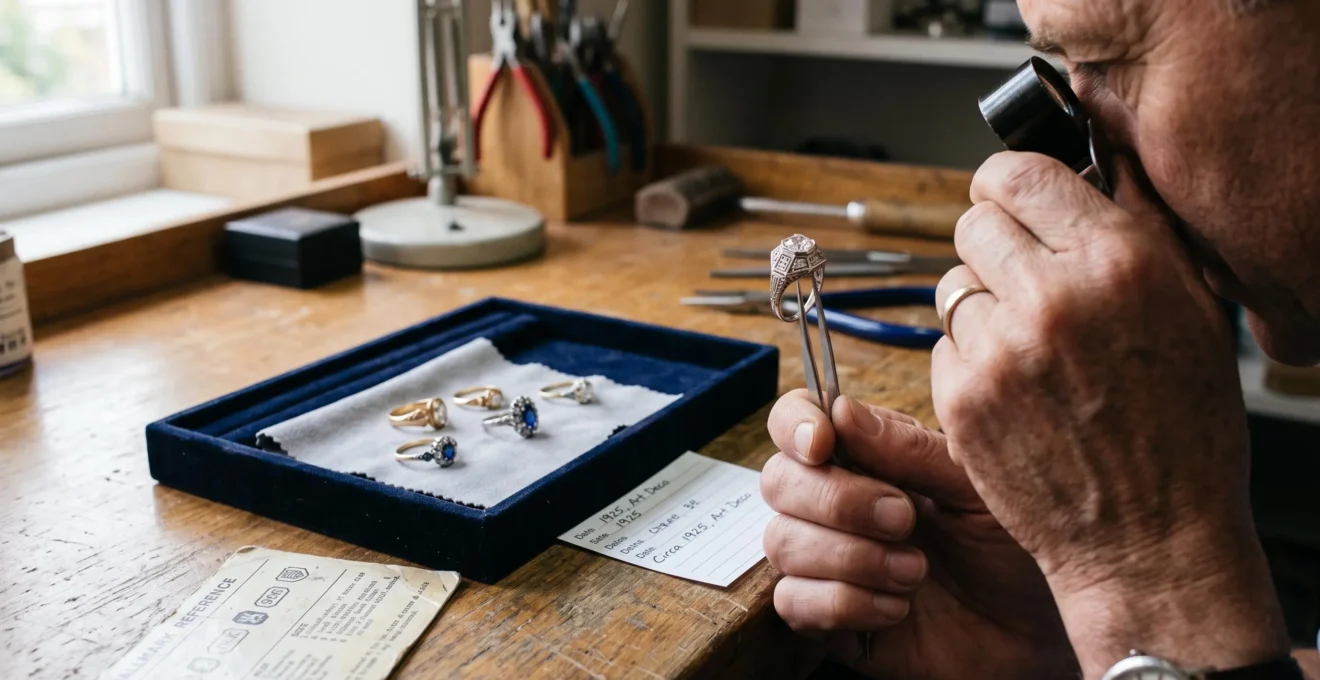
A ring advertised as Victorian might have been manufactured in the 1980s. An Art Deco brooch might contain older diamonds in a later setting. And a seller describing something simply as « vintage » may not know its production decade at all.
The distinction matters because jewellery style, manufacturing date and gemstone age are three different things. A historically inspired design is not automatically a historical object, even when its materials and workmanship look convincing.
Recognising jewellery eras requires more than matching a silhouette to a photograph. Stone cuts, precious-metal marks, construction methods, fittings and evidence of alteration all contribute to a defensible attribution.
For shoppers comparing second-hand listings, the practical goal is not to identify a precise year from one photograph. It is to establish a plausible period, recognise contradictions, and know when the evidence is insufficient to justify a period-specific price.
Vintage jewellery identification: the essentials
« Vintage » does not establish a particular era; Victorian, Edwardian, Art Nouveau, Art Deco, Retro and mid-century describe more specific historical contexts.
Check the mounting and fittings alongside gemstones, hallmarks and construction. A stone can be considerably older than its setting.
Treat an unsupported period attribution as a hypothesis, not authentication. Request additional photographs before paying a collector’s premium.
Contents
Why Do Online Sellers Mislabel Jewellery Eras So Often, and Why Does It Change the Price?
How to Date a Piece of Jewellery Using 5 Clues You Can Check From Photos?
Edwardian or Art Deco: Which Era Does Your Platinum-Look Piece Fit Best?
The Cleaning Mistake That Can Cut a Vintage Piece’s Value by 50% Overnight
In What Order Should You Learn Jewellery Eras to Avoid Misbuys in Your First 3 Purchases?
How to Infer a Jewel’s Trade-Route Origin From 4 Design Clues on the Piece?
How to Vet an « Art Nouveau » Listing Using 5 Details Sellers Rarely Photograph
Why Do Certain Gems Show Up in Jewellery Styles Thousands of Miles From Their Source?
Why Do Online Sellers Mislabel Jewellery Eras So Often, and Why Does It Change the Price?
Online sellers mislabel jewellery because they misunderstand inherited pieces, borrow fashionable period names for visibility, or confuse dates associated with hallmarks and makers with manufacturing dates. These errors matter because a genuine period attribution can influence collectability and asking prices. However, an older label alone does not prove additional value.
Consider the language of a marketplace listing. « Art Deco ring » suggests a period attribution, while « Art Deco-style ring » describes its appearance without necessarily claiming historical manufacture. « Vintage » provides even less precision.
Three mechanisms explain much of the confusion:
Inherited descriptions: Estate sellers may repeat a family story without documentary evidence. A ring inherited from a grandmother was not necessarily manufactured during her youth.
Keyword inflation: Period terms attract searches, encouraging some sellers to describe geometric jewellery as Art Deco or floral jewellery as Victorian, whether deliberately or through misunderstanding.
Dating shortcuts: A maker’s registration date, hallmark reference or old diamond cut gets mistaken for proof of the entire jewel’s production year.
In Britain, official guidance distinguishes hallmarking dates from other identifying marks. UK government hallmarking guidance explains that date letters identify when an item was hallmarked and that these letters are optional under the current system. A maker’s registration date must not be treated as the object’s manufacture date.
How the same ring can attract different prices
Imagine three hypothetical listings for a visually similar white-metal diamond ring.
Listing description
What the buyer is being asked to believe
Appropriate response
Genuine 1920s Art Deco platinum ring
Historical mounting, period design and specified metal
Require evidence for each claim
1970s Art Deco revival ring
Later manufacture using earlier design influences
Assess revival craftsmanship and materials
Vintage white-gold diamond ring
Older jewellery, without a precise attribution
Verify metal, stones, condition and approximate age
These descriptions can produce substantially different asking prices, but no reliable universal price bracket follows from the label. Diamond quality, metal content, condition, maker and market demand can outweigh the attributed era.
A useful contradiction test compares the claimed date against the newest apparently original component. A ring promoted as Edwardian but showing modern-looking cast construction and an integrated contemporary setting deserves further investigation. A modern cut alone is not decisive, because diamonds can be replaced.
If the attribution proves false, a buyer’s options depend on the actual listing claims, evidence and applicable marketplace policy. An explicit manufacturing-date claim is generally easier to dispute than a subjective style description. Keep screenshots of the listing, photographs, messages and any authentication documents.
The most useful question is not whether a seller sounds knowledgeable, but whether independent physical evidence supports the stated era. That requires a consistent photographic inspection process.
How to Date a Piece of Jewellery Using 5 Clues You Can Check From Photos?
To estimate a jewel’s period from photographs, inspect five features in order: gemstone cut, metal and hallmarks, clasps or fittings, construction, and wear. Each provides a different clue. The strongest attribution comes from features that agree, while unexplained modern components or missing photographs should lower confidence rather than force a precise date.
The following checklist establishes what to examine and which photograph to request.
Clue
Potential period indicator
Photograph needed
Diamond cut
Old mine: commonly 18th–19th century; old European: late 19th–early 20th; transitional: especially early-to-mid 20th century
Close face-up and angled stone views
Metal and hallmark
Precious-metal standard, assay office, possible hallmarking date
Clear, sharply focused interior or reverse marks
Clasp and fittings
Hinge, catch, pin stem or safety mechanism may indicate a construction period
Entire reverse with hardware both open and closed
Construction
Hand-fabricated, die-struck, assembled or cast characteristics
Macro views of gallery, joints and solder
Proportions and wear
Design silhouette, engraving, repeated contact wear and repair history
Front, side, reverse and profile views
The Gemological Institute of America‘s guide to antique diamond cuts explains distinctions among old mine, old European and transitional cuts.
Old mine diamonds typically have a cushion-like outline, relatively high crowns and often noticeable culets. Old European diamonds generally have rounder outlines. Transitional diamonds bridge older cutting traditions and the modern round brilliant.
These are valuable dating clues, but a diamond’s cut does not date its mounting.
Apply the latest-date rule carefully
When several features indicate different periods, investigate the newest feature that appears integral and original to the construction.
For example, a brooch containing an old European-cut diamond might feature a much later fabricated mounting. The diamond cannot establish the brooch’s original manufacture date.
Conversely, a genuinely older brooch may have received a replacement clasp decades after manufacture. The newest component then dates a modification, not necessarily the jewel.
The practical rule is therefore to identify the latest securely dated original feature, rather than automatically dating the entire object by whichever part looks newest.
Photography has important limitations. Reflective metal can disguise construction seams, repaired jewellery may combine several periods, and newly produced diamonds can deliberately imitate historical cuts.
If the photographs cannot distinguish original manufacture from later alteration, request an in-person inspection or independent professional assessment rather than guessing.
Five checks to complete before placing a bid
- Save the complete listing and claimed era. Deliverable: a dated copy of the description and photographs.
- Request face-up and angled gemstone photographs. Deliverable: a visual record of the cut and setting.
- Ask for close-ups of every visible stamp or hallmark. Deliverable: legible images suitable for checking against official references.
- Request full reverse, side and clasp photographs. Deliverable: a hardware and construction record.
- Write down which features support or contradict the seller’s attribution. Deliverable: a short evidence summary stating what remains uncertain.
Once the structural evidence is recorded, visual comparisons become much more reliable. One particularly instructive distinction is between Edwardian and Art Deco jewellery, two styles that frequently share white metals and diamonds.
Edwardian or Art Deco: Which Era Does Your Platinum-Look Piece Fit Best?
Edwardian-style jewellery generally favours delicate garlands, lace-like pierced metalwork and flowing arrangements, while Art Deco jewellery emphasises geometry, symmetry and striking colour contrasts. Both styles can feature diamonds and platinum-looking metals, so colour alone cannot distinguish them. The most useful comparison examines design structure, setting construction and evidence of later alteration.
The Victorian and Albert Museum‘s historical overview places the Garland style around 1895–1910 and describes the shift towards geometric Art Deco designs from the 1920s.
In practical collecting terminology, Edwardian jewellery generally refers to the early twentieth century, particularly 1901–1910 and related styles continuing beyond those dates. Art Deco is principally associated with the 1920s and 1930s, although its influence continued afterwards.
Feature
Edwardian / Garland style
Art Deco
Dominant design
Floral garlands, ribbons and swags
Geometric and architectural arrangements
Composition
Delicate, flowing, sometimes airy
Structured, angular and often strongly symmetrical
Metalwork
Pierced openwork, fine milgrain and knife-edge elements
Linear framing, stepped motifs and geometric settings
Gem arrangements
Diamond clusters and soft ornamentation
Calibre-cut accents, contrasts and repeated geometric patterns
Dating usefulness
Supports an early twentieth-century stylistic attribution
Supports a 1920s–1930s stylistic attribution
These are characteristic tendencies, not exclusive features. Milgrain appears in both, and a geometric outline does not prove Art Deco manufacture.
A difficult example is a ring with a garland-style gallery beneath a sharply geometric head. It may be a transitional design, a later remount or a modern interpretation incorporating both languages.
What breaks a close attribution?
Start with the underside. Does the gallery belong naturally to the head and shank? Are solder joints or finishing details consistent with the rest of the ring? Does the stone mounting show evidence of modification?
Then inspect the diamonds. Old European cuts are compatible with Edwardian jewellery, while transitional cuts may support a later attribution. Neither is conclusive.
A hallmark date letter, where present, can provide more concrete chronological evidence, but its meaning depends on the particular country’s marking system. French marks and British hallmarks must be interpreted separately; there is no universally applicable 1926 platinum hallmark rule that dates all European platinum jewellery.
When structural clues conflict, « Edwardian-style ring, subsequently altered » may be more accurate than assigning a single uncompromising period.
An accurate identification protects more than the purchase decision. It also informs how the object should be cared for, since older surfaces, fragile gemstones and original fittings may be vulnerable to inappropriate cleaning.
The Cleaning Mistake That Can Cut a Vintage Piece’s Value by 50% Overnight
Aggressive cleaning can permanently damage vintage jewellery by loosening stones, harming sensitive gem materials or removing historically important surface evidence. Ultrasonic equipment, harsh chemicals and excessive polishing are particular concerns. A 50% loss is a hypothetical illustration of severe damage, not an established average or a predictable consequence of cleaning antique jewellery.
Consider an engraved antique ring with a faint maker’s mark. An enthusiastic polish might brighten the metal but also weaken the engraving and further obscure the mark.
For collectors, such changes can matter because original workmanship, surfaces and identifying details contribute to authentication. Their market effect depends on the specific object and buyer, rather than following a fixed percentage.
Cleaning risks differ by material
The GIA’s jewellery-care recommendations warns that ultrasonic vibration can loosen gemstones and damage certain treated stones or organic materials.
Material or condition
Main risk
Sensible approach
Sound, untreated diamond jewellery with secure settings
Dirt and abrasion, with possible setting vulnerability
Gentle cleaning may be suitable after checking condition
Pearls, amber, coral and other organic materials
Sensitivity to chemicals, moisture or ultrasonic treatment
Follow material-specific specialist advice
Fracture-filled gemstones
Damage to filling materials
Avoid ultrasonic cleaning and unidentified chemicals
Foil-backed or closed-back antique settings
Moisture trapped behind stones, damage to backing
Avoid immersion; seek specialist guidance
Loose stones, glued components or fragile enamel
Detachment, cracking or loss
Stop cleaning until professionally assessed
Heavily engraved or marked antique metalwork
Loss of surface definition from abrasion
Avoid abrasive polishing
A clean jewel is not necessarily a better-preserved jewel. Historical patina can be meaningful, although not all patina is original or desirable.
A hypothetical valuation example makes the distinction clearer: suppose an antique brooch has significant collector value because its original finish and identifying marks remain intact. If aggressive polishing destroys those features, a specialist buyer might offer substantially less. The loss could theoretically reach half its previous value in a severe case, but that outcome cannot be generalised.
Before any intervention, photograph the front, back, marks and damaged areas. Identify the gemstones and possible treatments. For jewellery with unknown materials, unstable settings or unusual construction, obtain an appropriate professional cleaning recommendation.
Careful handling protects future evidence, but the simplest way to avoid an expensive mistake is to develop reliable identification habits before purchasing ambitious or poorly documented pieces.
In What Order Should You Learn Jewellery Eras to Avoid Misbuys in Your First 3 Purchases?
Beginners should learn jewellery eras according to how easily they can recognise and verify them, not simply by historical order. Victorian and Art Deco designs provide useful contrasting reference points. Edwardian-to-Deco transitions and Retro-to-mid-century overlap become easier to assess after practising hallmarks, stone cuts and construction checks on less expensive pieces.
A practical reference timeline is:
Era or movement
Approximate period
Useful design references
Georgian
1714–1830, British historical convention
Closed-back settings, handcrafted construction and period-specific gem arrangements
Victorian
1837–1901, British reign
Romantic, mourning, revival and later aesthetic influences
Art Nouveau
Approximately 1895–1910
Organic lines, insects, flowers and expressive enamel
Edwardian / Garland
Approximately 1901–1910, with stylistic overlap
Delicate garlands, pierced metalwork and white-metal diamond settings
Art Deco
Mainly 1920s–1930s
Geometry, symmetry and contrasting materials
Retro
Mainly 1930s–1940s
Bold forms, sculptural metalwork and prominent gold designs
Mid-century
Broadly 1940s–1960s
Varied modernist, cocktail and postwar commercial designs
Vintage revival jewellery
Later decades
Reinterpretations of earlier motifs and manufacturing styles
These windows are orientation tools, not strict manufacturing boundaries. Movements overlap, persist and return.
Three purchases as a learning sequence
Purchase one: learn the marks. Choose an affordable piece with legible hallmarks, a clear description and return terms you understand. A later twentieth-century hallmarked piece can be a more effective learning object than an expensive, supposedly rare Georgian jewel.
Purchase two: test photographic identification. Select a reasonably documented item with distinctive fittings or construction. Compare your predictions with the object in hand, ideally under magnification.
Purchase three: assess a genuine attribution claim. Consider a more historically specific jewel only when you can explain why its stone cuts, metalwork and marks agree with the claimed period.
The financial lesson is straightforward: low-cost, honestly described « Art Deco-style » jewellery can be valuable study material without requiring payment for unverified historical significance.
Online museum collections and official hallmark resources provide useful reference comparisons. They do not replace physical examination for high-value purchases, but they make early research more rigorous.
After style and dating become familiar, a more complex question emerges: where was a jewel actually made? Its gemstone, design vocabulary and mounting may reveal different parts of a much wider trading history.
How to Infer a Jewel’s Trade-Route Origin From 4 Design Clues on the Piece?
A jewel’s possible trade-route connections can be investigated through four clues: gemstone characteristics, metal marks, decorative vocabulary and construction technique. These features may suggest different regions involved in the object’s history. However, design alone rarely establishes a gemstone’s geographical origin or reconstructs its precise journey from mine to workshop.
A ruby set in a European-style ring may have been extracted, traded, cut and mounted in different places. The mounting’s design does not establish where the ruby originated.
This distinction is essential: gemstone origin and jewellery manufacturing origin are separate questions.
The four clues should be interpreted together.
1. Gemstone species and cutting style. Pearls historically traded from the Persian Gulf, rubies associated with Myanmar and emeralds historically sourced from Colombia illustrate geographically extensive supply networks. Appearance alone does not prove these origins; gemological testing and documentary evidence may be necessary.
2. Metal alloy and hallmark system. A recognised assay mark may help locate where a finished item was tested or marked. It cannot identify the mine supplying its gold or the source of its gemstones.
3. Decorative vocabulary. Mughal-inspired flowers, Indian-derived ornament or Chinese export motifs can suggest cultural influences. Motifs frequently travelled through trade, adaptation and imitation, so they cannot independently prove workshop location.
4. Construction technique. Setting methods, metalworking traditions and reverse-side assembly can provide stronger evidence when compared with documented examples from known workshops.
Workshop history is not stone provenance
Consider a hypothetical jewel featuring an emerald, Indian-inspired ornament and a European hallmark. Its components could point to an international design and supply history, but these observations do not establish a specific Colombian origin, Indian workshop or documented trade route.
The object might have been manufactured locally using imported stones and internationally fashionable designs.
Commercial descriptions sometimes compress this complexity into a single national label. Buyers should ask whether that label refers to the gemstone, the mounting, the designer, the hallmarking jurisdiction or the place of sale.
Historical trade connections may make a particular combination plausible without proving that this individual jewel travelled the supposed route. Similarly, no automatic discount or premium follows from having a gemstone and mounting associated with different regions.
This distinction becomes especially important with Art Nouveau jewellery, whose distinctive motifs are widely reproduced and whose genuine craftsmanship often reveals itself in details omitted from marketplace photographs.
How to Vet an « Art Nouveau » Listing Using 5 Details Sellers Rarely Photograph
To assess an Art Nouveau listing, examine the reverse construction, enamel technique, maker’s marks, gemstone materials and clasp or pendant hardware. Organic motifs alone are insufficient because later reproductions can closely imitate the style. A seller who cannot provide clear photographs of construction and marks leaves the period attribution unverified, regardless of the asking price.
Victoria and Albert Museum‘s history of jewellery places Art Nouveau jewellery around 1895–1910 and describes its emphasis on sinuous forms and experimental materials.
The movement includes historically important work by designers such as René Lalique and Philippe Wolfers, but an unsigned floral pendant should not automatically be attributed to a famous workshop.
Five details deserve particular attention:
1. Reverse and gallery construction. Look for joins, repairs, tool marks, casting evidence and finishing quality. Handwork can support an attribution but is not exclusive to historical production.
2. Enamel technique. Genuine plique-à-jour enamel has a translucent, stained-glass-like appearance without a conventional continuous backing. Transparent resin may resemble it in photographs, so both front and back views matter.
3. Maker’s mark and hallmark placement. Examine every mark in close-up. A distinctive signature must be checked against reliable examples, and the metal marks need jurisdiction-specific interpretation.
4. Pearls and gemstone materials. Their identity, treatments and mounting methods can help test plausibility. Material choice is not sufficient to date the jewel by itself.
5. Clasp and pendant-bail hardware. Hinge design, attachment points, repairs and solder may reveal later modification or modern manufacture.
Art Nouveau’s collecting market also requires a distinction between signed work from documented makers and unsigned objects.
For a signed French piece, a plausible design is only the beginning. The signature, workmanship, documentary references and provenance must support the attribution. For an unsigned English, American or continental piece, construction and stylistic consistency take on greater importance.
Later twentieth-century Nouveau-inspired jewellery can be attractive and collectible in its own right. Cast seams, shallow details or resin-like decoration may raise questions, but no single feature conclusively proves a reproduction.
A neutral photo request is usually sufficient: « Could you send clear photographs of the reverse, bail, clasp and all marks in natural light? I am checking the construction before purchasing. »
For an expensive piece, missing reverse and hallmark photographs should be treated as a reason not to pay a verified-period premium. Unmarked authentic jewellery exists, but authenticity still needs supporting evidence.
Understanding the piece’s decorative language is only part of its history. The materials themselves may have crossed continents long before the jewel acquired its final form.
Key takeaways before considering gemstone origins
A gemstone’s historical availability can make an era attribution more or less plausible, but usually cannot prove an individual stone’s origin.
Old stones may have been reset, recut or reused; a mounting and its contents need separate examination.
Unusual design-and-gem combinations deserve investigation rather than immediate dismissal as reproductions.
Why Do Certain Gems Show Up in Jewellery Styles Thousands of Miles From Their Source?
Gemstones appear far from their original source regions because jewellery has always participated in long-distance trade, cultural exchange and the reuse of valuable materials. Pearls, rubies, sapphires and emeralds could travel through multiple commercial centres before reaching a jeweller. Their presence in a particular style can therefore reflect international supply networks rather than local geological origin.
Historical pearl trading connected Gulf suppliers with markets elsewhere in Asia and Europe. Emeralds from the Americas entered European and Asian commercial networks after Spanish colonial expansion. Rubies and sapphires circulated through longstanding Asian trading systems and eventually appeared in European jewellery.
These histories help explain why seemingly unexpected gemstones occur in particular settings.
A Victorian-style ring containing a ruby need not be geographically inconsistent. Nor is an Art Deco bracelet with Indian-influenced ornament and emeralds necessarily a modern fantasy.
The historical context establishes plausibility, not proof of a specific stone’s origin or original mounting.
Use gemstones as a plausibility test, not a date stamp
Gemstone identification becomes more informative when combined with manufacturing evidence.
Observation
What it may indicate
What it cannot establish alone
Old mine or old European-cut diamond
Compatibility with historical cutting practices
Original manufacture date of the ring
Emerald in an Indian-inspired design
Possible connection to international gemstone trade and design influence
Colombian mining origin or Indian manufacture
Natural pearls in a period-style setting
Potential consistency with historical high-value jewellery
Original period attribution without testing
Ruby or sapphire in a European mounting
A plausible cross-regional material supply history
Exact mining source or trade itinerary
Modern-looking replacement stone in an old mounting
Possible repair or remounting
That every part of the object is modern
The strongest warning signs arise when a seller’s claims are more specific than the available evidence.
For instance, « original Victorian Burmese ruby ring » combines several distinct assertions: an original nineteenth-century mounting, a ruby, a particular geological origin, and continuity between the stone and mounting. Each may require separate verification.
An old gemstone could have been transferred into a later piece. Equally, modern treatment or recutting may alter a stone’s appearance without changing the age of the original mounting.
One especially important distinction is between a gemstone that was historically available and a particular modern treatment or manufactured material that emerged later. Identifying an anachronistic material can challenge a seller’s claim that all components are original, but it need not invalidate an older mounting.
The next practical step is to create a small evidence file for any serious purchase: save the listing, identify what each mark and component actually demonstrates, list unresolved questions, and seek independent examination when the claimed period or gemstone origin materially affects the price.
How old must jewellery be to count as vintage?
Vintage is a flexible commercial term rather than a universally fixed age classification. Some sellers use a threshold of around 20 years, while others reserve it for older twentieth-century jewellery. Antique commonly refers to objects approximately 100 years old or more, although terminology and legal definitions can vary by jurisdiction. Always ask for an estimated manufacturing period rather than relying on the label alone.
Can genuine vintage jewellery have no hallmark?
Yes. Hallmark requirements differ across countries, periods, metals and object categories. Some genuine pieces have no visible hallmark, while others may have lost marks through alteration or wear. Absence of a hallmark is not proof of reproduction, but it limits what can be established without further examination or metal testing.
Does an old-cut diamond prove that a ring is Victorian or Edwardian?
No. Old diamonds can be reset into newer mountings, and modern cutters can recreate historical diamond styles. The cut is useful supporting evidence when it agrees with the metalwork, marks and construction, but it cannot independently establish the ring’s production date.
Is a reproduction of Art Deco or Art Nouveau jewellery necessarily less valuable?
Not necessarily. A reproduction can have value because of its materials, craftsmanship, maker or design quality. What matters is whether its price and description accurately reflect what it is. A later piece should not command an unsupported period-authenticity premium simply because its appearance imitates an earlier movement.
When should a buyer pay for professional jewellery authentication?
Independent examination becomes worthwhile when a claimed maker, historical period, valuable gemstone or purported provenance substantially influences the purchase price. Seek an appropriately qualified gemologist for gemstone identification and a knowledgeable period-jewellery specialist for historical attribution. A gemological report and an era-authentication opinion answer different questions.