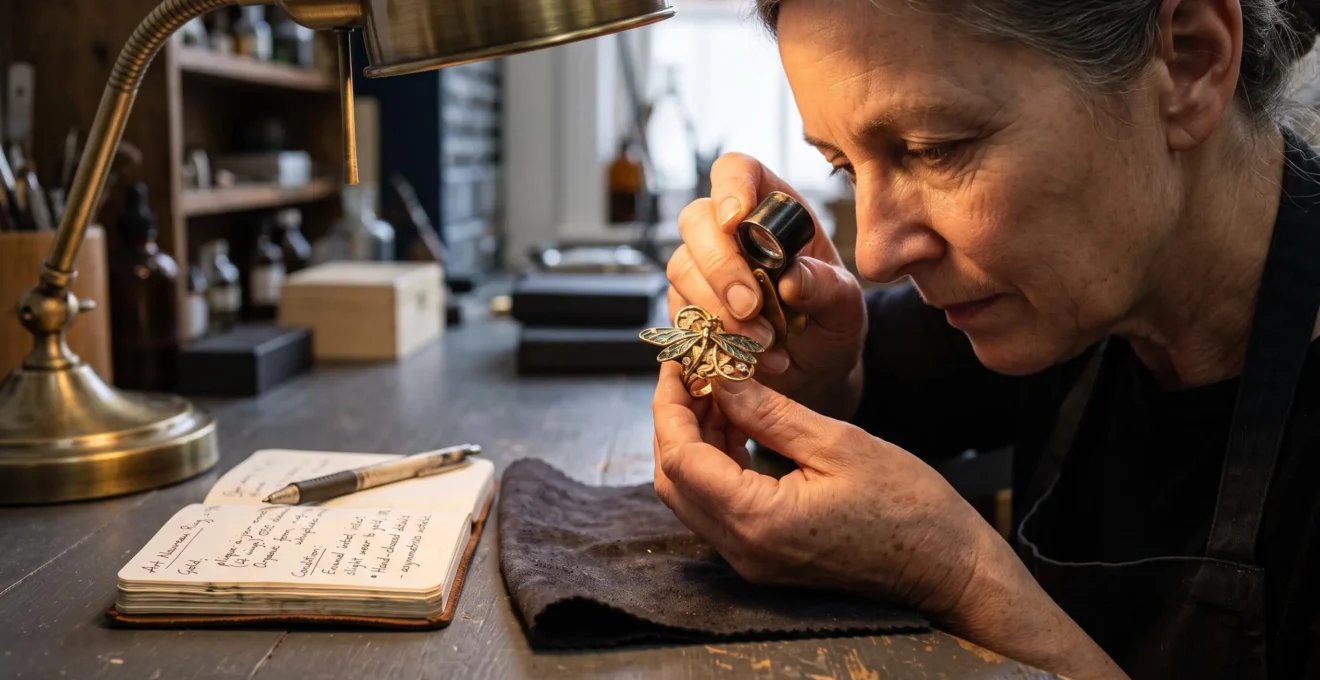
A dragonfly brooch with translucent wings, a gold ring shaped like climbing vines, or a pendant framed by flowing hair can look unmistakably Art Nouveau. Yet the appearance alone does not establish whether the jewellery was made around 1900 or manufactured decades later in an Art Nouveau-inspired style.
The most useful starting point is a sequence of three visual checks: organic design, three-dimensional construction, and physical evidence of manufacture and age. Together, they help collectors distinguish historically convincing jewellery from decorative imitations and identify purchases that deserve specialist examination.
Art Nouveau jewellery is generally associated with the period from the 1890s to the First World War. Its distinctive vocabulary includes botanical forms, insects, female figures, enamel and expressive curves. However, modern makers can reproduce these features, and authentic period pieces do not all follow one construction formula.
The objective is therefore not to authenticate an antique through photographs alone. It is to recognise meaningful evidence, question unsupported seller descriptions and decide when further investigation is justified.
Three visual checks before buying Art Nouveau jewellery
- Examine the design: look for organic lines that shape the jewellery itself rather than simply decorate a conventional mounting.
- Inspect the construction: compare the front, side and reverse for dimensional detail, assembly techniques and evidence of finishing.
- Evaluate age and condition: examine marks, surface wear, repairs and provenance together. No single visual feature proves authenticity.
- Why Did Art Nouveau Jewellery Reject Straight Lines, and How Does That Show in Motifs?
- How to Vet an « Art Nouveau » Listing Using 5 Details Sellers Rarely Photograph
- Original Art Nouveau or Modern Revival: Which Should You Choose for Wearable Jewellery?
- The Restoration Mistake That Can Erase Art Nouveau Value in One Workshop Visit
- When Should You Request an Independent Appraisal for an Art Nouveau Purchase Over 4 Figures?
- Edwardian or Art Deco: Which Era Does Your Platinum-Look Piece Fit Best?
- The Polishing Request That Can Destroy Antique Character in One Afternoon
- Why Can Professional Polishing Make a Ring Look Worse by Rounding the Details?
Why Did Art Nouveau Jewellery Reject Straight Lines, and How Does That Show in Motifs?
Art Nouveau jewellery favoured flowing natural forms because its designers sought an alternative to rigid historicist ornament and conventional geometric arrangements. Plants, insects, female figures and sweeping curves could determine the entire composition of a jewel. The first visual check is therefore whether the organic motif shapes the design or merely decorates an otherwise ordinary setting.
Art Nouveau was not governed by an absolute prohibition against straight lines. The Victoria and Albert Museum‘s Art Nouveau collection overview identifies tendrils, organic forms, sweeping lines and eccentric geometry within the movement’s visual language.
The distinction matters because an authentic period jewel can include geometry, while a modern imitation can display elaborate botanical curves.
Consider two hypothetical brooches featuring a dragonfly. In the first, the insect’s body establishes the central axis, its wings define the brooch’s silhouette, and the surrounding metalwork follows the movement of the creature. In the second, an ornamental dragonfly is attached to a standard oval mounting. The first has a more integrated Art Nouveau composition, but neither arrangement alone proves a manufacturing date.
The whiplash line is another useful design clue. This energetic, flowing curve changes direction and suggests the movement of a stem, tendril or strand of hair. Study how the curve connects different elements rather than merely counting how many curves appear.
A documented example is René-Jules Lalique‘s necklace dated approximately 1897–1899 in the Metropolitan Museum of Art‘s René Lalique necklace record. Female figures, curling hair and gold tendrils participate in the composition instead of functioning as isolated surface ornaments.
Historical reference: Lalique’s necklace, circa 1897–1899
The Metropolitan Museum of Art attributes this necklace to René-Jules Lalique and records gold, enamel, opals and amethysts among its materials.
Its intertwined figurative and organic design demonstrates how Art Nouveau ornament could influence the construction and overall composition. This makes it a useful comparative reference, not a universal authentication standard.
Now turn the hypothetical brooch sideways. Does the motif retain sculptural depth? Do its branches or wings interact with the mounting, or does the decoration sit on a flat backing? These questions help reveal design relationships hidden in frontal photographs.
Integrated natural forms make an Art Nouveau attribution stylistically plausible. Establishing actual age requires the second and third checks: construction and physical evidence.
How to Vet an « Art Nouveau » Listing Using 5 Details Sellers Rarely Photograph
To evaluate an Art Nouveau listing, request five specific views: the reverse, the setting’s profile, the shank or structural joins, any hallmarks, and close-ups of wear. These photographs can reveal construction and condition information missing from glamorous front-facing images. They cannot authenticate a jewel conclusively, but they can expose unanswered questions before payment.
Online listings often emphasise colour, gemstones and the most decorative angle. An appraiser needs to understand how the entire object was made and subsequently altered.
Start with the reverse. Inspect whether the back contains visible assembly joints, tool marks, casting seams or later repairs. A continuous seam may raise questions about casting, while chased details can indicate additional hand-finishing.
Neither finding is decisive. Casting and hand-finishing are not mutually exclusive, and modern jewellery can be extensively worked by hand. Similarly, older jewellery can contain cast elements.
The profile reveals whether a supposedly sculptural design has real depth. The shank, pin mechanism or suspension loop can disclose construction choices, replacements and alterations. A modern fastening on an antique brooch may be an ordinary repair rather than proof that the entire object is modern.
Hallmarks and maker’s marks require careful interpretation. Their location, legibility and consistency with the surrounding metalwork matter more than simply finding a familiar name. Marks can be missing, misread or reproduced.
Finally, assess wear patterns in relation to how the jewellery would have been handled. Wear concentrated on exposed surfaces may be plausible, but artificial ageing, historic repairs and refinishing can complicate interpretation.
Five photographs to request before committing to a purchase
- Request the full reverse. Save a clear photograph showing the backing, fastenings, visible seams and repairs.
- Request a side profile. Obtain an image showing the height of the setting and how decorative elements connect.
- Request structural close-ups. Record the ring shank, soldered joints, brooch pin or pendant suspension as applicable.
- Request every visible mark. Save sharply focused images with the seller’s written transcription of any hallmark or signature.
- Request condition photographs. Document worn edges, enamel, stones and repaired areas, together with a written condition description.
If the seller cannot provide photographs, ask why. A refusal to explain construction or disclose damage increases purchasing uncertainty, although inability to take a specialist photograph is not itself evidence of fraud.
Original boxes, invoices and recorded ownership can strengthen an attribution. Yet packaging may be mismatched and documents can be altered, so provenance should support examination rather than replace it.
Once the evidence is assembled, the next decision is whether the item should be purchased as a historical collectible or as jewellery intended for regular wear.
Original Art Nouveau or Modern Revival: Which Should You Choose for Wearable Jewellery?
Choose modern Art Nouveau-inspired jewellery for frequent wear when durability, straightforward maintenance and replacement options are priorities. Choose original period jewellery when historical craftsmanship, documented age and collecting significance matter more. Neither category is automatically superior: the appropriate purchase depends on intended use, condition, authenticity evidence and the price assigned to historical significance.
Original Art Nouveau jewellery can contain delicate enamel, intricate openwork, fine settings and materials that require specialist care. Plique-à-jour enamel, in particular, can be vulnerable to impact because its translucent sections may lack a continuous metal backing.
A modern revival can capture the same botanical movement while incorporating contemporary construction choices. However, modern manufacture does not automatically guarantee strength, and antiques are not necessarily too fragile to wear. Individual condition remains decisive.
The comparison becomes clearer when intended use, financial exposure and maintenance are considered together.
| Buying consideration | Original period jewellery | Modern revival jewellery |
|---|---|---|
| Historical authenticity | Requires evidence supporting period manufacture | Contemporary manufacture should be disclosed |
| Frequent wear | Depends on structural condition and delicate materials | May be practical if adequately constructed |
| Repairs | May require conservation expertise | May permit conventional repairs, depending on materials |
| Collecting appeal | Can include historical, maker and provenance significance | Usually valued primarily for design, maker and craftsmanship |
| Resale uncertainty | Depends on attribution, rarity, condition and demand | Depends on maker, quality, demand and original price |
It would be misleading to promise that a revival piece retains its value or that an original necessarily appreciates. Both can lose resale value, and purchase premiums are not guaranteed to be recovered.
Read the listing vocabulary literally. “Art Nouveau style” and “Art Nouveau inspired” describe an aesthetic, not a manufacturing date. “Art Nouveau era” makes a historical claim requiring supporting evidence. “Circa 1900” proposes an approximate date that must also be substantiated.
Hybrid jewellery deserves attention. A period enamel panel or decorative component may have been remounted into a modern ring or pendant. Such objects can be attractive and collectible when the seller accurately identifies the original and replacement elements.
For example, a hypothetical pendant combining an antique enamel element with a contemporary gold frame should not be described as an entirely original Art Nouveau pendant without qualification.
Before purchasing a fragile original, consider not only how it will be worn but also what future repairs might do to its surfaces and historical character.
The Restoration Mistake That Can Erase Art Nouveau Value in One Workshop Visit
The most consequential avoidable restoration mistake is authorising aggressive polishing or refinishing without first assessing the jewellery’s original surfaces. Abrasive treatment can remove patina, soften hand-finished detail and damage thin coatings. This loss may reduce historical information and collecting appeal, although the financial effect depends on the individual piece and cannot be predicted universally.
Traditional jewellery repair often prioritises brightness and an attractive finished appearance. Antique conservation has a different objective: protecting significant original materials, workmanship and evidence of age.
A beautifully polished contemporary ring and an appropriately conserved Art Nouveau brooch may therefore require completely different workshop instructions.
The Canadian Conservation Institute‘s guidance on caring for metal objects explains that polishing removes original surface material. It also warns of risks to historic finishes, patinas and delicate metal coatings.
Those principles are particularly relevant when an antique jewel contains fine chasing, engraving, original gilding or other vulnerable surface treatments.
Appropriate conservation begins with a material and condition assessment. Possible interventions include stabilising a loose setting, addressing a damaged joint or removing harmful deposits, but only after the specialist establishes which methods are compatible with the object.
Minimal intervention and clear documentation should guide the work. Reversible treatments are preferable where technically feasible, although some necessary structural repairs cannot be reversed without additional intervention.
Original gemstones and enamel should not be replaced merely because they show age. A replacement may occasionally be warranted for safety or stability, but it should be justified and recorded.
Before authorising work, photograph the entire piece and its vulnerable details. Request a written treatment proposal explaining what will be cleaned, repaired, replaced or left untouched. Retain dated before-and-after images and the workshop’s description of completed work.
This record assists later condition assessment and helps distinguish earlier interventions from subsequent conservation.
A careful restoration can preserve usability and stability. For a substantial purchase, however, independent examination should ideally happen before decisions about repair or refinishing are made.
When Should You Request an Independent Appraisal for an Art Nouveau Purchase Over 4 Figures?
Request an independent specialist assessment when an Art Nouveau purchase reaches a four-figure amount that represents meaningful financial exposure, when authenticity is uncertain, or when buying remotely without physical inspection. The purpose is to establish whether the seller’s description, condition and asking price are supportable before the buyer becomes committed to an expensive mistake.
A four-figure price is a practical risk trigger rather than an official appraisal threshold. A lower-priced object may also merit examination if it carries a significant maker attribution or unusual materials.
Dealer documentation can be valuable, but a certificate issued by the seller is not equivalent to an independent assessment. The dealer has a direct commercial interest in the transaction.
An appropriate specialist may be an appraiser experienced in historical jewellery, a qualified gemmologist with relevant period expertise, or an auction-house specialist familiar with comparable objects. Gemmological qualifications alone do not establish expertise in antique jewellery attribution.
A useful Art Nouveau appraisal should address more than gemstone value. Depending on the scope of the assignment, ask for:
- An approximate manufacturing date and the evidence supporting it.
- Attribution to a maker or workshop, if justified, with uncertainty clearly stated.
- Identification of principal materials and relevant techniques.
- A condition report documenting repairs, replacements and alterations.
- Comparisons with documented period jewellery.
- A valuation specifying its purpose, such as insurance replacement or an estimated resale context.
These valuation purposes are not interchangeable. An insurance replacement figure may differ substantially from what a buyer could obtain in a resale transaction.
Whenever possible, make the purchase conditional on an inspection whose scope and consequences are agreed in writing. For remote transactions, confirm the inspection period, return conditions and responsibility for transport before payment.
An assessment completed immediately after delivery can still be useful, provided the buyer remains within the applicable return or contractual inspection window. Consumer rights vary by jurisdiction and seller type, so no universal return entitlement should be assumed.
Ask the specialist to distinguish observations from conclusions. “Consistent with Art Nouveau manufacture” is not necessarily equivalent to a verified maker attribution or an established date.
Even a well-documented appraisal depends on choosing the correct historical comparison group. Edwardian and Art Deco jewellery are important neighbouring categories.
Edwardian or Art Deco: Which Era Does Your Platinum-Look Piece Fit Best?
Edwardian jewellery generally favours delicate garlands, bows, ribbons and lace-like settings, while Art Deco jewellery more often emphasises geometry, symmetry and contrasting colours. Both periods used platinum, so a white-metal appearance cannot date a piece reliably. Compare the overall design language, construction and materials before deciding whether Art Nouveau, Edwardian or Art Deco is the most appropriate attribution.
The distinction matters because these design periods overlap stylistically or chronologically. A floral white-metal pendant may be Edwardian rather than Art Nouveau, while a geometric ring may belong to the Art Deco period or represent later manufacture in an older style.
The Gemological Institute of America‘s historical jewellery design comparison places Art Nouveau approximately in 1890–1914, Edwardian jewellery around 1900–1915 and Art Deco principally in the 1920s and 1930s.
These ranges are useful conventions, not hard borders defining the manufacture of every object.
| Feature | Art Nouveau | Edwardian | Art Deco |
|---|---|---|---|
| Typical design language | Flowing, expressive, organic | Delicate, formal, garland-like | Geometric, structured, contrasting |
| Common motifs | Insects, flowers, female figures, tendrils | Bows, ribbons, garlands, floral sprays | Angular patterns, stylised forms, repeated geometry |
| Characteristic materials | Gold, enamel, varied gemstones | Platinum, diamonds, pearls | Platinum and other metals, coloured gemstones |
| First visual question | Does organic movement define the composition? | Does delicate ornament resemble lace or garlands? | Does symmetry or geometry organise the design? |
Material analysis can narrow possibilities but rarely settles the question. Platinum became especially prominent in Edwardian jewellery and remained important in Art Deco design. White gold can provide additional context, but metal colour, plating and later alterations complicate visual identification.
A platinum-look finish should therefore prompt testing and inspection rather than an immediate period label. A modern rhodium-plated setting can resemble an older white-metal jewel in photographs.
Transitional jewellery presents another complication. Designers did not adopt a new visual language simultaneously, and contemporary workshops could produce objects reflecting different fashions.
A piece combining flowing floral elements with a symmetrical framework may deserve a nuanced description instead of being forced into a single category.
When checking a seller’s attribution, ask what specific characteristics justify the proposed era and whether relevant dated comparisons exist.
Correct historical classification improves the quality of subsequent authentication questions. Preserving the object’s surviving surface details ensures that those questions can still be answered.
The Polishing Request That Can Destroy Antique Character in One Afternoon
Never ask a jeweller to “make it look like new” without specifying how an antique’s original finish must be protected. That instruction may be interpreted as permission for abrasive polishing, which removes surface metal and can soften engraved or chased details. A safer approach is to request assessment and conservation-appropriate cleaning before authorising any material removal.
The problem is not necessarily the jeweller’s competence. Conventional jewellery finishing and historical conservation pursue different results.
On an antique ring, the deepest recesses may remain dark while raised details develop highlights through ordinary handling. Those contrasts can contribute to the legibility of flowers, tendrils and sculptural relief.
Mechanical polishing alters that relationship by abrading exposed areas. Repeated treatments can gradually reduce fine definition and affect delicate surface finishes.
A distinction must also be made between genuine historic patina and potentially harmful contamination or corrosion. Preserving every deposit regardless of its nature is not an appropriate conservation strategy.
Even apparently gentle cleaning methods may be unsuitable for jewellery containing vulnerable enamel, pearls, opals, adhesives or unstable settings. The actual materials must be identified before treatment.
The Canadian Conservation Institute’s metal-care guidance provides the broader conservation principle: original finishes matter, and abrasive polishing necessarily involves surface loss.
A practical written workshop instruction might be:
“Please assess the piece for conservation-appropriate cleaning only. Do not mechanically polish, re-plate, abrade or alter its original finish without separate written approval.”
Such wording does not prescribe a universal cleaning method. Instead, it establishes an important boundary between examination and irreversible intervention.
For collectible jewellery, take detailed photographs before leaving the piece. Include the high points of decorative relief, the reverse, any visible marks and existing wear.
Ask the workshop to identify proposed materials and techniques, explain foreseeable risks and document any intervention performed.
Good conservation is not the same as neglect. The objective is to address genuine condition problems without unnecessarily sacrificing historical surfaces.
What to remember before approving jewellery work
- Protect diagnostic detail: sharp relief, engraving and surviving finishes may provide useful evidence of manufacture.
- Separate appearance from condition: a brighter surface does not necessarily mean a better-preserved antique.
- Record the starting condition: photographs and written instructions make future treatment decisions more accountable.
Why Can Professional Polishing Make a Ring Look Worse by Rounding the Details?
Professional polishing can make an antique ring look less distinctive because abrasive wheels remove metal from exposed details while increasing surface reflectivity. Raised leaves, engraved lines and sculptural edges may gradually lose definition. Art Nouveau jewellery often relies on these subtle differences in relief, so a brighter finish can produce a flatter and visually less expressive result.
The effect comes from the interaction between the polishing tool and the object’s surface.
A rotating polishing wheel works against exposed metal and can affect projecting elements differently from protected recesses. Pressure, abrasive compounds, technique and treatment duration all influence the outcome.
Fine decorative peaks are especially vulnerable to changes in shape. Once their original contours have been removed, subsequent cleaning cannot restore the missing material.
Consider a hypothetical gold ring decorated with intertwined leaves. Before polishing, the veins and raised edges create small shadows under angled light. After excessive abrasive treatment, the surfaces may appear smoother and more reflective, while the leaf outlines seem less distinct.
This does not establish that every polished antique loses its attribution or market value. An expert may still identify its age from materials, construction, markings and comparable objects. Nevertheless, avoidable alteration can reduce the evidence available for condition assessment.
Raking-light photography offers a practical way to monitor fine relief. Position a light source at a shallow angle, capture the surface from several directions and include consistent reference views.
If treatment is subsequently performed, compare photographs taken under similar lighting and magnification. Differences in shadows alone do not prove material loss, but images can help identify areas requiring closer examination.
Some antique rings genuinely need professional intervention, particularly when a setting is insecure or deterioration threatens the object. The appropriate response is a specialist assessment, not an absolute ban on repairs or cleaning.
For jewellery incorporating enamel, delicate gemstones or mixed materials, choose a professional who can explain conservation risks and coordinate specialist treatment where necessary.
For a practical next step, compare the ring’s organic composition, side profile, reverse and surface condition, then retain photographs and obtain an independent assessment before paying a significant premium for purported Art Nouveau age or authorship.
Can a genuine Art Nouveau piece be completely symmetrical?
Yes. Asymmetry and flowing curves are important characteristics of many Art Nouveau designs, but symmetry does not automatically exclude a period attribution. Assess the overall composition, manufacturing evidence, materials and historical comparisons rather than using symmetry as a pass-or-fail rule.
Does a visible casting seam prove jewellery is a modern reproduction?
No. Casting has a long history in jewellery manufacture, and cast components may be combined with hand-finishing. A seam can help identify a manufacturing process, but dating requires additional evidence. The characteristics of the casting, subsequent workmanship and overall construction should be examined together.
Can Art Nouveau jewellery be authentic without a maker’s mark?
Yes. The absence of a recognised signature does not rule out authentic period manufacture. Conversely, a famous name stamped onto a jewel does not establish that the object came from that maker’s workshop. Attribution requires consistent evidence from design, materials, workmanship, marks where present, and documented comparisons.
Is plique-à-jour enamel proof that a jewel is from the Art Nouveau period?
No. Plique-à-jour enamel is closely associated with notable Art Nouveau jewellery, but the technique can also be used outside that period. Its presence supports a stylistic comparison, not a manufacturing date. Condition, construction and any later repairs or replacements require separate examination.
Should an unsigned Art Nouveau-style jewel always cost less than a signed one?
Not necessarily. A securely attributed signature may support a premium, but value also depends on workmanship, rarity, condition, materials, provenance and demand. An unsigned original of exceptional quality may be more desirable than a damaged or incorrectly attributed signed piece. Ask for comparable evidence rather than assuming a fixed pricing rule.