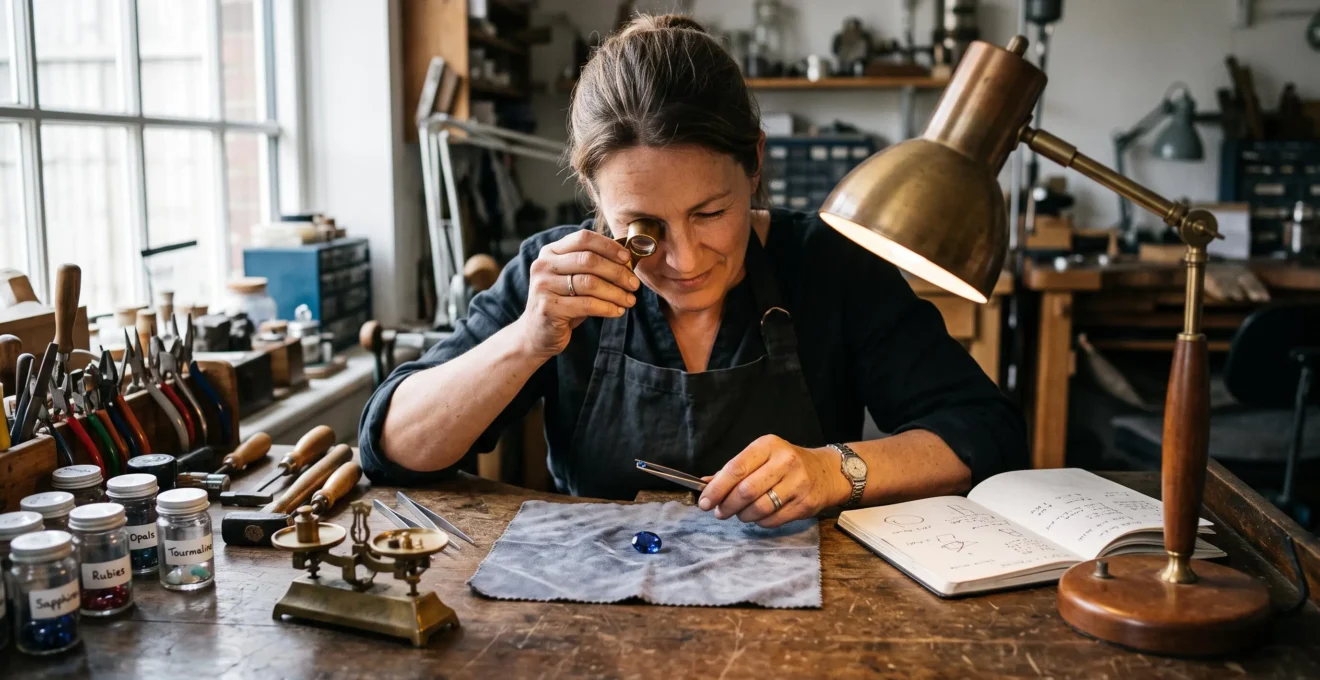
A gemstone can travel thousands of miles before becoming part of a jewel, crossing commercial networks, political borders and cultural traditions along the way. Its geological origin, the place where it was cut, the workshop that mounted it and the society that gave it meaning may all be different. This explains why familiar materials and motifs appear in jewellery from distant regions, sometimes in combinations that initially seem surprising.
Trade routes did more than transport precious stones. They connected craftspeople, patrons and markets, allowing materials and artistic ideas to circulate together. Yet a travelling gemstone did not automatically bring its original design tradition with it. Local jewellers often adapted unfamiliar materials to established techniques, producing objects that reflected several cultural influences rather than one identifiable origin.
For collectors, the distinction matters. A stone’s presence in a region may demonstrate contact with distant markets, but it cannot independently establish where a finished jewel was made or when. Stronger attribution combines material identification, construction, motifs, chronology and documented history. These clues help distinguish a plausible historical connection from an attractive sales narrative—and encourage more confident decisions when buying antique or historically inspired jewellery.
What to Know Before Attributing a Jewel
- A gemstone’s geological origin, the jewellery’s place of manufacture and its later ownership history are separate questions.
- Trade routes explain the circulation of materials and artistic ideas, but physical evidence is needed to support a specific attribution.
- Motifs, metalworking techniques, construction details and documented provenance provide a stronger basis for judgement than an evocative historical story alone.
- Why Did Jewellery Designs Change So Fast Once New Trade Routes Opened?
- How to Infer a Jewel’s Trade-Route Origin From 4 Design Clues on the Piece?
- Moorish-Inspired or Byzantine-Inspired: Which Style Fits the Era Sellers Claim?
- The Story-Only Trap That Makes People Overpay for « Silk Road » Jewellery
- In What Order Should You Learn Historic Trade Routes to Recognise Jewellery Influences Faster?
- Why Did Art Nouveau Jewellery Reject Straight Lines, and How Does That Show in Motifs?
- How to Inspect Plique-à-Jour Enamel Quality Using 4 Light Tests Before You Buy?
- How Can You Tell Real Art Nouveau Organic Design From Modern Imitations in 3 Visual Checks?
Why Did Jewellery Designs Change So Fast Once New Trade Routes Opened?
Jewellery designs could change rapidly when new trade routes expanded access to unfamiliar gemstones, metals and decorative ideas. Craftspeople adapted these arrivals to local skills and established tastes, while changing patterns of wealth created new demand for distinctive ornaments. The resulting designs often combined imported materials with familiar techniques instead of copying a foreign style exactly.
The key mechanism was visual hybridisation. A jeweller receiving a newly available stone could work it into a setting already familiar to local customers. The material might be foreign, but the metalwork, proportions and decorative vocabulary could remain recognisably local. Alternatively, a new material might encourage experimentation because existing techniques offered an unfamiliar opportunity to explore colour, transparency or contrast.
Long-distance exchange also complicates the relationship between a gemstone and its finished setting. Objects moved through commercial centres where traders, patrons and craftspeople had different preferences. Archaeological discoveries in ancient Afghanistan illustrate the broader pattern: objects associated with Greek, Roman, Indian and other artistic traditions occur within a region that connected major trading networks. The Metropolitan Museum of Art‘s exhibition on ancient Afghan treasures documents this cultural interaction and the distinctive craftsmanship that emerged from it.
Not every change came directly from new materials. Imported gems could also become status symbols, encouraging wealthy customers to seek unusual combinations or more elaborate settings. Conversely, established religious or dynastic motifs could persist even as trade intensified, because their meaning depended on continuity rather than novelty.
These mechanisms should not be confused with a universal rule that every stop on a route transformed a jewel’s design. Exchange created opportunities for influence; surviving objects are needed to establish which influences actually occurred.
The practical lesson is that trade routes explain how a design could become possible, but the individual object’s construction reveals how that opportunity was used. That distinction leads to a more reliable method for examining a jewel.
How to Infer a Jewel’s Trade-Route Origin From 4 Design Clues on the Piece?
A jewel’s possible trade-route connections are best assessed through four complementary clues: gemstone species, setting technique, motif vocabulary and construction details. No single clue normally identifies a complete origin. A non-local stone may demonstrate access to distant trade, while compatible techniques and motifs can strengthen a proposed cultural attribution. Even then, the conclusion should remain provisional unless supported by additional evidence.
Clue 1: The gemstone. Identify the material before assigning it a geographic story. A stone that was not locally available may indicate long-distance exchange, but gem species alone cannot identify the workshop, trading route or date of manufacture. Geological origin also requires specialist assessment when the precise source matters.
Clue 2: The setting technique. Examine how the stone is secured and how the metal has been worked. Bezel settings, granulation and filigree can provide evidence about workshop practice. Compare these features with documented objects from relevant collections rather than assuming that one technique belongs exclusively to one culture.
Clue 3: The motif vocabulary. Geometric interlace, floral ornament, religious imagery and other recurring forms may suggest cultural connections. Their value depends on the complete composition and chronology, since motifs can be copied, revived or exchanged between neighbouring regions.
Clue 4: The construction. Inspect joins, settings, clasps and the relationship between the stone and its mount. These details may help distinguish a coherent historical object from a jewel assembled or altered later. Wear and tool marks can be informative, but they require interpretation rather than automatic conclusions.
A useful working rule is to seek at least two independent, converging clues before proposing a cultural crossover. This is a cautious collecting heuristic, not a validated authentication standard. A stone may have been reset centuries after its original cutting, so the stone’s history and the setting’s history should be assessed separately.
Hypothetical example: a blue stone in a locally worked gold ring
Imagine a ring with a blue gemstone, a gold bezel and a repeating geometric border. The stone’s identity is confirmed, but its exact geological origin remains unknown. The bezel resembles examples from a documented regional collection, and the border has parallels in the same cultural sphere. The combined clues support a possible connection, but they do not prove the ring travelled along a particular route. A later replacement setting remains another possibility to investigate.
A five-step attribution record
- Record the observed gemstone species, colour and visible inclusions in a written description.
- Photograph the setting, clasp, joins and overall construction from several angles.
- List the motifs actually visible on the jewel, distinguishing observation from interpretation.
- Compare at least two independent features with documented museum objects and record the references consulted.
- Write a provisional attribution that separates established facts, plausible interpretations and unresolved questions.
Once these clues have been recorded, the next task is to test the proposed style against its historical context. Similar-looking ornament can belong to different traditions or to a later revival.
Moorish-Inspired or Byzantine-Inspired: Which Style Fits the Era Sellers Claim?
Moorish-inspired and Byzantine-inspired jewellery can be distinguished provisionally by examining the overall design vocabulary, construction and claimed chronology together. Dense geometric interlace and arabesque ornament may suggest Moorish influence, while frontal symmetry, enamelled goldwork and religious imagery may support a Byzantine comparison. These are interpretive clues, not exclusive signatures, and neither establishes a date on its own.
The first distinction is between a visual resemblance and a historical attribution. A contemporary maker can reproduce geometric ornament associated with Moorish art, just as a modern jeweller can evoke Byzantine goldwork. The presence of a familiar motif therefore establishes stylistic similarity, not necessarily age, place of manufacture or direct transmission from a historical workshop.
Chronology provides a second test. Ask whether the seller’s proposed period is compatible with the design, manufacturing methods and cultural context. A convincing claim should account for the complete object rather than relying on an isolated feature that looks old. Where a design combines several traditions, the explanation should acknowledge the mixture rather than forcing the jewel into a single category.
| Criterion | Moorish-inspired | Byzantine-inspired |
|---|---|---|
| Visual vocabulary | Geometric interlace, repeated patterns and arabesque ornament | Frontal symmetry, formal compositions and religious iconography |
| Decorative emphasis | Pattern, rhythm and intricate surface ornament | Goldwork, enamel and symbolic imagery |
| Attribution risk | Geometric patterns may occur in multiple traditions and periods | Religious imagery and goldwork may be reproduced in later pieces |
| Best next check | Compare construction and motifs with dated regional examples | Compare materials, workmanship and iconography with dated examples |
Seller wording also matters. “In the style of” generally describes an aesthetic resemblance; “attributed to” presents a proposed attribution whose supporting evidence should be explained; a precise historical date makes a more specific claim. The exact legal implications of these phrases vary by jurisdiction and sales context, so their wording should not replace a written description of the evidence.
A hybrid design may be historically plausible without being securely attributable to one culture. When the evidence cannot establish the claimed date, the uncertainty should remain visible in both the description and the price assessment.
The Story-Only Trap That Makes People Overpay for « Silk Road » Jewellery
“Silk Road” is not, by itself, a precise provenance claim. The term covers extensive networks of exchange operating across different regions and periods, so a seller’s use of it does not establish where a jewel was made, which route it travelled or who owned it. Treat the phrase as historical context to investigate, not as proof that justifies a premium.
The problem is narrative inflation. A piece with an appealing gemstone and an unfamiliar design may be described as having travelled through ancient trading cities or belonged to a distant court. Such a story can increase perceived desirability even when the seller cannot provide records connecting the actual object to those places or people.
Separate three questions before evaluating the price:
- What is established? Consider the material, dimensions, visible condition, construction and any documented historical information.
- What is proposed? Identify claims about cultural origin, age, former ownership or route of travel that have not been independently verified.
- What can be corroborated? Compare the physical features with documented examples and examine any available invoices, collection records, previous catalogues or ownership documents.
The reverse mistake is to assume that an undocumented jewel cannot be historically significant. Objects can circulate without complete records, and missing paperwork does not automatically establish that a piece is fake. It does, however, limit what can responsibly be claimed about its history.
A practical decision rule is to assign no additional value to an elaborate historical narrative unless the claimed connection has meaningful support. Assess the materials, workmanship, condition and evidence independently, and decide whether the price remains acceptable without the story.
Hypothetical buying decision: a ring described as a Silk Road artefact
A dealer offers a gold ring with a coloured stone and describes it as an ancient Silk Road object, but provides no supporting ownership records or specific archaeological context. The ring’s construction and decorative motifs can still be examined, and the stone can be assessed independently. Until those checks support a narrower attribution, the route narrative should not determine the purchase price.
Ask the seller who previously owned the piece, when and where it entered the market, what documents support the description and whether the attribution has been independently assessed. The quality of the answers helps clarify the difference between an interesting possibility and an evidence-based claim.
The most effective protection is not to reject every intriguing origin story, but to evaluate each claim at the level the evidence supports. That same discipline makes learning trade routes considerably more productive.
In What Order Should You Learn Historic Trade Routes to Recognise Jewellery Influences Faster?
Learn historic trade routes by pairing each network with documented materials, characteristic artistic vocabulary and dated objects, rather than memorising route names in isolation. Start with well-documented examples that connect recognisable production and consumption centres, then add overlapping networks and later periods. This approach helps distinguish a plausible material connection from an unsupported claim about a jewel’s origin.
Begin with a concrete case. Ancient Afghanistan provides a useful starting point because archaeological discoveries document encounters among different artistic and commercial traditions. From there, examine the circulation of luxury materials in other periods. For example, the Metropolitan Museum of Art’s exhibition on Chinese hardstone carvings describes how land and maritime trade supported the arrival of gemstone materials in China during the Qing dynasty, alongside the role of craftsmanship and imperial patronage.
For every route, create a paired reference record containing three elements:
- Materials: Which stones or other luxury materials are documented in the relevant objects?
- Design vocabulary: Which motifs, settings and decorative techniques appear in the same cultural and chronological context?
- Chronology: Which periods and regions are supported by dated objects or reliable collection records?
Keep a simple timeline alongside a map. Routes overlapped, changed in importance and connected with existing networks; a single jewel could also have been remounted long after its gemstone first entered circulation. Learning the chronology alongside the geography reduces the temptation to assign every unfamiliar material to the most famous route.
Practise with museum collection databases. Select an object, write down the likely material, design influence and date before reading its catalogue record, then compare your observations with the documented attribution. Record which clues were useful and which assumptions were unsupported. Over time, this builds a more reliable visual vocabulary than memorising isolated stylistic labels.
This method also makes it easier to recognise later artistic movements shaped by international exchange. Art Nouveau offers a particularly clear example of a modern design language that developed through both local experimentation and contact with Japanese art.
Why Did Art Nouveau Jewellery Reject Straight Lines, and How Does That Show in Motifs?
Art Nouveau jewellery favoured flowing contours, asymmetry and natural forms because designers sought a more organic visual language than rigid, repetitive ornament. Curves became part of the composition rather than mere surface decoration. Flowers, insects, plant-like figures and water-inspired shapes helped jewellers express movement, while enamelling and other materials expanded the possibilities for colour and translucency.
The movement developed in France and Belgium in the mid-1880s, and Japanese artistic influence contributed to its visual vocabulary. This exchange is an important reminder that a movement associated with rejecting established artistic conventions could itself draw inspiration from objects and ideas arriving through international trade.
Three motif families are especially useful to recognise:
- Plants and flowers: Orchid-like blooms, leaves and stems can form asymmetrical compositions that appear to grow across the piece rather than sit within a rigid frame.
- Insects: Dragonflies and butterflies offer opportunities to combine delicate outlines, transparent colour and sculptural details.
- Water and flowing lines: Curves that sweep through a composition create a sense of movement, sometimes described in design history as a whiplash line.
Materials helped designers realise these ideas. Enamel could introduce colours and translucent effects that were difficult to achieve with gemstones alone. Sculpted horn and glass also expanded the range of forms available to jewellers, while opals were appreciated for their shifting play of colour.
The Metropolitan Museum of Art documents these relationships in its collection record for the Marcus and Co. Art Nouveau brooch, manufactured in New York around 1900. Made with plique-à-jour enamel, conch pearl, diamond, platinum and eighteen-karat gold, the brooch combines sculpted sweet-pea blossoms and leaves with a naturalistic enamel palette. It illustrates how French design innovation informed work by an American manufacturer.
These features establish a useful stylistic comparison, but not an automatic authentication rule. Naturalistic motifs can appear in later revivals, and a material combination cannot independently prove a particular date.
Recognising the movement’s visual language is only the first step. When buying an enamelled piece, the next question is whether the technique itself is consistent with the description and condition being offered.
Key Takeaways
- Assess a jewel’s claimed period using the complete design and its construction, not a single naturalistic motif.
- Check enamel condition and structural integrity separately from the question of historical authenticity.
- Ask about restoration and repairs before assigning significance to the appearance or price of a delicate enamelled object.
How to Inspect Plique-à-Jour Enamel Quality Using 4 Light Tests Before You Buy?
Plique-à-jour enamel can be examined through transmitted light, close inspection of the cells, observation of colour and assessment of structural condition. Genuine plique-à-jour has transparent enamel cells without an opaque backing, allowing light to pass through like stained glass. These checks can reveal visible defects or repairs, but they cannot independently establish authenticity, date or the identity of the maker.
Test 1: Backlighting. Hold the piece carefully in front of a suitable light source and observe how light passes through its open-backed enamel cells. Look for differences in transparency, cloudy areas and visible bubbles or interruptions. Uneven appearance can have several explanations, including workmanship, damage or restoration, so it should prompt closer inspection rather than an immediate verdict.
Test 2: Cell integrity. Use magnification to examine the enamel partitions and surrounding metal framework. Look for hairline cracks, missing material, damaged edges and areas that appear to have been filled. Because the enamel lacks an opaque backing, the integrity of the cells and their supporting framework matters. Avoid pressing or flexing the piece to test its strength.
Test 3: Colour and depth. Observe the colour in transmitted and reflected light. Some panels display variation within individual cells, while others have a more uniform appearance. Colour gradients can be visually informative, but their presence or absence alone does not prove quality, date or authenticity. Lighting conditions, enamel formulation and restoration can all affect what is visible.
Test 4: Repairs and restoration. Inspect the edges of the enamel, the metalwork around the cells and any areas that appear inconsistent with the surrounding surface. Ask the seller whether the enamel has been repaired, stabilised or replaced and whether any conservation records are available. An apparently attractive surface may conceal previous intervention that matters to the object’s condition and valuation.
The fragility of plique-à-jour makes handling important. Examine the piece on a padded surface where practical, use appropriate magnification and leave suspected structural damage to a qualified specialist. Visual observations are useful screening evidence, not a substitute for professional examination of a valuable or fragile object.
For a documented comparison, the approximately 1900 Marcus and Co. brooch described by the Metropolitan Museum of Art demonstrates the transparent, unsupported cells characteristic of plique-à-jour. That record provides a reference for understanding the technique, not a checklist that can authenticate another object by resemblance alone.
A careful visual examination can identify questions worth asking and defects that deserve further assessment. The final decision should also consider the object’s broader construction, material consistency and the exact historical claim made by the seller.
How Can You Tell Real Art Nouveau Organic Design From Modern Imitations in 3 Visual Checks?
Distinguishing period Art Nouveau jewellery from a modern imitation requires more than recognising flowers, insects or flowing lines. Examine the logic of the composition, the construction of the object and the consistency of its materials with the claimed period. These three checks can identify reasons for further investigation, but none independently proves that a piece is original or fraudulent.
Check 1: Asymmetry with purpose. Look at how the forms relate to one another. In an organic composition, stems, leaves, wings and curves may create a coherent sense of growth or movement. A later imitation may reproduce the same motifs without the same compositional relationship. However, deliberate asymmetry is not exclusive to Art Nouveau, and an attractive, coherent design cannot establish age on its own.
Check 2: Construction and finishing. Inspect the clasp, joins, settings, edges and surface finish under suitable magnification. Compare these details with documented objects from the proposed period. Look for evidence that the components belong together, while remaining alert to later repairs, replacement fittings and remounting. Machine-made precision is not proof of a modern date, just as visible hand-finishing is not proof of historical manufacture.
Check 3: Material consistency. Compare the actual materials with the seller’s description and the design’s documented context. Art Nouveau jewellers used enamel, opals, moonstones, horn and other materials selected for colour, translucency or sculptural possibilities. Yet no single combination is mandatory for all authentic pieces. A mismatch should prompt questions about the date, attribution or possible restoration, rather than automatically disqualifying the object.
Use museum records to anchor the comparison. A documented object provides evidence about a known maker, approximate date, materials and technique. Similarity to that object can help generate a hypothesis, but it cannot transfer the museum’s attribution to another jewel.
Keep the distinction between historical originality and stylistic legitimacy clear. A modern revival may be a skilfully made and honestly described piece of jewellery. The relevant question is whether its age, maker, materials and provenance match the claims attached to it.
For a final buying decision, record what is visible, ask for evidence supporting the seller’s description and seek independent specialist assessment when the value or claimed history warrants it. A disciplined attribution protects both historical understanding and the integrity of the purchase.
Does a gemstone’s geological origin reveal where a piece of jewellery was made?
No. A gemstone’s geological origin concerns where the material formed or was sourced, whereas a jewel’s place of manufacture concerns where it was cut, set or assembled. A stone may have travelled through several markets before being mounted, and its setting may have been replaced later. Establishing these histories requires different kinds of evidence.
Can a single motif prove that antique jewellery came from a particular culture?
No. Motifs can be borrowed, adapted, revived or reproduced in later periods. Compare the complete composition with the object’s construction, materials, chronology and documented parallels. A motif is a useful starting point for attribution, not independent proof of origin or authenticity.
Does jewellery without provenance documentation have to be fake?
No. An incomplete ownership history does not automatically make an object inauthentic. It does limit the historical claims that can be substantiated. Evaluate the materials, workmanship, condition and physical evidence separately, and avoid paying a premium for an unverified story.
Can plique-à-jour enamel be authenticated using a light test alone?
No. Transmitted light can help reveal the open-backed structure and visible condition of the enamel, but it cannot independently establish the object’s age, maker or authenticity. Examine the cells and supporting metalwork, ask about restoration, and seek a qualified specialist’s assessment when necessary.
What is the most useful first step when evaluating a historical jewellery claim?
Start by separating observable facts from the seller’s interpretation. Record the materials, motifs and construction details, then compare them with documented museum objects from the relevant period. Ask which parts of the attribution are established and which remain uncertain before deciding how much weight to give the claimed history.