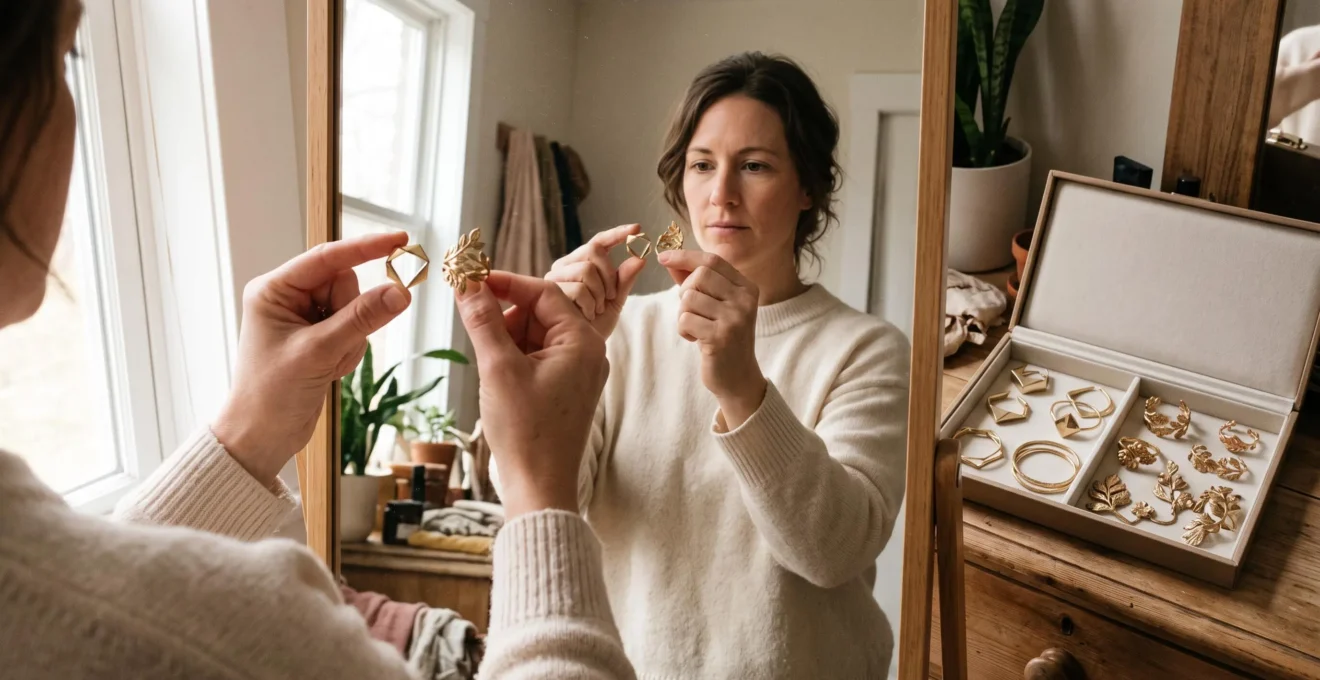
The choice between geometric jewellery and natural motifs is less about following a trend than understanding how shapes interact with clothing, personal style and everyday routines. Geometric pieces use symmetry, straight lines, repeated patterns and defined angles to create a deliberate visual statement. Nature-inspired designs draw on leaves, flowers, branches, animals and flowing curves, often producing a softer or more expressive effect.
Neither direction is inherently more elegant, versatile or timeless. A brushed geometric ring can look understated with jeans and a T-shirt, while a polished botanical brooch can feel decidedly formal. The difference lies in the complete design: its proportions, finish, construction, contrast with fabric and position on the body.
For daily wear, the most reliable choice is the piece that works with clothes already in the wardrobe, feels comfortable throughout the day and remains appealing beyond a single outfit. A few practical tests can reveal whether angular precision or organic movement better suits that reality. Historical context, craftsmanship and maintenance also matter, particularly when choosing a signature piece intended to last for years.
Geometric or Natural: The Quick Decision Guide
- Choose geometric jewellery for graphic lines, structured styling and deliberate contrast; choose natural motifs for flowing forms, botanical references and a more expressive visual narrative.
- Test any potential everyday piece with a structured outfit, a soft casual outfit and a real-life weekly outfit before buying.
- Judge long-term suitability by comfort, finish, construction and personal attachment rather than assuming one design direction is automatically more timeless.
- Why Do Geometric Pieces Look More “Formal” Even With Casual Outfits?
- How to Test Whether a Geometric or Natural Piece Matches Your Wardrobe Using 3 Outfits?
- Geometric or Natural: Which Should You Choose for a “Signature” Piece You’ll Wear for 10+ Years?
- The Sharp-Edge Design Mistake That Snags Knitwear and Scratches Skin
- When Should You Invest in a Geometric or Natural Statement Piece if Your Style Is Evolving?
- Why Did Art Nouveau Jewellery Reject Straight Lines, and How Does That Show in Motifs?
- How to Build a Contrasting Jewellery Palette Using the 3-Colour Rule Without Clashing?
- Why Do High-Contrast Jewellery Combinations Sometimes Look Chaotic Instead of Bold?
Why Do Geometric Pieces Look More “Formal” Even With Casual Outfits?
Geometric jewellery can look more formal than organic jewellery because straight lines, symmetry and sharp angles resemble the deliberate construction of architecture, tailoring and graphic design. The eye can interpret these precise shapes as intentional visual structure, even when the rest of an outfit is relaxed. However, the effect depends on finish, scale and material as much as on the shape itself.
Consider a simple white T-shirt and jeans. A sharply faceted ring or a rigid, symmetrical cuff introduces a clear focal point with defined edges. It can make the outfit feel more composed without adding another layer of clothing. The jewellery supplies the structure that the outfit lacks.
Organic curves generally introduce a different rhythm. A leaf-shaped pendant, an irregular gold hoop or a flowing branch motif can echo the movement of the body and soften straight garment lines. Yet this is not a universal hierarchy. A highly polished botanical brooch in gold may look more formal than a small, brushed geometric ring.
**Finish is often the easiest way to control the effect.** Matte, hammered and oxidised surfaces reduce the uninterrupted reflections associated with high polish. A geometric design can therefore retain its clean silhouette while appearing less dressy. Crisp cotton and silk may complement its defined edges, whereas soft knits can create a stronger contrast.
That contrast also has a practical side. Angular settings and projecting details deserve closer inspection when they will sit against loose fibres. The issue is not that geometry is unsuitable for everyday wear; it is whether the piece has been finished properly for the way it will be worn.
The useful distinction is between visual precision and excessive formality. Once those qualities are separated, the next step is to test how each design direction behaves across actual outfits rather than judging it in isolation.
How to Test Whether a Geometric or Natural Piece Matches Your Wardrobe Using 3 Outfits?
The most useful way to assess geometric or natural jewellery is to wear it with three outfits: one structured, one soft and casual, and one you regularly wear in real life. Check comfort, proportions, fabric interaction and visual balance in each combination. A piece that works across all three is a stronger everyday candidate than one that looks convincing only with occasionwear.
Begin with a structured outfit, such as a blazer, collared shirt or tailored jacket. This reveals whether the jewellery reinforces existing lines or creates an unnecessary second focal point. A triangular pendant may echo a pointed collar, while an organic pendant can introduce a deliberate contrast.
Next, try a soft outfit built around a knit sweater, jersey top or relaxed cardigan. Pay attention to movement: does a pendant remain in place, does a ring catch the fabric, and does a large piece overpower the softer silhouette? Loose knits and fine fabrics are particularly useful for revealing practical problems that a smooth display surface conceals.
Finally, use an outfit you wear most weeks. This is the most important test because it reflects the actual context in which the purchase must earn its place.
Neckline geometry deserves particular attention. A triangular pendant over a rounded neckline creates a contrast between angular and curved forms. Over a V-neck, the same pendant may repeat the neckline’s direction, producing a more coordinated effect. Neither combination is automatically better; the test is whether the result looks intentional and proportionate.
Photographs can make the comparison easier. Take one picture of each outfit, then review them the following day at a normal viewing distance. A piece that looks impressive close to the mirror may dominate the overall silhouette when viewed from across a room.
Your Five-Step Jewellery Fit Checklist
- Choose one geometric or natural piece and record its name or a photograph as your test item.
- Wear it with a structured outfit and save a photograph showing its relationship to the collar, neckline and other accessories.
- Repeat with a soft casual outfit and note any fabric catching, uncomfortable contact or awkward movement.
- Repeat with a real-life weekly outfit and record whether the piece feels proportionate and practical without adding new clothing.
- Review all three photographs the next day and write a final verdict: daily-wear candidate, occasional piece or unsuitable for your current wardrobe.
A piece that works only with the structured outfit has not failed the test. It may simply be an occasion piece, which is a useful distinction before spending money. The decision becomes clearer when wardrobe compatibility is assessed alongside the comfort and longevity required of a signature design.
Once a piece has demonstrated that it works with real clothes, the next question is whether its appeal is likely to survive changing tastes and years of regular wear.
Geometric or Natural: Which Should You Choose for a “Signature” Piece You’ll Wear for 10+ Years?
For a signature piece intended to last ten years or longer, choose geometric jewellery if versatility and graphic simplicity are your main priorities; choose natural motifs if personal meaning and a connection to the natural world matter more. Neither direction guarantees lasting appeal. Long-term satisfaction depends on the strength of the design, the quality of construction and how closely the piece reflects values that remain important to you.
Geometric jewellery has a long historical record, from repeated ornamental patterns to the bold forms associated with Art Deco. The Metropolitan Museum of Art documents a 1920s bracelet attributed to Dreicer & Co., made with diamonds, emeralds and platinum, whose geometric patterning reflects the period’s distinctive visual language. The object’s documented family provenance illustrates that a design associated with a particular era can remain meaningful across generations.
Natural motifs offer a different source of continuity. Leaves, flowers, animals and celestial references can carry associations with a place, a relationship, a memory or a personal interest. Such meaning can sustain affection even when a piece no longer matches a current trend. But a natural motif is not automatically timeless, just as geometric jewellery is not automatically destined to look dated.
Before committing to a substantial purchase, consider four questions:
– Does the design refer to something that is likely to remain meaningful, or mainly to a look that currently feels fashionable?
– Can the shape be made in a comfortable, durable metal weight without relying on sections that feel unnecessarily thin?
– Will minor scratches and changes in surface finish remain acceptable, or is the design dependent on a flawless reflective surface?
– Can a jeweller realistically maintain, repair or refinish the piece without compromising its defining details?
Construction matters as much as affection. The GIA guide to engagement ring settings explains that durability depends on workmanship as well as setting style, and that worn prongs or loose stones can require attention. Although the guidance focuses on rings, its broader lesson is useful when evaluating any fine-jewellery investment: understand how the piece is assembled and maintained.
A signature design also needs to suit the way it will be worn. A delicate branch motif may have fine projecting elements that require careful handling, while a geometric ring may have edges or settings that need periodic inspection. Ask the jeweller about the specific construction rather than assuming the overall silhouette reveals its durability.
The strongest signature piece is the one whose appeal survives both wardrobe changes and ordinary wear. That makes practical edge finishing and construction the next criteria to examine, especially for jewellery worn every day.
The Sharp-Edge Design Mistake That Snags Knitwear and Scratches Skin
The main risk with angular jewellery is not geometric design itself but poor finishing: unrefined corners, projecting setting edges and abrupt transitions can catch fabric or rub against the skin. Well-made geometric pieces can retain a crisp external silhouette while using softened bevels and carefully finished inner surfaces. Inspecting the actual contact points is therefore more reliable than judging wearability from appearance alone.
The most vulnerable areas include the corners of rings and cuffs, the edges of prongs around gemstones, and changes in thickness along a rigid bangle. A design may look perfectly clean from above while exposing an awkward edge underneath. These details become more important when a ring is worn for hours or a bracelet repeatedly moves against sleeves.
The Gemological Institute of America addresses one specific example in its quality-assurance benchmark for V-prong settings. Its guidance explains that raised prong edges can catch clothing and that pulling on a snagged setting may compromise the gemstone’s security. The lesson is about workmanship, not a blanket disadvantage of geometric jewellery.
At a jewellery counter, examine the piece under good lighting and ask to handle it if permitted. Check the inside of a ring, the underside of its setting and the transitions between thicker and thinner sections. If an edge feels rough or catches during normal handling, ask the jeweller to inspect it rather than attempting to alter it yourself.
A thin nylon stocking can help reveal snagging points when a retailer permits such a test, but it is not a substitute for a professional inspection. Avoid forcefully dragging a gemstone setting over fabric or skin, since this may damage the item or create a false sense of security.
Fabric choice also changes the practical risk. Loose knits, lace and fine merino can be vulnerable to projecting details, while more robust woven fabrics may be less prone to catching. This is a relative distinction, not a guarantee: fabric construction, the jewellery’s orientation and the way it moves all matter.
Comfort requires attention to the inner profile as well. A rounded inner band, smoothly finished edges or slightly domed corners can improve wearability without changing the outward design. If a ring repeatedly causes redness, pain or persistent irritation, stop wearing it and have its fit and finish assessed.
A design that passes this inspection is better prepared for regular use, but the timing of a significant purchase still matters when personal style is changing. The right piece should suit both the wardrobe you have and the direction you are reasonably confident you want to pursue.
When Should You Invest in a Geometric or Natural Statement Piece if Your Style Is Evolving?
Invest in a statement piece when you can identify at least three outfits in your current wardrobe that work with it without requiring additional purchases. If the piece only makes sense after an imagined wardrobe transformation, it is probably premature as a major investment. During a period of change, a moderately priced design, a smaller motif or a versatile convertible piece can reduce the risk of buying for a style you have not yet settled into.
The timing decision is different for different kinds of change. Someone moving towards minimalism and structured clothing may find that a geometric cuff or angular pendant quickly establishes a consistent visual language. Someone exploring romantic, eclectic or nature-inspired dressing may prefer to begin with small botanical earrings or a delicate leaf pendant before committing to a large organic statement necklace.
These are useful patterns, not fixed rules. A person developing a minimalist wardrobe may still prefer an irregular sculptural ring, while someone who loves romantic clothing may build a signature look around bold geometry. The test is how the piece works with actual outfits, not whether it fits a style category perfectly.
Budget can also guide the decision. A mid-priced statement piece can be a sensible experiment while tastes are evolving. A more significant purchase deserves closer scrutiny of comfort, construction, maintenance and the likelihood of continued use. Waiting is not a missed opportunity if it prevents a costly mismatch.
Convertible designs can offer another route. A pendant that detaches into a brooch, for example, may serve different styling contexts, provided the conversion mechanism is secure and practical. Ask to see how the piece changes form and whether both configurations work with clothing you already own.
Passing jewellery on to another person may influence the choice, but no motif guarantees heirloom appeal. A botanical design may carry personal associations, while a geometric piece may represent a meaningful period or family story. The documented family history of historical jewellery, including examples recorded by museums, demonstrates the possibility of such continuity without predicting which modern purchases will acquire it.
The right moment is when the design feels like an extension of your established habits rather than a bet on a future identity. Historical design offers another useful perspective: it shows how geometric precision and organic movement developed as distinct, but overlapping, approaches to jewellery.
Key Takeaways Before Choosing Your Colour Palette
- Identify whether the piece’s shape or its personal meaning is the main reason for buying it; this helps determine which design details deserve priority.
- Choose a dominant visual direction for the outfit before adding contrasting jewellery, particularly when mixing large angular and organic pieces.
- Evaluate finish and scale alongside colour, since competing reflections or equally strong focal points can undermine an otherwise coordinated combination.
Why Did Art Nouveau Jewellery Reject Straight Lines, and How Does That Show in Motifs?
Art Nouveau jewellery became known for flowing, organic forms rather than strict geometric repetition, drawing inspiration from plants, insects and the natural world. Associated with approximately 1895–1910, the movement favoured sinuous lines and asymmetrical compositions that made the shape itself an expressive feature. Its importance today lies in showing that nature-inspired jewellery can be an intentional design philosophy rather than a decorative leaf added to an otherwise conventional form.
The Victoria and Albert Museum’s history of jewellery traces organic design through the Arts and Crafts and Art Nouveau movements. The Arts and Crafts movement rejected machine-led production in favour of individual craftsmanship, while Art Nouveau designers such as René Lalique and Philippe Wolfers explored natural forms and unconventional materials, including enamel, glass and horn.
These related developments should not be treated as identical. The rejection of machine-led production is particularly associated with Arts and Crafts; it would be misleading to attribute exactly the same motivation to every Art Nouveau designer. What connects the styles for a modern jewellery buyer is their attention to individual form, material and craftsmanship.
The difference is visible in the composition. An organic design might allow a stem to curve unevenly, a wing to extend to one side or a flower to unfold asymmetrically. A geometric design, by contrast, may repeat triangles, circles or rectangular forms to establish rhythm and balance. Neither approach is necessarily more sophisticated, but each creates a different visual experience.
Art Nouveau also demonstrates how demanding flowing natural forms can be to execute. Techniques such as plique-à-jour enamelling can create translucent effects that allow light to pass through enamelled areas, while sculpted metal and carved materials can preserve the movement of a motif. The Victoria and Albert Museum identifies plique-à-jour on undulating surfaces as an exceptional technical achievement.
For the buyer, this history provides a practical distinction between an organic composition and a geometric piece with a superficial botanical decoration. Look at the overall silhouette, how the lines flow, and whether the motif influences the construction rather than merely sitting on its surface.
Asymmetry also affects styling. A branch or wing may extend more strongly towards one side of the body, making its position on a lapel, neckline or ear important. A symmetrical geometric pendant may be easier to centre, while an organic brooch may need to be tried on both sides to find the better balance.
Art Nouveau offers a strong example of natural forms carrying both visual character and technical complexity. Once the motif is chosen, metal colour and finish can help it work with the rest of the jewellery without making the overall combination feel disconnected.
How to Build a Contrasting Jewellery Palette Using the 3-Colour Rule Without Clashing?
The three-colour rule is a practical styling framework: limit the jewellery palette to three dominant colour elements, usually two metal tones and one coloured stone or accent. The goal is not to make every element equally prominent, but to establish a clear hierarchy. One metal can anchor the look, a second can provide contrast, and a small accent can connect the jewellery to a detail in the outfit.
Start by identifying the main metal visible across your pieces. Yellow gold, silver-toned metal and rose gold each create a different visual effect, but mixed metals can work together when the proportions and finishes feel deliberate. As a starting point, let one metal account for roughly two-thirds of the visible metal, with the secondary metal and accent used more sparingly. This is a styling guideline, not a measured rule of design.
The third colour does not need to come from another piece of jewellery. A coloured stone, a handbag buckle or a scarf can supply the accent. Borrowing an existing colour from the outfit often creates a stronger connection than introducing an unrelated stone simply to complete a palette.
Finish is a separate variable. Two pieces in the same metal colour may still compete if both have broad, mirror-polished surfaces. Brushed, hammered or oxidised textures can provide contrast without adding another colour.
The design direction matters, too. Geometric pieces often support deliberately mixed metals because the contrast reinforces their graphic lines and constructed appearance. Natural motifs can benefit from a more unified finish that allows the shape and fine detail to remain the main attraction. These are useful starting points rather than rules: an organic pendant can look striking in mixed metals, and a geometric piece can be beautifully understated in a single finish.
Before changing the palette, identify the actual source of a clash:
– **Colour:** too many metal tones or competing accent colours.
– **Scale:** multiple large pieces demanding equal attention.
– **Line:** angular and flowing forms of similar visual weight competing in the same area.
– **Finish:** several highly reflective surfaces competing for attention.
Correct the specific problem instead of removing contrast indiscriminately. If the colours work but the pieces still feel unsettled, changing the scale or finish may be enough.
A coherent palette gives each piece room to contribute, but colour alone cannot make every combination work. The final step is to understand when contrast creates a deliberate statement and when competing shapes, scales and reflections become distracting.
Why Do High-Contrast Jewellery Combinations Sometimes Look Chaotic Instead of Bold?
High-contrast jewellery looks bold when one element leads and the others support it. It looks chaotic when several pieces compete at once through scale, colour, line or reflective finish. A large angular ring and a large sculptural botanical bracelet, for example, may both demand attention without establishing a clear focal point. Contrast works best when the pieces differ in visual weight or occupy separate areas of the body.
Begin by choosing the kind of contrast you want to emphasise. A geometric ring paired with a fine botanical pendant can create a conversation between sharp and flowing forms because the pieces differ in scale and placement. Two equally large statement necklaces, or an angular and an organic piece with similarly dominant silhouettes, are more likely to compete.
Placement is a useful control. Let one body zone carry the stronger experiment: ears, neck, wrists or hands. If the neck features a dramatic pendant, keep the other zones relatively restrained. If a bold cuff is the focal point, a simpler necklace can provide balance without removing the contrast entirely.
This does not mean that every outfit needs only one striking piece. Several statement pieces can work together when they share a clear relationship, such as a repeated metal tone, a similar scale or a common directional line. The important point is to avoid making every element the focal point at the same time.
Finish can resolve a combination that initially seems too busy. High polish reflects light strongly, and multiple polished pieces may compete even when their colours and shapes complement one another. Pairing one polished piece with a brushed or oxidised finish can reduce that competition while preserving the difference in form.
When a combination feels chaotic, remove one piece at a time. This reveals whether the problem comes from a particular pairing or from the total amount of visual information. Reintroduce pieces only when each one adds something distinct.
For geometric and natural jewellery, the strongest combinations often create a clear dialogue rather than a contest. A graphic ring can anchor an otherwise flowing look; a delicate botanical pendant can soften a structured outfit. The objective is not to eliminate difference, but to give the eye a clear place to begin.
Choose the piece that best reflects your personal style, test it with clothes you already wear and introduce contrast with intention. If a combination feels unsettled, adjust one variable at a time—scale, placement, colour or finish—until every piece has a clear role.
Is geometric jewellery better for everyday wear than natural-motif jewellery?
No. Everyday suitability depends on construction, comfort, finish, proportions and the clothes you wear. A small geometric ring with smooth edges can be practical, while a delicate botanical design may need more careful handling. Try both styles with your usual outfits and inspect any projecting details before deciding.
Can geometric and organic jewellery be worn together?
Yes. Mixing the two works best when the pieces have different visual weights or occupy different areas of the body. For example, a graphic ring can complement a fine botanical pendant. If both pieces are large and equally prominent, simplify the rest of the jewellery or change the placement to establish a clearer focal point.
Which jewellery design is more timeless for a long-term investment?
Neither geometric nor natural designs are universally more timeless. Geometric forms can offer versatility across different wardrobes, while natural motifs may provide a more personal narrative. Historical jewellery demonstrates that both directions can remain meaningful across generations. Prioritise a design you genuinely enjoy, robust construction and realistic maintenance requirements.
How can you tell whether a ring will snag knitwear?
Inspect the edges, inner band and gemstone setting, paying particular attention to raised or poorly finished prongs. If permitted, a gentle test with suitable fabric can help reveal catching points, but it cannot guarantee that a ring is snag-free. Ask a jeweller to assess rough edges or projecting settings rather than attempting to modify them yourself.
Should metal colour or jewellery shape guide the choice first?
Start with the shape if the main decision is between geometric precision and organic expression. Test the design with your wardrobe before refining the palette. Once the shape and scale work, use metal colour and surface finish to coordinate the piece with existing jewellery and clothing. This avoids buying a colour combination that looks attractive but does not suit your everyday style.